
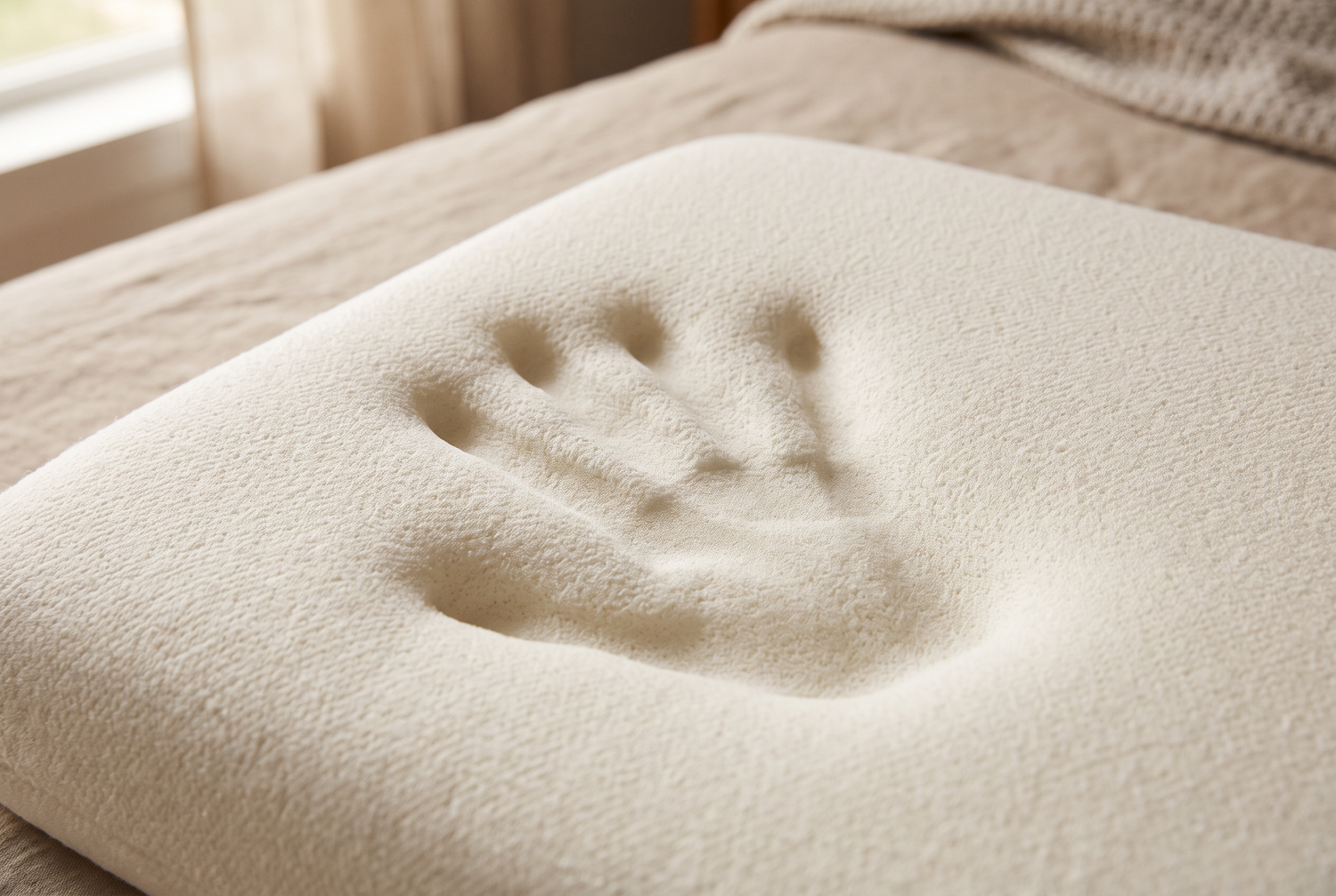
For decades, mattress shopping followed the same pattern: estimate weight, choose firmness level, hope it fits. The problem is that people are not static bodies. We change sleeping positions 20 to 60 times per night, our weight is distributed completely differently on our side than on our back, and couples with a 25 kg weight difference share the same sleeping surface. An adaptive mattress solves this dilemma with technology: its material reacts to pressure, heat, and body shape and automatically adapts – without motors, without an app, without adjustments. In this article, we will look at how adaptive foams work, how they differ from classic memory foam, and for whom the switch is worthwhile.
The short answer: Adaptive mattresses use modern premium foams like EvoPoreHRC, which yield differently depending on pressure and contact surface. Heavy body zones like the shoulders and pelvis sink deeper, while lighter zones like the waist are supported – in every sleeping position and at virtually any body weight. Thus, a single adaptive mattress replaces the outdated system of rigid firmness levels and is suitable for individuals as well as for couples with different builds.
- Adaptive foams react to pressure and body shape – they support and relieve pressure simultaneously, without the need to choose a firmness.
- Unlike classic viscoelastic foam, modern adaptive materials recover in fractions of a second and are hardly affected by room temperature.
- For couples with different weights, an adaptive mattress is usually a better solution than two separate firmness levels.
- High-quality adaptive foams achieve densities of RG 40 and above and last 8 to 10 years.
- Changes in position are automatically cushioned – important because we change positions 20 to 60 times at night.
What makes a mattress adaptive at all?
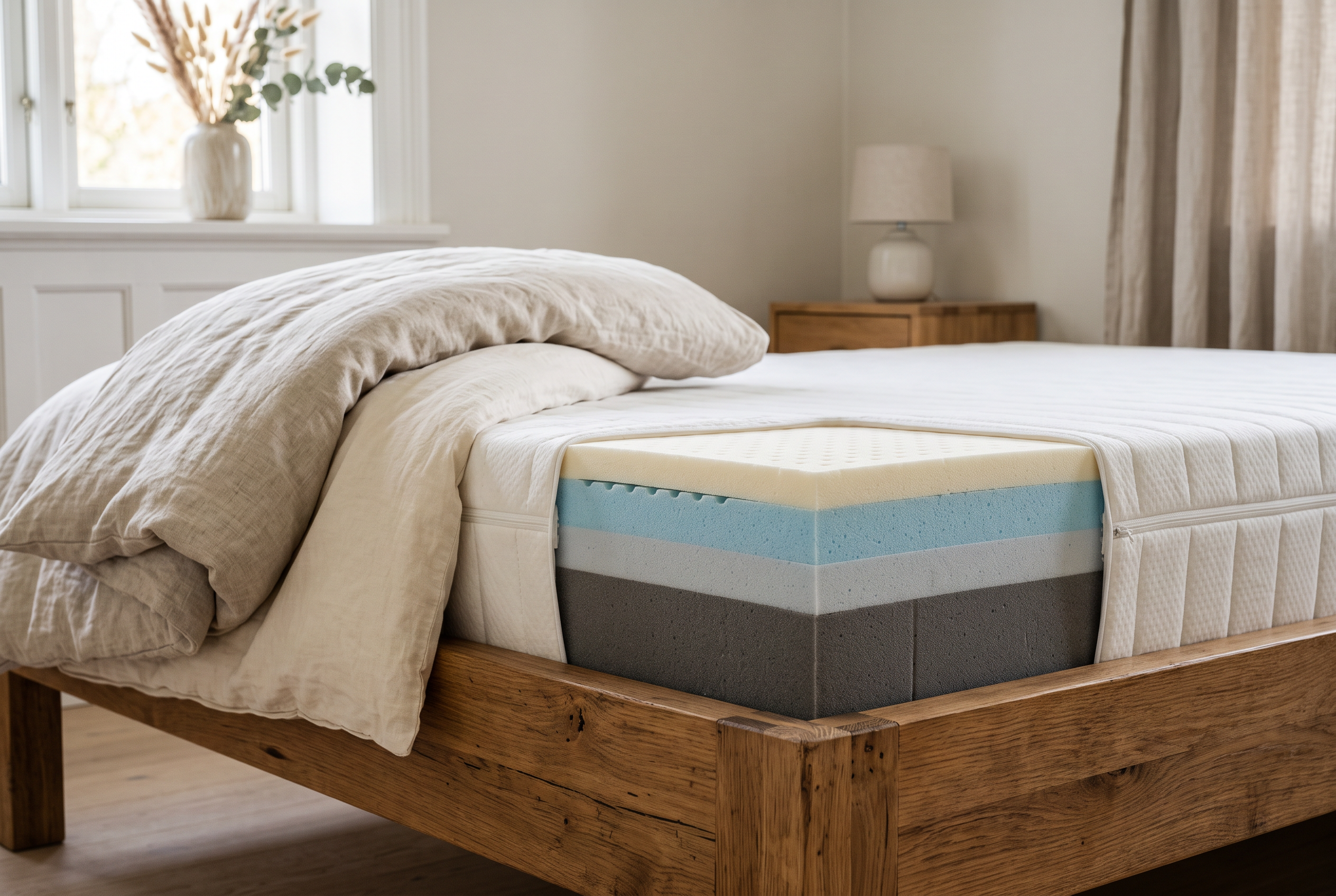
Adaptive means that the material does not behave uniformly, but reacts locally to the applied force. This is made possible by open-cell foam structures with progressive indentation hardness – the foam yields softly under low pressure and builds up increasing counterforce with increasing load. A person weighing 55 kg will sink in just enough for their spine to be straight, and a person weighing 95 kg will also – on the same mattress. Classic mattresses with fixed firmness cannot do this: they are designed for a specific weight window and become too hard or too soft outside of it. Adaptive systems also work point-elastic: only where pressure is applied does the material yield, while the surroundings remain stable. This distinguishes them from area-elastic surfaces, where the entire surroundings also sink and distort the body posture.
EvoPoreHRC: the technology behind modern adaptive mattresses
EvoPoreHRC (High Resilience Climate) is a new-generation premium memory foam that combines the pressure relief of viscoelastic foam with the resilience of high-quality cold foam. Three properties are crucial. First, the high recovery speed: while classic memory foam remains in the old indentation for several seconds after a change of position, EvoPoreHRC recovers almost immediately – making turning effortless. Second, temperature stability: the material maintains its feel at 16 °C bedroom temperature as well as at 24 °C, whereas conventional viscoelastic foam becomes noticeably harder in a cool room. Third, climate regulation: the open-pore structure allows air and moisture to circulate, which reduces heat build-up – relevant because a person releases up to half a liter of moisture per night. You can read more about the distinction from classic materials in the article Viscoelastic foam and memory foam explained.
Why rigid firmness levels are obsolete
The firmness level system dates from a time when foam technology did not know adaptive properties – so the customer had to choose the firmness themselves. But H1 to H5 are still not standardized: each manufacturer defines the levels differently, an H3 can feel like a foreign H2 or H4. There is also a logical problem: Which firmness level should be correct if you switch between side, back, and stomach positions at night and each position requires different sink depths? The side position needs a soft shoulder zone, the back position more pelvic support. A fixed firmness is always a compromise – an adaptive mattress, on the other hand, answers the question anew every second. You can find the detailed argumentation under Why firmness levels are obsolete. In short: The question of the correct firmness level is the wrong question. The right one is whether the mattress adapts to you – or you adapt to the mattress.

Adaptive mattress compared to classic types
How does adaptive technology fare against innerspring, cold foam, and classic viscoelastic foam? The following overview shows the most important differences in everyday use. Our mattress type comparison offers a detailed comparison of all constructions.
| Property | Adaptive foam (EvoPoreHRC) | Classic viscoelastic foam | Innerspring |
|---|---|---|---|
| Adaptation to body shape | automatic, in every position | good, but slow | limited |
| Recovery time | almost immediate | several seconds | immediate |
| Temperature dependence | very low | high (harder when cold) | none |
| Motion isolation for couples | very good | very good | moderate |
| Suitable for different weights | yes, without choosing firmness | limited | only by firmness |
Who particularly benefits from an adaptive mattress?
Firstly, for couples with different builds: instead of two mattresses with different firmnesses and an annoying gap, a continuous sleeping surface is sufficient, which behaves individually under each body – more on this in the guide Mattress for couples. Secondly, for people with changing sleeping positions, i.e., the vast majority: those who sometimes sleep on their side, sometimes on their back, benefit from the support effect readjusting with each change. Thirdly, for people whose weight changes – for example, due to pregnancy, muscle building, or losing weight: the mattress remains suitable without having to be replaced. Fourthly, for anyone who simply doesn't want complicated purchasing decisions. And fifthly, for people with tension or pressure sensitivity in the shoulders and hips, as the precise pressure relief reduces pressure points many times over compared to a too-hard surface.
Fact-checking myths
Myth one: "Adaptive is just a marketing word." False – the difference can be measured, for example, via compression hardness curves and pressure distribution images: Adaptive foams show a progressive characteristic curve, cheap foams a flat one. Myth two: "Memory foam is always warm." This was true for early, closed-cell viscoelastic foams; modern open-pore climate foams dissipate heat and moisture significantly better. Myth three: "Heavy people absolutely need a firm mattress." The decisive factor is not firmness, but support with simultaneous pressure relief – which is precisely what progressive foam provides. Myth four: "You feel cemented in adaptive foam." This describes slow, old-generation visco; highly resilient materials immediately release movements. Myth five: "One mattress cannot possibly suit everyone." This is true for extreme special cases, but for over 95 percent of adults, practice shows the opposite – see also One mattress for all: the Ora principle.
What to look for when buying an adaptive mattress
Not everything that claims to be adaptive actually offers true adaptability. Check four points. First, the density (RG): Below RG 40, even the best foam loses its progressive characteristic curve after a few years; high-quality adaptive foams are in the RG 40 to 60 range. Second, the foam height: The adaptive comfort layer should be at least 4 to 6 cm thick, and the total height 20 cm or more, to ensure sufficient sink-in reserve. Third, the recovery speed: Press your hand into the material – if the impression remains visible for more than 2 to 3 seconds, it is slow, old visco foam. Fourth, the trial sleep: Since adaptive lying is only fully experienced after a few weeks, 100 to 200 trial nights at home are more important than any data sheet. The article Buying a mattress online with trial sleep shows how to use this trial phase in a structured way.
Get CHF 25 discount
Subscribe to the newsletter and receive a one-time CHF 25 discount. ✓ 200 nights trial sleep ✓ 10-year warranty
How adaptive sleeping feels in everyday life
The most common first impression: "I'm just lying there – and don't feel anything special." That's exactly the point. A well-adjusted surface doesn't make itself known through a spectacular feeling, but through the absence of disruptive signals: no pressure on the shoulder, no hollow back, no numb leg, no tedious turning. Many users report waking up less often after the acclimatization period of 2 to 4 weeks and feeling less tension in the morning. The effect becomes measurable indirectly: those who reduce nocturnal pressure points change position less often and spend more consecutive time in the restorative deep sleep phases – how important these are is explained in the article about sleep phases. However, consciously give your body time: After years on a worn-out or too-hard mattress, correct lying initially feels unfamiliar.

Frequently Asked Questions about Adaptive Mattresses
What is the difference between adaptive foam and memory foam?
Classic memory foam reacts slowly and is temperature-dependent, while adaptive premium foam like EvoPoreHRC recovers almost immediately and maintains its feel at any room temperature. Both adapt to body shape, but only adaptive foam does so in real-time.
Does an adaptive mattress require power or an app?
No. The adaptation happens purely through the material properties of the foam – without motors, sensors, or electronics. There's nothing to adjust and nothing that can break.
Is an adaptive mattress suitable for couples with a significant weight difference?
Yes, that's one of its biggest advantages. The foam reacts individually under each body, so both partners are correctly supported – without two separate mattresses and without a gap.
How long does it take to get used to an adaptive mattress?
Typically 2 to 4 weeks. The body needs to adjust to proper support, especially after years on a worn-out or unsuitable mattress. An unfamiliar feeling in the first few nights is normal.
Are adaptive mattresses also suitable for stomach sleepers?
Yes. Stomach sleepers need a surface that doesn't allow the pelvis to sink in too deeply, to avoid a hollow back. The progressive support of adaptive foams does exactly that, while the chest and head areas remain relieved of pressure.
How long does an adaptive mattress last?
With high-quality foam with a density of RG 40 or higher, 8 to 10 years is realistic. Regular rotation, an intact slatted frame, and good bed ventilation are important.








Leave a comment
This site is protected by hCaptcha and the hCaptcha Privacy Policy and Terms of Service apply.