
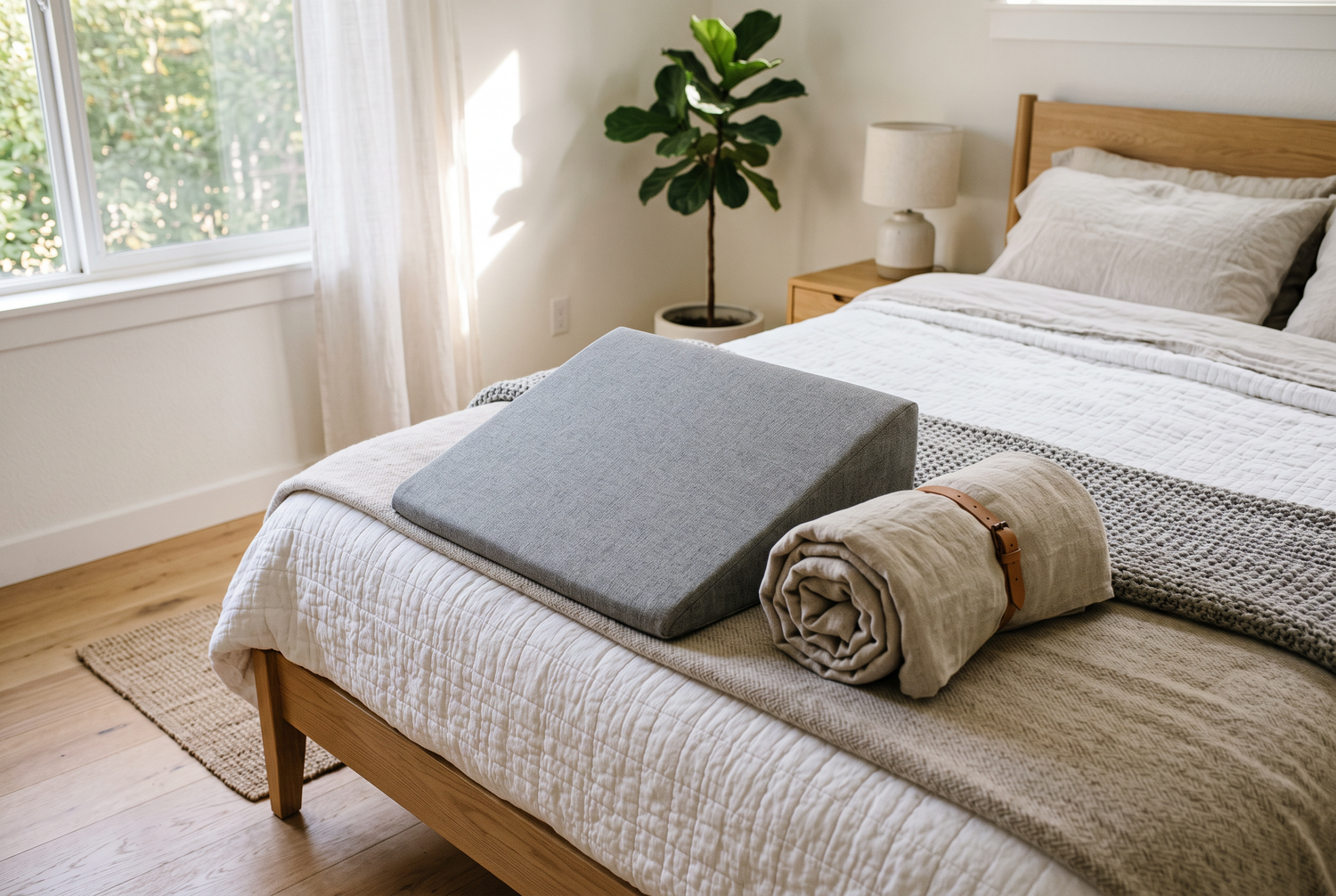
Heavy, swollen legs in the evening, a nagging lower back, or cramps at night: many people instinctively reach for a pillow under their legs and genuinely sleep better that way. Others have tried it only to give up in the morning due to numbness or neck pain. Whether elevating your legs during sleep helps depends on why you're doing it, how high you elevate them, and how the rest of your body is positioned. Physiologically, the effect is clearly measurable: even 15 to 20 cm above heart level significantly accelerates venous return and relieves the lumbar spine. At the same time, there are situations where elevation is unsuitable or even risky. This guide sorts through the facts, provides specific measurements in centimeters, and shows what aids can help maintain the position comfortably throughout the night.
The short answer: Elevating your legs during sleep is beneficial for tired, heavy, or swollen legs, mild venous insufficiency and varicose veins, water retention during pregnancy, and lower back pain when lying on your back. Ideal elevation is 15 to 20 cm above heart level, with the knees slightly bent and the entire length of the legs supported, not just the heels. Elevation is unsuitable for arterial circulatory disorders, acute thrombosis, heart failure, and for devoted side or stomach sleepers, as it only makes their position worse. If you are unsure whether your symptoms are venous or arterial, you should consult a doctor beforehand.
- 15–20 cm above heart level is sufficient; higher provides no added benefit and strains the hips and lumbar spine.
- Support along the entire length of the legs (wedge pillow, adjustable slatted frame) instead of just the heels, otherwise the knees hyperextend.
- Helps with venous complaints, edema, pregnancy, and lower back pain in the supine position.
- Not suitable for peripheral arterial disease, acute thrombosis, heart failure, and severe reflux tendencies without simultaneous head elevation.
- Side sleepers benefit more from a pillow between their knees than from elevation.
What happens in the body when the legs are above heart level
The venous system of the legs works against gravity. During the day, calf muscles and venous valves pump blood back to the heart; when standing, a hydrostatic pressure of about 90 to 100 mmHg is exerted on the ankle veins. When lying down, this pressure naturally drops significantly, and as soon as the legs are above heart level, gravity actively assists the blood flow back to the heart. Fluid that has accumulated in the tissue of the lower legs and feet during the day is returned to the vessels and excreted via the kidneys. This is precisely why people with edema often need to use the toilet more frequently after a night with elevated legs.
The second effect concerns the spine. When lying flat on your back with straight legs, the hip flexor (iliopsoas muscle) pulls on the lumbar spine and accentuates the hollow back. When the knees and lower legs are raised, the hip flexor relaxes, the pelvis tilts slightly backward, and the lumbar spine lies flatter and is relieved. This principle is also used in the so-called step-by-step positioning in physiotherapy. To learn why sleeping position is so crucial for your back, read our article on sleeping position for back pain.
Who benefits from elevating their legs during sleep?
Heavy, tired, and swollen legs
Those who stand or sit a lot are familiar with swollen ankles in the evening. Elevating the legs overnight accelerates the drainage of fluid and makes the legs feel lighter in the morning.
Venous insufficiency and varicose veins
For chronic venous insufficiency, vascular specialists explicitly recommend elevating the legs, in addition to wearing compression stockings during the day. It reduces pressure on weakened venous valves and can alleviate symptoms such as a feeling of tension and nocturnal calf cramps. Our own guide shows what else helps with nighttime calf cramps.
Pregnancy
Water retention in the legs affects up to 80% of pregnant women in the last trimester. Since lying on your back in late pregnancy can compress the vena cava, a combination of left-side lying and slightly elevated legs with a pillow is recommended. More tips in our article Sleeping during pregnancy.
Lower back and sciatica
The relaxed step-by-step positioning with raised lower legs relieves the lumbar spine and can make the night significantly more comfortable for muscular complaints, sacroiliac joint irritations, and mild sciatica.
After sports or long journeys
After intense exertion or a long-haul flight, elevation supports regeneration and prevents swelling.

When you should not elevate your legs
Elevation is not a universal remedy, and in some situations, it is counterproductive. In peripheral arterial disease (PAD), commonly known as "window shopper's disease," blood circulation in the legs is already impaired. If the legs are raised, arterial blood must flow downwards against gravity, which intensifies pain. Affected individuals typically tend to keep their legs lower. The difference is important: venous complaints improve with elevation, while arterial ones worsen. If unsure, consult a doctor to clarify whether the symptoms are venous or arterial in origin.
In the case of acute deep vein thrombosis, identifiable by unilateral swelling, pain, warmth, and bluish discoloration, self-treatment is inappropriate; immediate medical attention is required. People with heart failure should also discuss elevation with a cardiologist, as the increased venous return can put additional strain on a weakened heart. Those suffering from reflux should not elevate their legs in isolation, because the stomach would then be lower than the esophagus; here, additional elevation of the upper body is crucial, as described in our article on heartburn and reflux at night. And finally: If you are a side or stomach sleeper and do not maintain the position anyway, a foot pillow will be of little benefit.
How high, how long, in what position?
The common misconception that "higher is better" is false. For venous return, it is sufficient for the lower legs to be about 15 to 20 cm above heart level, which, when lying down, corresponds to an angle of about 20 to 30 degrees at the hip joint. Higher elevations offer no additional benefit but tilt the pelvis so much that the lumbar spine becomes unnaturally rounded and the hip flexors shorten.
Even support is crucial. If only a pillow is placed under the heels, the knees sag and become hyperextended; this irritates the back of the knee and the cruciate ligament. A better option is a support that extends from the back of the knee to the heels, so that the knees remain slightly bent (about 20 to 30 degrees). The head should remain in a neutral position, with a pillow that supports the cervical spine without pushing the chin to the chest. When elevating the legs, one should also ensure that the mattress does not allow the pelvis to sag; otherwise, a hammock-like shape will form on a too-soft surface. Regarding duration: an entire night is unproblematic, as long as none of the mentioned contraindications are present and you wake up in the morning without numbness. Tingling or numb feet are a sign that the elevation is too high or is putting pressure on nerves.
Aids compared
| Aid | Elevation | Advantages | Disadvantages | Approx. price |
|---|---|---|---|---|
| Rolled blanket / normal pillow | 10–15 cm | Immediately available, free | Slips, uneven | CHF 0 |
| Vein pillow / wedge pillow | 15–25 cm | Supports entire leg length, dimensionally stable | Takes up space, only for back sleeping | CHF 40–120 |
| Step-by-step positioning cube | approx. 40 cm (lower legs horizontal) | Maximum back relief | Usually too high for the entire night | CHF 60–150 |
| Adjustable slatted frame (manual) | Continuously up to approx. 30 cm | Even, no slipping, can be combined with head section | Adjustment only possible outside the bed | CHF 150–400 |
| Electric slatted frame / motor frame | Continuously, via remote control | Adjustable at night, comfort | Price, requires flexible mattress | CHF 500–1500 |
Our guide on adjustable slatted frames clarifies whether one is worthwhile for you. Important: Not every mattress is suitable for adjustable frames; more on this in the article mattress for adjustable slatted frame.
Practical guide: How to correctly elevate your legs
Start with the simplest option: roll a blanket into a roll about 15 cm in diameter and place it horizontally under your knees so that your lower legs gently slope down towards your heels. While lying down, check three points: Your knees are slightly bent, not hyperextended. Your lower back lies flat, without a hollow back and without feeling pressure. Your head is in a neutral position, with your chin neither pointing towards your chest nor the ceiling.
After two to three nights, you will know if the position suits you. If you wake up with lighter legs and a relaxed back, a dimensionally stable wedge pillow that doesn't slip is worthwhile. Test the height gradually: 15 cm is a good start, 20 cm is the sensible maximum for the entire night. If you also slightly raise your head (5 to 10 cm), for example, due to reflux or snoring, you should solve this with an adjustable frame instead of stacked pillows, so that the spine does not bend. Combine the positioning with the basics of good sleep hygiene: a cool room around 18 °C, sufficient fluids during the day, but not shortly before sleeping, and regular exercise during the day to activate the calf pump. For venous insufficiency, compression stockings during the day are also necessary; at night, they are usually not needed.

Secure a CHF 25 discount
Subscribe to the newsletter and receive a one-time CHF 25 discount. ✓ 200 nights trial sleep ✓ 10 years warranty
Frequent questions about elevating legs during sleep
How high should one elevate the legs during sleep?
About 15 to 20 cm above heart level. This corresponds to an angle of about 20 to 30 degrees at the hip joint. Higher elevations provide no additional benefit for venous return and strain the lumbar spine and hip flexors.
Is it healthy to sleep with elevated legs all night?
Yes, for people with venous problems, edema, or lower back pain, provided there are no arterial circulatory disorders, heart failure, or acute thrombosis. Tingling or numbness in the morning are signs that the elevation is too high.
Does elevating legs help with back pain?
Yes, in the supine position. Elevated knees relax the hip flexors, the pelvis tilts slightly backward, and the lumbar spine lies flatter. This principle corresponds to the step-by-step positioning used in physiotherapy.
Should one elevate the legs at night if they have varicose veins?
Yes, vascular specialists recommend it as a supplement to compression stockings during the day. Elevation relieves the weakened venous valves and reduces feelings of tension and swelling.
When should you not elevate your legs?
In cases of peripheral arterial disease, acute deep vein thrombosis, and untreated heart failure. In these situations, elevation can worsen symptoms. If in doubt, consult a doctor to determine whether the symptoms are venous or arterial in origin.
What is better: a pillow or an adjustable slatted frame?
A wedge pillow is inexpensive and sufficient for starting out. An adjustable slatted frame elevates the legs evenly along their entire length, does not slip, and can be combined with head elevation. However, it requires a flexible mattress.
This article is for general information only and does not replace medical advice.









Leave a comment
This site is protected by hCaptcha and the hCaptcha Privacy Policy and Terms of Service apply.