
When buying a bed, the question eventually arises: a normal slatted frame or an adjustable one? The price difference is considerable – a simple roll-up slatted frame costs 60 to 150 Swiss francs, a manually adjustable frame 200 to 500, and an electric one can quickly reach 700 to 2000 Swiss francs. Salespeople often describe the adjustment function as a comfort feature for bookworms, which doesn't do it justice: for certain conditions, an elevated upper body position is medically relevant and not just a gimmick. Conversely, many people pay the extra cost and stop using the adjustment after three months. This guide explains what an adjustable slatted frame actually does, for whom it is worthwhile, what its limitations are, and how to recognize a good frame – so you don't have to make your decision based on catalog promises.
The short answer: An adjustable slatted frame is particularly worthwhile if you regularly want or need to sleep with your upper body elevated – for example, due to reflux, breathing difficulties, snoring, swollen legs, or limited mobility. For perfectly healthy sleepers, it's a comfort feature, not a must. It's important to distinguish: a frame with head and foot section adjustment changes the sleeping position, while a frame with a slider firmness adjustment only changes the yield in the pelvic area. These two are often confused. It's also crucial that the mattress is flexible enough to adapt.
- Two different things: position adjustment (head/foot section) and firmness adjustment (sliders in the pelvic area).
- Clearly beneficial for reflux, respiratory problems, leg edema, and limited mobility.
- Price range: manual 200–500 CHF, electric 700–2000 CHF per sleeping area.
- Only useful with a flexible foam mattress – Bonnell spring mattresses are unsuitable.
- Pay attention to the number of slats (min. 28), load capacity, emergency lowering, and cable length.
Adjustable is not always the same as adjustable
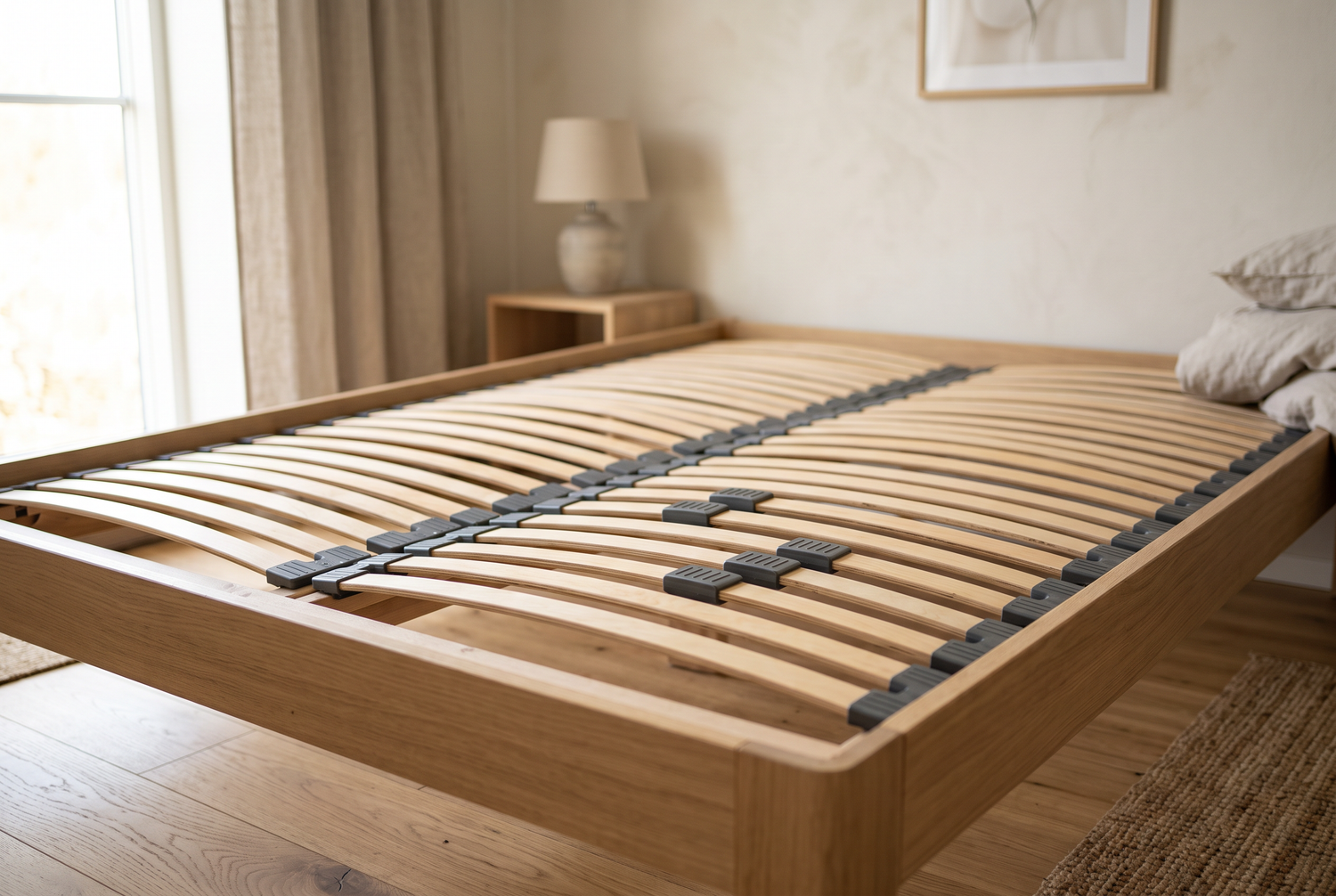
The biggest confusion in retail arises because two completely different functions bear the same name. Firmness adjustment consists of sliders that are moved over two slats each in the pelvic and shoulder areas. They increase the rigidity there – the frame yields less. This function does not change the sleeping position, but only the give in one zone. It is inexpensive, maintenance-free, and included in almost every better slatted frame from about 150 Swiss francs. Position adjustment, on the other hand, divides the frame into movable segments that are raised by fittings, gas pressure springs, or motors. It actually changes the body posture in bed. A third type, the disc or spring element frame, replaces slats with individually mounted discs and is particularly point-elastic – it can also be combined with an adjustment function. So, if you hear "adjustable" in the store, always ask which of the three variants is meant. Basics on the right bed base are explained in the article Slatted frame and mattress.

Who truly benefits from position adjustment
For several conditions, an elevated upper body position is beneficial and recommended by doctors. For reflux and heartburn, an incline of about 15 to 30 degrees helps because gravity keeps stomach contents down; studies on sleep positions for reflux tend to show an advantage for the elevated position in combination with sleeping on the left side. For respiratory problems and a stuffy nose, the upright position facilitates the drainage of secretions. For snoring, a slight elevation can reduce the falling back of the base of the tongue – however, it does not replace an investigation if breathing pauses are involved. For water retention in the legs, a raised foot section relieves venous return. And for limited mobility – such as after hip or knee operations, in old age, or for care needs – the assistance in getting up provided by a raised head section is often the real gain. Those considering this for any of these reasons can find further information under Heartburn and reflux at night and Snoring: Causes and what helps.
Manual, gas spring, or electric?
The three designs differ significantly in terms of operating comfort, price, and maintenance.
| Type | Price (per sleeping area) | Operation | Suitable for |
|---|---|---|---|
| Manual (ratchet fitting) | 200–400 CHF | Bed must be empty, segment locked manually | occasional use, guest room |
| Gas spring | 350–600 CHF | Can be raised while lying down, continuously adjustable | regular use without electricity |
| Electric (motorized frame) | 700–2000 CHF | Remote control, often with memory positions | daily use, medical needs |
The honest practical advice: Manual frames are empirically used least often because the bed must be empty to adjust them. Those who truly need the function are better off with gas pressure or motor. Details on the electric version can be found under Electric slatted frame.
What to look for when buying
The number of slats is the first quality feature: below 28 slats per sleeping surface, the support becomes coarse; good frames have 42 to 44. The slats should be made of multi-layered laminated wood – usually beech or birch – and sit in elastic caps, not rigidly screwed. The slat spacing should not exceed 3 to 4.5 cm, otherwise the mattress will push through between the slats. Check the load capacity: commercially available frames are designed for a total load of 100 to 150 kg including the mattress; heavier people need reinforced versions. For electric frames, an emergency lowering function via battery is important – if the power goes out while the head section is up, you don't want to sleep sitting up. Look for quiet motors under 45 dB, a cable length that suits the nearest power outlet, and ensure the remote control can be operated in the dark. And finally: check the internal dimensions of your bed frame, as motorized frames are often 2 to 5 cm higher than a roll-up slatted frame. How this affects the overall height can be read under The ideal bed height.

Myths fact-checked
"An expensive slatted frame compensates for a bad mattress." No. The slatted frame supports and ventilates, the mattress forms the sleeping surface. A 900 franc frame under a sagging mattress changes practically nothing. The order is always: first mattress, then bed base. "The more zones, the better." Zone numbers are not standardized and are arbitrarily inflated in marketing. A frame with seven advertised zones is not automatically better than one with three – the number of slats, material, and suspension are decisive. "Firmness adjustment changes the firmness of the mattress." It changes the give of the frame in the pelvic area – noticeable mostly only with thin mattresses under 16 cm. With a 22 cm foam core, little of that reaches the top. "Adjustable frames are noisy." Good motors today operate at 40 to 45 dB, which is quieter than a whisper in the room. Cheap devices, however, can hum significantly. "You get used to sleeping flat." There is no reliable evidence for this; most people use the elevation situationally.
When the investment is not worthwhile
There are situations where the money is better spent elsewhere. If your mattress is older than eight years or has a noticeable sag, invest there first – anything else treats symptoms. If you are predominantly a stomach sleeper, head section adjustment provides little to no benefit, as the position renders it useless. If your bed frame has a solid base or a low side rail, a motorized frame often won't fit at all. If you sleep as a couple in a 160 cm bed on a continuous mattress, you would have to switch to two separate sleeping surfaces for adjustment – this noticeably changes the sleeping experience as a couple. And if the budget is tight: a solid, non-adjustable slatted frame with 42 slats for 200 Swiss francs plus a good mattress will always beat a cheap motorized frame plus a compromise mattress. Those who only occasionally need elevation can often get by with a wedge pillow for 40 to 80 Swiss francs – an honest alternative rarely mentioned in retail.
Get CHF 25 discount
Subscribe to newsletter and receive a one-time CHF 25 discount. ✓ 200 nights trial sleep ✓ 10 years warranty
Frequently asked questions about adjustable slatted frames
Is an adjustable slatted frame worthwhile at all?
It is clearly worthwhile if you sleep with your upper body elevated for health reasons – for example, due to reflux, breathing difficulties, swollen legs, or limited mobility. For symptom-free sleepers, it is purely a comfort feature. In that case, it is better to invest in a good mattress first.
What is the difference between firmness adjustment and position adjustment?
Firmness adjustment consists of sliders above the slats in the pelvic area and only changes the flexibility of the frame at that point. Position adjustment divides the frame into movable segments and raises the head or foot section, thus actually changing your sleeping position.
How much does an adjustable slatted frame cost?
Manual frames with ratchet fittings are about 200 to 400 Swiss francs per sleeping surface, models with gas springs 350 to 600 Swiss francs, and electric motorized frames 700 to 2000 Swiss francs. For double beds, the cost is twice as much, as two separate sleeping surfaces are required.
How many slats should a good slatted frame have?
At least 28 slats per sleeping surface; good frames have 42 to 44. The distance between the slats should not exceed 3 to 4.5 centimeters, otherwise the mattress will press through between the slats and wear out faster.
Does every mattress fit on an adjustable slatted frame?
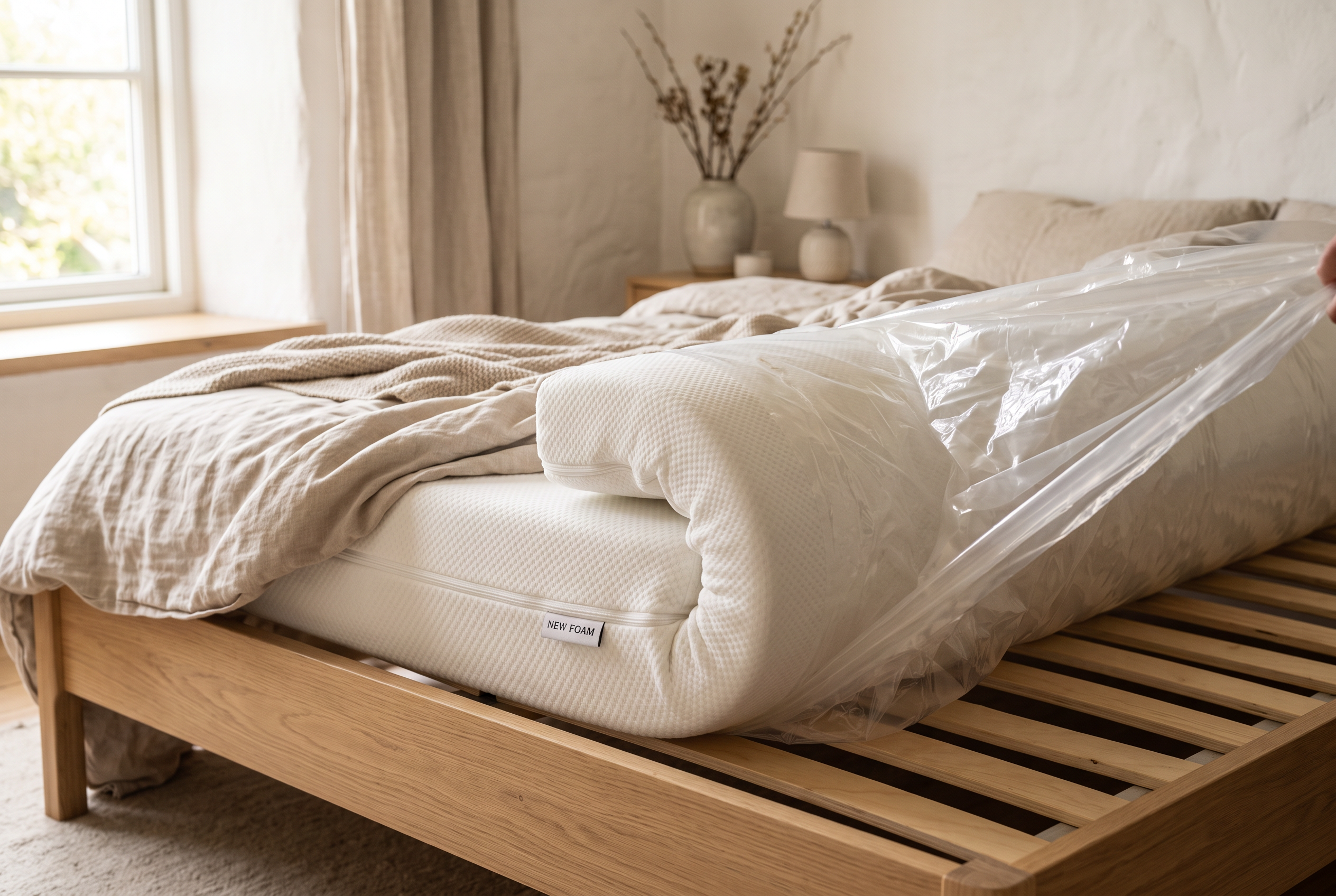
No. Flexible, point-elastic foam mattresses with a core height of 16 to 24 centimeters are suitable. Bonnell spring core mattresses are unsuitable, pocket spring core mattresses only with explicit manufacturer approval. Without a suitable mattress, the adjustment function is practically ineffective.
What happens to an electric slatted frame during a power outage?
Good motorized frames have an emergency lowering function with batteries, which can return the bed to the flat position even without mains power. Make sure to explicitly look for this when buying – without this function, the frame will remain in the last set position.
This article is for general information and does not replace medical advice.








Leave a comment
This site is protected by hCaptcha and the hCaptcha Privacy Policy and Terms of Service apply.