
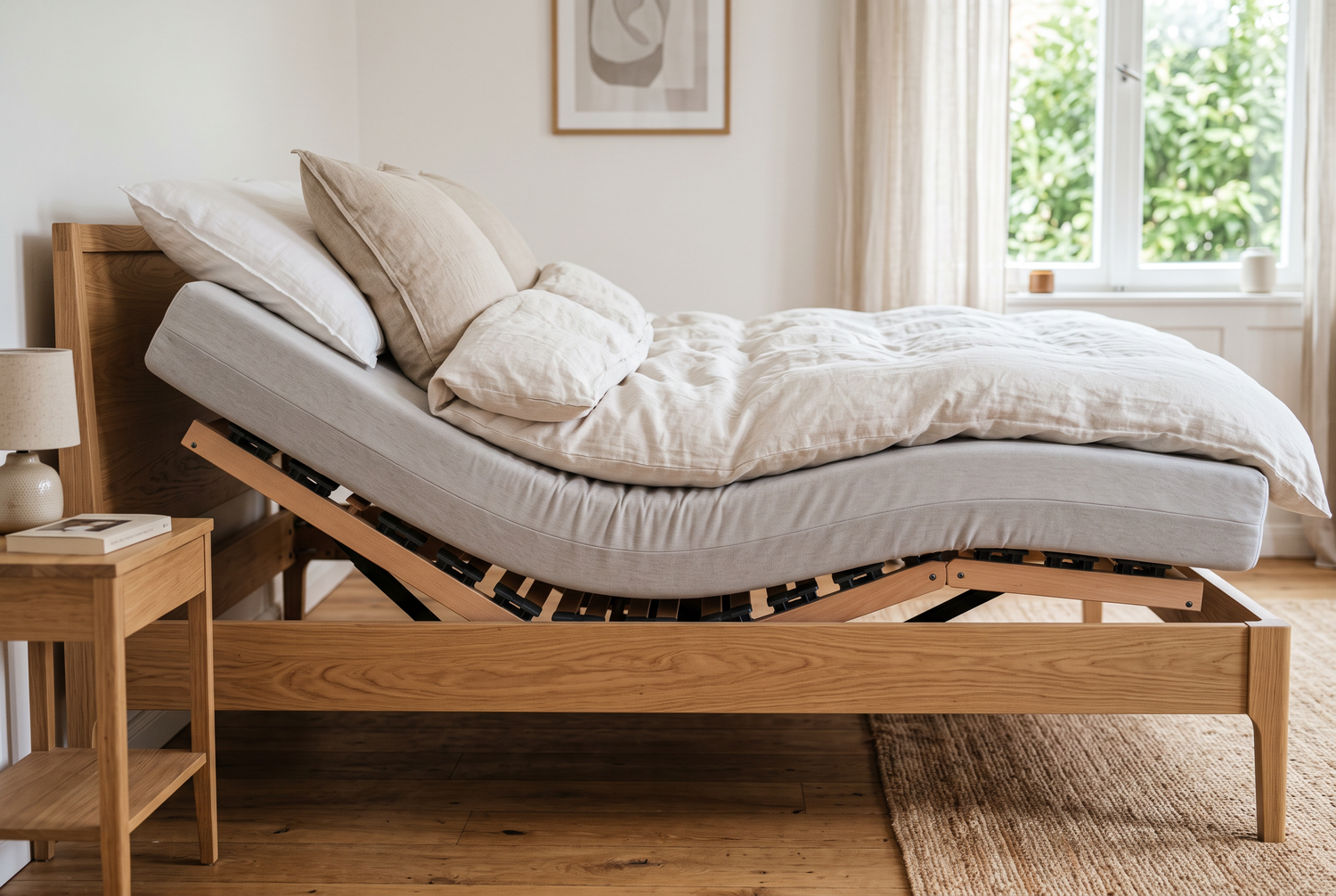
An adjustable slatted frame is an investment that only pays off if the mattress cooperates. This is precisely where many combinations fail: The frame dutifully lifts the head section by 40 degrees, but the mattress remains stiff as a board, bulges at the edges, or slides forward a bit with every adjustment. This is annoying because both together were expensive – and because the actual benefit, namely relieving sleeping positions for reflux, breathing difficulties, or back pain, is lost. Therefore, anyone looking for a mattress for an adjustable slatted frame needs different criteria than for a classic bed. In this guide, you will learn which materials are truly flexible, what height is suitable, what to look for in the cover, and which combinations you should avoid.
The short answer: For an adjustable slatted frame, flexible, point-elastic foam mattresses are best – meaning cold foam, viscoelastic, and modern premium memory foams. They follow the bend without forming creases or kinks in the hinge area. Spring core mattresses are only partially suitable, and Bonnell spring cores are not suitable at all. A core height of 16 to 24 cm is ideal; significantly thicker mattresses hinder the adjustment mechanism. Additionally, look for a non-slip bottom and ensure that the cover has enough room to move in the bending zones.
- Foam mattresses (cold foam, viscoelastic, premium memory foam) are the first choice – they bend uniformly.
- Bonnell spring core is unsuitable: The rigid spring assembly can break or poke through the fabric.
- Core height 16–24 cm; from about 26 cm, adjustability decreases noticeably.
- Non-slip bottom and a cover with extra stretch prevent shifting and creasing.
- Latex is flexible but heavy – always check the load capacity of the motor frame.
Why not every mattress fits an adjustable slatted frame
An adjustable slatted frame usually has four or five movable segments: head, back, seat, upper and lower leg areas. When adjusting, hinge points are created between these segments, where the material on the top must compress and on the bottom must stretch. A point-elastic material distributes this tension over many centimeters and forms a smooth curve. A surface-elastic material, on the other hand – such as a continuous spring core – tries to maintain its shape and kinks sharply at a single point. This results in two problems: First, the kink edge presses into the body exactly where relief was intended. Second, the material suffers: springs lose their tension, adhesive seams between foam layers detach, and covers chafe through. After two years of daily adjustment, the damage is often visible. Additionally, there's a practical detail: The stiffer the mattress, the more force the motor has to exert. With inexpensive motor frames, this leads to slow, jerky operation and a shorter lifespan for the drives. You can find basic information on selecting the base in the article Properly combining a slatted frame and mattress.

Materials compared: what works and what doesn't
The following overview summarizes how common mattress types behave on adjustable frames.
| Mattress Type | Suitability | Reasoning |
|---|---|---|
| Premium Memory/Viscoelastic Foam | Very good | highly point-elastic, forms a soft curve, no kink point |
| Cold Foam | Very good | flexible and light, low motor load |
| Gel Foam | Good | flexible, but often taller and heavier |
| Latex | Conditional | flexible, but weighs 25–40 kg – check load capacity |
| Pocket Spring | Only with approval | only specially designed models with flexible zones |
| Bonnell Spring | Unsuitable | rigid spring assembly, risk of breakage and puncturing |
If you're considering a spring core model, be sure to read about the differences between the designs beforehand: Bonnell spring core and pocket spring core compared.
Height, weight, and construction: the technical limits
When it comes to core height, there's a simple relationship: The thicker the mattress, the larger the radius it has to describe when adjusting – and the less of the set incline actually reaches the top. Between 16 and 24 cm is the range where comfort and flexibility combine well. At 26 cm and more, you will notice clearly that while the head section rises, your upper body does not straighten as much as expected. Weight is the second factor: Standard motor frames are usually designed for a total load of 100 to 150 kg per sleeping surface – this includes the mattress, bedding, and person. A 90x200 latex mattress can quickly weigh 30 kg, eating up a third of the budget. Foam mattresses of comparable size typically weigh between 12 and 18 kg. For construction, it's worth looking at the adhesive seams: Multi-layered mattresses with many glued layers are more susceptible to delamination than models with a continuous core. And check whether the manufacturer explicitly approves use on adjustable bases – if this approval is missing, there may be discussions in case of a warranty claim.
The cover: the overlooked detail
The cover also plays a role in whether a combination works long-term. A tightly and narrowly cut cover without extra stretch will be strained at the segment transitions with every adjustment. After a few months, you will see permanent horizontal creases there, and later the fabric will chafe along these lines. Therefore, look for a cover with an elastic stretch component or deliberately more generously cut quilting. The second point is the underside: With every adjustment, a small pushing force acts towards the foot end, and over weeks the mattress moves several centimeters downwards. A non-slip underside – such as a fabric with an anti-slip coating – prevents this. If it is missing, an anti-slip mat from the hardware store or a footboard on the frame can help. Also practically important: If the cover is divided and both halves are connected by a zipper, it should not be located exactly at a segment transition. You can read how to properly care for the cover under Washing mattress covers.
Topper on the adjustable slatted frame
A topper is almost always useful on adjustable frames, but only if it is secured. Without fixation, it slides a bit with every adjustment and lies crooked after a week. Use models with corner elastic straps or a fitted sheet that encompasses both the mattress and topper. You should factor in the height: a 5 cm topper on a 22 cm core results in a total height of 27 cm – putting you in the range where the adjustment effect decreases. For thinner cores from 16 cm, a topper is unproblematic and provides noticeably more pressure relief for the shoulders and hips. Another advantage: A topper compensates for small unevenness that can occur at the segment transitions, making the transition points imperceptible. Make sure that the topper is also made of flexible foam; stiff cold foam toppers with high indentation hardness make the bend unnecessarily hard. The Topper Guide provides an overview of topper variants.

Common mistakes when combining
Continuing to use the old spring mattress. The most common mistake of all: The new motor frame arrives, the ten-year-old Bonnell spring mattress stays. After a few weeks, it squeaks, the headboard bulges, and both parts suffer. Buying too high. A 30 cm mattress looks luxurious in the store, but makes adjustment practically ineffective. Ignoring load capacity. Two heavy latex mattresses on a double motor frame quickly exceed the manufacturer's specifications – the motors then run continuously at their limit. Assembling without anti-slip protection. After four weeks at the latest, the mattress will be hanging over the foot end. Too rarely returning to the basic position. Leaving the mattress in a bent position for months on end causes permanent deformation. Keep the frame flat during the day. Exaggerating the headboard angle. 45 degrees during sleep sounds like a lot of relief, but often leads to sliding down in bed and a kink in the neck. Start with 10 to 15 degrees and increase slowly. Those who primarily want to use the adjustment function due to back pain can find more information under Mattress for back pain.
Practical advice: how to test the combination at home
After assembly, slowly move the frame into different positions and observe the mattress from the side. It should move with a gentle curve without forming a sharp edge at any point. Then place a hand flat on the segment transition – if you feel a hard edge, the material is too stiff. For the second test, lie in your typical reading position and check whether your pelvis rests stably on the seat segment or if you slide forward. Sliding indicates that either the knee bend is not raised or the surface is too smooth. Finally, mark the position of the mattress edge on the frame with a pen and check after a week whether it has shifted. Use the trial sleep phase for all of this: Two to four weeks is a realistic period to assess whether the frame and mattress harmonize – the body's adjustment takes longer anyway, as described in Getting used to a new mattress.
Get a CHF 25 discount
Subscribe to our newsletter and receive a one-time CHF 25 discount. ✓ 200 nights trial sleep ✓ 10-year warranty
Frequently asked questions about mattresses for adjustable slatted frames
Which mattress is best for an adjustable slatted frame?
Point-elastic foam mattresses are best suited: cold foam, viscoelastic foam, and modern premium memory foams. They follow the bend in a soft curve instead of kinking sharply at the segment transitions, and their low weight places little burden on the motors.
Can I use a spring mattress on an adjustable slatted frame?
Bonnell spring mattresses are unsuitable because the rigid spring assembly can break or poke through the fabric when bent. Pocket spring mattresses are only suitable if the manufacturer explicitly approves them for adjustable bases. Without this approval, you risk material damage and warranty disputes.
How high can the mattress be on a motor frame?
A core height between 16 and 24 centimeters is the sensible range. From about 26 centimeters, less and less of the set incline reaches the top, because the mattress has to describe too large a bending radius. Include a topper in the total height calculation.
Why does my mattress slide on the adjustable slatted frame?
With every adjustment, a small pushing force acts towards the foot end, which accumulates over weeks. Solutions include a non-slip mattress bottom, an anti-slip mat between the frame and mattress, or a retaining bar at the foot end of the frame.
Do I need a special topper for an adjustable slatted frame?
Not a special one, but a flexible and secured one. The topper should be made of flexible foam and secured with corner elastic straps or a shared fitted sheet, otherwise it will slip with every adjustment. Stiff toppers with high indentation hardness make the bend unnecessarily hard.
Does it damage the mattress if I leave the frame permanently adjusted?
Yes, over a longer period, this can lead to permanent deformations in the areas of the bends. Regularly return the frame to its flat basic position during the day so that the material can fully relax and return to its original shape.







Leave a comment
This site is protected by hCaptcha and the hCaptcha Privacy Policy and Terms of Service apply.