
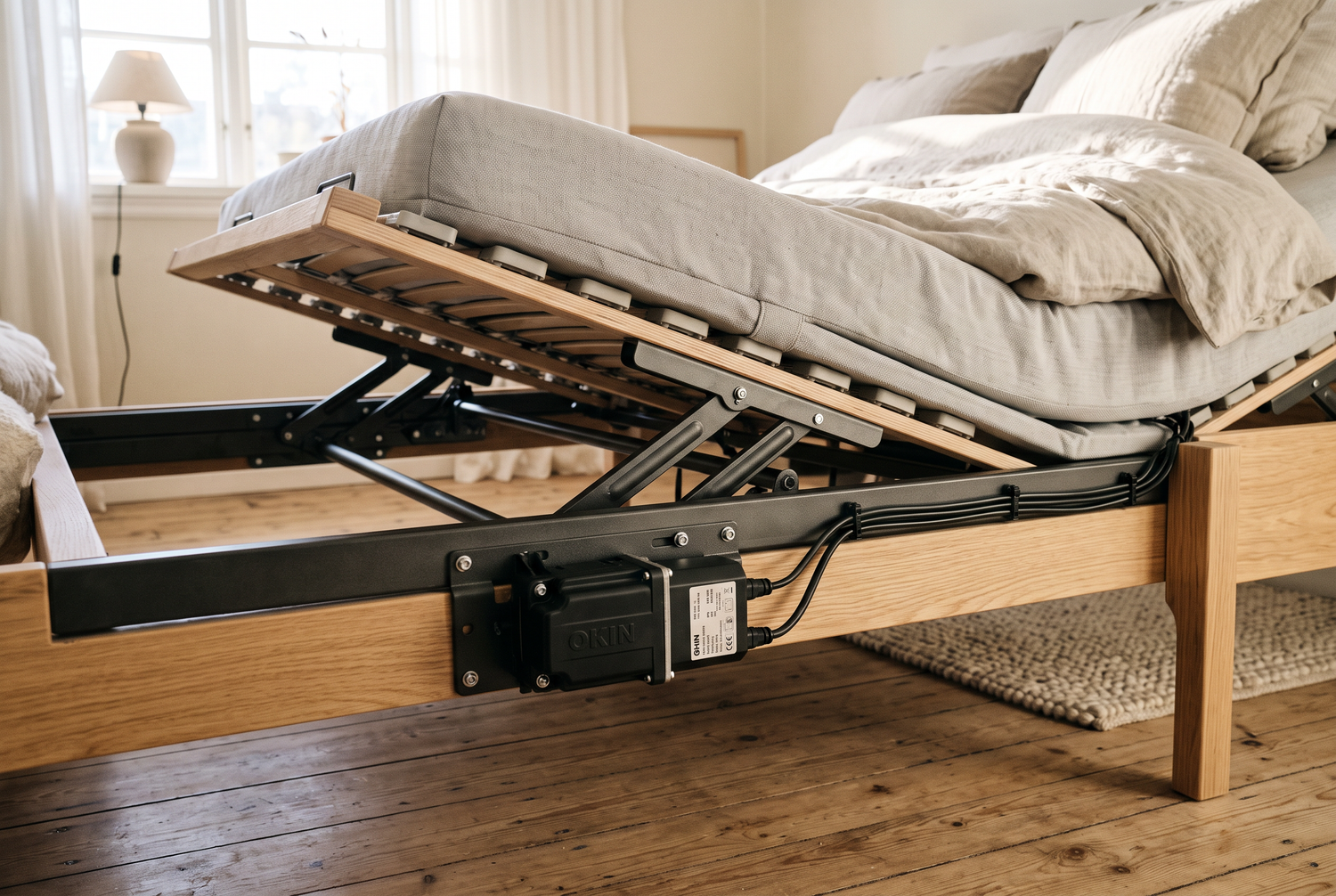
An electric slatted frame is the most comfortable, but also the most technically sophisticated type of bed base. At the touch of a button, the head section moves into a reading position, the foot section raises the legs, some models store favorite positions or slowly move into an assisting position in the morning for getting up. What is impressive in the showroom, however, quickly raises questions at home: How loud is the device at night? What happens in the event of a power outage? How much weight can the frame actually support? And is the extra cost of several hundred Swiss francs compared to a gas-spring variant worth it? This guide systematically reviews the technology, provides concrete figures on load capacity, noise level, and power consumption, and identifies the equipment details that genuinely make a difference in everyday life – so you can buy a motorized frame based on facts and not on the showroom effect.
The short answer: An electric slatted frame is worthwhile if you use the adjustment function daily – for health reasons, due to limited mobility, or because you read and watch TV in bed. When buying, look for at least 42 spring slats, a load capacity that suits you and your mattress (100–150 kg is common), a battery-operated emergency lowering function, and quiet motors below 45 dB. The power consumption is negligible, at around 1–3 kWh per year. Expect to pay 700 to 2000 Swiss francs per sleeping area – and be sure to check in advance whether the frame fits into your bed frame.
- Two motors (head and foot separate) are standard; one motor for both segments is significantly less flexible.
- Emergency lowering via a 9-V battery is mandatory – otherwise the frame will remain in position during a power outage.
- Load capacity typically 100–150 kg including mattress; reinforced models up to 200 kg.
- Power consumption only when adjusting – approx. 1–3 kWh per year, so less than 1 Swiss franc.
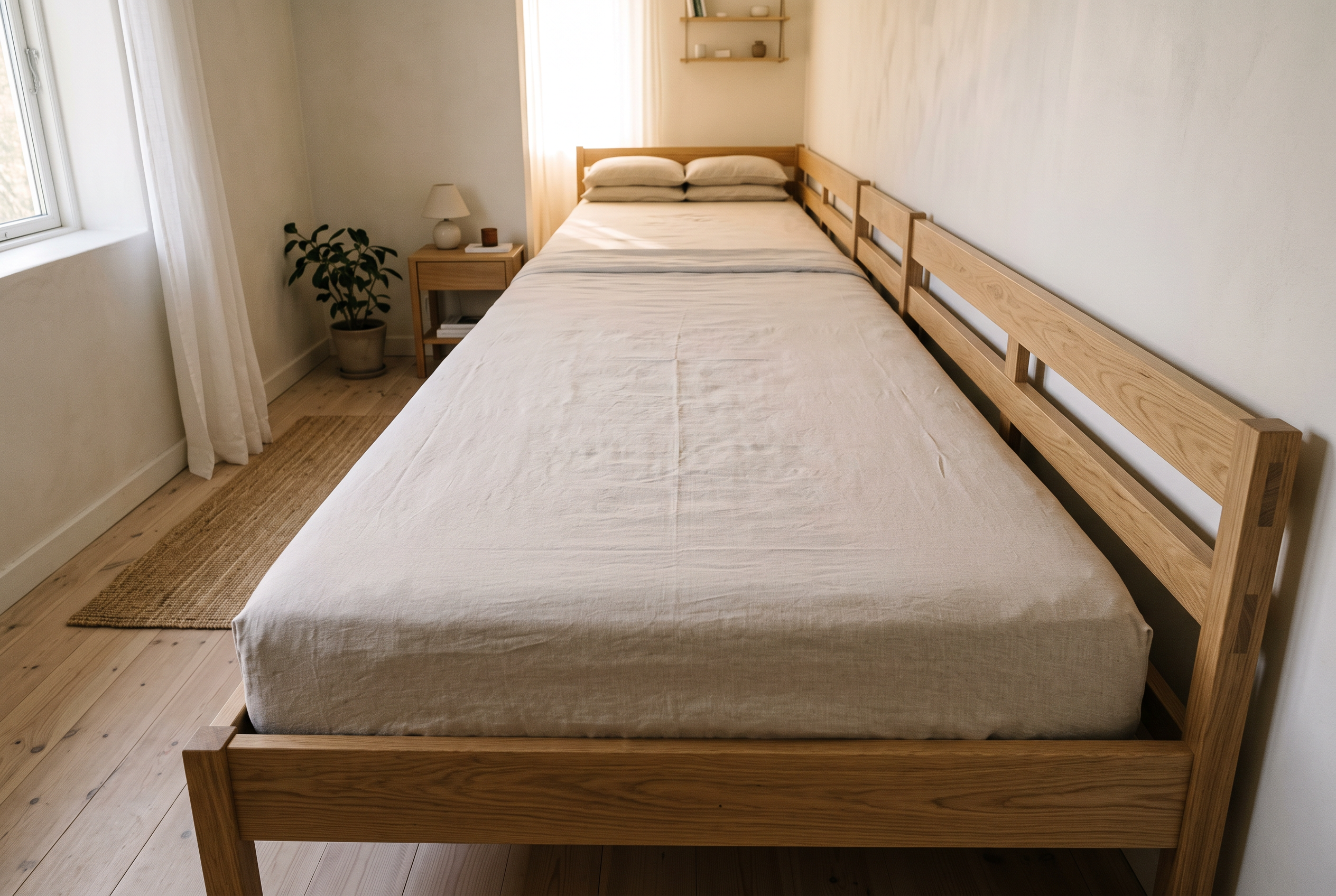
- Motorized frames are 2–5 cm higher than roll-up slatted frames: measure the inner dimensions of the bed frame beforehand.
How an electric slatted frame is technically constructed
A motorized frame consists of a sturdy wooden or metal frame in which 42 to 44 spring slats are seated in elastic caps, as well as two to four movable segments. These segments are driven by linear actuators – small electric motors that rotate a threaded spindle and thus extend a lifting arm. A control unit distributes the power, a power supply unit converts 230 volts to mostly 24 or 29 volts low voltage. Operation is via a wired remote control or radio. Common drive manufacturers include Okin, Limoss, and Dewert; their motors are found in frames of various brands, which is an advantage for spare parts. Important to know: Most frames draw a small standby current of about 0.3 to 0.5 watts in idle state. Models with mains cut-off disconnect the connection as soon as there is no movement – this not only reduces consumption but also electrical alternating fields in the head area, which is important to some people. The article Adjustable slatted frame: is it worth it? explains the basics of the substructure.

The most important key figures at a glance
You should check these values before buying – they are listed in the data sheet but are rarely mentioned in sales conversations.
| Key figure | Good value | Why it matters |
|---|---|---|
| Spring slats | 42–44 per sleeping surface | even support, less mattress wear |
| Slat spacing | 3–4.5 cm | larger gaps allow the mattress to sag |
| Load capacity | 120–150 kg (reinforced up to 200 kg) | calculate including mattress weight |
| Motor noise level | under 45 dB | does not disturb partner during nocturnal adjustments |
| Emergency lowering | 9-V battery, integrated | safety in case of power outage |
| Overall height | 8–12 cm | must fit into the bed frame |
Head section, foot section, memory positions: what you really need
The head section adjustment is the function almost everyone uses – for reading, watching TV, and with reflux or a stuffy nose. An angle range of up to 60 degrees is perfectly sufficient; the last few degrees tend to be less comfortable for sitting. The foot section adjustment is used less often but is valuable for water retention, after leg or knee operations, and for people with vein problems. A knee bend – i.e., a separate segment in the thigh area – prevents you from sliding forward when raising the head section; it is significantly more important than the number of memory positions. Memory storage for two to three positions is pleasant if you use the same angles daily. A zero-gravity position, in which the upper and lower body are slightly raised, is perceived by many as pressure-relieving – however, there are hardly any reliable studies on this, it remains a matter of personal preference. A wireless remote control with illumination is more practical in the dark than it sounds. You can usually do without integrated massage motors: they are loud, consume a disproportionate amount of power, and are rarely used after a few weeks, based on experience.
Which mattress belongs on a motorized frame
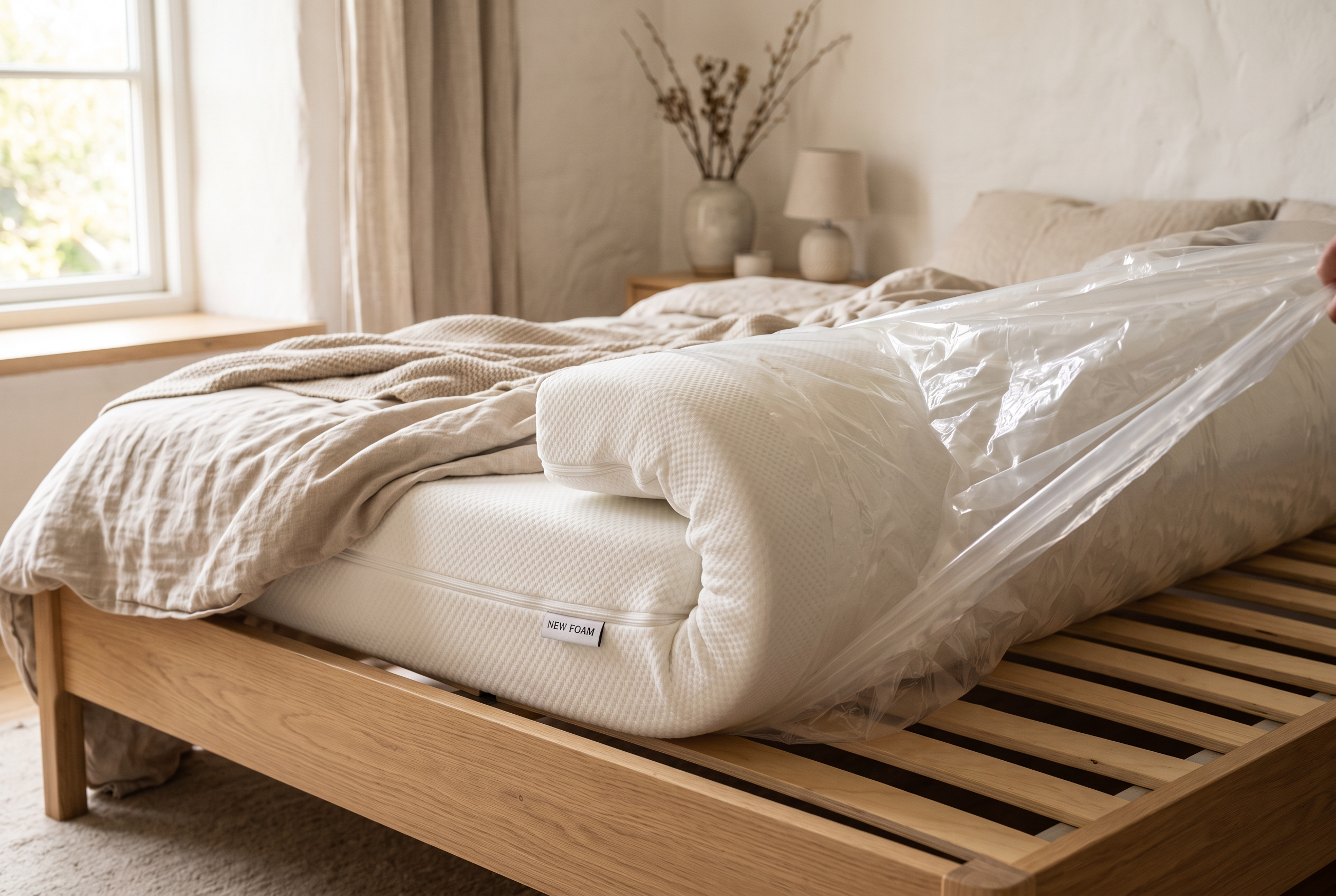
The best frame is useless if the mattress doesn't cooperate. Point-elastic foam mattresses – cold foam, visco, and premium memory foams – with a core height of 16 to 24 cm are suitable. They follow the curve in a gentle arc without kinking at the segment transitions and are light enough at 12 to 18 kg to protect the motors. Bonnell spring mattresses are unsuitable: the rigid spring unit can break. Pocket spring mattresses require explicit manufacturer approval. Latex is flexible but heavy at 25 to 40 kg – factor this weight into the load capacity. A practical point many overlook: The mattress needs an anti-slip underside or a retaining bar at the foot end, otherwise it slides down a bit with every adjustment. The guide Mattress for adjustable slatted frame covers this in detail. Those unsure which mattress type is suitable can find an overview under Mattress types compared.

Common mistakes when buying and installing
Not measuring the internal dimensions. The most common problem by far: The frame is ordered, but doesn't fit into the bed frame or protrudes at the top. Measure the internal length, internal width, and the available height between the support angle and the top edge of the bed frame. Only considering body weight for load capacity. Mattress, topper, and bedding count; 20 to 30 kg quickly add up. Forgoing emergency lowering. Without it, the frame remains in the last set position in the event of a power outage. Choosing a cable that is too short. Check the length to the nearest outlet and whether the cable can be routed neatly under the bed – loose cables rub against moving parts. Only motorizing one side. With double beds, this leads to different installation heights and a noticeable step in the middle. Leaving the mattress bent permanently. Keep the frame flat during the day, otherwise permanent deformations will occur. Letting children play unsupervised. Pinch points can occur between moving segments and the bed frame – good frames have a child lock on the remote control, use it.
Costs, consumption, and lifespan
For a solid motorized frame with two drives, 42 spring slats, and emergency lowering, expect to pay 700 to 1200 Swiss francs per sleeping area; brand frames with disc springs, wireless remote control, and additional functions cost between 1200 and 2000 Swiss francs. For a double bed, this doubles because two separate sleeping areas are required – this is the point where many people reconsider their decision. The ongoing power consumption, however, is negligible: an adjustment process briefly draws 60 to 100 watts and takes 15 to 30 seconds. With ten adjustments per day, this adds up to about 1 to 3 kilowatt-hours per year, well under one Swiss franc. More relevant is the standby consumption of 0.3 to 0.5 watts, which amounts to about 3 to 4 kilowatt-hours over the year – a device with mains cut-off or a switched power strip can solve this. Regarding lifespan: linear actuators from good manufacturers are designed for about 10,000 to 20,000 cycles, which corresponds to 8 to 15 years of normal use. Replacement motors cost 150 to 300 Swiss francs and can usually be replaced without a specialist – ask about spare parts availability before buying.
Secure a CHF 25 discount
Subscribe to the newsletter and receive a one-time CHF 25 discount. ✓ 200 nights trial sleep ✓ 10-year warranty
Frequently asked questions about electric slatted frames
How much power does an electric slatted frame consume?
When adjusting, the frame briefly draws 60 to 100 watts, and one operation takes 15 to 30 seconds. Over a year, with normal use, this adds up to about 1 to 3 kilowatt-hours, well under one Swiss franc. More relevant is the standby consumption of 0.3 to 0.5 watts, which a mains cut-off or a switched socket avoids.
What happens in the event of a power outage?
Frames with integrated emergency lowering return to the flat position via a 9-volt battery. If this function is missing, the slatted frame remains in the last set position until power is restored. Explicitly look for emergency lowering when purchasing.
How loud are the motors?
Good linear actuators operate at 40 to 45 decibels, which is equivalent to a quiet conversation and generally does not wake a sleeping partner. Cheaper devices can hum significantly louder. Ask for a demonstration of the frame in the store and listen carefully.
How much weight can a motorized frame support?
Typically 100 to 150 kilograms total load per sleeping area, reinforced versions support up to 200 kilograms. Important: This figure includes the mattress, topper, and bedding, which together quickly add up to 20 to 30 kilograms.
How long does an electric slatted frame last?
The drives of good manufacturers are designed for about 10,000 to 20,000 adjustment cycles, which corresponds to 8 to 15 years of normal use. Replacement motors cost 150 to 300 Swiss francs and can usually be replaced yourself. Ask about spare parts availability before purchasing.
Does a motorized frame fit into every bed frame?
No. Motorized frames are significantly higher at 8 to 12 centimeters than a roll-up slatted frame and require sufficient space between the support angle and the top edge of the bed frame. Before ordering, measure the internal length, internal width, and the available installation height of your bed frame.







Leave a comment
This site is protected by hCaptcha and the hCaptcha Privacy Policy and Terms of Service apply.