
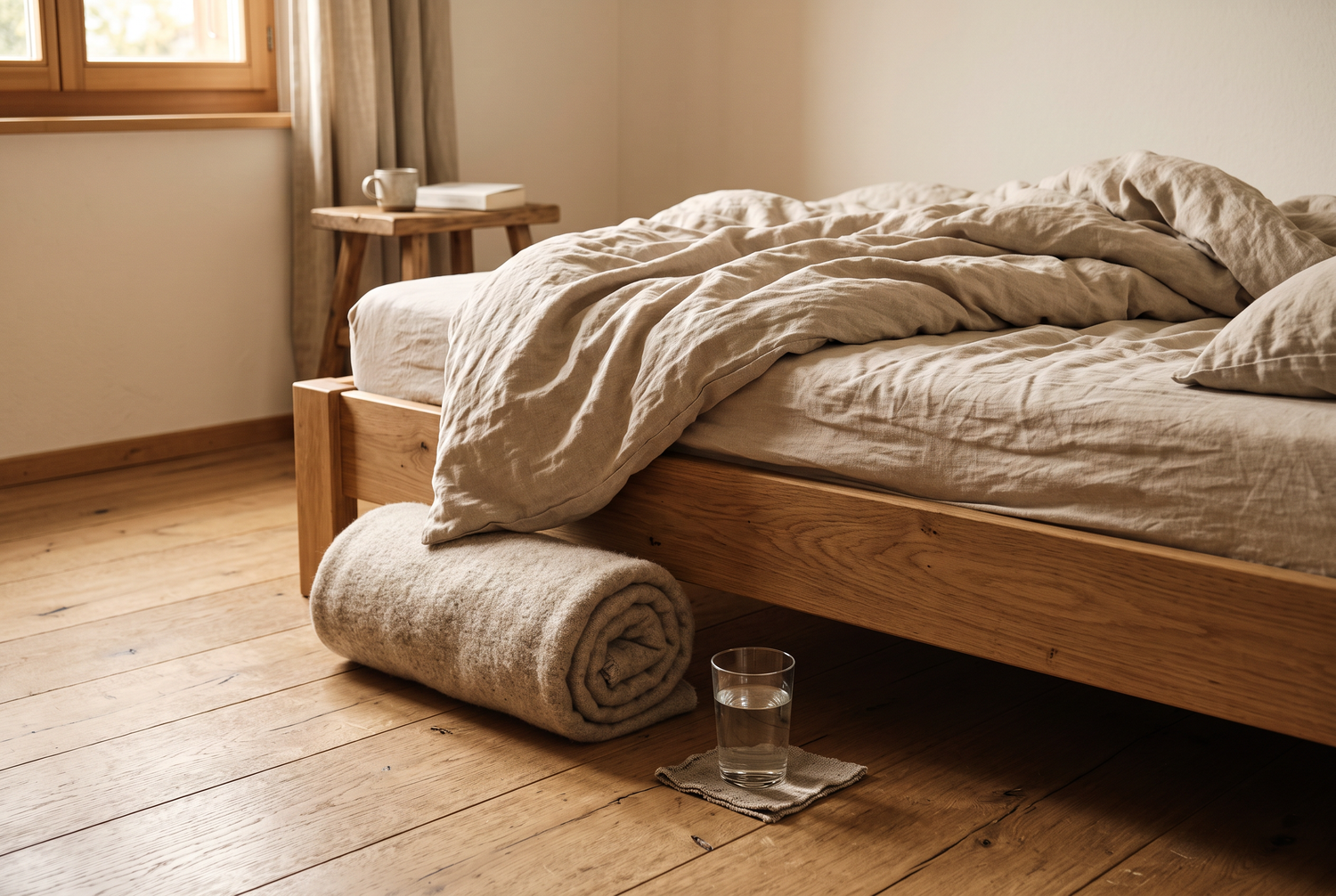
The pain comes out of nowhere. One moment you're relaxed, the next your calf tightens like a steel cable, your foot cramps downwards, and you're sitting bolt upright in bed. Night-time calf cramps usually last only a few seconds to two minutes, but the muscle soreness afterwards often persists until the next day – and sleep is gone for good. About one in three adults experiences this phenomenon, and from the age of 60, around half even report occasional night-time cramp attacks. The good news: in most cases, there's nothing threatening behind it, and with a few specific measures, the frequency can be noticeably reduced. This article explains what happens in the muscle, what really helps in an acute situation, and what preventive measures are worthwhile.
The short answer: A nocturnal calf cramp is an involuntary, painful, sustained contraction of the calf muscle, usually triggered by hyperexcitable nerve endings at the muscle-tendon junction. The cramp is most quickly relieved by passive stretching: forcefully pull your toes towards your shin and hold for 20 to 30 seconds. Regular stretching before bedtime, adequate hydration, and a light duvet that doesn't push the foot into a plantarflexed position are effective preventive measures. Magnesium only reliably helps in cases of proven deficiency.
- Passive stretching for 20 to 30 seconds is the fastest and most effective immediate aid.
- Plantarflexion during sleep – often due to a heavy duvet – is a common trigger.
- Three minutes of calf stretching daily before bedtime can significantly reduce frequency.
- Magnesium is only weakly supported for healthy individuals without deficiency – no miracle cure.
- Warning signs: unilateral swelling, redness, overheating, or cramps with muscle weakness – then seek medical advice.
What happens in the muscle during a calf cramp
The classic explanation was long: electrolyte deficiency and dehydration. This view is now considered too simplistic. The most convincing theory currently is that of disturbed neuromuscular control. Simply put: the excitatory nerve impulses to the muscle increase, while the inhibitory signals from the tendon receptors decrease. The result is a sustained contraction that does not resolve on its own – the muscle, so to speak, no longer receives a stop signal.
A muscle that is already shortened is particularly susceptible. This is exactly what happens at night: when lying on your back, the foot is often in a plantarflexed position, meaning the calf is in its shortest position. If a small stimulus is added now – a movement, a stretch, a change of position – the cascade can start. That's why calf cramps almost never occur when standing or walking, but typically when lying down and often in the second half of the night.
The affected muscle is usually the gastrocnemius, the superficial calf muscle, less often the sole of the foot or the thigh. After the cramp, a dull muscle ache often remains due to micro-damage to the muscle fibers – this is uncomfortable but harmless.
First aid: 30 seconds that relieve the cramp
The reflex to massage the calf is understandable, but stretching works faster. It activates the tendon receptors and sends precisely the inhibitory signal that is currently missing.
Option 1 – while sitting (most effective): Sit up, extend the affected leg, and forcefully pull your toes towards you. If you can't reach, use a towel or a bathrobe belt as a sling around the forefoot. Hold for 20 to 30 seconds, even if it pulls.
Option 2 – while standing: Stand up, take a lunge step backward with the affected leg, keeping the heel on the ground. Shift your weight forward until you feel the stretch in your calf.
Option 3 – the cool tile: Some report that standing barefoot on a cool floor further relieves the cramp. It's a classic home remedy with sparse data, but no risk.
Afterwards: Warmth in the form of a hot water bottle or gentle stroking of the calf towards the back of the knee for 10 minutes can alleviate residual pain. Avoid vigorous kneading that night – the muscle is irritated.

Overview of the most common triggers
Usually, several factors work together. This overview helps identify your main culprit.
| Trigger | Typical indicator | What helps |
|---|---|---|
| Shortened calf muscles | Lots of sitting, high heels, infrequent stretching | Stretch 3 minutes daily |
| Plantarflexion during sleep | Heavy duvet, tightly tucked sheet | Leave foot end loose, lighter duvet |
| Unusual exertion | Cramps after a hike or first running training | Increase exertion slower, then stretch |
| Fluid and electrolyte loss | Heat, heavy sweating, diarrhoea | Adjust fluid intake, mineral-rich water |
| Medication | Onset after new diuretic or statin | Discuss with doctor, never stop on your own |
| Pregnancy | Common in second and third trimester | Stretch, lie on left side, elevate legs |
Fact check on myths
"Magnesium always helps." This is not entirely true. In people with a proven magnesium deficiency or during pregnancy, there is some evidence of benefit. However, in older adults without a deficiency, controlled studies showed little difference compared to placebo. A four-week trial is harmless, but don't expect a miracle – more on this in the article about Magnesium for sleep.
"Cramps always come from not drinking enough." Dehydration is a risk factor, but rarely the sole cause. Many affected people drink perfectly adequately and still get cramps.
"A bar of soap under the sheet helps." A popular home remedy with no plausible mechanism of action. The observed effect is likely due to expectation – but it doesn't do any harm either.
"Bananas for potassium." Potassium deficiency can promote cramps, but it is rare with a balanced diet. A banana does not replace stretching.
"Cramps are a sign of circulatory problems." In peripheral arterial disease, calf pain typically occurs during walking and improves at rest – exactly the opposite of nocturnal cramps.
Practical guide: The three-minute evening program
In a widely-cited study, daily calf stretching before bedtime significantly reduced the frequency and intensity of nocturnal cramps in older adults. The effort is minimal.
Exercise 1 – Calf stretch against the wall (2 × 30 seconds per leg). Stand one step in front of a wall, support yourself with your hands. One leg far back, heel remains on the ground, knee straight. Push your pelvis forward until you feel the stretch in your calf. Breathe calmly, do not bounce.
Exercise 2 – Deep calf muscle stretch (2 × 20 seconds per leg). Same starting position, but slightly bend the back knee. This targets the soleus muscle, which is often overlooked.
Exercise 3 – Ankle circles (10 circles each). While sitting or lying down, slowly make large circles with your ankles. Activates the muscle pump.
Exercise 4 – Elevate legs (5 minutes). Lie with your legs straight against a wall or on a pillow, about 20 to 30 cm above heart level. This supports venous return and relieves the calves.
Do the program consistently for six weeks before evaluating it. Keep a simple calendar to note which nights cramps occurred – the numbers will tell you more than your feeling.
The role of bed, duvet, and sleeping position
One factor that is often overlooked: How is your foot positioned? A heavy duvet or a sheet tucked tightly under the mattress pushes the forefoot down and keeps the calf in a shortened position for hours. If you tend to sleep on your back, this effect is strongest. Remedy: Leave the duvet loose at the foot of the bed, choose a lighter summer duvet, or place a small pillow under your lower legs so that your heels can float freely and your foot can remain in a neutral position.
The mattress also plays a role. If the pelvis sinks too deeply, it tilts backward, and the entire leg chain is under altered tension. Conversely, a mattress that hardly gives way leads to more position changes per night – and every position change is a potential opportunity for a cramp. If you already experience heavy legs in the evening, you can find further starting points in the article on Restless Legs and Sleep.

Drinking, nutrition, and exercise – what really matters
As a rule of thumb, adults should consume about 1.5 litres of fluid per day in addition to water from food; more when it's hot, during exercise, or with a fever. The distribution throughout the day is important – those who only drink two glasses in the evening risk mainly nocturnal toilet visits. Drink your last larger glass about two hours before bedtime.
Regarding minerals, magnesium (guideline value about 300 to 400 mg per day), potassium, and calcium are relevant. Good sources include whole grain products, nuts, legumes, green leafy vegetables, and mineral water with a higher magnesium content. Those who eat a varied diet usually meet their needs without supplements.
When it comes to sports, progression is crucial. Increase volume or intensity by no more than about ten percent per week and add five minutes of stretching to each session. Late evening exercise is a common scenario for nocturnal cramps, as the muscle goes into night rest heated without having been adequately stretched.
When you should consult a doctor
Most nocturnal calf cramps are harmless. However, there are situations where clarification is advisable: if cramps occur several times a week and permanently disrupt sleep; if there is additional muscle weakness, muscle wasting, or sensory disturbances; if the symptoms coincided with the start of new medication; or if one calf is unilaterally swollen, red, and overheated – the latter is a possible sign of thrombosis and should be clarified immediately.
Medical examinations then usually include electrolytes, kidney values, thyroid function, blood sugar, and the medication list. Neurological causes can also be behind it, but are rare. Never discontinue prescribed medication on your own, even if you suspect a connection.
Get CHF 25 discount
Subscribe to our newsletter and receive a one-time CHF 25 discount. ✓ 200 nights trial sleep ✓ 10 years warranty
Frequently Asked Questions about Night-time Calf Cramps
What is the fastest way to relieve an acute calf cramp?
Passive stretching. Extend your leg and forcefully pull your toes towards your shin, using a towel as a sling if necessary. Hold this position for 20 to 30 seconds, even if it's uncomfortable. This activates the tendon receptors and sends the inhibitory signal that the muscle is currently lacking.
Why do calf cramps almost only occur at night?
When lying down, the foot is often in a plantarflexed position, keeping the calf in its shortest position. A shortened muscle is much more prone to cramping. Additionally, there is a lack of movement at night, and a heavy duvet further pushes the forefoot down.
Does magnesium help with nocturnal calf cramps?
Only to a limited extent. In cases of proven magnesium deficiency and during pregnancy, there is evidence of benefit. In older adults without a deficiency, controlled studies showed little difference compared to placebo. A four-week trial is harmless, but it does not replace stretching.
How often should I stretch for prevention?
Daily, ideally directly before bedtime. Two calf stretching exercises of 20 to 30 seconds per leg, totalling about three minutes, are sufficient. Studies show that this can significantly reduce the frequency and intensity of cramps over several weeks.
Can the duvet cause calf cramps?
Indirectly, yes. A heavy duvet or a tightly tucked sheet pushes the forefoot down and keeps the calf shortened for hours. Leave the foot end loose, choose a lighter duvet, or place a flat pillow under your lower legs so that your heels remain free.
When should I see a doctor for calf cramps?
Immediately if there is unilateral swelling, redness, or overheating of the calf, as this can indicate thrombosis. Also, if cramps occur several times a week over a longer period, with additional muscle weakness or sensory disturbances, or if the symptoms started with a new medication.
This article is for general information purposes only and does not replace medical advice.









Leave a comment
This site is protected by hCaptcha and the hCaptcha Privacy Policy and Terms of Service apply.