
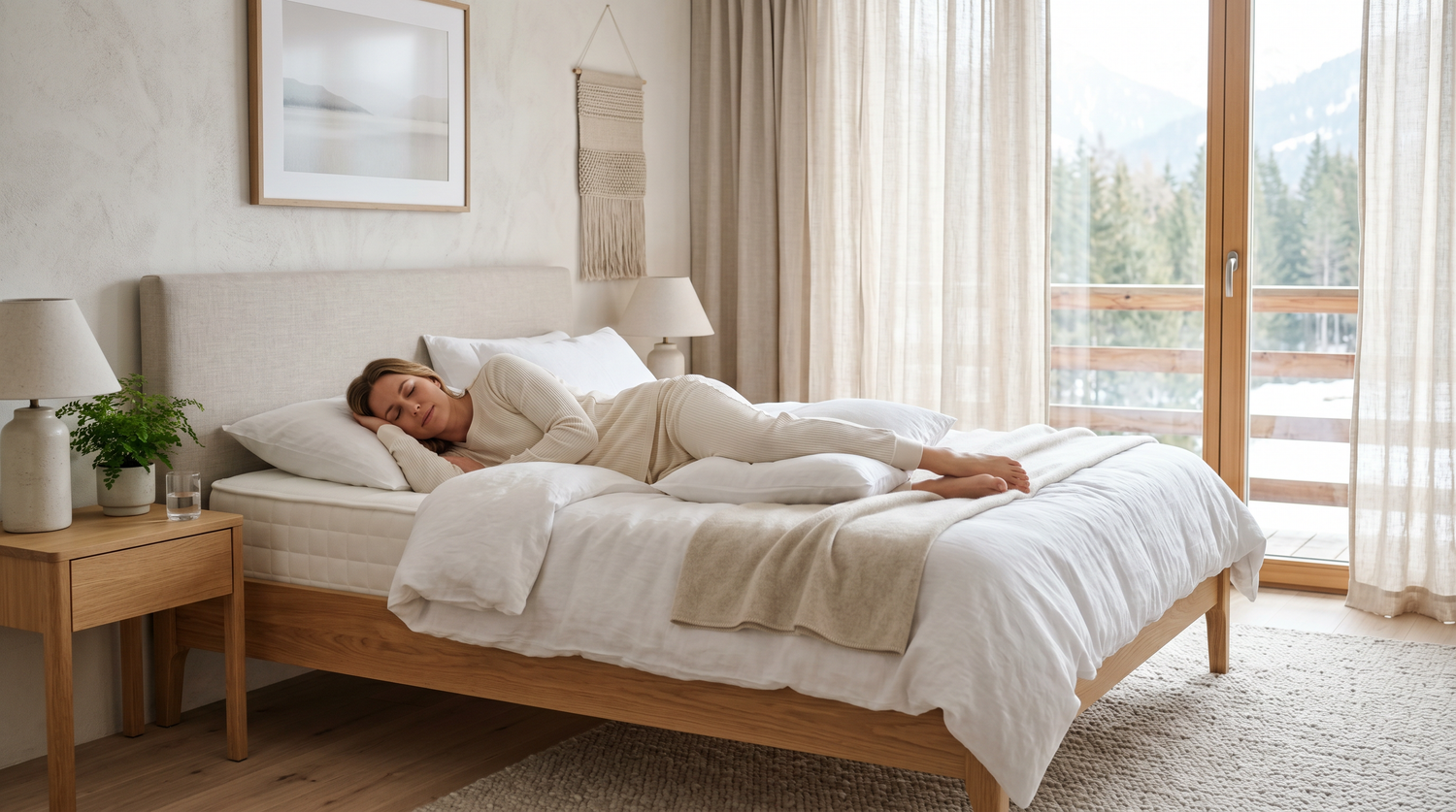
If you wake up in the morning with a stiff or aching lower back, you often look for the cause in your daily routine – but much is decided during the night. We spend about a third of our lives in bed, and during this time, the spine should regenerate: the intervertebral discs absorb fluid, the muscles relax, and minor misalignments of the day are compensated for. However, if the body lies in an unfavorable position night after night or on a surface that does not conform to the body shape, the opposite happens: the lumbar spine is hyperextended or sags, muscles continue to work instead of relaxing – and pain becomes a permanent companion.
The short answer: For the lower back, lying on your back with slightly elevated knees and on your side with a pillow between your knees are the best sleeping positions. Both maintain the spine's natural double-S shape. The prone position is the least favorable for back pain because it exacerbates lordosis. Just as important as the position is a mattress that allows the shoulders and pelvis to sink in and supports the lumbar zone – regardless of weight and sleeping position.
- Sleeping on your back with slightly bent knees and on your side with a knee pillow relieve the lumbar spine most reliably.
- The prone position exacerbates lordosis and twists the cervical spine – avoid it if possible with back pain, or mitigate it with a flat pillow under the pelvis.
- Pillows are your most important aid: placed under the knees, between the knees, or under the stomach, they immediately correct your sleeping position.
- The best position is of little use on the wrong surface: an adaptive mattress that automatically adjusts to your body and sleeping position is the basis for a relaxed back.
Why your lower back hurts at night
The lumbar spine bears the main load of the upper body during the day. At night, it should recover – provided it lies in its natural form. This is precisely where the problem lies for many sleepers: If the pelvis sinks too deeply, the body's center sags; if the mattress is too firm, a hollow space remains between the lumbar spine and the surface, which the back muscles bridge all night long. Both lead to tension, which manifests as dull lower back pain or stiffness in the morning and usually improves after the first few steps – a typical sign that the cause lies in the bed.
Added to this is the sleeping position itself. Each posture changes the pressure distribution along the spine – and not every position is suitable for a sensitive lower back. The direct comparison shows how strong the influence is.
Comparing sleeping positions
| Position | Effect on the lower back | Recommendation |
|---|---|---|
| Supine position | Weight is distributed over a large area, the spine is neutral. A pillow under the knees additionally relieves tension from the lumbar region. | Very well suited |
| Side sleeping | Relieves the lumbar spine if the shoulder and pelvis sink in sufficiently. A pillow between the knees prevents the pelvis from twisting. | Very well suited |
| Fetal position | Slightly bent legs open the intervertebral spaces – often pleasant for sciatica. However, being rolled up too tightly can impair breathing and neck posture. | Well suited (moderately rolled up) |
| Prone position | Exacerbates lordosis, the head is turned to the side for hours. Most frequent cause of morning lower back and neck pain. | Avoid if possible |
Supine position: the neutral king's position
In the supine position, body weight is distributed over the largest area, and no single vertebral section is subjected to pinpoint pressure. Those who wake up with back pain should place a flat pillow or rolled blanket under their knees: The slight hip flexion tilts the pelvis minimally backward and relieves the lumbar spine of hyperextension. A rather flat pillow is important so that the cervical spine remains in alignment with the thoracic spine – more on this in the Pillow Guide.

Side sleeping: the favorite – with a simple trick
Side sleeping is the most common sleeping position and excellent for the lower back – if two conditions are met. First: the shoulder and pelvis must be able to sink deeply enough into the mattress so that the spine forms a straight line when viewed from the side. Second: a pillow between the knees prevents the upper leg from tilting forward and twisting the pelvis – and thus the lumbar spine. This simple trick makes the difference between a stiff and a restful night for many sufferers. Detailed tips can be found in our guide Mattress for side sleepers.
Prone position: the problem case
In the prone position, the pelvis presses into the mattress, the lumbar spine goes into lordosis, and the head is turned to the side for hours. If you cannot fall asleep otherwise, you should at least use a very flat or no pillow and place a thin pillow under your stomach and pelvis – this significantly reduces hyperextension. In the long term, it is worthwhile to gently switch to side sleeping, for example with a body pillow placed on the side as a "fall-over brake." More on this in the article Mattress for back and stomach sleepers.
The foundation matters: mattress and pillow
The best sleeping position is of little use if the mattress doesn't cooperate. In the past, it was recommended to choose a specific firmness level for back pain – a concept now considered outdated: firmness levels are not standardized, each manufacturer defines them differently, and a rigid firmness level cannot simultaneously offer flexibility to the shoulder and support to the lumbar zone. Instead, the adaptability of the material is crucial: modern adaptive foams like the EvoPoreHRC Premium memory foam react point-elastic to pressure – they allow the shoulder and pelvis to sink in while supporting the body's center, automatically and in any sleeping position. Why the classic firmness level thinking is obsolete can be read in the article Mattress firmness levels; an overview of the connection between mattress and back pain is provided in the guide Mattress for back pain.

The pillow is also part of the equation: if it's too high or too flat, the cervical spine bends – and tension travels down the spine. Side sleepers need a higher pillow, back sleepers a flatter one. And if you often toss and turn despite a good position, you should also consider your sleeping environment: Consistent sleep hygiene and the right sleeping temperature help the body find its way into muscle-relaxing deep sleep phases.
Gently getting up: the first minutes of the morning
For acute back pain, a conscious start to the day is worthwhile: First, turn onto your side, bend your legs, and push yourself up sideways with your arms while swinging your legs out of bed – this keeps the spine stable instead of being abruptly straightened. A few minutes of gentle mobilization – pelvic tilts, bringing knees to chest, cat-cow stretches – get the intervertebral discs moving. If the pain radiates into your leg, you'll find more in-depth information in the article Mattress for sciatica and disc problems.
Get a CHF 25 discount
Subscribe to our newsletter and receive a one-time CHF 25 discount. ✓ 200 nights trial sleep ✓ 10-year warranty
Thanks to EvoPoreHRC Premium memory foam, the Ora Ultra mattress automatically adapts to your body and sleeping position – without any guesswork about firmness. Shoulder and pelvis sink in, while the lumbar zone remains supported: ideal for side and back sleepers. Is your mattress still good but too firm? The Ora Ultra topper adds adaptability. And with the Ora Ultra Second Life, you sleep just as ergonomically – sustainably reconditioned and more affordable.
Frequently asked questions about back pain and sleeping position
Which sleeping position is best for lower back pain?
The most suitable positions are sleeping on your back with a pillow under your knees and on your side with a pillow between your knees. Both positions keep the spine in its natural shape and relieve the lumbar region. The prone position should be avoided as much as possible if you have back pain.
Why do I have back pain in the morning that disappears during the day?
If the pain improves shortly after getting up, it strongly suggests a nocturnal cause: an unfavorable sleeping position, a worn-out or unsuitable mattress, or the wrong pillow. If the symptoms persist throughout the day or radiate into the leg, medical advice should be sought.
Does a pillow between the knees really help with back pain?
Yes. In the side-lying position, a pillow between the knees prevents the upper leg from tilting forward and twisting the pelvis. This keeps the lumbar spine in a neutral line – one of the simplest and most effective immediate measures for nocturnal back pain.
Should the mattress be firm or soft for back pain?
Neither – adaptability is crucial. A mattress that is too firm doesn't allow the shoulder and pelvis to sink in, while one that is too soft causes the body's center to sag. Adaptive materials like premium memory foam automatically adjust to body shape and sleeping position and support the lumbar zone in any position.
What's the best way to get up with acute back pain?
Via the side position: Bend your legs, push yourself up sideways with your arms, and swing your legs out of bed at the same time. This keeps the spine stable and prevents sudden strain.
This article is for general information only and does not replace medical advice.







Leave a comment
This site is protected by hCaptcha and the hCaptcha Privacy Policy and Terms of Service apply.