
You only buy a mattress about every 8 to 10 years – so it's understandable that there's a lot of uncertainty when the time comes. The market is confusing: dozens of materials, marketing terms like firmness levels or lying zones, and price ranges from 200 to over 3000 Swiss francs don't make the decision any easier. Yet you spend about a third of your life on this one purchase, and poor sleep directly affects concentration, mood, and health. A structured mattress buying checklist helps you keep track and separate truly relevant criteria from mere sales pitches. In this guide, we'll go through all the points that should be clarified before buying, step by step. At the end, you'll find a compact table to check off.
The short answer: When buying a mattress, six points matter: the right size (at least 20 cm longer than your height), a high-quality, adaptable material, ergonomic support for the spine and shoulders, a removable, washable cover, a genuine trial sleep offer of at least 100 nights, and a 10-year warranty. If you follow this checklist, you are highly likely to make a good decision – regardless of the price.
- The mattress should be at least 20 cm longer than your height and at least 90 cm wide per person.
- Material and workmanship determine the lifespan: high-quality foam lasts 8 to 10 years, cheap goods often only 3 to 5.
- Firmness levels are not standardized – what's more important is whether the mattress adapts to your body and sleeping position.
- A removable cover, washable at 60 °C, is essential for hygiene and allergy sufferers.
- Trial sleeping at home (at least 100 nights) is more meaningful than any trial lying in a store.
Step 1: Clarify your needs – who sleeps how?
Before comparing models, you should know your own starting point. Note down: height and weight of all people sleeping on the mattress, preferred sleeping position (side, back, stomach, or changing), and existing complaints such as back, neck, or shoulder pain. Around 60 percent of people are predominantly side sleepers, but almost everyone changes position 20 to 60 times a night – so a good mattress must support all positions, not just one. The sleeping climate is also relevant: those who sweat a lot need a breathable, open-pored material. Couples should also pay attention to motion isolation so that a partner turning over doesn't wake them up – more on this in the guide Mattress for Couples. If you write down these points, you can specifically measure each offer against them, instead of being swayed by discount promotions.
Step 2: The right size and height
The rule of thumb for length: body height plus at least 20 cm. If you are 175 cm tall, 200 cm length is good; from about 185 cm, it's worth looking at 210 or 220 cm. For width, 90 to 100 cm per person is considered a minimum, for restless sleepers rather 120 cm. For couples, this means: 160 cm is the minimum, 180 cm significantly more comfortable. In Switzerland, 90×200, 140×200, 160×200 and 180×200 cm are the most common formats. Height also matters: mattresses under 18 cm total height usually offer too little support reserve for heavier people; 20 to 25 cm is a good guideline. Also check whether the mattress fits your existing bed frame and slatted base – you can find tips on this in the article Choosing a Bed Frame. A too-small frame or a sagging slatted base can hinder even the best mattress.
Step 3: Understand material and construction
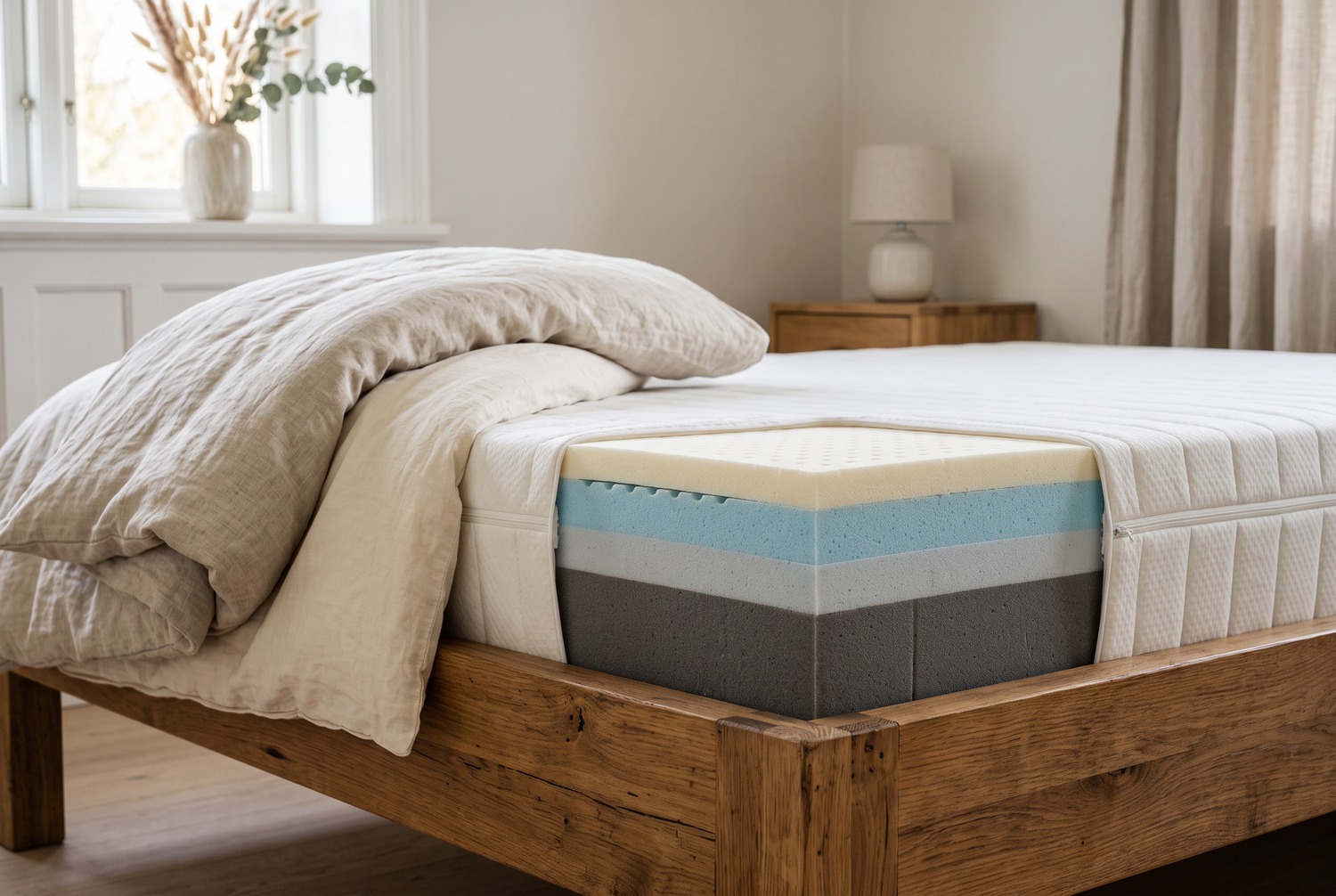
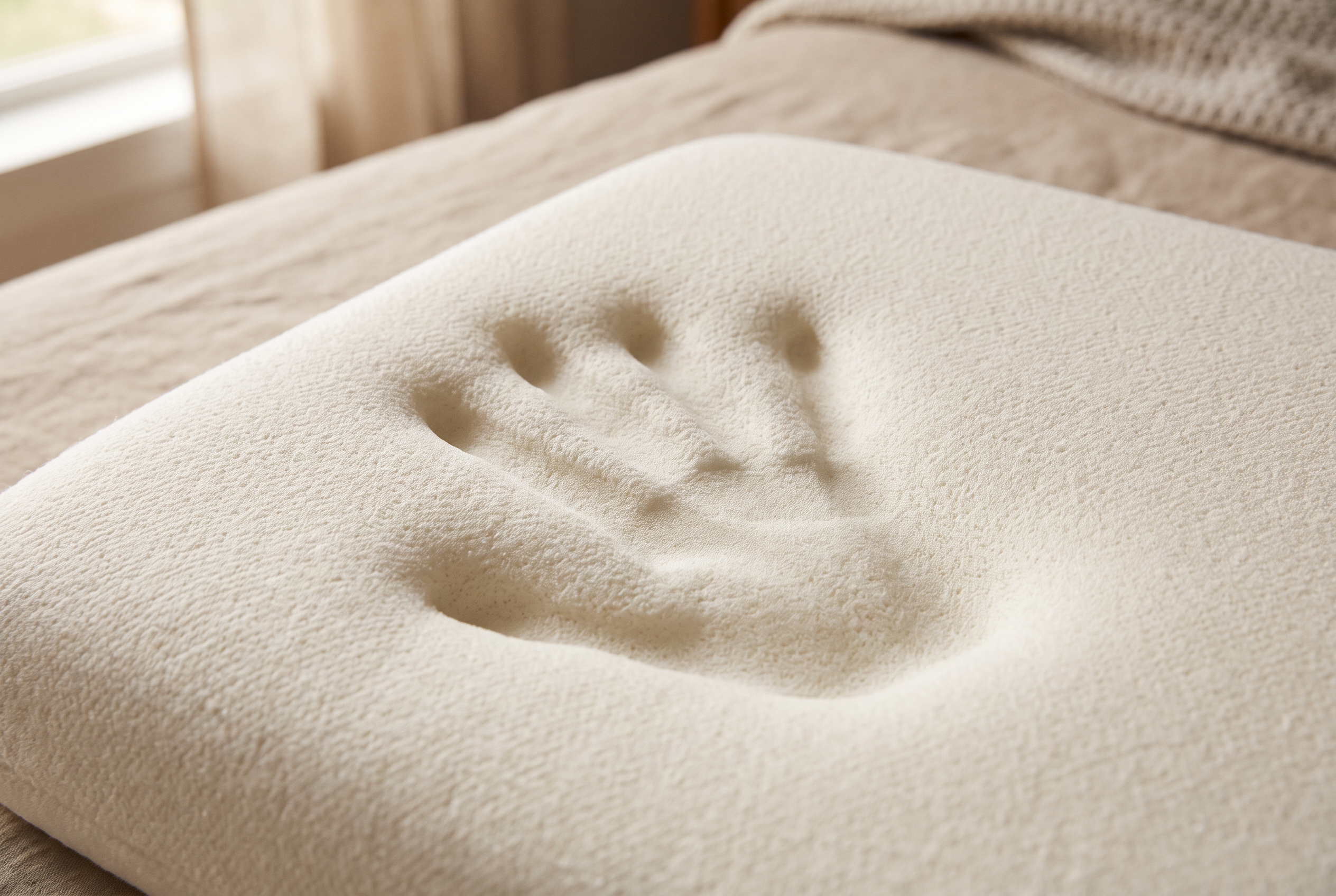
Cold foam, innerspring, latex, memory foam – each material has its own feel. Innerspring is cool and bouncy, latex is heavy and point-elastic, classic memory foam reacts slowly and is temperature-dependent. Modern adaptive premium foams like EvoPoreHRC combine the advantages: high point elasticity, quick recovery, and good ventilation. For foam, pay attention to the density (RG): values from RG 40 are considered durable, below RG 30 you can expect premature sagging. A detailed overview can be found in the Mattress Type Comparison. The layered construction is also important: a stable base layer of at least 10 cm provides support, while comfort layers above it provide pressure relief. Certificates like OEKO-TEX Standard 100 ensure that no questionable harmful substances are present – a point that should not be missing from any checklist.
Step 4: Check lying feel and ergonomics
The central ergonomic criterion: when lying on your side, the spine should form a straight line; when lying on your back, it should maintain its natural double-S shape. The shoulders and pelvis must be able to sink in a few centimeters, while the waist remains supported. Many buyers orient themselves by the firmness level – but H1 to H5 are manufacturer-specific and not standardized: an H3 from one brand corresponds to an H4 from another. The article Why Firmness Levels Are Obsolete explains why this concept is outdated. More meaningful is the question of whether the material adaptively conforms to different body shapes and positions. A simple test at home: lie on your side and have a second person check if your spine is horizontal. If your hips sag, the mattress is too soft; if your shoulder is pushed up, it's too firm.
Step 5: Cover, hygiene, and care
The cover is often overlooked, but it's used daily. Ideal is a removable cover with an all-around zipper that can be washed at 60 °C – this temperature reliably kills dust mites. For allergy sufferers, this is a crucial criterion. Also check the weight of the mattress: models over 30 kg are difficult to turn or cover alone. Climate fibers and breathable materials in the cover significantly improve the sleeping climate; incidentally, the ideal room temperature for sleeping is 16 to 19 °C, as shown in the guide to the ideal sleeping temperature. Also plan for a mattress protector or waterproof cover if children or pets share the bed. A well-maintained mattress lasts an average of 2 to 3 years longer than a neglected one.
Step 6: Trial sleep, warranty, and returns
Ten minutes of lying in a store reveals little: the body needs 2 to 4 weeks to get used to a new surface. Therefore, a trial sleep offer at home is the most important purchase criterion of all. Reputable providers grant at least 100 nights, good ones 200 – with free returns and full refunds. Read the fine print: Are there return shipping costs? Are there deductions? How does pickup work? Details can be found in the article Buying a Mattress Online with Trial Sleep. For the warranty, 10 years on core material and dimensional stability is a strong signal for material quality – shorter periods often indicate cheaper foams. Pay attention to what the warranty specifically covers: sagging of 2 cm or more should be included.
Common mistakes when buying a mattress
Mistake number one: deciding solely on price. Neither the cheapest nor the most expensive model is rarely the best choice – what matters is the relationship between material, workmanship, and services, as shown in the guide What does a good mattress cost? Mistake two: relying on the firmness level instead of actually testing the feel. Mistake three: ignoring old bedding – a 15-year-old slatted base with worn-out slats makes any new mattress worse. Mistake four: for couples, choosing two separate firmness levels, even though an adaptive mattress would suit both and avoid the annoying "visitor's gap". Mistake five: blindly trusting test seals without reading the test criteria. And mistake six: not allowing the mattress to settle after purchase – the first few nights almost always feel unusual, which is normal and not a reason for complaint.

The complete mattress buying checklist at a glance
The following table summarizes all the checkpoints. Print it out or save it on your phone – this way, you'll have all the criteria in view when comparing different offers and won't be distracted by individual marketing promises.
| Criterion | Recommendation | Warning Sign |
|---|---|---|
| Length | Body height + 20 cm | Feet or head at the edge |
| Width per person | min. 90–100 cm | under 80 cm |
| Height | 20–25 cm | under 18 cm |
| Foam density | from RG 40 | under RG 30 |
| Cover | removable, washable at 60 °C | fixedly sewn |
| Trial sleep | 100–200 nights free | only trial lying in store |
| Warranty | 10 years | 2 years or less |
| Harmful substances | OEKO-TEX certified | no certificates |
Get CHF 25 discount
Subscribe to newsletter and receive a one-time CHF 25 discount. ✓ 200 nights trial sleep ✓ 10 years warranty
How to apply the checklist specifically
A practical approach in four stages: First, create your sleeper profile (step 1) and determine size and budget. Second, select three to five models that meet all the table criteria – consistently filter out anything that doesn't pass, no matter how big the discount. Third, order the most convincing model with a trial sleep guarantee and test it for at least 30 nights before judging; note in the first and fourth week how you wake up. Fourth, only then make a final decision. This approach takes a little longer than an impulse buy, but drastically reduces the risk of a bad investment. And if the first choice doesn't fit: A reputable return policy makes switching uncomplicated – that's exactly what it's for.

Frequently asked questions about the mattress buying checklist
How long should I test a new mattress?
At least 30 nights, preferably more. The body needs 2 to 4 weeks to get used to a new surface. A judgment after a few nights is almost always premature.
What mattress size is right for one person?
At least 90 to 100 cm wide and body height plus 20 cm long. Restless sleepers benefit from 120 cm width. For most adults, 90×200 cm or 100×200 cm is suitable.
Is a high price a sign of quality?
Only to a limited extent. Price alone says little – what matters are density, workmanship, cover quality, trial sleep offer, and warranty. There are overpriced weak models as well as fairly priced top products.
How important is firmness when buying?
Less important than often claimed. Firmness levels are not standardized and vary from manufacturer to manufacturer. More important is whether the mattress adaptively conforms to the body and sleeping position and keeps the spine straight.
What does density mean for foam mattresses?
Density (RG) indicates how many kilograms of raw material per cubic meter of foam were used. From RG 40, a foam is considered durable and dimensionally stable; below RG 30, premature sagging is a risk.
Do I also need a new slatted base for a new mattress?
Not necessarily, but check it: if it's older than 10 years, has broken or worn-out slats, it should be replaced. A defective slatted base impairs the effect of even the best mattress.









Leave a comment
This site is protected by hCaptcha and the hCaptcha Privacy Policy and Terms of Service apply.