
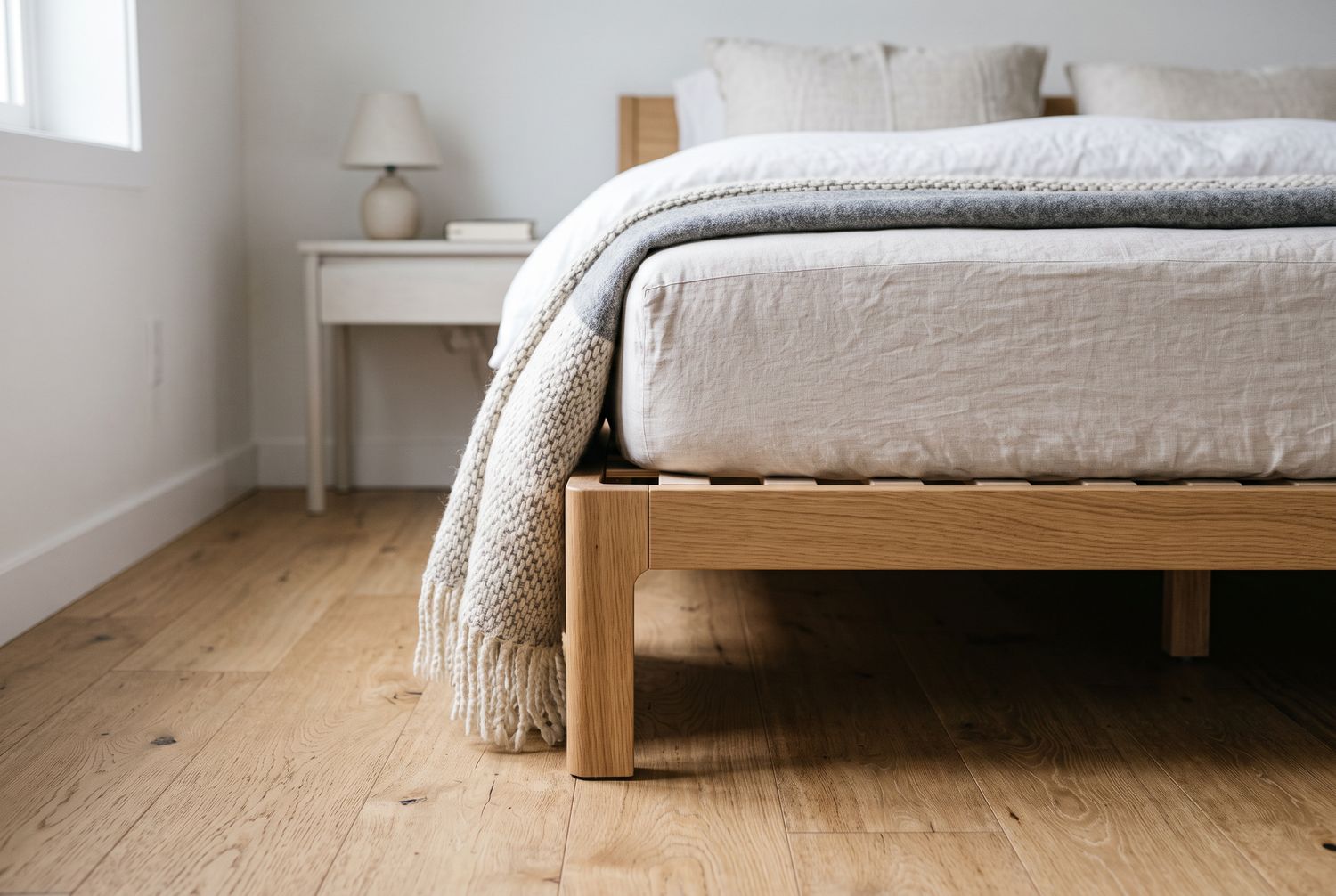
Bed height is one of the dimensions least considered when buying a bed – and one of the most noticeable in everyday life. A bed that is too low forces you into a deep squat every morning; one that is too high leaves your feet dangling when you sit on it and makes changing the sheets a climbing exercise. Because the height is composed of three components – frame, slatted frame, mattress – it often doesn't match what was in the catalogue. And because the body changes over the years, the right height at 30 is different from that at 70. This guide shows you how to determine your personal ideal height in two minutes, which values apply to whom, and how to easily make an existing bed higher or lower.
The short answer: The ideal bed height corresponds to your sitting height: When you sit on the edge of the bed, your feet should be flat on the floor, and your knees and hips should form an approximate 90-degree angle. For most adults, this means 45 to 55 cm to the top edge of the mattress. Those taller than 185 cm often fare better with 55 to 65 cm; seniors and people with knee or hip problems prefer the upper half of this range. Important: Measurements are always taken to the top edge of the mattress in a loaded state, not to the frame.
- Standard range: 45–55 cm to the top edge of the mattress – the entire package is measured, not just the frame.
- Test criterion: Sitting on the edge, feet flat on the floor, knees and hips at about 90 degrees.
- Comfort beds for seniors are 55–65 cm, children's beds are 25–40 cm.
- Mattress and slatted frame together account for 25–35 cm – the frame is usually the smaller part.
- Too low can be corrected with bed legs or risers, too high usually only with a thinner mattress.
How to determine your personal ideal height
The simplest and most reliable test takes two minutes. Sit on a chair whose seat height you find comfortable – typically a dining chair with 45 to 48 cm. Place your feet flat on the floor. Your lower legs should be vertical, your knees and hips should each form a right angle, and your thighs should be roughly horizontal. Now measure the distance from the floor to the seat. This value is your ideal bed height to the top edge of the mattress. As a rule of thumb, the height of your popliteal fossa (back of the knee) also works: Measure from the floor to the back of your knee while standing and add 2 to 4 cm, as the mattress will sink under your weight. An important point for accuracy: Measure while sitting with the mattress loaded, not at the unloaded edge. With a soft foam core, there can quickly be a difference of 3 to 5 cm between these two values. And if you sleep with a partner and there's a significant height difference, orient yourself to the person who has more difficulty getting up – they will benefit more from the compromise.

Guidelines by life situation
The following table summarizes the usual ranges. They are guidelines, not laws – the sitting test trumps any table.
| Group of people | Recommended height | Reason |
|---|---|---|
| Toddlers (2–6 years) | 25–35 cm | low fall height, independent getting in and out |
| Children and adolescents | 35–45 cm | grows with them, consider sitting height |
| Adults up to 175 cm | 45–50 cm | standard range, corresponds to chair seat height |
| Adults 175–185 cm | 50–55 cm | longer lower legs |
| Adults over 185 cm | 55–65 cm | otherwise too low sitting position |
| Seniors, knee/hip problems | 55–65 cm (comfort bed) | less effort when getting up |
For beds for older people, the term comfort or senior bed has become established; it simply means an entry height of about 55 cm or more. Further aspects can be found under Sleep in old age.
What makes up the total height
The most common planning error: reading the frame height in the catalogue and thinking that's the bed height. In reality, it consists of three parts. The frame – i.e., the construction up to the support surface for the slatted frame – is usually 15 to 35 cm. The slatted frame varies in height depending on the type: a simple roll-up slatted frame 3 to 5 cm, a sprung slatted frame 6 to 8 cm, a motor frame 8 to 12 cm. The mattress contributes 16 to 26 cm, a topper another 4 to 8 cm. Let's calculate an example: 20 cm frame plus 7 cm sprung slatted frame plus 22 cm mattress results in 49 cm – exactly in the target range. If you replace the frame with a motor frame of 10 cm, it's already 52 cm; if you add a 6 cm topper, you end up at 58 cm. Therefore, always plan from top to bottom. First, determine the desired total height, then subtract the mattress, topper, and slatted frame – what remains is the maximum frame height. Details on choosing the bed frame can be found under Choosing the right bed frame, and on motor frames under Electric slatted frame.
What an incorrect bed height means in everyday life
A bed that is too low means that you have to get up from a deep position. The effort required in the thighs and hip flexors increases significantly, and anyone with knee or back sensitivity feels this every morning. Sitting is also uncomfortable: if the seat is too low, the knees are higher than the hips, the pelvis tilts backward, and the lumbar spine rounds – in the long run, not a good posture for the evening book. A bed that is too high presents other problems: feet dangle when sitting, pressure on the underside of the thighs increases, and making the bed becomes a stretching exercise. For very high beds over 70 cm, the fall height is also a safety issue, especially for children, during pregnancy, and for people prone to dizziness. An often overlooked side effect: the bed height influences how easily you can vacuum under the bed. Below 15 cm of clearance, hardly any vacuum cleaner attachment fits – which is relevant for allergy sufferers, as explained in Allergy-friendly bedroom.

Practice: Making the bed higher or lower
Making the bed higher
The simplest solution is retrofittable bed legs: they are available in heights of 5 to 20 cm for 30 to 120 Swiss francs, mostly with standard M8 or M10 threads. Check beforehand whether your frame even has screw-on legs. Bed risers – plastic or wooden blocks into which the existing legs are placed – cost 20 to 60 Swiss francs per set and add 5 to 12 cm. Pay attention to the load capacity specification and non-slip undersides. The third option is the mattress or topper: 4 to 8 cm of additional height without any modifications, while also providing more pressure relief. Improvisations with books, bricks, or wood scraps placed underneath are not recommended – they can tip over and warp the frame.
Making the bed lower
Here, the options are more limited. The most effective is a thinner mattress: switching from 26 to 18 cm saves 8 cm. A thinner slatted frame – a roll-up slatted frame instead of a sprung slatted frame – saves 3 to 5 cm, but at the expense of suspension and comfort. With some beds, the legs can be shortened or unscrewed; check whether there is still enough ground clearance for ventilation – at least 5 cm should remain. And finally: some frames have multiple support positions for the slatted frame. It's worth checking the assembly instructions before making modifications.
Get CHF 25 discount
Subscribe to the newsletter and receive a one-time CHF 25 discount. ✓ 200 nights trial sleep ✓ 10 years warranty
Frequently asked questions about bed height
How high should a bed ideally be?
For most adults, the ideal bed height is 45 to 55 centimeters to the top edge of the mattress. The best test: When sitting on the edge of the bed, your feet should be flat on the floor and your knees and hips should form an approximate right angle.
Is the bed height measured with or without a mattress?
Always with the mattress, because only the top edge of the sleeping surface is relevant in everyday life. Ideally, measure when the mattress is loaded, i.e., while you are sitting on the edge – there can easily be a difference of 3 to 5 centimeters between a loaded and unloaded soft core mattress.
What bed height is suitable for seniors?
55 to 65 centimeters are recommended, often referred to as a comfort or senior bed. At this height, the effort required to get up is significantly less, as you don't have to push yourself up from a deep position. The same applies to people with knee or hip problems, regardless of age.
How can I raise a bed that is too low?
The easiest way is with retrofittable bed legs with standard threads, with wooden or plastic bed risers, or with a topper that adds 4 to 8 centimeters. Improvised solutions with books or bricks are not recommended – they can easily tip over and warp the frame.
How much height do the slatted frame and mattress add?
A roll-up slatted frame adds 3 to 5 centimeters, a sprung slatted frame 6 to 8, and a motor frame 8 to 12 centimeters. The mattress contributes 16 to 26 centimeters, and a topper another 4 to 8. Together, this often amounts to 25 to 35 centimeters – the frame is usually the smaller part.
What is the correct bed height for children?
For toddlers between two and six years old, 25 to 35 centimeters is sensible so they can get in and out independently and the fall height remains low. For older children and adolescents, aim for 35 to 45 centimeters, based on their sitting height.








Leave a comment
This site is protected by hCaptcha and the hCaptcha Privacy Policy and Terms of Service apply.