
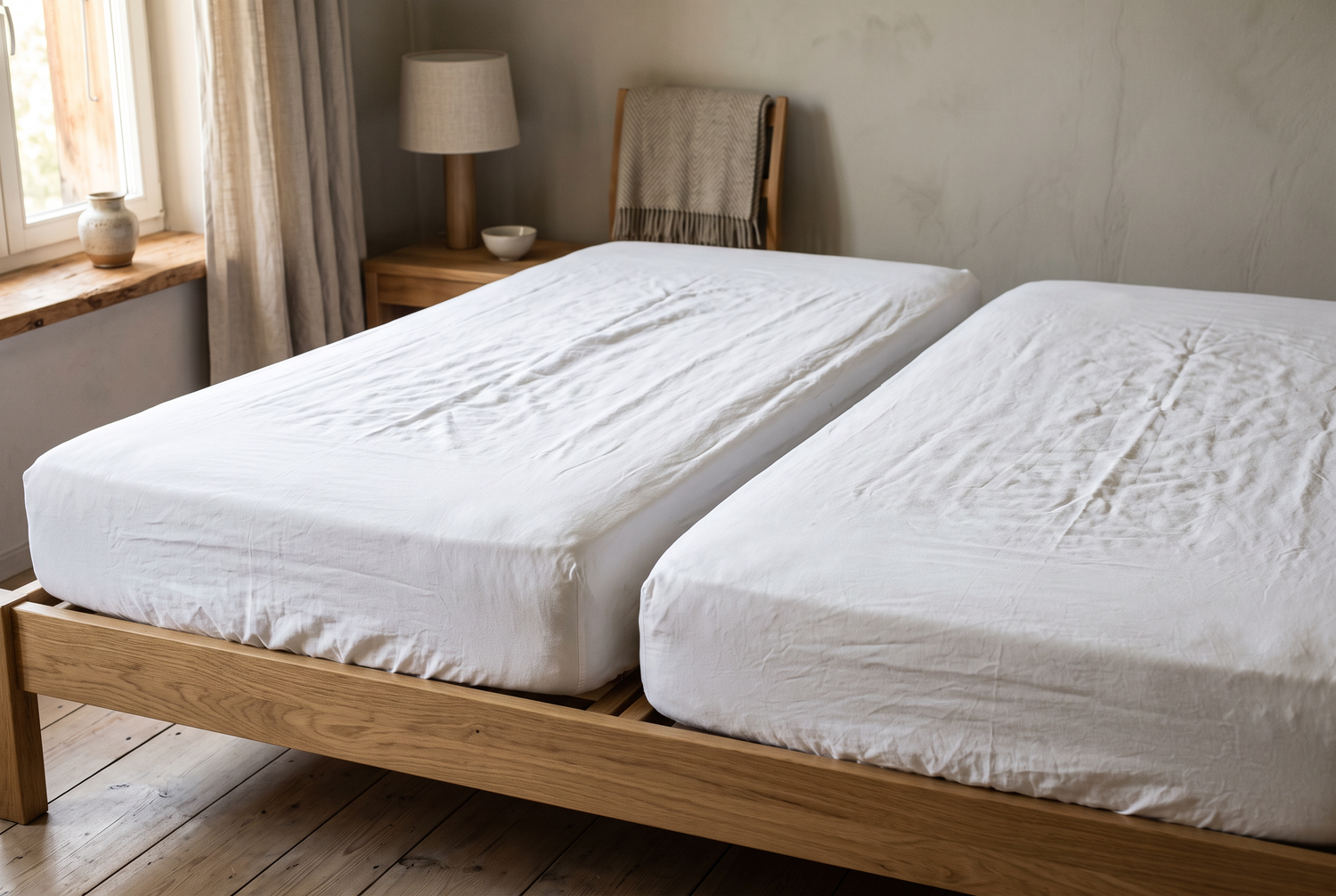
Anyone setting up a double bed will sooner or later face the same question: a continuous mattress measuring 160 × 200 cm or 180 × 200 cm – or two separate mattresses, each 80 × 200 cm or 90 × 200 cm? At first glance, this seems like a matter of taste. In reality, very practical things depend on it: how much you feel your partner's movements, how easily the mattress can be turned and aired, whether an annoying gap forms in the middle, and how much you ultimately pay. In Switzerland, the division into two is particularly common because many beds are supplied with two slatted frames anyway. However, this does not automatically mean that two mattresses are the better choice. This guide objectively classifies both variants and shows what really matters in everyday life.
The short answer: For most couples, a continuous mattress in a double bed is the more comfortable solution because it doesn't create a gap in the middle and offers an uninterrupted sleeping surface. Two separate mattresses are mainly worthwhile if there is a very large weight difference, an adjustable slatted frame is involved, or the bed needs to be transported through narrow staircases. If you choose a modern, point-elastic mattress, motion transfer is hardly an issue with the larger version. Ultimately, it's less about the number of mattresses and more about the quality of the material.
- A continuous mattress (160 × 200 cm or 180 × 200 cm) prevents the "visitor's gap" and looks more generous.
- Two mattresses of 80 × 200 cm or 90 × 200 cm are easier to transport, turn, and replace individually.
- Modern point-elastic foams dampen movements so well that the classic separation is hardly necessary for this purpose anymore.
- With two separate mattresses, you need two fitted sheets or an oversized sheet plus a gap filler.
- Two single mattresses usually cost slightly more than one large one – and together don't always result in the exact desired size.
Why the question "one or two mattresses" arises at all
Historically, the division into two was a technical necessity. Classic spring mattresses widely transfer movements: if one person turns, the entire surface oscillates. Two separate cores mechanically interrupted this transfer. At the same time, mattresses used to be significantly heavier and could hardly be maneuvered through narrow Swiss old-building staircases in large formats. A 180 × 200 cm mattress weighs between 30 and 45 kg depending on its construction, while two individual parts each weigh 15 to 22 kg – a noticeable difference if you turn it alone.
There's also the aspect of individual adjustment. As long as mattresses were sold in firmness levels, each person theoretically needed their own. Exactly this concept is now outdated: firmness levels are not standardized, each manufacturer defines them differently, and the body reacts not to a label but to the actual sink-in behavior of the material. Modern adaptive foams adapt within a single mattress to bodies of different weights and changing sleeping positions. This eliminates one of the strongest historical arguments for the two-part system. You can read more about this in our article on mattress firmness levels.
The continuous mattress: advantages in everyday life
The biggest advantage of a continuous mattress is trivial yet crucial: there's no gap. Anyone who slides towards the middle at night won't end up in a hollow but on an even surface. Especially couples who sleep close to each other or move a lot find this much more comfortable. Making the bed also becomes easier: one fitted sheet instead of two, one mattress protector instead of two.
Visually, a large sleeping surface also appears calmer and more high-quality. In small bedrooms, where the bed is the dominant piece of furniture, this definitely makes a difference. Also practically relevant is the even load distribution: with two mattresses, each is only loaded on one half, which puts more strain on the outer edges. A continuous mattress distributes this somewhat more favorably, provided you turn it regularly – for details, see turning or flipping a mattress.
The weight remains a disadvantage. Anyone who wants to turn a 180 × 200 cm mattress alone on the third floor without a lift needs strength and space. Realistically, plan for two people or choose a model that does not need to be turned.

Two separate mattresses: when they make sense
There are clear situations where the divided variant is superior. First, transport: if the staircase is narrow, the spiral staircase steep, or the lift small, two 80 × 200 cm or 90 × 200 cm parts are often the only realistic option. Second, adjustable slatted frames. If both people want to adjust the head and foot sections independently with a motor, you absolutely need two mattresses – a continuous one would get twisted when lifted. You can find details on this under adjustable slatted frame.
Third, replaceability. If one person is significantly heavier and that half of the mattress wears out faster, only that one side can be replaced with the divided variant. This can save money over ten years. Fourth, hygiene: two smaller mattresses are easier to stand upright against the wall and air from below – relevant in bedrooms with high humidity or on closed bed bases.
Fifth, separate sleeping needs. If one person sweats a lot and needs a particularly breathable model, while the other gets cold, different constructions can be combined with two mattresses. In practice, however, this case is rarer than thought, because the sleeping climate depends much more on the duvet, bedding, and room temperature than on the mattress itself.
Motion transfer: the often overestimated factor
The most common argument for two mattresses is: "Otherwise I'll feel every movement." That's true – but only with certain materials. Spring core and especially Bonnell spring core widely transfer movements because the springs are connected or at least coupled via a common upholstery layer. With a classic Bonnell spring core mattress 180 cm wide, a partner's turn is indeed noticeable all the way to the other edge of the bed.
Point-elastic foams behave fundamentally differently. They only yield where pressure is applied and hardly transmit deformation sideways. In practice, this means that on a good memory foam mattress, you usually don't even notice a turn 50 cm away. So, if you're primarily considering two mattresses because of motion transfer, you should first check which material is suitable. Often, the problem solves itself this way. Further background information in the comparison of mattress types.
The gap in the middle – and how to get rid of it
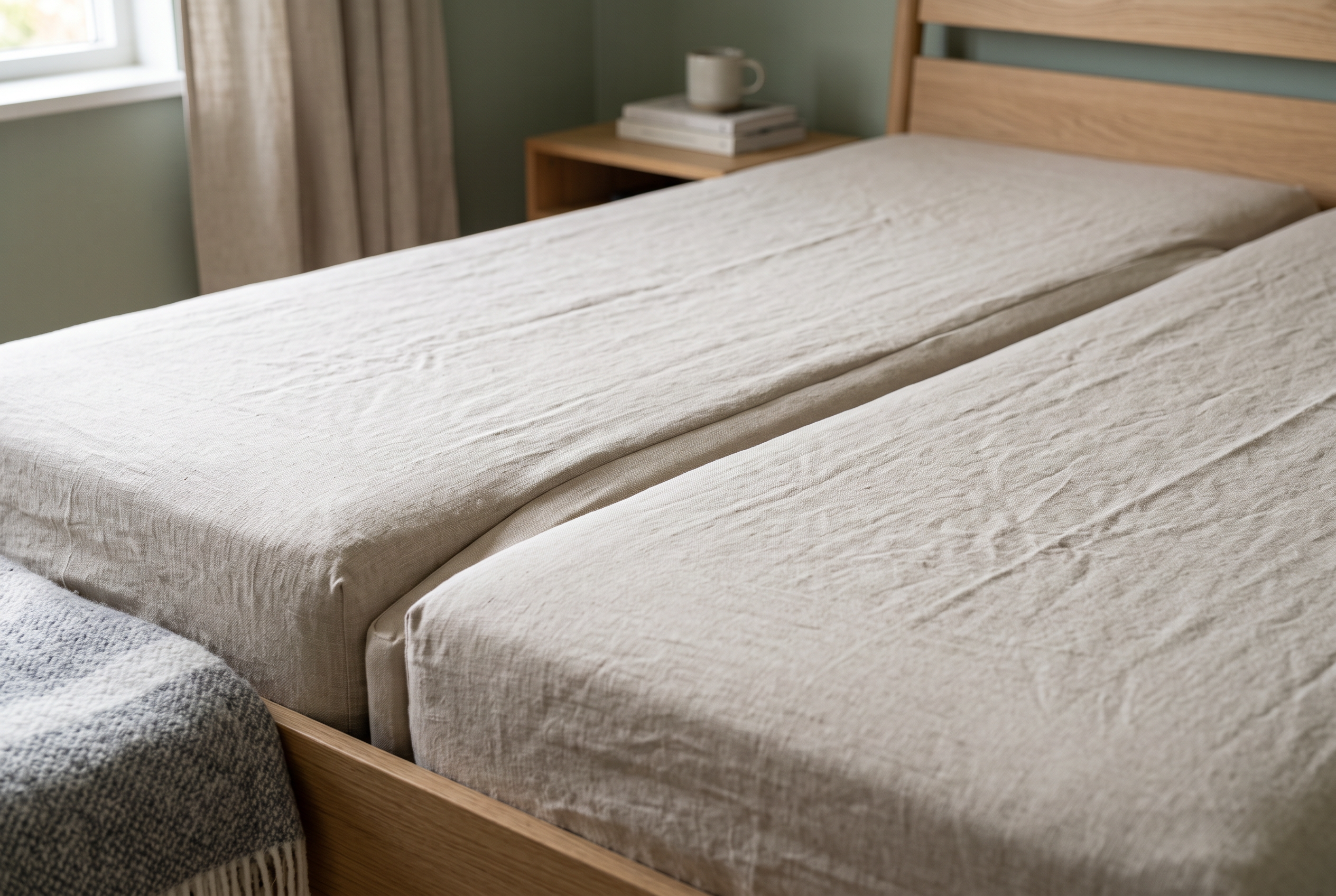
Those who opt for two mattresses get the so-called "visitor's gap" for free. It doesn't bother everyone, but once someone finds it bothersome, they rarely get used to it. There are three proven solutions. First, a gap filler, often called a "love bridge": a wedge-shaped foam strip about 190 cm long that is placed in the gap. Second, a continuous topper over both mattresses – the most elegant option, as it also unifies the sleeping surface. Third, an oversized fitted sheet that pulls both mattresses together.
It is important that the two mattresses are exactly the same height. A height difference of just 2 cm creates a noticeable step that even the best topper cannot completely compensate for. Therefore, buy both mattresses together and from the same series. We show you in detail how to close the gap in the article on mattresses for couples.
Sizes, dimensions, and what fits together
In Switzerland, combinations are largely standardized. Two mattresses of 80 × 200 cm result in 160 × 200 cm, two of 90 × 200 cm result in 180 × 200 cm. The sum is mathematically correct – but in practice, it happens that two cores in the bed frame require slightly more space because the covers protrude slightly at the sides. Therefore, plan for an inner frame with 1 to 2 cm tolerance.
| Criterion | One continuous mattress | Two separate mattresses |
|---|---|---|
| Middle gap | None | Present, requires filler or topper |
| Weight per part | approx. 30–45 kg | approx. 15–22 kg |
| Transport in staircase | Challenging from 160 cm width | Uncomplicated |
| Adjustable slatted frame | Only with synchronous adjustment | Independently per side possible |
| Bed linen | One fitted sheet | Two sheets or one oversized sheet |
| Individually replaceable | No | Yes |
| Price | Usually cheaper per m² | Slightly more expensive, two individual prices |
Common mistakes in the decision
The first mistake is to combine two mattresses of different models or production years. Even if the dimensions are correct, height, sink-in behavior, and aging differ. After two years, one side will be noticeably lower – and your back will react with a slight continuous twist.
The second mistake is to base the decision solely on weight difference. Anyone who believes that a 60 kg person and a 95 kg person absolutely need separate mattresses is still thinking in the old firmness level scheme. A modern adaptive material reacts locally to the respective pressure and supports both bodies differently – on the same surface.
The third mistake concerns the slatted frame. Many people buy a continuous mattress and place it on two separate slatted frames, between which a gap of 3 to 5 cm yawns. The mattress then sags slightly in the middle. Make sure that the slatted frames butt up against each other or that there is a continuous support surface. Basics on this in the guide Slatted frame and mattress.
The fourth mistake: forgetting the bed linen. Two mattresses either require two fitted sheets – in which case the gap remains visible – or an oversized sheet, which is not available everywhere. Plan for this before you order.

How to decide in five steps
Step 1 – Check access. Measure the narrowest bottleneck on the way to the bedroom: staircase width, door frame, lift dimensions. Below 90 cm passage width, an 180 cm wide mattress becomes difficult, unless it's delivered rolled up. Vacuum-packed mattresses almost always bypass this problem.
Step 2 – Define the slatted frame. Are you planning motorized adjustment per side? Then the decision automatically falls on two mattresses. With a rigid slatted frame, you are free.
Step 3 – Choose material. Check if the material has point elasticity. If it does, the movement argument is eliminated. If it's a classic spring core, the divided variant gains weight.
Step 4 – Measure the frame. Note down the inner dimensions of the bed frame to the exact centimeter. With two mattresses, the combined widths should be a maximum of 1 cm less than the inner dimensions to avoid an unnecessary gap.
Step 5 – Order accessories. If you decide on the divided variant, order a gap filler or topper and suitable bed linen at the same time. Retrofitting is more cumbersome than it sounds.
Get CHF 25 discount
Subscribe to the newsletter and get a one-time CHF 25 discount. ✓ 200 nights trial sleep ✓ 10 years warranty
Frequently asked questions about double beds and mattress selection
Is a continuous mattress or are two mattresses better for the back?
For your back, it's not the number of mattresses that counts, but how evenly your spine is supported. A continuous mattress has the advantage that no gap forms in the middle that you can fall into. Two mattresses are unproblematic as long as both are exactly the same height and age. It only becomes problematic if one side sags more than the other.
Which two mattresses make a double bed of 180 × 200 cm?
Two mattresses of 90 × 200 cm combine to make 180 × 200 cm. For a 160 cm wide bed, you would use two mattresses of 80 × 200 cm. Make sure that the internal frame of the bed allows 1 to 2 cm tolerance, as covers can protrude slightly at the sides.
How do I close the gap between two mattresses?
The most effective method is a continuous topper over both mattresses, as it completely covers the gap and simultaneously unifies the sleeping surface. Alternatively, there are wedge-shaped foam gap fillers that are placed in the gap, as well as oversized fitted sheets that pull both mattresses together.
Will I feel my partner's movements on a large mattress?
That depends heavily on the material. Bonnell spring mattresses transmit movements widely and noticeably. Point-elastic memory foams only yield where pressure is applied and transmit little sideways – here, you usually don't even notice a turn 50 cm away.
Do couples with a large weight difference absolutely need two mattresses?
No. That was an argument from the era of firmness levels. Modern adaptive foams react locally to the respective pressure and support bodies of different weights differently on the same surface. Two mattresses are an option in this case, but not a necessity.
Can I place a continuous mattress on two separate slatted frames?
Basically yes, provided the two slatted frames meet flush and are at the same height. If there is a gap of several centimeters between them, the mattress will sag slightly in the middle. However, a continuous mattress is not suitable for independently adjustable slatted frames.





Leave a comment
This site is protected by hCaptcha and the hCaptcha Privacy Policy and Terms of Service apply.