
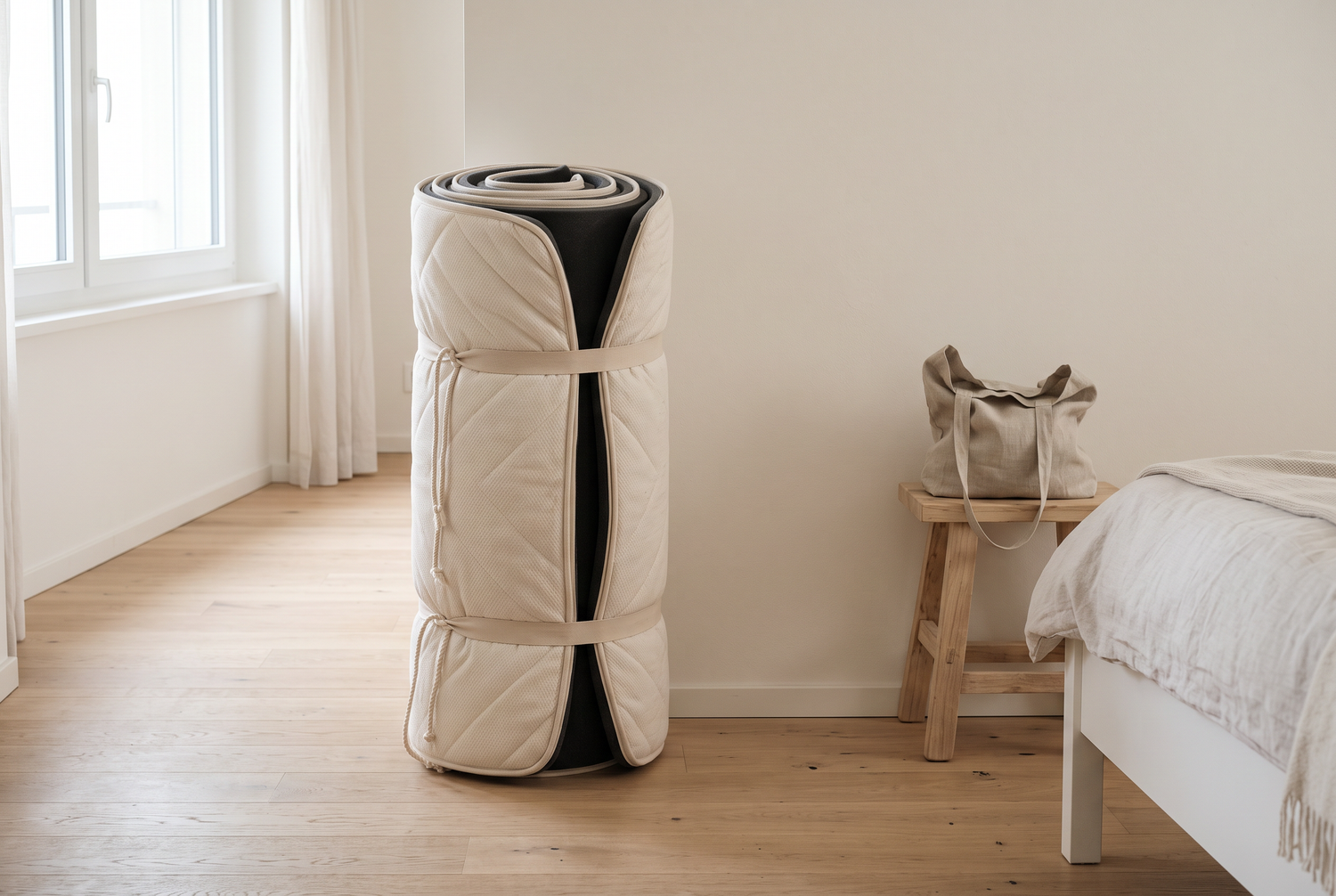
Twenty years ago, buying a mattress was a logistical affair: a delivery van, two movers, and a stairwell where the bulky item barely fit around the corner. Today, a mattress arrives in a box measuring approximately 40 x 40 x 110 centimeters and fits into the trunk of a compact car. This is made possible by roll-packing: the mattress is vacuum-sealed, compressed, and rolled up at the factory. This technique has made online mattress retail practical in the first place. The question that many buyers ask remains: Does the material suffer as a result? And is a rolled mattress therefore automatically of lower quality than a traditionally delivered one? This article answers both questions and shows where the real limits of the technology lie.
The short answer: A rolled mattress refers to a type of packaging, not a quality level. Modern foams tolerate a single compression to about a third of their volume without problems, provided they are designed for this process. After unpacking, most models reach their full height within 24 to 72 hours. However, classic innerspring mattresses with rigid wire frames and many natural latex models cannot be rolled. The decisive factors for quality remain the density, core height, and material composition – not whether the mattress was delivered rolled or flat.
- Rolled mattress = packaging type, not quality class.
- Full height usually reached after 24–72 hours; longer in cold temperatures.
- Transport advantage: fits through narrow stairwells and into standard car trunks.
- Cannot be rolled: classic innersprings with wire frames, many natural latex models.
- After unpacking, air thoroughly for 48–72 hours – the new smell usually dissipates then.
How a rolled mattress is manufactured and packaged
After production, the finished mattress passes through a roll press. First, it is sealed in foil, then the air is extracted – this compresses the foam to about 25 to 35 percent of its original volume. Subsequently, the flat package is rolled up by a roller and pushed into a box. The entire process takes a few minutes. Important for understanding: foams are cellular materials consisting predominantly of air. During vacuum sealing, this air is forced out of the open cells, and the cell walls collapse. As long as the walls do not kink or break, the process is reversible. This is precisely why foams with a higher density – i.e., thicker cell walls – tend to be more robust against compression. It becomes critical with very long storage in the compressed state: manufacturers usually specify a maximum of 6 to 12 months. After this, permanent deformations can occur. Therefore, pay attention to the production date on the box or label.
What happens when you unpack it – and how long it takes
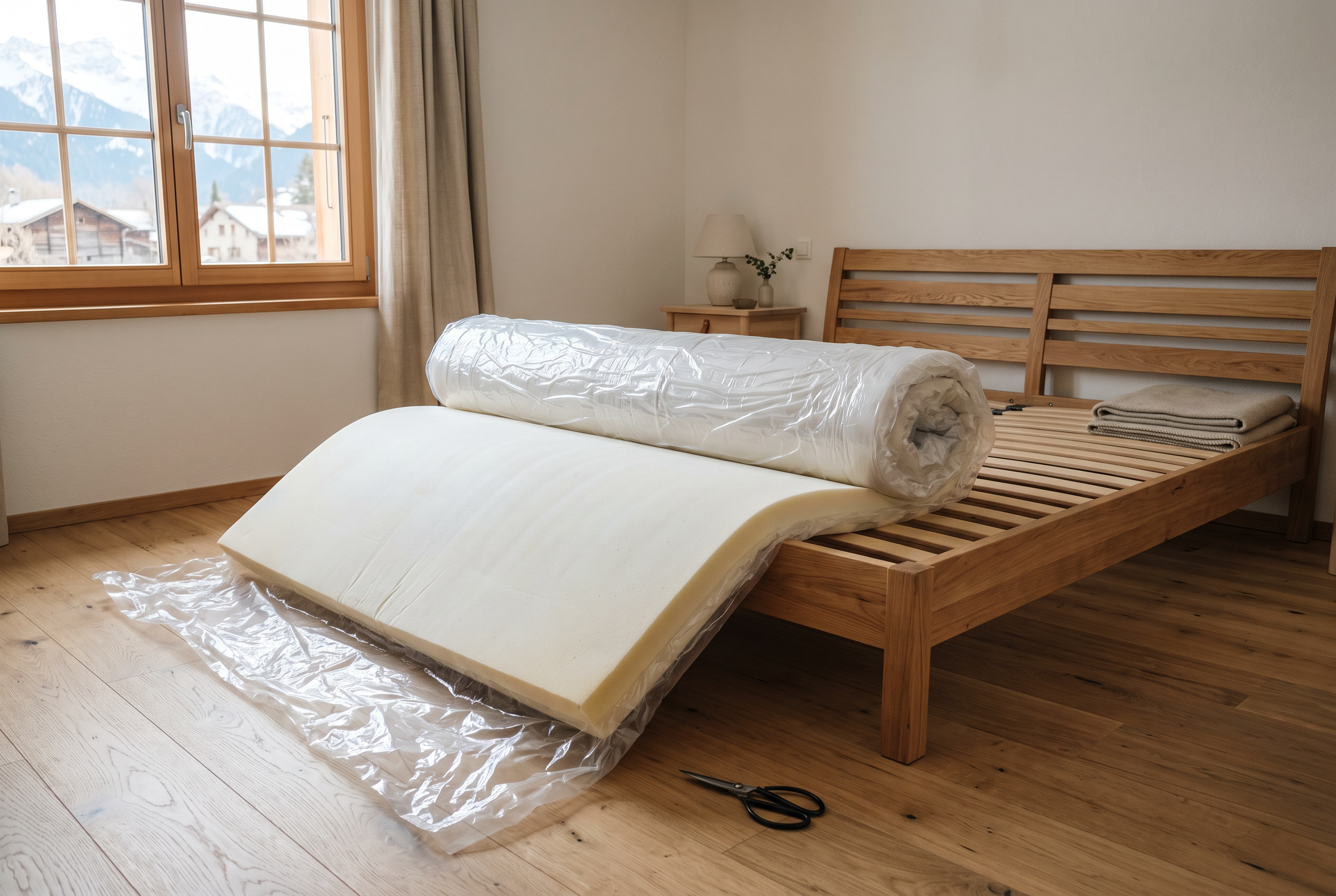
As soon as the film is cut, air flows back into the cell structure, and the mattress visibly expands. Most of the expansion occurs in the first few minutes; the last millimeters take longer. As a rule of thumb: 24 to 72 hours until full core height is reached. At room temperatures below 18 degrees, this can be significantly delayed, because foam reacts more sluggishly in the cold – therefore, allow a mattress delivered in winter to acclimatize for a few hours in a warm room before opening the film. Two points are practically important. First: Carefully cut the film, preferably with blunt scissors and only on the top, so that the cover remains undamaged. Second: Do not use the mattress in the first few hours, even if it already appears almost fully expanded. Detailed steps can be found in the article Unpacking your mattress correctly. The typical new smell – caused by volatile organic compounds from production – usually dissipates with good ventilation within 48 to 72 hours; see Removing mattress odors.

Advantages and disadvantages at a glance
| Aspect | Rolled mattress | Flat-delivered mattress |
|---|---|---|
| Transport to bedroom | Easy, usually possible alone | Bulky, often requires two people |
| Immediately usable | No, 24–72 h expansion | Yes |
| Shipping costs | Lower | Higher (bulky goods) |
| Possible materials | Cold, memory, gel foam, pocket spring (conditionally) | All, incl. Bonnell spring and natural latex |
| Compressed storage duration | Limited, approx. 6–12 months | Unlimited |
| Return | Mostly by pickup, cannot be re-rolled | Freight forwarding pickup |
Common mistakes and misunderstandings
"Rolled mattresses are cheap goods." This was partially true over ten years ago when mostly thin discount mattresses were rolled. Today, high-quality foams with densities over 50 kg/m³ are also packaged this way. Check the specifications, not the packaging – see Density explained. Covering and using too early. Covering the mattress after two hours hinders expansion and the removal of residual moisture. Cutting the film with a utility knife. A common reason for damaged covers. Expecting to be able to re-roll the mattress. Vacuum sealing is an industrial process and not reproducible at home. Therefore, for a return, the mattress is usually picked up uncompressed. Waiting too long if the target height is not reached. If after 72 hours more than about 1 cm is missing from the specified total height, you should contact the provider – this may indicate excessively long storage in the compressed state.
For whom a rolled mattress is particularly practical
The benefit of roll-packaging is greatest where logistics would otherwise become a problem. This includes narrow staircases in old buildings with tight turns, where an 180 x 200 cm mattress simply cannot make it around the corner. The same applies to attic apartments and rooms with sloping ceilings, small elevators, and apartments without an elevator on the fourth floor. For holiday homes and secondary residences in hard-to-reach locations, the rolled mattress is also the more practical solution. Those who move frequently also benefit – even if the mattress cannot be re-compressed, the original transport is already easier. The rolled version is not recommended if you need the mattress on the same day: the expansion time cannot be shortened. And for Bonnell spring cores and some natural latex mattresses, the process is not technically possible – more on this under Bonnell spring vs. pocket spring and Latex mattress. For all other cases, the packaging is a comfort feature, not a quality criterion. What matters is in the data sheet – and becomes apparent during a trial sleep.

Get CHF 25 discount
Subscribe to newsletter and receive a one-time CHF 25 discount. ✓ 200 nights trial sleep ✓ 10 years warranty
Frequently asked questions about rolled mattresses
Is a rolled mattress worse than a normally delivered mattress?
No. A rolled mattress refers to the type of packaging, not the quality. Modern foams tolerate a single compression without problems if they are designed for it. Density, core height, and material composition remain decisive.
How long does it take for a rolled mattress to reach its full height?
Usually 24 to 72 hours. At room temperatures below 18 degrees, it may take longer because foam reacts more sluggishly in the cold. Allow a mattress delivered in winter to acclimatize in a warm room for a few hours before opening it.
Can I sleep on a rolled mattress immediately?
It's better not to. Wait at least 24 hours, ideally 48 to 72 hours. During this time, the core fully expands, and residual moisture and production odors dissipate. Covering it too early hinders both processes.
Which mattresses cannot be rolled?
Classic Bonnell spring mattresses with a rigid wire frame cannot be compressed. Many natural latex mattresses also cannot be rolled due to their material properties and weight. Pocket spring mattresses can be rolled to a limited extent, depending on their construction.
How long can a mattress be stored rolled up?
Manufacturers usually specify 6 to 12 months. Longer storage in the compressed state can lead to permanent deformations. A production date on the carton or label provides information.
Can I roll the mattress back up for a return?
No. Vacuum sealing is an industrial process requiring a special press and cannot be replicated at home. For returns, the mattress is usually picked up uncompressed.








Leave a comment
This site is protected by hCaptcha and the hCaptcha Privacy Policy and Terms of Service apply.