
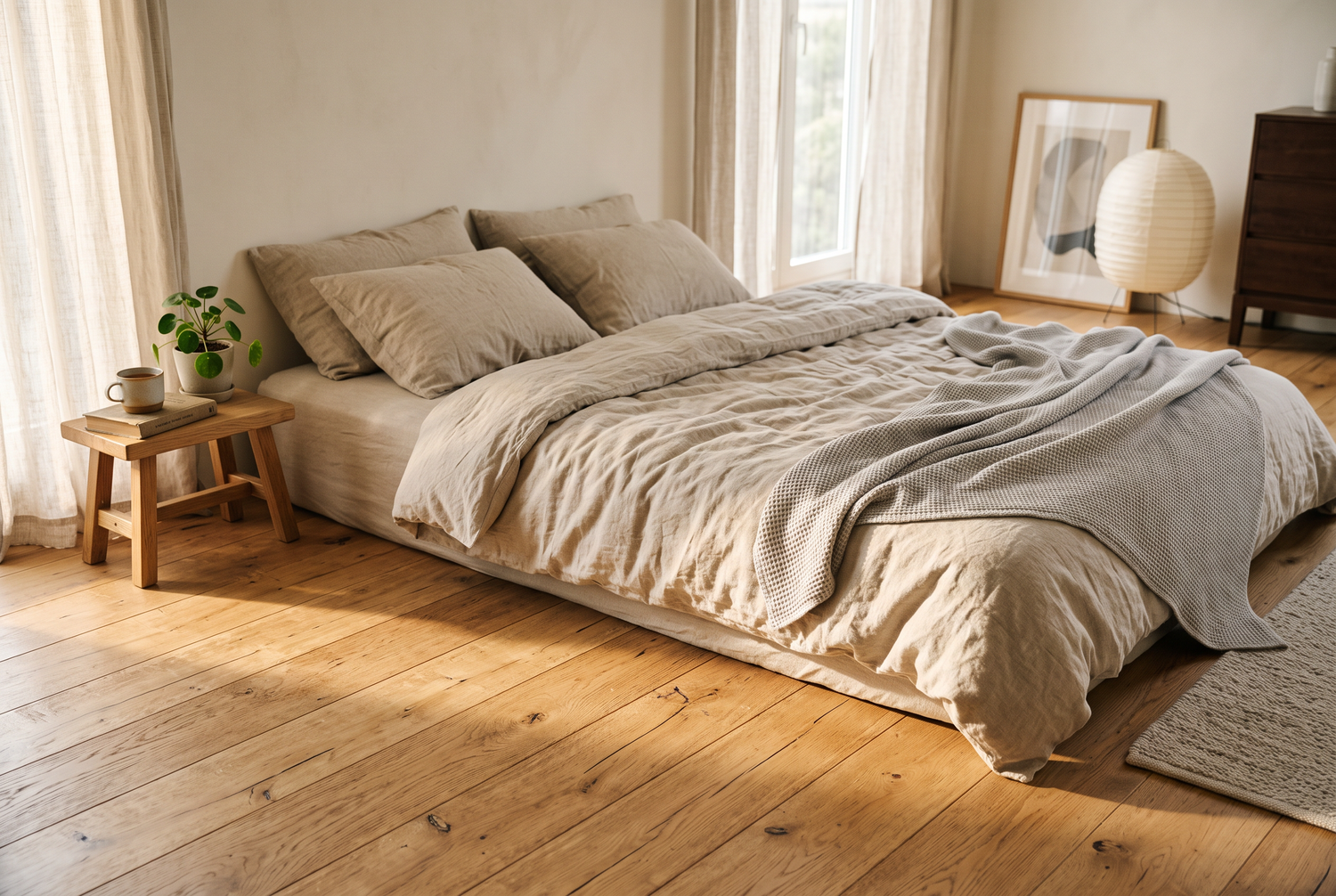
Simply placing a mattress on the floor: In small apartments, when moving in, in children's rooms, or as a conscious style choice in the sense of Japanese living culture, this is an obvious solution. It saves money, makes the room appear larger, is child-safe, and can be set up in ten minutes. At the same time, the warning that it is unhealthy and inevitably leads to mold persists. Both are half true. Whether a mattress on the floor works depends less on the fundamental question than on a handful of specific conditions: which flooring, how warm and humid the room is, what mattress material – and above all, whether you are willing to maintain a small daily routine. This guide categorizes the advantages, risks, and practical rules.
The short answer: A mattress on the floor is harmless to health as long as moisture can escape. The main risk is condensation on the underside: the floor is cooler than the room, and nocturnal body moisture collects precisely there. If you stand the mattress on its side daily or at least every other day, it will work permanently. Wooden floors are ideal; cold basement or concrete floors and thick carpets are unsuitable. Furthermore, you are lying in the dustiest air layer, which is relevant for allergy sufferers – and getting up is significantly more difficult with knee or back problems.
- The main risk is condensation between the mattress and the floor – not the mattress itself.
- Stand the mattress upright against the wall daily or every other day, for at least 2–3 hours.
- Suitable: parquet, laminate, floorboards. Unsuitable: concrete, cold basement floors, thick carpets.
- The dustiest air layer is in the lower 30 cm – a real argument against it for house dust allergy sufferers.
- Alternative with almost all advantages: a 15–25 cm low bed frame or a slatted frame with legs.
What speaks for sleeping on the floor
The practical advantage is obvious: no purchase costs for bed frame and slatted frame, no assembly, no moving effort. For a temporary apartment or a guest room, this is a perfectly reasonable solution. Visually, a room with a floor-level bed appears more spacious because the sightlines remain clear – an effect interior designers specifically use in small rooms. For families with small children, the lack of falling height is a real safety argument: A child rolling out of bed falls 20 instead of 60 centimeters. In Japanese living culture, with futons and tatamis, floor-level sleeping is standard anyway, but there it is combined with a thin mattress that is put away daily and a breathable rice straw mat underneath – precisely the combination that solves the moisture problem. Regarding the often-claimed effect on the back, caution is advised: There is no reliable evidence that floor-level sleeping in itself alleviates back pain. The decisive factor is not the height above the floor, but how well the mattress supports the spine – more on this under Mattress for back pain.

The moisture problem in detail
The flooring of a room is almost always cooler than the room air – typically 2 to 4 degrees, more so in external wall areas and above unheated basements. Warm, moist air that travels down through the mattress core at night cools at this interface. If the temperature drops below the dew point, the water vapor condenses into liquid water. A simple example: At 20 degrees room temperature and 60 percent relative humidity, the dew point is about 12 degrees. A floor area of 11 degrees – not uncommon in winter on an external wall – will therefore become damp. Since the mattress completely covers the surface, this water cannot evaporate during the day. From a relative humidity of around 65 percent on the surface, mold fungi find good conditions; visible spots often appear after only four to eight weeks. Both the underside of the mattress and the flooring underneath are then affected – in the case of parquet, this can lead to permanent damage. Background information and countermeasures can be found under Preventing mold on the mattress.
Which floor works – and which doesn't
| Flooring | Suitability | Note |
|---|---|---|
| Parquet, floorboards | Good | warm, buffers moisture – still ventilate daily |
| Laminate | Limited | closed surface, moisture remains |
| Tiles, stone | Poor | very cool, high risk of condensation |
| Concrete, basement floor | Unsuitable | cold and often damp itself |
| Thick carpet | Unsuitable | stores moisture and house dust |
| Tatami / Rice straw mat | Very good | breathable, actively regulates moisture |
With underfloor heating, incidentally, caution is advised: While it solves the condensation problem, it can overheat the mattress and damage the foam in the long term. Keep the flow temperature low or do without it in the sleeping area.
Practice: the rules for permanent floor sleeping
1. Stand it up daily
The most important rule: Stand the mattress upright against the wall in the morning and leave it for at least two to three hours. With thin mattresses up to 12 cm, this is effortless; with a 20 cm foam core weighing 15 kg, it is a real daily task – realistically consider whether you can keep this up.
2. Create an underlay
If daily standing up is not practical, place a ventilation mat, a tatami mat, or a simple slatted frame element with low legs underneath. Even 3 to 5 cm of air space fundamentally changes the situation.
3. Distance to the outer wall
Maintain at least 10 cm distance from cold outer walls. The combined effect of cold floor and cold wall is the most common mold constellation.
4. Keep an eye on the room climate
16 to 19 degrees room temperature and 40 to 60 percent relative humidity are the target range. A hygrometer costs 15 francs and immediately shows you if the room is critical. For ventilation: three times a day for five to ten minutes across, not permanently tilted – more on this under Proper ventilation for a good sleeping climate.
5. Check regularly
Check the underside and floor weekly for moisture, dark spots, or musty odors. The sooner you intervene, the easier it is to save the situation.

Common mistakes and myths
"Sleeping on the floor is good for your back." There is no reliable evidence for this. The crucial factor is the support provided by the mattress, not the height above the floor. Those who sleep on a thin mattress on a hard floor are more likely to experience pressure points on the shoulder and hip. "A foil under the mattress protects the floor." This only shifts the problem: moisture will then certainly accumulate on the foil. "It's not critical in summer." On the contrary – in summer you sweat more, and in humid weather, the air humidity is already high. "Ventilating once a month is enough." Condensation forms daily; monthly ventilation is too late. Pushing the mattress into a corner of the room. Two cold walls plus the floor is the most unfavorable combination of all. Ignoring house dust allergy. The highest concentration of dust and mite allergens is in the lower 30 centimeters of the room. Those who are allergic should sleep higher – details under House dust mites in the mattress and Allergy-friendly bedroom.
The better alternative: low instead of floor-level
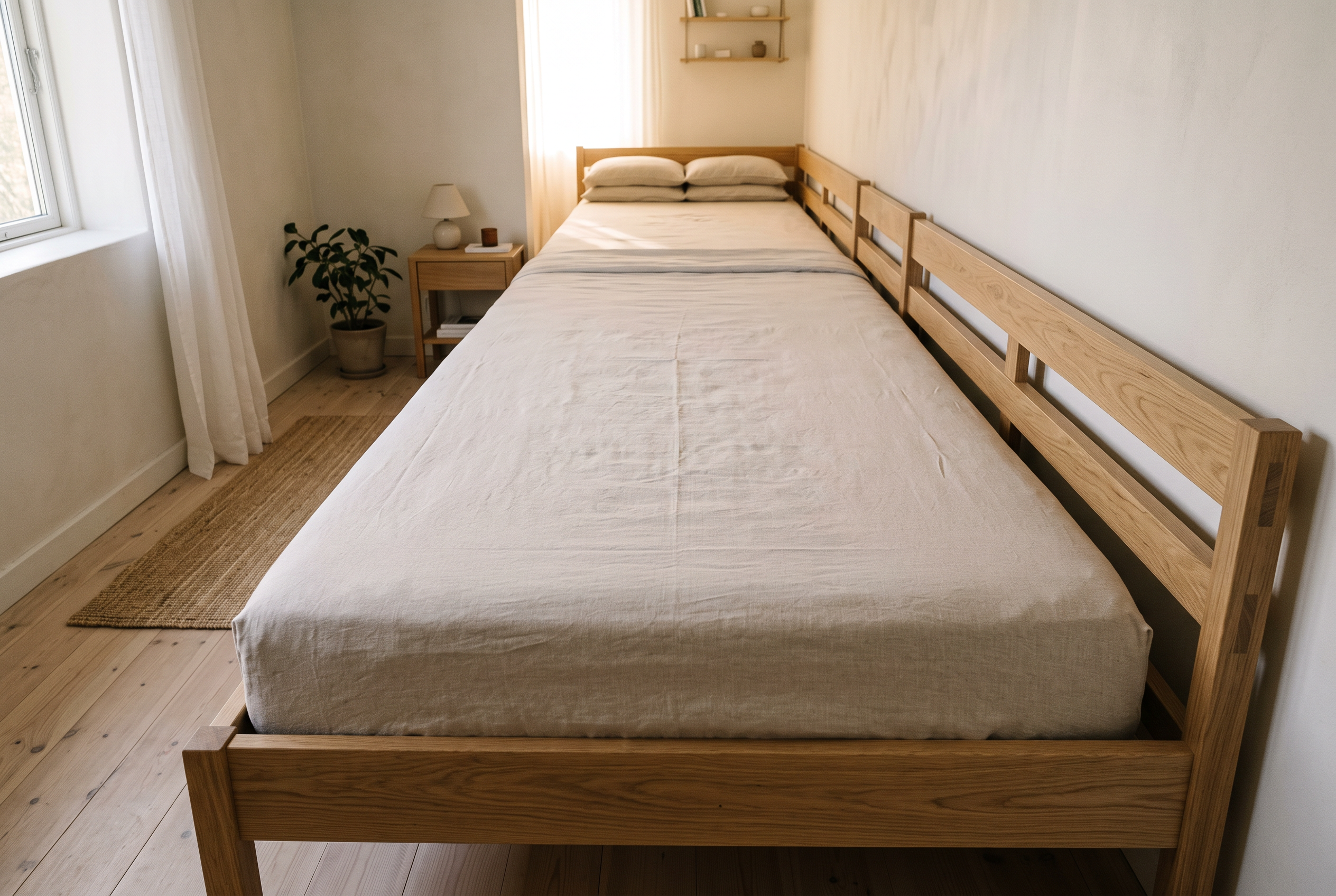
If optics and room feel are important to you, but not the moisture problem, there is a simple compromise: a low bed frame with a frame height of 15 to 25 cm. You retain the calm, floor-level effect, but gain a continuous air space under the mattress. Even cheaper is a roll-up slatted frame with screw-on legs for 60 to 120 francs or a tatami mat as an underlay. Add the mattress to the frame height: With a 20 cm frame plus a 22 cm mattress, you have an entry height of 42 cm – still low, but significantly more comfortable to get up from than 20 cm. This exact point is underestimated: getting up from a floor mattress requires strength in the knees, hips, and torso. With knee problems, arthritis, during pregnancy, or from about 60 years of age, this is a daily nuisance that one doesn't think about when moving in. The guide The ideal bed height helps you calculate which height is right for you; Choosing the right bed frame helps with the selection of the frame.
Get CHF 25 discount
Subscribe to our newsletter and receive a one-time CHF 25 discount. ✓ 200 nights trial sleep ✓ 10 years warranty
Frequently asked questions about mattresses on the floor
Is it unhealthy to sleep on a mattress on the floor?
Basically, no. It only becomes problematic if moisture cannot escape from under the mattress and mold forms. Those who regularly stand up the mattress and ventilate the room well sleep without health disadvantages. However, for house dust allergy sufferers, the floor-level position is unfavorable.
How often do I need to stand the mattress upright?
Ideally daily, but at least every other day, and then for two to three hours. Only then can the moisture that has accumulated overnight between the mattress and the floor evaporate again. Without this routine, mold is a matter of weeks.
On what kind of floor can I place the mattress?
Parquet, floorboards, and tatami mats work best. Laminate is conditionally suitable; tiles and stone are critical due to the low surface temperature. Concrete and basement floors as well as thick carpets are unsuitable because they are cold or store moisture and dust.
Does a foil or underlay help against moisture?
A foil worsens the problem because condensation accumulates on it. However, breathable underlays with air space are useful: a ventilation mat made of plastic honeycomb, a tatami mat, or a slatted frame with low legs.
Is sleeping on the floor better for your back?
There is no reliable scientific basis for this. The decisive factor is how well the mattress supports the spine, not how high it is. On a too-thin mattress on a hard floor, pressure points on the shoulder and hip are more likely to occur.
Who is not suitable for sleeping on the floor?
For people with knee, hip, or back problems, during pregnancy, in old age, and for house dust allergy sufferers. Getting up from a floor position requires strength and mobility, and the highest concentration of dust in the room is in the lower 30 centimeters.
This article is for general information purposes only and does not replace medical advice.








Leave a comment
This site is protected by hCaptcha and the hCaptcha Privacy Policy and Terms of Service apply.