
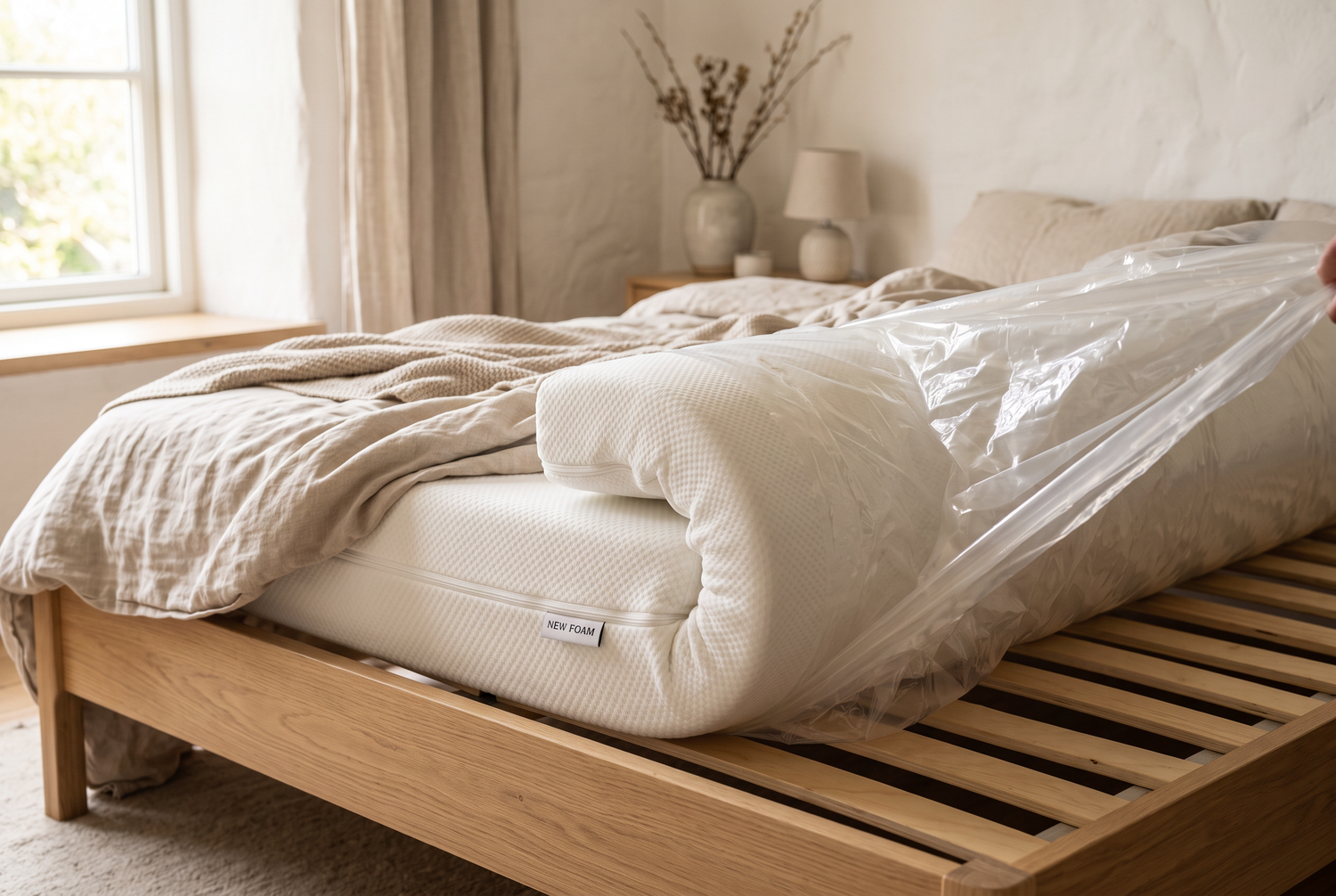
You unpack the new mattress, the vacuum escapes with a soft hiss – and then a sweet, chemical smell rises to your nose. Almost every vacuum-packed foam mattress smells for the first few days, and for many people, that's the first moment of uncertainty. Is it dangerous? Did I get an inferior product? Do I need to complain? The short version first: If a new mattress smells, with tested products it's normal, technically easily explainable, and usually harmless. The crucial thing is to react correctly in the first 48 hours – then the matter usually resolves itself. In this guide, you'll read where the smell comes from, what VOCs really mean, how long off-gassing realistically takes, and when you should actually be concerned.
The short answer: The smell of a new mattress comes from volatile organic compounds (VOCs) that are still trapped in the material after foam production and are released when the vacuum film is opened. In certified mattresses, the concentrations are far below the health-relevant guideline values. Expect the smell to significantly decrease after 24 to 72 hours and to be practically gone after one to two weeks. Removing the cover, letting the mattress air freely, and consistent burst ventilation noticeably shortens the phase. A pungent, stinging, or musty-moldy smell that remains unchanged after two weeks, however, is a reason for a complaint.
- The smell comes from volatile organic compounds (VOCs) from foam production – not from "chemicals in bed."
- Significant improvement after 24–72 hours, completely odorless usually after 7–14 days.
- Remove the cover, air the mattress upright or lying free, keep the room temperature at 20–22 °C, and ventilate 3–4 times daily for 5–10 minutes.
- OEKO-TEX Standard 100, CertiPUR, or an emission test according to AgBB are reliable indicators of tested pollutant levels.
- Pungent, sour, or musty smell after two weeks: do not sit it out, but report it to the dealer.
Where the smell of a new mattress comes from
Polyurethane foams – including cold foam, viscoelastic foam, and modern premium foams like EvoPoreHRC – are created by a chemical reaction of two components that foam up into a block in the factory. Tiny amounts of reaction residues, blowing agents, and processing aids always remain in the material. After foaming, the blocks usually mature for several days to weeks before being cut. If the finished mattress is then vacuum-packed and rolled, anything that is still off-gassing cannot escape – it accumulates in the film. You perceive precisely this concentrated load when you cut open the packaging. The smell is therefore not a sign of poor quality, but a consequence of logistics: an unpackaged mattress from the same block would have significantly less odor in the same situation because it has already off-gassed in the warehouse. The cover, the adhesive between the foam layers, and in spring mattresses, the oil on the steel springs also contribute their part. You can read in detail how to proceed best during the first unpacking under Unpacking a mattress correctly.

What VOCs are – and how to classify them
VOC stands for "volatile organic compounds". The term sounds more threatening than it is: even a peeled orange, freshly painted walls, a Christmas tree, or coffee release VOCs. The decisive factor is not their presence, but the concentration and type of compounds. Indoors, the total load is measured as the TVOC value in micrograms per cubic meter of air. In expert discussions, a range below about 300 µg/m³ is considered hygienically harmless; from around 1000–3000 µg/m³, one speaks of elevated values, at which longer-term ventilation should be carried out. A freshly unpacked foam mattress can generate locally measurable peaks in the first few hours, but these drop significantly within one to three days in a normally sized, ventilated bedroom. Studies by consumer organizations on European mattresses regularly show that tested products comply with the relevant guideline values. In contrast, individual substance groups such as certain plasticizers, flame retardants, or isocyanate residues are critically evaluated – and these are precisely the subject of common test seals. More on this in the guide OEKO-TEX and pollutants in mattresses.
How long does off-gassing really take?
The honest answer is: it depends on the material, room temperature, and especially the air exchange. Heat accelerates off-gassing, while cold and stagnant air slows it down. A bedroom at 21 °C that is cross-ventilated several times a day will become odorless much faster than a 16 °C cool, rarely ventilated room. The following table provides realistic empirical values for the typical process.
| Mattress type | Odor significantly reduced | Practically odorless |
|---|---|---|
| Cold foam, vacuum-packed | 24–48 hours | 5–10 days |
| Visco/Memory foam | 48–72 hours | 7–14 days |
| Gel foam | 24–72 hours | 7–14 days |
| Latex (natural and synthetic) | 3–7 days (typical latex smell) | 2–4 weeks, residual note may remain |
| Pocket spring with foam topper | 12–24 hours | 3–7 days |
Latex is the special case: the slightly milky-rubbery inherent odor of natural latex is typical for the material and may never completely disappear in some models. Those sensitive to odors should be aware of this before purchasing. A comparison of material properties can be found under Mattress types compared.
Step by step: how to air it out correctly
With the right approach, you can often shorten the odor phase to one or two days. Here's how to proceed:
1. Unpack immediately
It's best to open the packaging directly after delivery, not after two weeks in the cellar. The longer the mattress remains sealed, the more concentrated the initial burst of smell will be. Carefully cut open the film and dispose of it immediately, otherwise it will keep the smell in the room.
2. Remove cover
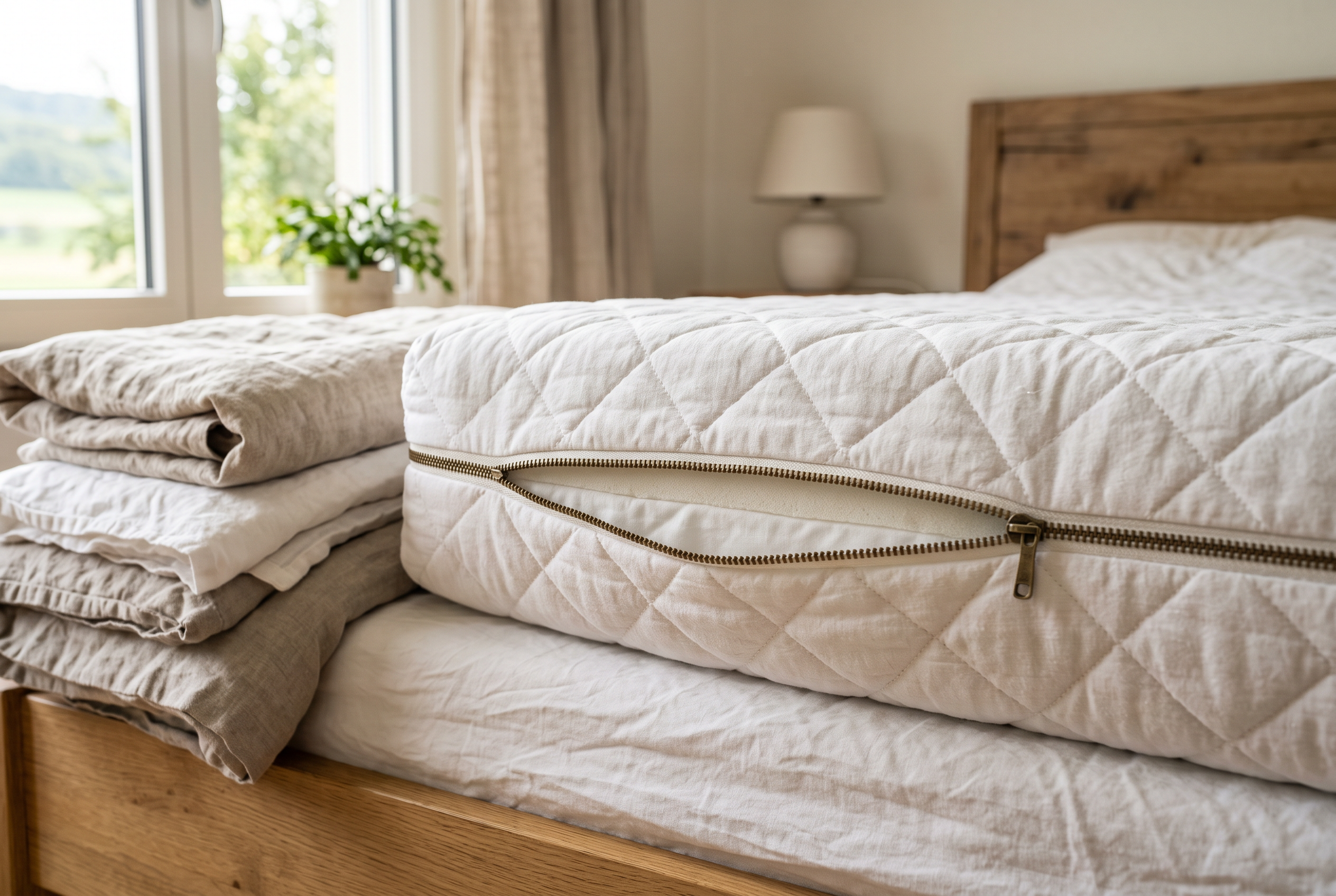
If the cover has an all-around zipper, remove it. The exposed foam core off-gasses considerably faster than through multiple layers of textile. You can wash the cover in parallel at 60 °C – details can be found in the article Washing a mattress cover.
3. Free-standing and burst ventilation
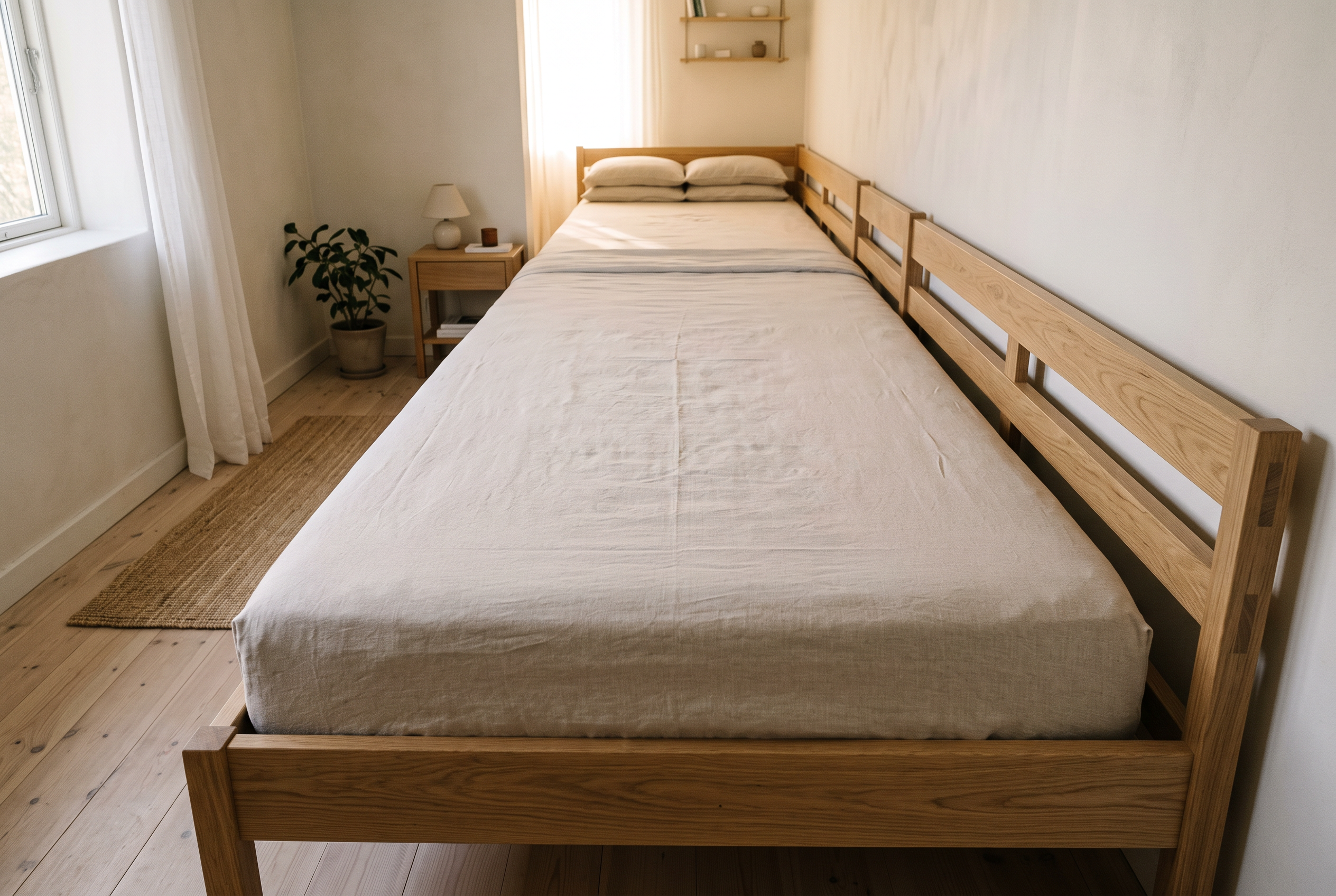
Place the mattress upright against a wall or lay it on the slatted frame so that air can circulate from all sides. Ventilate 3–4 times daily for 5–10 minutes with the window wide open, ideally with cross-ventilation. Permanently tilted windows provide little air exchange but cool the walls – Correct ventilation for a good sleeping climate explains how to ventilate efficiently.
4. Use warmth, avoid moisture
20–22 °C is ideal. Direct sunlight for hours should be avoided, as UV light damages foam and cover fibers in the long term. Damp household remedies like vinegar water or sprayed fragrance solutions do not belong in the foam core: moisture dries slowly there and promotes mold.
Common mistakes when off-gassing
By far the most common mistake is impatience in the wrong direction: the mattress is immediately covered with a fitted sheet, topper, mattress protector, and duvet, and then complaints are made that the smell remains. Every additional layer acts like a lid. Mistake two: spraying air fresheners, room perfumes, or deodorant on the mattress. This only masks the smell, delays the actual off-gassing, and leaves residues in the foam. Mistake three: generously sprinkling baking soda or bicarbonate of soda and leaving it for days. As a grease binder against sweat odor, baking soda has its justification, but it is largely ineffective against fresh VOC off-gassing – and powder residues are difficult to vacuum out of open-pore foam. Mistake four: heating the room strongly with the window closed. Warmth without air exchange increases the concentration in the room instead of reducing it. And mistake five: returning the mattress after three days because of the smell. Instead, use the trial sleep phase – the body's adjustment takes longer anyway, as shown in Adjusting to a new mattress.

Myths fact-checked
"The smell means toxic substances are off-gassing." The human nose is extremely sensitive to some compounds and detects concentrations in the range of a few micrograms, long before there is any health relevance. Odor intensity and hazard are not the same. "Expensive mattresses don't smell." High-quality foams also off-gas, sometimes significantly, because they are more open-pored. The price primarily indicates durability and workmanship, not new odor. "Natural materials don't smell at all." Natural latex, coconut, and horsehair have distinct inherent odors that often last longer than those of synthetic foam. "An air purifier solves the problem." Devices with activated carbon filters can reduce odors, but they don't replace air exchange – the cheapest and most effective "filter" remains the open window. "If it smells, I can't sleep on it." With certified mattresses, there's no reason not to sleep on it after 24–48 hours of ventilation. Those who are sensitive might prefer to wait two to three nights longer.
When the smell is a warning sign
There are situations where you should not wait. A sharp, pungent smell that makes your eyes water or scratches your throat is not typical for new goods and should be reported to the dealer. The same applies to a musty-moldy or cellar-like smell: it indicates moisture – for example, because the mattress was packed damp or stored wet – and can be associated with mold growth. A sour, vomit-like smell is also atypical. If the new smell remains consistently strong after two weeks of consistent ventilation, this is also a legitimate reason for a complaint. And if you repeatedly notice headaches, irritating coughs, burning eyes or skin reactions when sleeping on the new mattress, which disappear as soon as you sleep elsewhere, you should not use the mattress for the time being and have the symptoms clarified by a doctor. Such reactions are rare, but should be taken seriously – people with asthma, chemical sensitivity or pronounced allergies react more sensitively than average.
What to look for when buying
Test seals are not a marketing gimmick, but the only practical way to assess pollutant levels that you cannot measure at home. OEKO-TEX Standard 100 tests textiles and foams for over 1000 individual substances, including plasticizers, heavy metals, pesticides, and potentially carcinogenic dyes. CertiPUR is specifically designed for polyurethane foams and limits, among other things, formaldehyde, certain flame retardants, and the TVOC value after 72 hours in a test chamber. The AgBB scheme or emission tests according to ISO 16000 measure off-gassing under defined chamber conditions. For natural materials, GOTS (organic cotton) and GOLS (natural latex) are also relevant. Make sure that the seal refers to the mattress as a whole and not just to the cover fabric. If in doubt, ask the dealer for the test number – reputable providers will give it without hesitation. A provider with a long trial sleep phase also gives you the necessary buffer to calmly assess whether the material and smell suit you; how this works in practice is described in Buying a mattress online and trial sleeping.
Get CHF 25 discount
Subscribe to the newsletter and receive a one-time CHF 25 discount. ✓ 200 nights trial sleep ✓ 10 years warranty
Frequently asked questions about new mattress odors
How long does a new mattress need to air out before I can sleep on it?
Usually, 24 to 48 hours of good ventilation are enough for the smell to significantly diminish and for you to sleep on it without concern. If you are sensitive to odors or suffer from asthma, it's better to wait two to three nights. A foam mattress usually becomes completely odorless only after one to two weeks.
Is the smell of a new mattress harmful to health?
For pollutant-tested mattresses with OEKO-TEX, CertiPUR, or comparable certificates, the emissions are below the health-relevant guideline values. The smell is unpleasant, but according to current knowledge, not harmful. If headaches, irritating coughs, burning eyes, or skin reactions occur repeatedly, you should not use the mattress for the time being and seek medical advice.
What helps most quickly against the smell?
The most effective method is a combination of removing the cover, placing the mattress in a free-standing position, and cross-ventilating for five to ten minutes three to four times a day, at a room temperature of 20 to 22 degrees Celsius. Scented sprays, vinegar water, or heavily sprinkling with baking soda, on the other hand, do little and can leave residues or moisture in the foam.
Do all mattress types smell equally strongly?
No. Vacuum-packed visco and gel foams smell most intensely because they are dense and open-pored at the same time. Pocket spring mattresses usually smell the least and for the shortest time. Natural latex has a material-typical, milky-rubbery inherent odor that can last for weeks and may remain slightly noticeable in some models permanently.
Can I put the mattress on the balcony to air it out?
Only briefly and only in dry weather in the shade. Direct sun damages foam and cover fibers over time, and humidity or a sudden rain shower brings moisture into the core, which dries very slowly there. A well-ventilated indoor space is the safer choice.
When should I complain about a smelly mattress?
If the smell is pungent, sour, or musty-moldy, if it remains unchanged after two weeks of consistent ventilation, or if you repeatedly experience physical discomfort while sleeping. In these cases, contact the dealer – returns are usually straightforward within a trial sleep phase.
This article is for general information purposes only and does not replace medical advice.








Leave a comment
This site is protected by hCaptcha and the hCaptcha Privacy Policy and Terms of Service apply.