
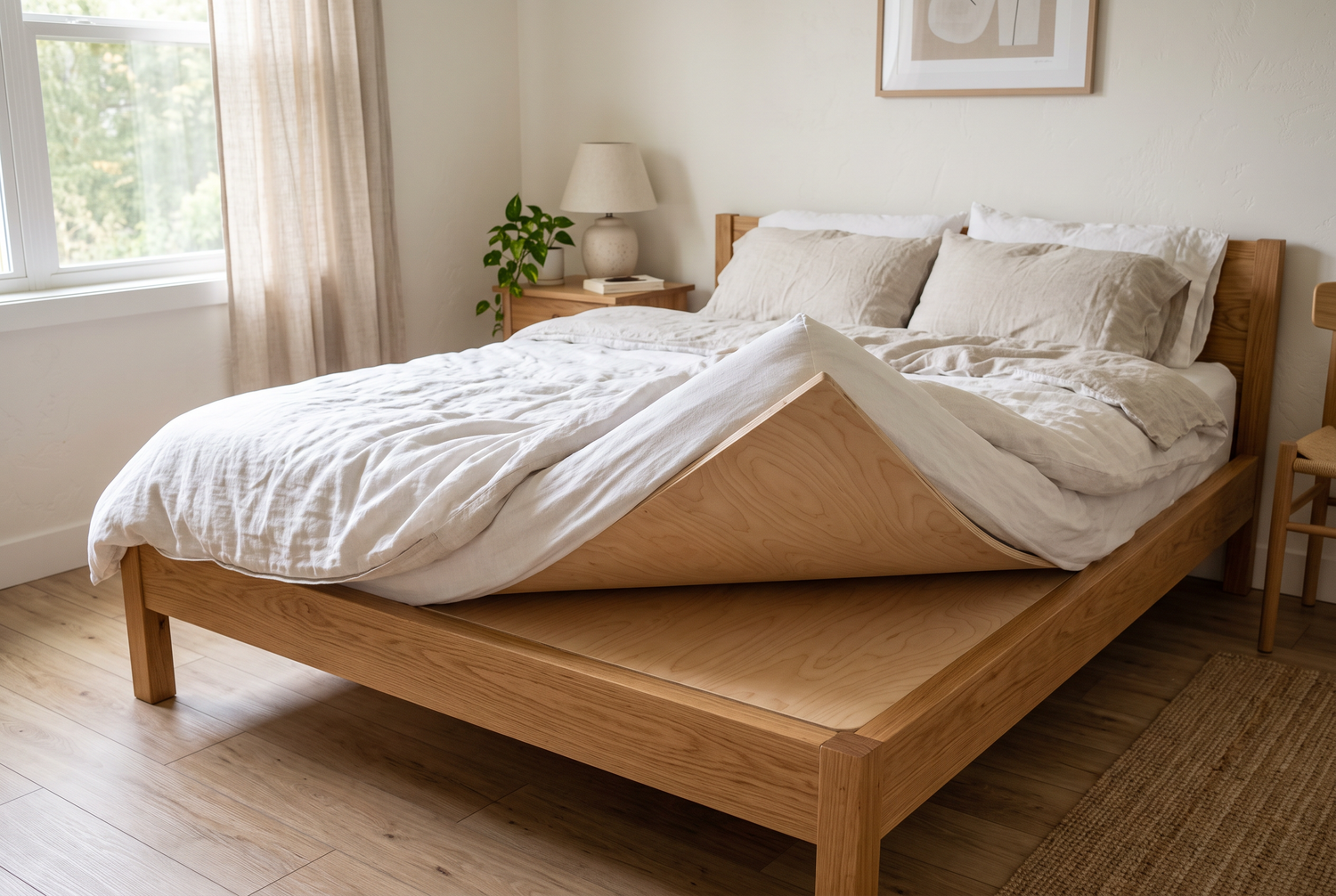
Platform beds, pedestals, pallet beds, box spring constructions, and many designer furniture pieces don't use a classic slatted frame: The mattress rests on a continuous board or on wide, closely spaced planks. This looks tidy, saves money, and makes the bed lower. However, the question that is almost always overlooked is crucial: What happens to the moisture that enters the mattress every night? A slatted frame has two tasks – support and ventilation – and only the first can be easily replaced by a board. This guide explains when a bed without a slatted frame works well, where the risks lie, which mattress types are suitable, and what simple measures you can take to reliably prevent mold under the mattress.
The short answer: Yes, a bed without a slatted frame works – but only with adequate ventilation. A closed chipboard without holes is the worst option because nightly moisture cannot escape and condensation collects on the underside of the mattress. Perforated boards with holes from 25 mm in diameter, wide planks with 2 to 3 cm spacing, or a solid board in combination with a ventilation mat work well. Also, use a mattress with an open-cell core, consistently ventilate the bedroom, and lift the mattress every two to three months to allow it to dry.
- A slatted frame supports and ventilates – a board replaces the support function, but not the ventilation.
- Closed boards without holes pose the greatest mold risk, especially against cold exterior walls.
- An adult releases 0.3–0.5 liters of fluid per night – some of it ends up in the mattress.
- Solutions: perforated board, planks with 2–3 cm spacing, or a ventilation mat (climate mat) underneath.
- Stand the mattress upright every 2–3 months and let it dry for half a day.
What a slatted frame actually does
A slatted frame has three functions, only one of which is obvious. First, it bears the weight and distributes it via the bed frame to the bed legs – a board can do this just as well. Second, it flexes: Elastically mounted spring slats yield slightly under the shoulder and pelvis, thus supporting the point-elastic effect of the mattress. How much of this effect reaches the top depends heavily on the mattress; with a 22 cm high foam core, the effect is minimal, but with a 14 cm thin mattress, it is noticeably palpable. Third – and this is the underestimated point – it ventilates. Air can circulate between the slats and carry away the moisture that migrates downwards through the mattress core overnight. An adult loses 0.3 to 0.5 liters of fluid during sleep, significantly more on warm summer nights. Some of this evaporates into the room, but a significant portion is absorbed by the mattress. If there is no air path downwards, this moisture condenses on the cooler underside – and this is precisely where mold forms. How to recognize this process is described in Preventing Mold on the Mattress.

Comparing the variants
Not every slatted-frame-free construction is equally problematic. The following overview categorizes common variants.
| Base | Ventilation | Assessment |
|---|---|---|
| Closed chipboard | none | High mold risk – only acceptable with a ventilation mat |
| Perforated board (holes from 25 mm) | good | Practical if the bed sides remain open |
| Wide planks, 2–3 cm spacing | very good | Functions like a rigid slatted frame |
| Pallet bed | good | Gaps provide ventilation, but spacing often too large |
| Box spring base | good | Spring core in the base provides suspension and air circulation |
| Mattress directly on the floor | none | Only practical with daily upright positioning |
For planks, a rule of thumb applies: The spacing should not exceed 3 to 4.5 cm, otherwise the mattress will press through between the planks and wear out faster there. For beds without a frame, read Mattress on the floor.
Which mattress suits a solid base
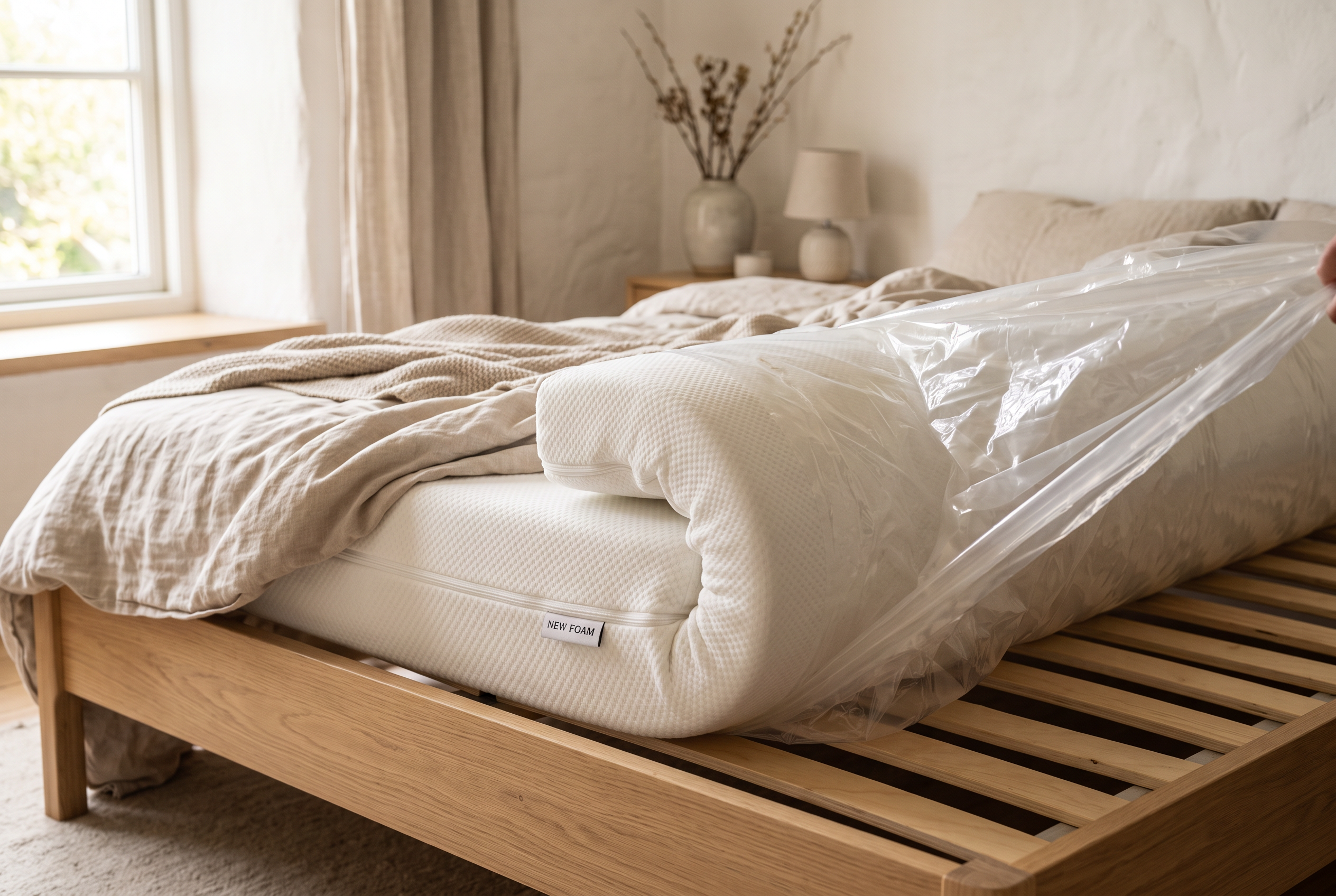
On a rigid surface, all the adjustment comes from the mattress – the base does not flex. This favors point-elastic materials with sufficient height. Foam mattresses with a core of 18 cm or more work well, as they allow the shoulders and pelvis to sink in sufficiently. Thin mattresses under 14 cm feel significantly firmer on a solid board than on a spring slat frame. Pocket spring mattresses also work, but require particularly good ventilation because a lot of humidity is stored in the spring chamber. Latex is the most critical case: The material is practically closed-cell on the underside and lies tightly against the board – without perforation or a ventilation mat, condensation is almost unavoidable. A mattress with an open-pore structure and a breathable cover is also important; models with a waterproof underside are unsuitable for solid boards. An overview of material properties is offered in Comparison of Mattress Types, and details on the construction of box spring structures can be found under Box Spring Bed: Construction and Function.
Practical tips: how to make a platform bed safe
1. Create ventilation
Drill holes of 25 to 40 mm diameter in an existing board, in a grid of about 15 cm – this takes half an hour and solves the basic problem. Alternatively, place a ventilation or climate mat between the board and the mattress: These 1 to 2 cm thick honeycomb mats made of plastic create a continuous air space and cost 60 to 150 Swiss francs.
2. Keep the bed sides open
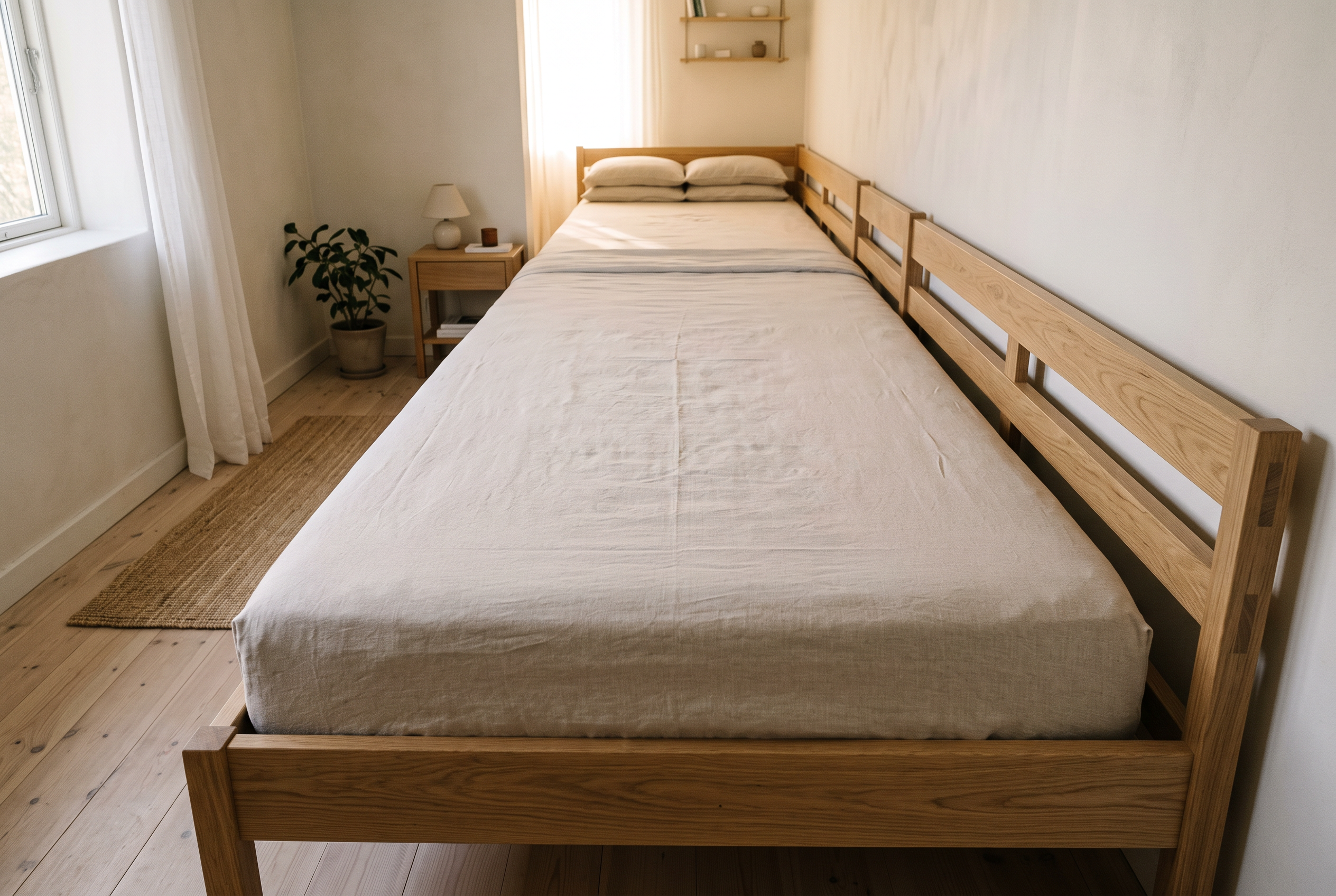
A completely enclosed bed frame negates the effect of the holes. Leave at least one side open or provide ventilation slots in the frame. This is particularly important for storage beds with a bed box – do not store textiles there that additionally retain moisture.
3. Maintain distance from exterior walls
Position the bed at least 5 to 10 cm away from cool exterior walls. The lowest surface temperatures, and thus the highest risk of condensation, occur directly against a cold wall.
4. Check regularly
Lift the mattress every two to three months and inspect the underside and the board. Dark spots, a musty smell, or a noticeably damp area are warning signs. In this case, stand the mattress upright for half a day and ventilate the room thoroughly.
5. Control indoor climate
Maintain relative humidity in the bedroom between 40 and 60 percent and temperature between 16 and 19 degrees Celsius. A hygrometer for 15 francs is the cheapest insurance. How to ventilate correctly is explained in Proper Ventilation for a Good Sleeping Climate.

Common mistakes
Placing the mattress on a closed board and never checking it. The classic – it usually only becomes apparent after months when it smells musty or dark spots appear. Placing a sheet or waterproof cover underneath. Well-intentioned, but counterproductive: Moisture will then build up for sure. Pushing the bed directly against a cold exterior wall. Especially in old buildings and poorly insulated rooms, this is the most common cause of mold behind and under the bed. Too wide plank spacing. At more than 4.5 cm, the mattress pushes through and forms premature indentations in these areas. Placing a carpet under the platform bed. A thick carpet under a low-lying bed further impedes air circulation from below. Using a latex mattress without perforation. Of all materials, latex is the most critical here. Hardly heating the bedroom in winter and rarely ventilating. Cold air absorbs less moisture, and without air exchange, relative humidity quickly rises above 65 percent – the threshold at which mold finds good conditions.
Get CHF 25 discount
Subscribe to our newsletter and receive a one-time CHF 25 discount. ✓ 200 nights trial sleep ✓ 10 years warranty
Frequently asked questions about beds without slatted frames
Can a mattress be used without a slatted frame?
Yes, if ventilation is provided in another way. A perforated board with holes from 25 millimeters, wide planks with 2 to 3 centimeters spacing, or a ventilation mat under the mattress work well. A closed board without any openings, however, poses a real mold risk.
Why does a mattress get moldy on a closed board?
An adult releases 0.3 to 0.5 liters of fluid per night, some of which is absorbed by the mattress. Without an air path downwards, this moisture condenses on the cooler underside. If it remains there permanently, ideal conditions for mold growth are created – especially against cold exterior walls.
How wide can the gaps between the planks be?
Between 2 and 4.5 centimeters is the sensible range. Smaller gaps ventilate less effectively, while larger ones allow the mattress to sag between the planks, leading to premature wear and indentations in these areas.
What is a ventilation mat and do I need one?
A ventilation or climate mat is a 1 to 2 centimeter thick honeycomb structure made of plastic, placed between the board and the mattress to create a continuous air space. It costs 60 to 150 Swiss francs and is the simplest solution if you don't want to drill into a closed board.
Is a mattress on a board firmer?
It usually feels somewhat firmer because the flexibility of the slatted frame is absent, and all the adjustment must come from the mattress itself. For core heights of 18 centimeters or more, the difference is slight; for thin mattresses under 14 centimeters, it is noticeably palpable.
How often should I check the mattress on a platform bed?
Lift the mattress every two to three months and check the underside and the platform for dark spots, moisture, or a musty smell. On this occasion, stand the mattress upright for half a day so that it can dry completely.








Leave a comment
This site is protected by hCaptcha and the hCaptcha Privacy Policy and Terms of Service apply.