
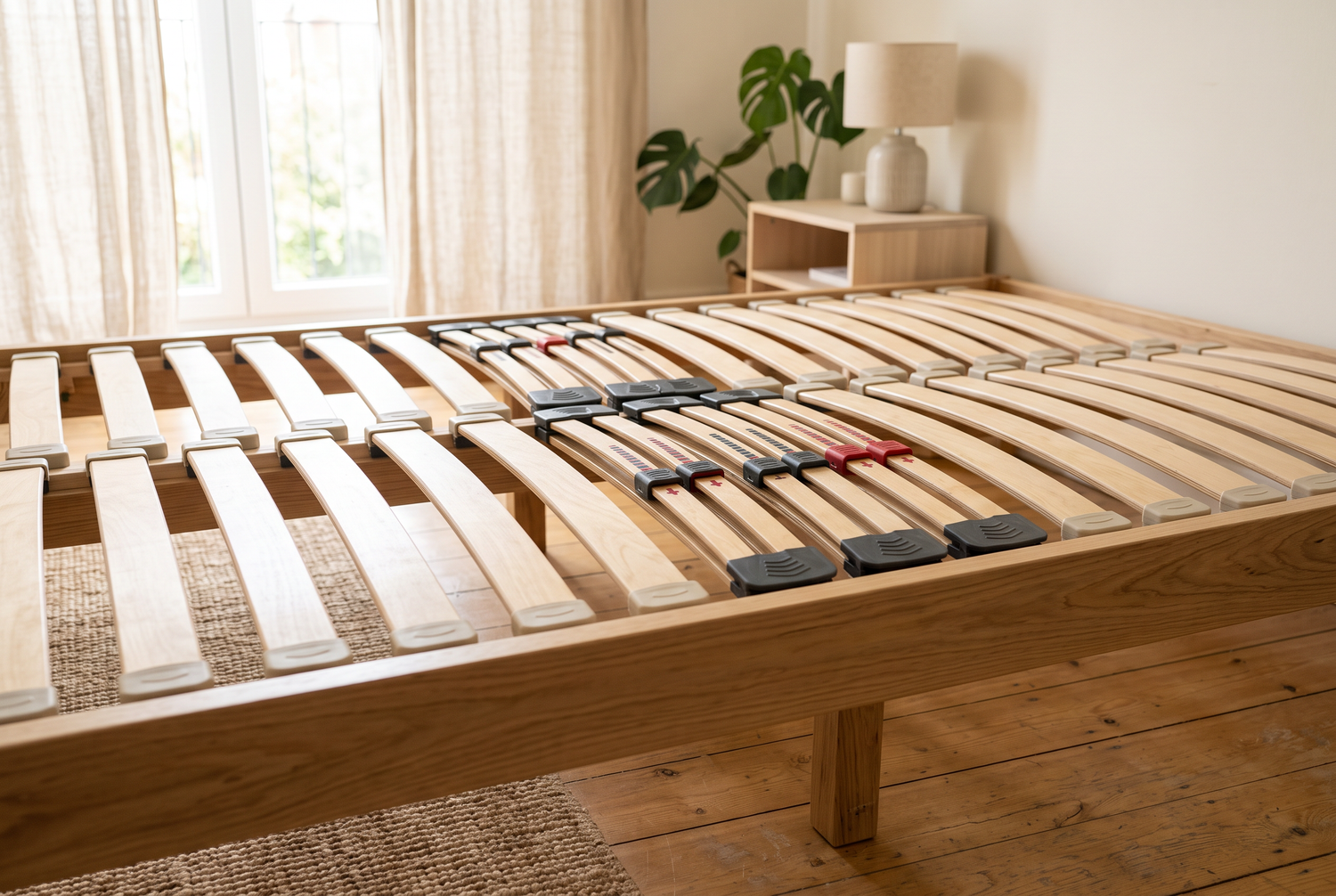
Most slatted frames have small sliders in the middle of the body – and most people have never touched them. Yet, these inconspicuous sliders can noticeably change the sleeping sensation: they make the pelvic area firmer or more yielding, influencing how deep the hips sink in. If set incorrectly, the frame can hinder a good mattress – for example, if the middle zone is set rock-hard and the hips are not allowed to sink in when lying on the side. If set correctly, it supports the mattress where your body needs it. In this guide, we explain how firmness adjustment technically works, which setting suits which sleeping position, and how you can optimally adjust your bed in 15 minutes. We also show when the slatted frame is less important than advertising claims.
The short answer: You adjust the firmness of a slatted frame using the sliders on the duo slats in the middle of the body: sliders pushed towards the middle of the slat result in a firmer zone, sliders pushed outwards result in a softer zone. Side sleepers should set the pelvic zone to soft to medium, allowing the hips to sink in; back sleepers should choose medium to firm to prevent the pelvis from sagging; stomach sleepers should set it to firm. Test each change for at least three nights – and remember: With high-quality, sufficiently high mattresses, the core does most of the adjustment, and the frame only provides fine-tuning.
- Sliders towards the middle = firmer, outwards = softer – they act on the duo slats in the pelvic and lumbar area.
- Basic rule by position: Side sleepers soft to medium, back sleepers medium to firm, stomach sleepers firm.
- Adjust both sides of the bed separately – body weight and sleeping positions of partners usually differ.
- Test each change for at least 3 nights and only change one setting at a time.
- The higher the quality and height of the mattress (from approx. 20 cm), the less influence the frame has on the sleeping sensation.
How does the firmness adjustment on a slatted frame work?
A classic sprung slatted base consists of 26 to 42 slightly curved slats made of glued laminated birch wood, mounted in flexible caps. In the middle of the body – usually at slat 10 to 16 counted from the head – there are so-called duo slats: two overlapping slats connected by movable plastic bodies. These sliders determine how strongly the two slats work together. If you push the sliders towards the middle of the slat, the effective levers overlap more: the zone becomes firmer and supports more weight. If you push the sliders outwards towards the ends, the slats decouple, and the zone yields more softly. The effect is concentrated on the pelvis and lumbar area – where around 40 to 50 percent of the body weight rests. Some frames also offer an adjustable shoulder zone with softer or lowered slats, as well as individually replaceable caps with different degrees of yielding. You can read about the types of frames available and their costs in the article Adjustable slatted frame.
Adjusting the slatted frame: Instructions by sleeping position
Proceed in four steps. Step 1: Establish a neutral position – move all sliders on both sides of the bed to the outermost position (soft) to have a defined starting point. Step 2: Choose a basic setting according to your sleeping position. Side sleepers leave the sliders on the outside or push them in by a maximum of one-third – the hips must be able to sink in so that the spine remains straight. Back sleepers push the sliders in about halfway to support the pelvis and prevent the lower back from sagging. Stomach sleepers set the zone firmly to avoid a hollow back. Step 3: Fine-tuning according to body weight – those weighing significantly over 90 kg tend to set it one notch firmer, those under 60 kg one notch softer. Step 4: Lie-down test with control. Lie down in your usual position and have a second person check if the spine forms a straight line when lying on your side or maintains its natural double-S shape when lying on your back. After that, the rule is: test for at least three nights, and only change one variable at a time. Tips on finding the right position yourself can be found in the guide Mattress for side sleepers.

Understanding the zones of the slatted frame
Good slatted frames are divided into zones corresponding to different body parts. The head zone remains neutral – the pillow does the work here. The shoulder zone is designed softer in many models, sometimes with special comfort slats, so that the shoulder can sink 4 to 7 cm deeper when lying on its side. The middle or lumbar zone with the duo slats supports the lumbar spine and pelvis; this is where the sliders are located. The leg zone carries comparatively little load and remains unchanged. The following overview summarizes the recommendations:
| Zone | Side Sleeper | Back Sleeper | Stomach Sleeper |
|---|---|---|---|
| Shoulder Zone | Soft (allow sinking) | Medium | Medium |
| Middle Zone (Sliders) | Soft to Medium | Medium to Firm | Firm |
| Leg Zone | Neutral | Neutral | Neutral |
Adjusting head and foot section: What to look out for
Many slatted frames can also be inclined at the head and foot ends – manually with ratchet fittings or conveniently by motor. A slightly raised headrest of 10 to 20 degrees makes reading in bed easier and can be pleasant for reflux or a stuffy nose; for sleeping, the inclination should remain moderate so that the spine does not bend. A footrest raised by 5 to 10 cm relieves veins and heavy legs. Important: Not every mattress can handle the adjustment. The core must be flexible enough to follow the bend without creasing – foam and latex mattresses are well suited, while innerspring and very high, firm cores can resist or be damaged at the bending points. When using adjustable slatted frames, secure the mattress against slipping, for example with a retaining frame at the foot end. The article Mattress for adjustable slatted frame explains which mattresses are suitable for adjustment; we illuminate the motor variant under Electric slatted frame.
Common mistakes when adjusting the slatted frame
Mistake one: Setting the middle zone rock-hard, "so that the back is supported". For side sleepers, this is precisely counterproductive – the hips cannot sink in, and the spine bends upwards. Mistake two: Setting both sides of the bed identically, even though partners have a 20 kg weight difference and different sleeping positions. Each side deserves its own setting. Mistake three: Readjusting daily. The body needs several nights to evaluate a new sleeping sensation – constantly changing will never lead to the right setting. Mistake four: Misusing the sliders to "repair" a sagging mattress. A hollow in the core cannot be compensated from below; only a mattress change helps here. Mistake five: Incorrect support direction – with slatted frames with shoulder lowering, the soft zone belongs at the head end. After a move, the slatted frame is surprisingly often assembled the wrong way around. Mistake six: Ignoring broken or popped-out slats. Even one defective slat noticeably changes the support and puts point pressure on the mattress – replacement slats are inexpensive and quickly installed.
When the slatted frame is less important than you might think
An honest attempt at classification: the influence of the slatted frame on the sleeping sensation depends heavily on the mattress. With thin mattresses under 16 cm high or soft cores, the frame structure pushes through to the surface – here, careful adjustment is noticeably worthwhile. With high-quality mattresses from about 20 cm high with a high density, however, the core itself takes over the body adaptation; the frame primarily serves as a ventilated, stable support. Modern premium foams are even deliberately designed to work on virtually any intact surface – from a simple roll slatted frame to a continuous platform. This also relieves the wallet: instead of investing in an expensive special slatted frame, the money is usually better spent on a better mattress. Two things remain important: the base must be even and intact (no hollows, no broken slats), and ventilation from below should be ensured so that moisture can escape. The article Bed without slatted frame clarifies whether a bed also works completely without a slatted frame.

Get CHF 25 discount
Subscribe to newsletter and receive a one-time CHF 25 discount. ✓ 200 nights trial sleep ✓ 10 years warranty
Frequently asked questions about adjusting the slatted frame
In which direction do I push the sliders for a firmer setting?
Push the sliders on the duo slats towards the middle of the slat – this couples the two slats more strongly, and the zone becomes firmer. Pushed outwards to the ends, the zone becomes softer.
How do I adjust the slatted frame as a side sleeper?
Set the middle zone from soft to medium so that the hips can sink in and the spine remains straight. The shoulder zone should also be soft – many slatted frames have special comfort slats at the head end for this purpose.
How long should I test a new setting?
At least three nights, preferably a week – the body needs time to evaluate a new sleeping sensation. Also, always change only one setting at a time so you know which change is effective.
Do both sides of the bed have to be set the same?
No, on the contrary: adjust each side individually according to body weight and sleeping position. With a 20 kg weight difference between partners, different settings are the rule, not the exception.
Can the slatted frame compensate for a sagging mattress?
No, a hollow in the mattress core cannot be adjusted away from below. The sliders only change the support force of the zone – for visible sleeping hollows or morning discomfort, only a mattress change helps.
How important is the slatted frame for a high-quality mattress?
For mattresses from about 20 cm high with a high-quality core, the mattress largely adapts to the body itself. The slatted frame then primarily needs to be even and intact and ensure ventilation from below – expensive special slatted frames are usually unnecessary.










Leave a comment
This site is protected by hCaptcha and the hCaptcha Privacy Policy and Terms of Service apply.