

Hardly any sleep topic is as passionately debated as the family bed. For some, sleeping together with children is the most natural thing in the world – globally, co-sleeping has even historically been the norm. For others, safety concerns, lack of space, and the loss of couple intimacy outweigh the benefits. The truth, as often, lies in the details: it makes a significant difference whether a newborn or a three-year-old sleeps in the bed, whether the bed is 140 or 280 cm wide, and whether clear safety rules are followed. This guide sorts through the arguments, summarizes the recommendations of professional societies, lists the safety rules for co-sleeping, and shows how a family bed can be practically planned – from sleeping width per person to the question of how children can successfully move out later.
The short answer: For infants in their first year of life, professional societies recommend their own sleeping surface in the parents' room – such as a co-sleeper – rather than the parents' bed itself, because soft mattresses, duvets, and pillows pose risks. From toddler age onwards, a family bed, when implemented correctly, is a legitimate, safe option: large, continuous sleeping surface (at least 70–80 cm width per person), firm mattresses, no gaps, no smokers in bed, and no alcohol. Whether it suits the family is ultimately a question of sleep quality and the needs of all involved – not ideology.
- First year of life: own sleeping surface in the parents' room (e.g., co-sleeper) – the parents' bed itself is associated with increased risks for infants.
- From toddler age onwards, co-sleeping with clear rules is safely possible: firm mattress, no gaps, sufficient width, smoke-free environment.
- As a rule of thumb, 70–80 cm sleeping width per person is recommended – for two adults and one child, this means at least 220–240 cm total width.
- Most common practical solution: two beds or mattresses placed side-by-side with a gap filler for a continuous surface.
- A family bed is not a one-way street: with gentle transition rituals, most children between 3 and 6 years old happily move into their own bed.
What exactly does co-sleeping mean – and what does research say?
Co-sleeping encompasses two different things: room-sharing (child sleeps in the same room, but on their own surface) and bed-sharing (child sleeps in the same bed). This distinction is crucial, as studies evaluate both differently. Room-sharing in the first year of life is explicitly recommended – it is associated with a lower risk of sudden infant death syndrome (SIDS) and facilitates breastfeeding. Bed-sharing with infants, however, increases the risk in studies, especially in the first three to four months of life, for premature babies, and if parents smoke, have consumed alcohol, or have taken sedating medications. Therefore, the professional consensus is: closeness yes, shared mattress with the infant no – the safe bridge is the co-sleeper. From toddler age onwards, when the child can independently roll over, sit up, and move freely, the risk situation fundamentally changes – then the family bed primarily becomes a question of sleep quality and family organization.
The arguments for: closeness, breastfeeding, quieter nights
Advocates of the family bed put forward strong arguments. Night-time closeness soothes: toddlers who wake up and immediately feel their parents often fall back asleep without prolonged crying – this means fewer night-time interruptions for everyone involved. Breastfeeding mothers benefit from short distances; studies show that bed-sharing families breastfeed longer on average. From a developmental psychology perspective, there is also nothing against co-sleeping: children who sleep in a family bed, contrary to a common prejudice, do not become less independent – research finds no evidence of later disadvantages in independence or sleep quality. And finally, the practical argument: if a child ends up in the parents' bed every night anyway, a consciously planned, large family bed is often a more honest and restful solution than the night-time bed carousel with overtired parents on the edge of the bed.

The arguments against: sleep quality, couple time, space
The counter-arguments are equally serious. Parents' sleep suffers measurably when a toddler lying across the bed spreads elbows and feet – adults in family beds more frequently report waking up and lighter sleep. Couple relationships need retreats: intimacy must be consciously planned outside the bedroom or at other times, otherwise it gradually disappears. Space is a practical limitation: in a 160 cm bed, co-sleeping with a growing child becomes unrestful for everyone – and chronically poor sleep is a real health issue, not a minor flaw. Finally, there are families where one parent is a very light sleeper, works shifts, or snores – here, the family bed can create more stress than it fosters closeness. An honest assessment is important: does the majority of the family sleep better or worse in the shared bed? The answer may also change with the children's age.
Safety rules and planning: how to set up a family bed
Those who choose a family bed should consciously build it rather than improvise. The basis is width and surface:
| Configuration | Recommended minimum width | Typical solution |
|---|---|---|
| 2 adults + 1 toddler | 220–240 cm | 180 cm bed + attached 60–70 cm cot or 240 cm surface from two beds |
| 2 adults + 2 children | 280–320 cm | two 140/160 cm beds placed side-by-side |
| 1 adult + 1 child | 160–180 cm | Standard double bed |
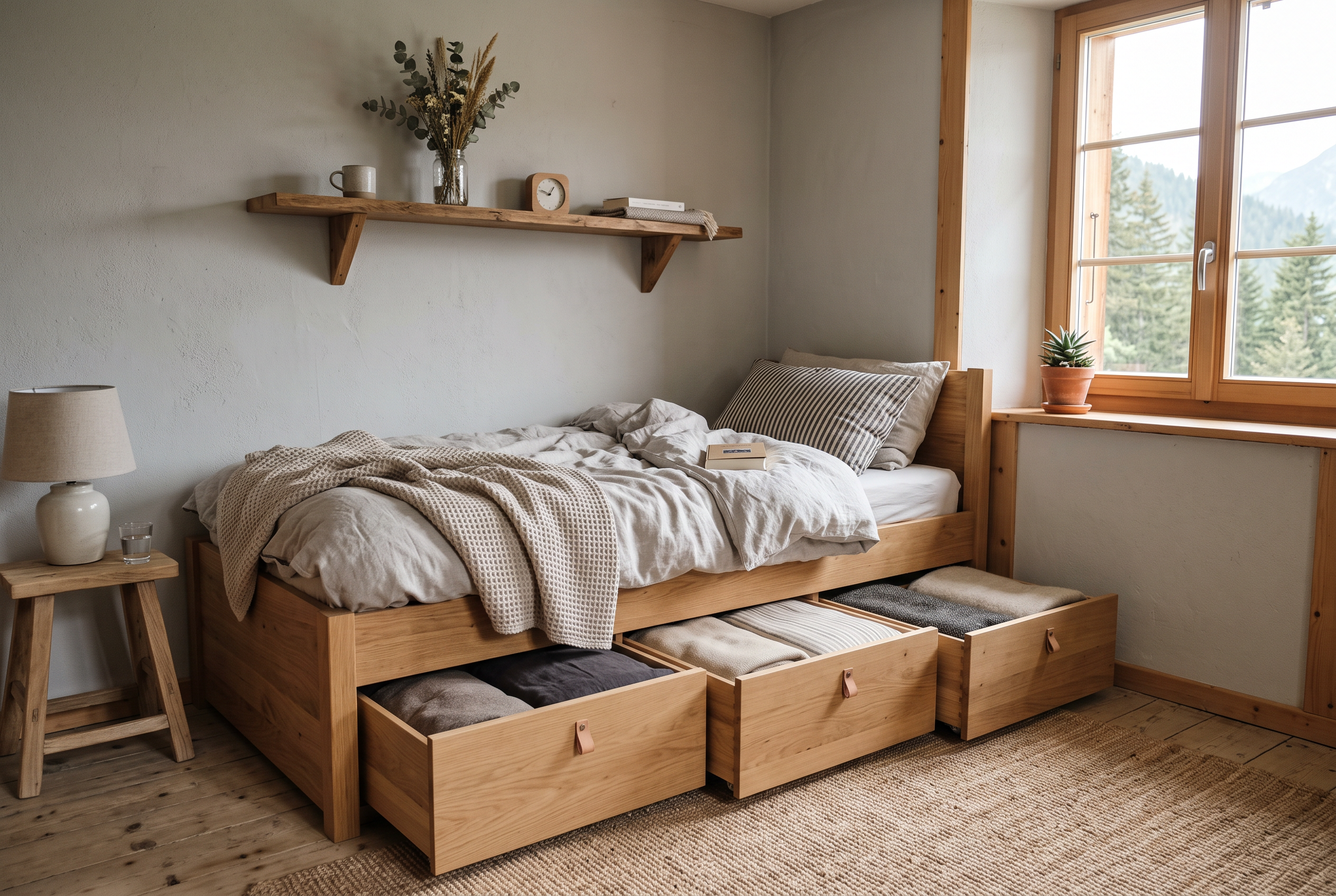
In addition, there are safety rules: continuous firm mattresses (no soft waterbeds or deeply sinking sofas), no gaps – a gap filler helps between two mattresses, the bed must be flush with the wall or have sufficient distance – a low frame or fall protection on the child's side, and restraint with pillows and heavy duvets near the child. Absolute exclusion criteria for bed-sharing are smoking, alcohol, and sedating medications. Practical tips for connecting two beds without gaps can be found in the article on guest gaps, and whether one or two mattresses are the better choice is clarified in the article Double bed: one or two mattresses?.
Moving out: how children gently transition to their own bed
The fear that the child will "never move out" is unfounded – most children between three and six years old develop a desire for their own space. The transition happens in stages: first their own mattress in the parents' room, then their own room with an extended bedtime ritual, later falling asleep independently. Consistency beats speed: fixed bedtimes, a predictable routine, and loving but clear guidance work better than pressure. Setbacks during transition phases – starting daycare, new sibling, teething – are normal and temporary; more on this in the article about sleep regressions in toddlers. It helps to make their own bed attractive: the child can help choose bedding, the room is jointly made sleep-friendly, and you can find the right bedtimes for each age in the guide Bedtimes for children.
Common mistakes in the family bed
Mistake one: improvised surfaces – letting the toddler sleep between two drifting mattresses or on the sofa is more dangerous than any planned family bed. Mistake two: too little width; below 70 cm per person, sleep becomes a matter of negotiation. Mistake three: using the family bed as a permanent solution for sleep problems – if a child can only fall asleep with physical contact and this is straining the family, it's worth looking at gentle sleep guidance instead of ever larger beds. Mistake four: neglecting the parents' mattress; those who sleep three or four on a twelve-year-old, saggy mattress should not be surprised by back pain – especially with higher surface load, support and point elasticity matter. And mistake five: prioritizing ideology over observation. Neither "family bed at all costs" nor "own room from birth" does justice to every child; what matters is what allows all family members to sleep well consistently.
Get CHF 25 discount
Subscribe to newsletter and receive a one-time CHF 25 discount. ✓ 200 nights trial sleep ✓ 10 years warranty

Frequently asked questions about family beds and co-sleeping
Is co-sleeping with a baby dangerous?
Bed-sharing with infants – especially in the first few months – is associated with increased risks. Professional societies recommend a separate sleeping surface in the parents' room, such as a co-sleeper, for the first year of life. From toddler age onwards, co-sleeping with clear safety rules is well possible.
How big does a family bed need to be?
Allow 70–80 cm sleeping width per person: For two adults and one child, that's at least 220–240 cm; with two children, it's more like 280–320 cm. In practice, two beds or mattresses are usually placed side-by-side without gaps.
Do children become less independent in a family bed?
There is no scientific evidence for this. Most children between three and six years old naturally develop a desire for their own bed; a gradual, lovingly guided transition usually goes smoothly.
Which mattress is suitable for a family bed?
A firm, point-elastic mattress with good support that correctly accommodates both light children and heavier adults. Soft, deeply sinking surfaces are unsuitable; a gap filler ensures a continuous surface between two mattresses.
What are the most important safety rules?
Firm mattresses without gaps, sufficient width, fall protection on the child's side, no heavy pillows and duvets near the child – and never co-sleeping after alcohol, sedating medications, or in smoking households in the same bed.
How do we end the family bed without drama?
In stages: a separate mattress in the parents' room, then their own room with a fixed bedtime ritual, finally independent falling asleep. Consistency, predictability, and patience work better than pressure – setbacks during transition phases are normal.
This article is for general information and does not replace medical advice.








Leave a comment
This site is protected by hCaptcha and the hCaptcha Privacy Policy and Terms of Service apply.