
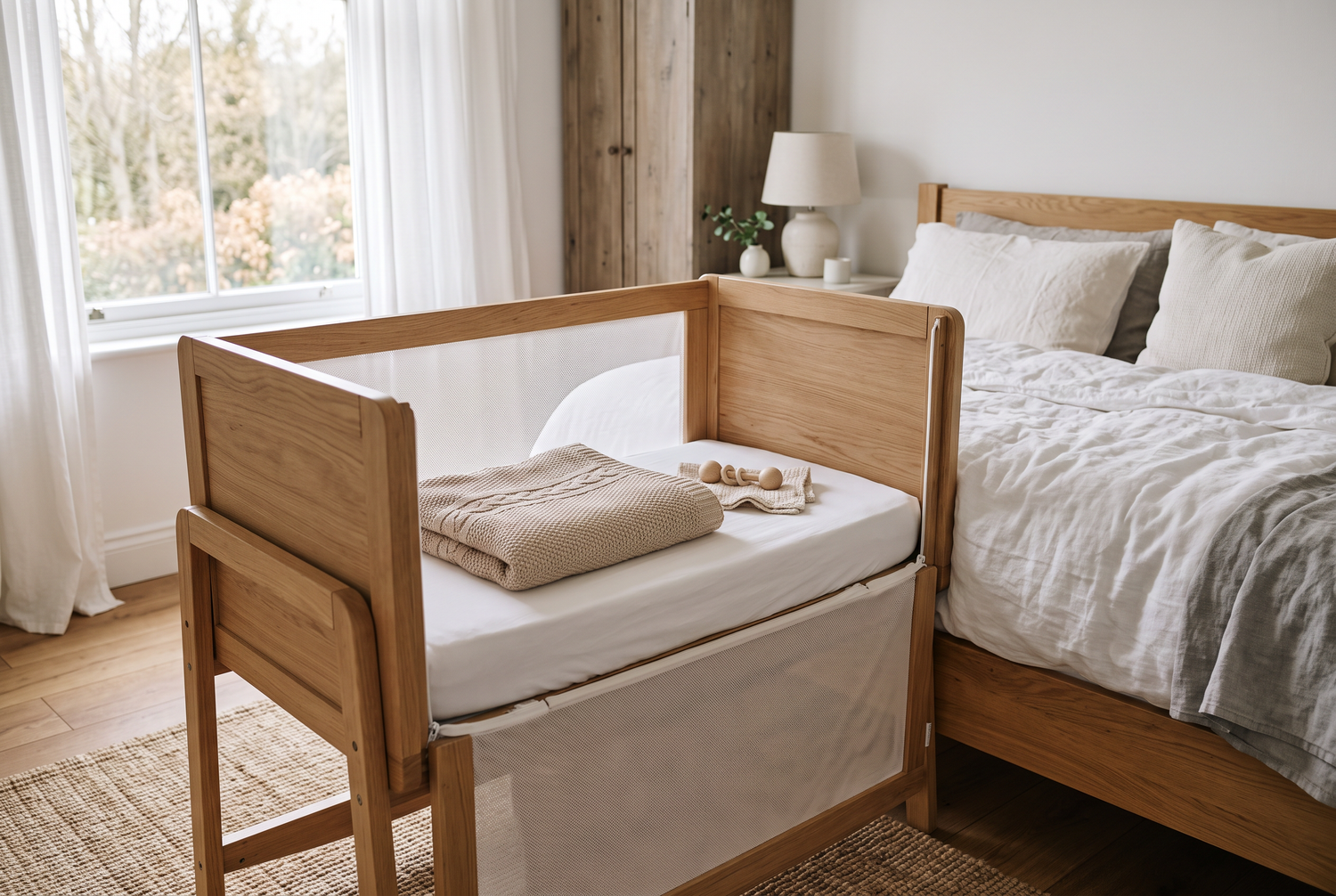
The first months with a newborn primarily mean one thing: many nighttime interruptions. Breastfeeding, soothing, changing diapers – if you have to get up and go to another room every time, you lose valuable sleep, often two hours per night or more. A co-sleeper elegantly solves this problem: it is attached to the side of the parents' bed, with the open side facing the parents, and the baby sleeps on its own safe sleeping surface within reach. Professional societies recommend that infants sleep in the parents' bedroom during their first year of life – or at least for the first six months – but on their own sleeping surface: this is exactly the combination that a co-sleeper offers. This guide explains what to consider when buying and assembling a co-sleeper, what kind of mattress is needed, how long a co-sleeper can be used, and what mistakes parents should absolutely avoid.
The short answer: A co-sleeper is the safest way to have a baby sleep close to you: its own firm sleeping surface, but with eye and touch contact with the parents. Crucial factors are a stable, gap-free attachment to the parents' bed (a maximum of a few millimeters distance), a firm, perfectly fitting baby mattress, and avoiding pillows, blankets, and bumper pads in the baby's bed. It is typically used until about 6–9 months – as soon as the baby can sit up or reaches the weight limit (usually 9 kg), it's time to move to a crib.
- Recommendation of professional societies: sleep in the parents' room during the first year of life, but on one's own sleeping surface – the co-sleeper fulfills both.
- Safety core: seamless, firm connection to the parents' bed, height precisely adjusted to the parents' mattress, tested stability (EN standard).
- The baby mattress must be firm, perfectly fitting (edge distance less than 2–3 cm), and breathable – no soft surfaces.
- In a co-sleeper, as in a crib: sleeping bag instead of a blanket, no pillows, stuffed animals, or bumper pads, back sleeping position.
- Usage typically up to 6–9 months or approx. 9 kg – then switch to a crib, ideally still in the parents' room initially.
Why a Co-Sleeper? The Benefits for Baby and Parents
Proximity to parents has been shown to regulate a newborn's breathing, temperature, and stress levels – babies who sleep in the parents' room show more stable sleep patterns. At the same time, experts warn against sleeping in the parents' bed itself, especially in the first months: adult mattresses are too soft, and duvets and pillows pose risks of suffocation. The co-sleeper combines both worlds: the baby lies on its own firm surface with its own sleeping climate, and the mother can simply pull the child over to breastfeed without getting up, and then put them back. Studies on rooming-in also show that breastfeeding relationships last longer when nightly trips are short. For parents, this means measurably more sleep – and especially during the exhausting newborn period, that's no small thing. To learn more about how parents can organize their nights in general, read the article Sleeping with a Newborn.
Safety: What Matters for Assembly and Setup
The most critical aspect of any co-sleeper is its connection to the parents' bed. There must be no gap between the baby's mattress and the parents' mattress into which a head or arm could slip – the fastening straps must be tightly secured under the parents' bed frame and checked regularly. Equally important: the sleeping surfaces should be at the same height or the baby's surface slightly below, never above. Good models can be adjusted in multiple stages (often 5–11 positions) to fit bed frames from approximately 40 to 60 cm in height. Look for the tested standard for co-sleepers (EN 1130), stable standing even with the side lowered, and lockable wheels. Box spring beds are a special case: due to their high, soft edge, some co-sleepers may not fit flush – check compatibility before purchasing. And at night: the open side should always face the parents' side; if the bed is used freestanding in the room during the day, the fourth side must be installed or raised.

The Right Mattress for the Co-Sleeper
Baby mattresses have their own rules that differ significantly from adult mattresses: they must be firm so that the face cannot sink in – as a practical test, a head impression should immediately spring back, and the depth of the impression should remain shallow. The mattress must fit exactly: the distance to the edge should be no more than two to three centimeters to prevent dangerous gaps. Breathable, pollutant-tested materials (e.g., according to OEKO-TEX Standard 100) and a removable, washable cover at 60 °C are mandatory – spit-up stains and nocturnal accidents are part of everyday baby life. Avoid used, sagging baby mattresses from unknown sources: indentations and old moisture damage are risk factors. All details on a safe sleeping environment – from back sleeping to sleeping bags – are summarized in our guide Baby Mattress and Safety, and an overview of mattresses for later children's beds is provided in the Children's Mattress Guide.
Co-Sleeper, Moses Basket, Cradle, or Family Bed?
New parents encounter many sleeping solutions – the overview shows the differences:
| Solution | Usage Duration | Strengths | Limitations |
|---|---|---|---|
| Co-sleeper | 0–approx. 9 months | maximum proximity with own sleeping surface, breastfeeding-friendly | limited size, check compatibility with bed frame |
| Cradle/Moses Basket | 0–approx. 6 months | mobile, gentle rocking | no direct bed connection, outgrows it early |
| Crib in parents' room | 0–approx. 3 years | long usable, later convertible | getting up to breastfeed necessary |
| Family Bed | variable | maximum proximity | increased risks for infants; strict safety rules necessary |
For on-the-go and holidays, there are also foldable and travel-friendly versions – more on this in the article Travel Cot and Co-Sleeper for Baby.
Common Mistakes with Co-Sleepers
Mistake one: loose straps. The fastening loosens over time – check weekly whether the co-sleeper is still flush and firm. Mistake two: height difference. If the parents' mattress is higher, an adult's rolling movement can become a risk; if the baby's surface is higher, the baby risks rolling out. Mistake three: soft extras. Bumper pads, furs, pillows, and loose blankets have no place in a baby's bed – a suitable sleeping bag completely replaces a blanket. Mistake four: using the co-sleeper as a storage area and then letting the baby sleep in the parents' bed – especially after nightly breastfeeding in a semi-sleep, this is a common, risky pattern; consistently put the baby back on their own surface. Mistake five: using it for too long. As soon as the child can sit up, pull themselves up, or lean over the edge – usually between six and nine months – the low co-sleeper is no longer safe. And mistake six: overheating. 16–18 °C room temperature is sufficient even for a baby; a room that is too warm and thick clothing significantly increase the risk of restless nights.
When and How to Transition to a Crib?
The transition is due when the baby reaches the manufacturer's weight limit (usually around 9 kg), sits up, or visibly has too little space. A gentle transition can be achieved in stages: first, place the crib next to the parents' bed to maintain the familiar environment, then gradually increase the distance and – if desired – move it to the nursery. Familiar routines, the same sleeping bag, and a consistent evening routine facilitate the adjustment; how to establish healthy sleep habits is shown in the article Baby and Sleeping Through the Night. By the way: Many co-sleepers can be reused after the baby stage – as a freestanding cot with a fourth side, as a bench, or a side table. Paying attention to such conversion options when purchasing significantly extends the useful life.
Get CHF 25 discount
Subscribe to our newsletter and receive a one-time CHF 25 discount. ✓ 200 nights trial sleep ✓ 10 years warranty

Frequently Asked Questions about Co-Sleepers
How long can a co-sleeper be used?
Typically until about six to nine months, or until the manufacturer's limit of usually 9 kg. At the latest, when the baby can sit up or lean over the edge, it's time to switch to a crib.
Is a co-sleeper safer than a family bed?
For infants, yes: the baby lies on its own firm surface without an adult duvet and pillow, but remains in close proximity. This combination – parents' room, but own sleeping surface – corresponds to the recommendations of professional societies.
What kind of mattress belongs in a co-sleeper?
A firm, perfectly fitting baby mattress with a maximum of two to three centimeters of edge distance, breathable and pollutant-tested, with a washable cover. Soft mattresses, furs, or additional padding increase risk and do not belong in a baby's bed.
Does a co-sleeper fit every parents' bed?
No. The height adjustment must match the height of the parents' mattress, and with box spring beds, some models do not fit flush. Before purchasing, check the frame height, fastening method, and manufacturer's compatibility information.
Does the baby need a blanket in the co-sleeper?
No – during the first year of life, the baby sleeps safest in a suitable sleeping bag, on their back, and without pillows, blankets, bumper pads, or stuffed animals. A room temperature of 16–18 °C is sufficient in combination with appropriate clothing.
How can the transition from a co-sleeper to a crib be successful?
Gradually: first place the crib directly next to the parents' bed, maintain familiar routines and the same sleeping bag, and slowly increase the distance. This way, the environment remains familiar, and the transition usually succeeds without major protest nights.
This article is for general information and does not replace medical advice.










Leave a comment
This site is protected by hCaptcha and the hCaptcha Privacy Policy and Terms of Service apply.