
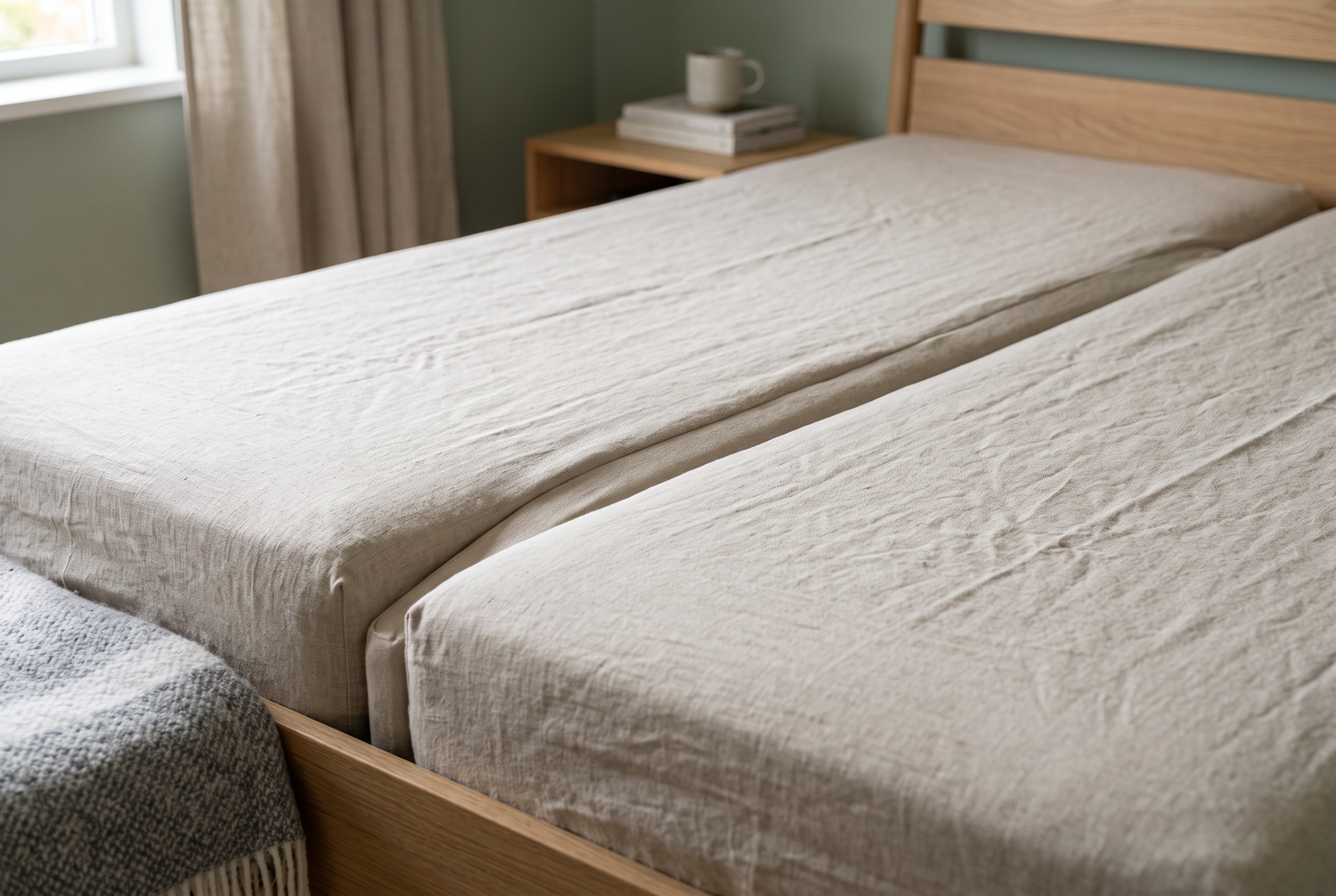
It lies exactly where you least need it: in the middle of a double bed. The "visitor gap" – that seam between two mattresses lying next to each other – has a charming name but an unpleasant reality. Anyone who rolls to the middle at night feels the edge on their back. Those who want to sleep close together find no flat surface. And anyone with cold feet discovers a surprisingly reliable draft channel in the gap. The good news: There are three proven solutions, and together they cost less than one bad night is worth. The less good news: Not every solution works equally well for every bed configuration. This guide categorizes the options and shows which one suits your situation.
The short answer: The most effective solution against the visitor gap is a continuous topper over both mattresses, as it completely covers the gap and simultaneously unifies the sleeping surface. A "love bridge" made of foam, placed wedge-shaped into the gap and secured with a tension strap, functions as a more affordable interim solution. An oversized fitted sheet over both mattresses pulls them together and reduces the gap, but does not eliminate it. The most elegant option remains a single continuous mattress – then the gap doesn't even form in the first place.
- A continuous topper of 5 to 8 cm height is the most reliable solution to the problem.
- Love bridges are wedge-shaped foam strips, approximately 190 cm long, and usually cost CHF 30 to 60.
- Both mattresses must be exactly the same height – even a 2 cm difference will remain noticeable.
- A bed frame without a central support allows the mattresses to drift apart and widens the gap.
- The most durable solution is a continuous mattress in 160 × 200 cm or 180 × 200 cm.
Why the visitor gap occurs at all
The gap is not a design flaw, but a consequence of Swiss bed tradition. Many double beds in Switzerland are supplied with two separate slatted frames, as this facilitates transport and allows for individual adjustments. Two frames usually mean two mattresses – and thus a seam in the middle. Historically, this made perfect sense: classic spring mattresses widely transferred movements, and two separate cores mechanically interrupted this transfer.
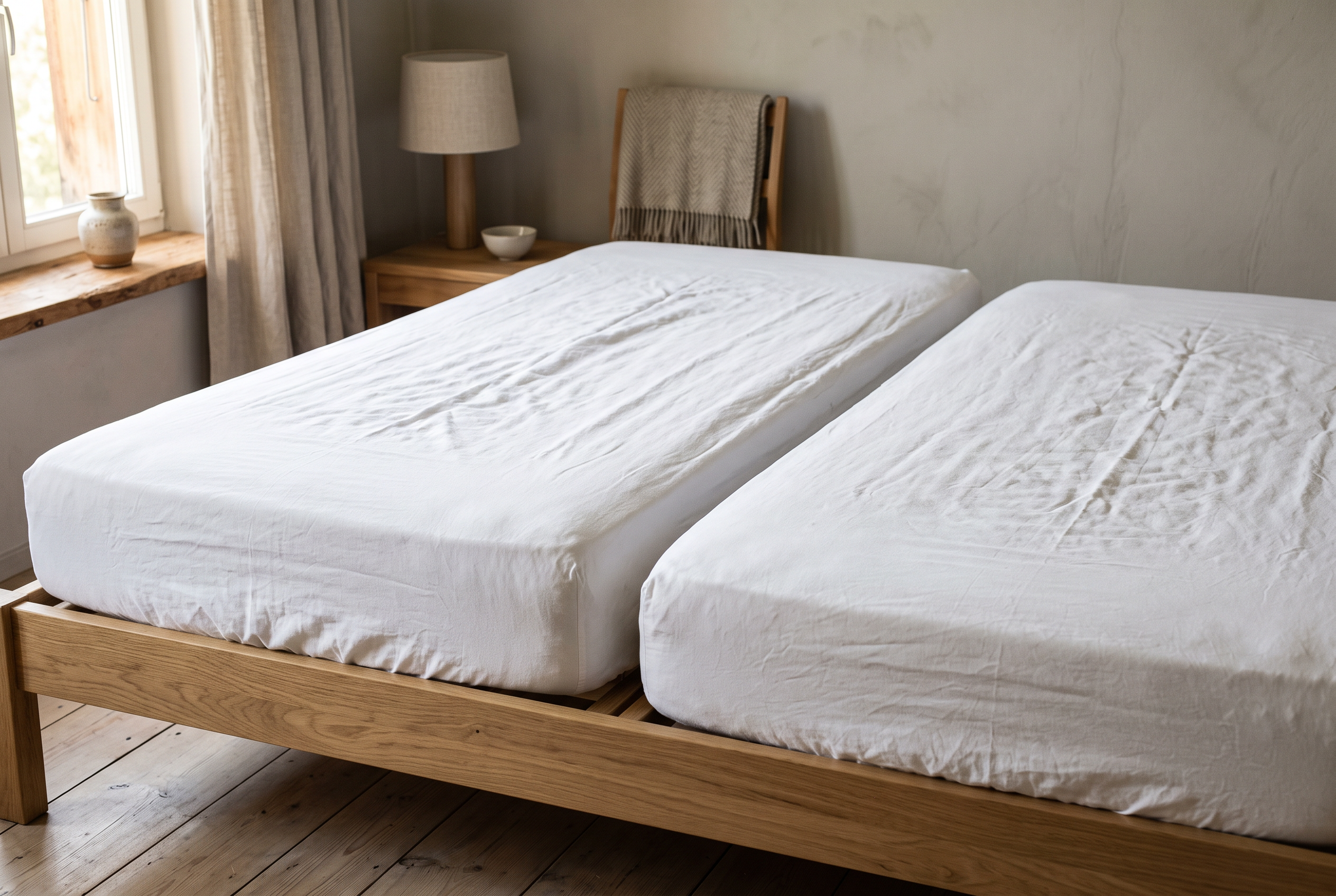
Compounding the problem, the two mattresses do not stay put in everyday use. When getting up, turning over, and changing sheets, they slowly drift apart. Without a central support or side restraints in the bed frame, the gap grows over weeks from a few millimeters to two or three centimeters. Therefore, anyone who wants to combat the gap must address two things: bridging the gap itself – and stopping the mattresses from drifting apart.
A third factor is often overlooked: differing mattress heights. If one side was replaced later or comes from a different series, a step is created in addition to the gap. This combination is significantly more disruptive than the gap alone and cannot be completely compensated for with any filler.
Solution 1: The Love Bridge
The "love bridge," also known as a gap filler or mattress wedge, is the most well-known solution. It is a wedge-shaped foam strip, typically 190 to 200 cm long, 10 to 15 cm wide, and triangular or trapezoidal in cross-section. It is placed in the gap with the wide side facing down. Many models come with an elastic tension strap that goes around both mattresses, pulling them together simultaneously.
The advantage lies in the price: CHF 30 to 60 is typical. Installation takes five minutes. The disadvantage is the feel. The wedge usually consists of significantly firmer foam than the mattresses themselves, as it would otherwise slip. Therefore, it is felt as a slightly harder zone in the middle. For people who mostly stay on their half, this is irrelevant. Those who consciously lie in the middle – for example, with a child between the parents – will notice the difference.
When purchasing, make sure the wedge fits the width of the gap. A filler that is too narrow will slip through, and one that is too wide will push the mattresses apart and create new edges. Measure the gap beforehand when loaded: Sit on one half of the mattress and then measure.

Solution 2: The Continuous Topper
A topper over both mattresses is the most technically convincing solution. It lies as a continuous layer over the gap, evenly distributes pressure, and visually and haptically transforms two mattresses into one sleeping surface. Heights between 5 and 8 cm are sensible. Below that, the gap will show through under pressure; above that, the topper changes the feel of the underlying mattresses more than desired.
A second advantage: The topper compensates for small height differences between the mattresses. If the step is 1 to 2 cm, it practically disappears under a 7 cm high layer. However, for larger differences, this also does not help – in that case, you should consider replacing one of the mattresses.
The correct size is important: The topper must cover the combined width, i.e., 160 × 200 cm or 180 × 200 cm. A two-piece topper would only shift the problem upwards. Expect to pay CHF 150 to 400 depending on material and quality. Details on construction and selection can be found in the Topper Guide.
Solution 3: The Oversized Fitted Sheet
A single fitted sheet over both mattresses is the simplest and cheapest measure. It mechanically pulls the mattresses together and prevents them from drifting apart over the course of weeks. For two mattresses of 90 × 200 cm, you need a sheet of 180 × 200 cm; for two of 80 × 200 cm, one of 160 × 200 cm – each with sufficient depth for the mattress thickness.
The catch: A sheet covers the gap, but does not fill it. As soon as weight rests in the middle, the fabric gives way and the gap becomes noticeable again. As a sole measure, this is only sufficient if the gap is already narrow. In combination with a love bridge, however, it yields a very good result: The wedge fills, the sheet holds it together. What you should look for in a sheet can be found under the right fitted sheet.
The Solutions Compared
| Solution | Effect | Approximate Cost | Suitable for |
|---|---|---|---|
| Love Bridge | Fills the gap, remains slightly noticeable | CHF 30–60 | Quick, inexpensive remedy |
| Continuous Topper | Completely covers gap and small differences in height | CHF 150–400 | Best everyday solution for couples |
| Oversized Sheet | Pulls mattresses together, does not fill | CHF 40–100 | Combination with wedge or topper |
| Continuous Mattress | Gap doesn't even form | New purchase | Permanent solution |
Myths Debunked
"The gap will disappear on its own over time." The opposite is true. Without fixation, the mattresses will drift further apart with every time you get up. After a few months, the gap will be wider than at the beginning, not narrower.
"Two mattresses are healthier for couples." This idea comes from the firmness level logic: everyone should have their own firmness level. However, firmness levels are not standardized and are defined differently by each manufacturer. A modern adaptive material reacts locally to the applied pressure and supports two bodies of different weights differently on the same surface. More on this in the article about the mattress for couples.
"A thick duvet will compensate for the gap." No. The duvet lies on top; the gap acts from below. What is missing is support, not warmth.
"Rolled towels in the gap also work." Short-term yes, long-term no. Fabric rolls compress overnight, slip, and attract moisture. Acceptable as a temporary solution for a week, not recommended as a permanent state.
Step-by-Step: Permanently Closing the Gap
Step 1 – Check the cause. Pull the mattresses together and measure the remaining gap. If it remains under 1 cm, fixation is usually sufficient. If it is wider, you need filling material.
Step 2 – Compare heights. Measure both mattresses at the same spot with a ruler. If the difference is more than 2 cm, plan for a replacement – no filler will compensate for that permanently.
Step 3 – Check the frame. Is there a central support or side restraint? If not, a tension strap or an oversized sheet is mandatory, otherwise the mattresses will continue to drift apart.
Step 4 – Insert filler. Place the love bridge with the wide side down into the gap and tighten the tension strap so that the mattresses noticeably move closer together without bulging.
Step 5 – Cover. Pull an oversized fitted sheet over both mattresses. Alternatively, place a continuous topper over them – in many cases, you can then do without the wedge.
Step 6 – Follow-up check. After two weeks, check if everything is still in place. The first few nights will show if the fixation holds.

If the gap remains: consider the mattress
All the solutions described are repairs to a fundamental problem. If you are already considering a mattress change, a continuous mattress solves the issue definitively. This is particularly worthwhile if your mattresses are already older than seven years or show initial indentations – we describe signs of this under recognizing a worn-out mattress.
An argument that previously spoke against the large version has now largely been refuted: motion transfer. Point-elastic foams only yield where pressure actually occurs. A partner's turn 50 cm away therefore usually goes unnoticed. Handling can also be planned: vacuum-packed mattresses even fit through narrow stairwells, as we describe under properly unpacking a mattress.
Get CHF 25 discount
Subscribe to our newsletter and receive a one-time CHF 25 discount. ✓ 200 nights trial sleep ✓ 10-year warranty
Frequently Asked Questions about the Visitor Gap
What is a visitor gap?
A visitor gap refers to the seam that forms between two adjacent single mattresses in a double bed. It is typically 1 to 3 cm wide and is felt as an edge or depression when lying in the middle of the bed.
What is better against the gap: a love bridge or a topper?
A continuous topper of 5 to 8 cm height is more reliable because it completely covers the gap and additionally compensates for small height differences between the mattresses. The love bridge is significantly cheaper but remains noticeable as a slightly firmer zone in the middle of the bed.
How long should a love bridge be?
Typical gap fillers are 190 to 200 cm long and thus designed for standard mattresses of 200 cm length. For extra-long mattresses of 220 cm, you need a correspondingly longer version or two pieces placed end-to-end.
Why do my mattresses keep drifting apart?
Because they lack lateral guidance. Bed frames without a central support or without an all-around restraint allow the mattresses to slip a bit with every movement. A tension strap around both mattresses or an oversized fitted sheet reliably holds them together.
Can I compensate for two mattresses of different heights with a topper?
Up to about 2 cm difference in height, a 7 cm high topper will virtually completely level the step. For larger differences, the edge will remain noticeable. In this case, replacing the lower mattress is the better solution.
Does the visitor gap really disappear with a continuous mattress?
Yes, because then no gap exists at all. The prerequisite is that the underlying slatted frames butt up against each other flush and are at the same height. If there is a large gap between them, the mattress may sag slightly in the middle.









Leave a comment
This site is protected by hCaptcha and the hCaptcha Privacy Policy and Terms of Service apply.