
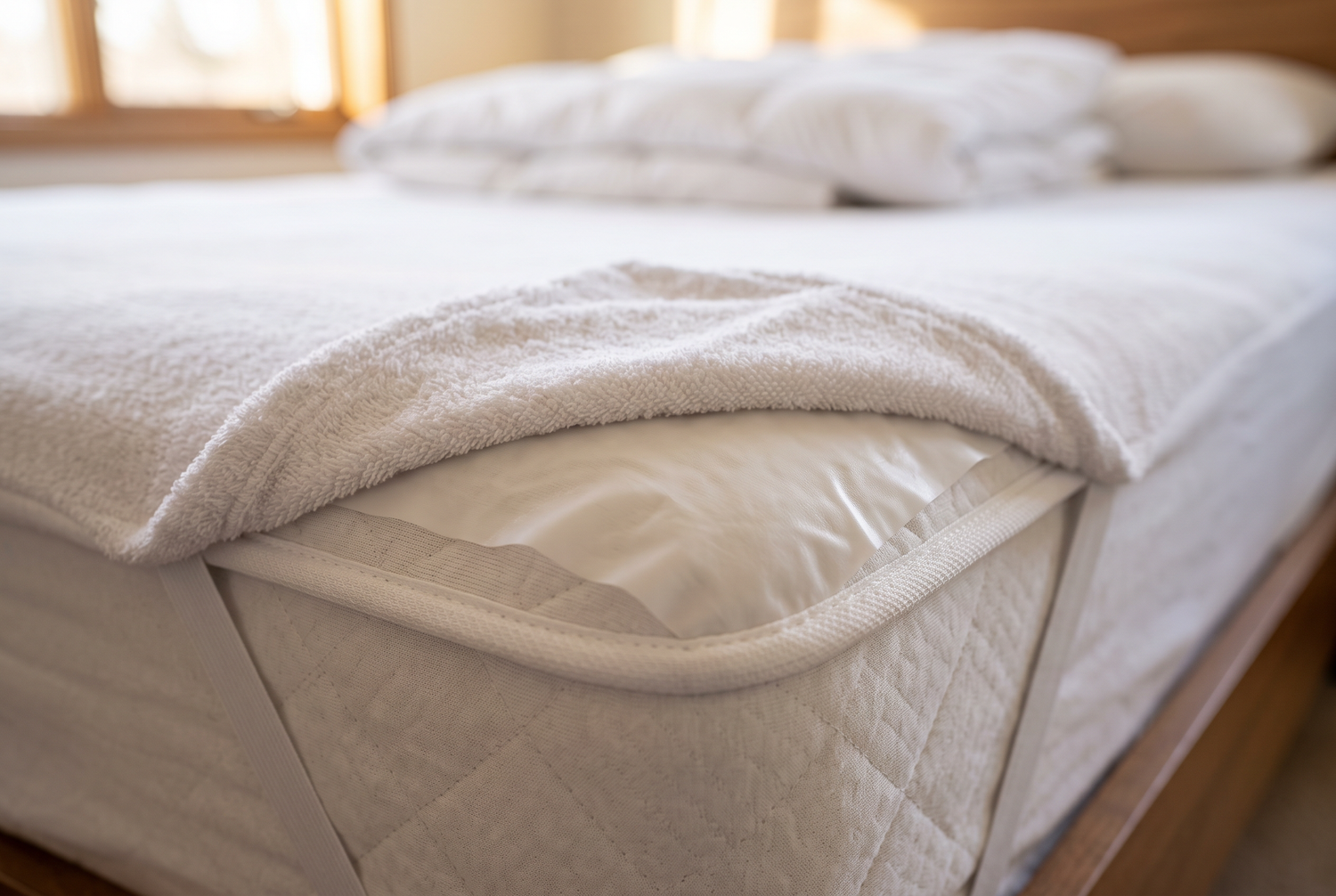
A child's mattress has a tough life: nighttime accidents during potty training, spilled water bottles, stomach bugs, sweat, and eventually the first overnight guests. Without protection, all of this goes directly into the mattress core – leaving stains, odors, and hygiene problems that can hardly be completely removed. A waterproof mattress protector is therefore perhaps the most sensible investment around the bed for families with small children – for 30 to 60 Swiss francs, it protects a mattress worth several hundred francs for years. But the offerings are confusing: terry cloth or molleton, PU membrane or coating, fitted protector or insert? And how do you prevent a "rubber sheet" from rustling and causing sweating? This guide provides an overview – with material comparisons, size advice, washing instructions, and the most common mistakes in handling waterproof mattress protection.
The short answer: The best choice for children is a fitted protector made of cotton terry cloth or molleton with a laminated polyurethane membrane: it is 100 percent waterproof, yet breathable and silent – unlike the rustling plastic films of previous generations. Important features are the right size with an elasticated skirt (e.g., 70×140 or 90×200 cm), washability at a minimum of 60 °C, and tumble drying suitability at a low temperature. For the potty training phase, it's worth buying two protectors for a double-layer system.
- Modern protectors combine an absorbent surface (terry/molleton) with a thin PU membrane: waterproof, breathable, silent.
- 60°C washability is a must – for hygiene after accidents and against dust mite allergens.
- Fitted protectors with elastic do not slip – important for active sleepers; insert protectors are only suitable as an additional layer.
- Two protectors in a layered system make nighttime changes for bedwetting a five-minute affair.
- Properly cared for, a good protector lasts 3–5 years – fabric softener and hot drying destroy the membrane prematurely.
How does a waterproof mattress protector work?
The core of modern protectors is a wafer-thin membrane made of polyurethane (PU), which is laminated onto a textile surface. This membrane works on the same principle as functional jackets: liquid water cannot penetrate it, but water vapor – i.e., body moisture – diffuses through. The result is protection that holds tight without the bed feeling like a plastic bag. The textile layer above has two tasks: it quickly absorbs liquid and distributes it so that nothing runs off the sides, and it ensures a pleasant, dry sleeping feeling. Cotton terry cloth absorbs a particularly large amount of liquid (up to several times its own weight), molleton – a cotton fabric brushed on both sides – is thinner, quieter, and bulges less. Older constructions with PVC film or rubber are not recommended: they rustle, trap heat, make children sweat, and sometimes contain plasticizers. When buying for children's beds, it is important to check for harmful substances, for example with OEKO-TEX Standard 100.
The variants in comparison: protector, insert, encasing, fitted sheet
The market offers four basic types of moisture protection – with clearly different uses:
| Type | Attachment | Strengths | Limitations |
|---|---|---|---|
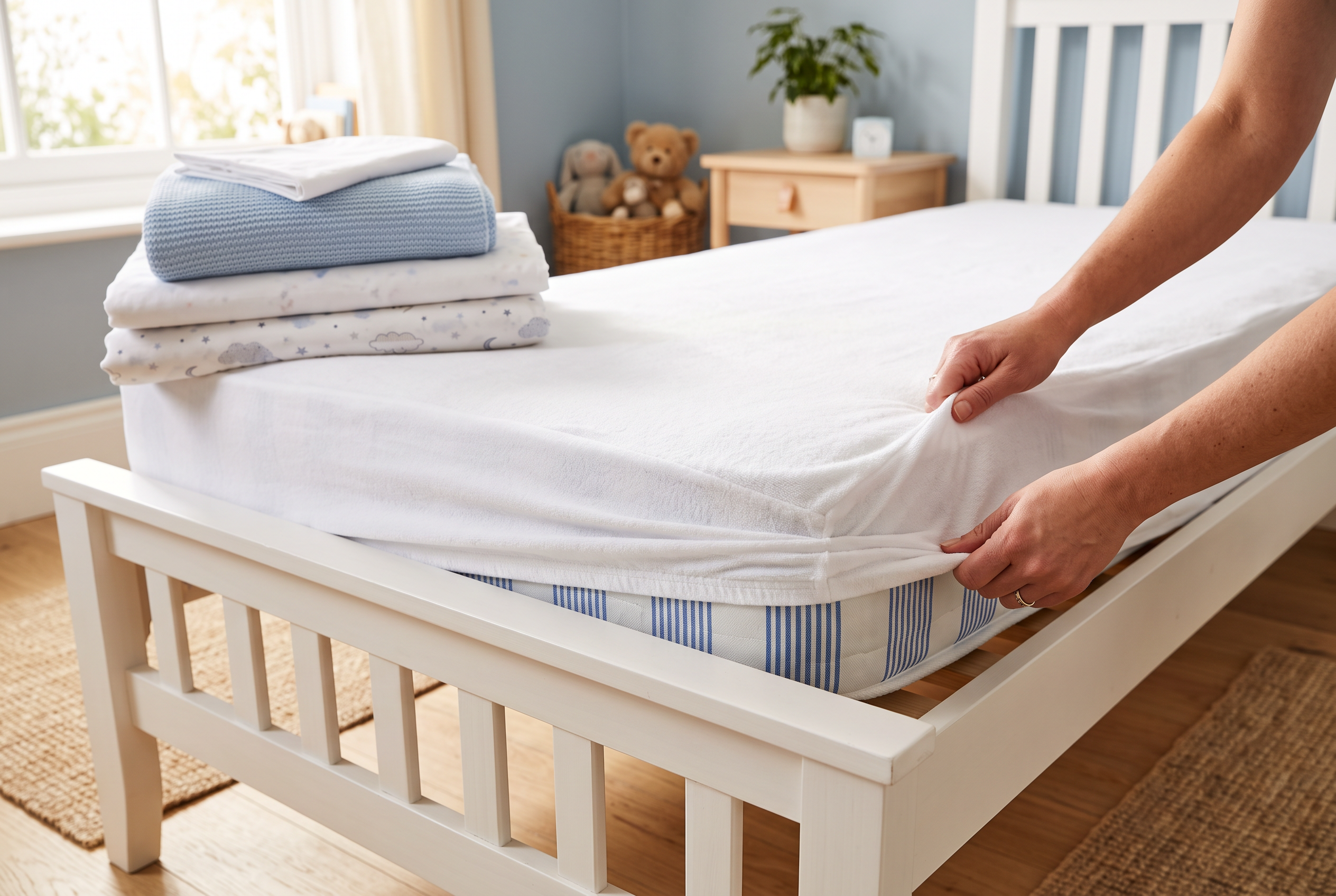
| Fitted protector with membrane | Elastic band all around | Non-slip, full-surface protection, silent | Sides of the mattress remain unprotected |
| Insert/Quilted protector | Loose or corner elastics | Quick to change, ideal as a 2nd layer in a layered system | Can slip with restless sleepers |
| Encasing (full cover) | Zipper, encloses everything | Also protects sides and bottom, dust mite proof | More elaborate to change – more basic than everyday protection |
| Waterproof fitted sheet | Like a normal fitted sheet | 2-in-1: sheet and protection in one | Lower absorbency than terry cloth protectors |
For everyday use in the children's room, the combination has proven effective: a fitted protector as permanent protection, with the normal sheet over it – and during intensive phases (potty training, stomach bug season) a second protector-sheet layer on top. How this layered system shortens nighttime changes to five minutes is shown in the article on bedwetting; the allergen-proof variant is explained in detail in the guide Mattress Protector and Encasing.

Size and fit: what matters
The protector must exactly match the mattress size – usually 60×120 or 70×140 cm in a cot and toddler bed, 70×160 cm in a junior bed, and from the large child's bed onwards 90×200 cm. Pay attention to the depth of the elasticated skirt: for children's mattresses with a height of 10–12 cm, shallow skirts are sufficient; for adult mattresses from 20 cm, correspondingly deep ones are needed. Protectors that are too small will stretch and tear at the corners; those that are too large will wrinkle – and wrinkles are not only uncomfortable but also channel liquid unintentionally to the edge. If you want to protect a co-sleeper or crib, you will also find suitable small sizes (e.g., 50×90 cm); especially for babies, however, the protector must also be tight and wrinkle-free and must not noticeably change the firmness of the surface – the safety rules from the article Baby Mattress and Safety still apply without restriction. For the transitional age, it is worth looking at grow-with-me solutions: a 90×200 protector can accompany the child from their first big bed into their teenage years.
Washing and care: how to keep the protector waterproof
A waterproof protector is only as good as its care – and the most common cause of leaky protectors is incorrect washing. The rules: wash at 60 °C (kills mites, removes odors and allergens), use mild detergent or heavy-duty detergent without fabric softener – fabric softener leaves a film on the membrane, reduces absorbency and makes the material brittle over time. Also taboo: bleach and ironing directly on the membrane side. In the dryer, use a low temperature (gentle cycle); too hot drying can cause the PU layer to stick together or bubble. The most gentle way to dry the protector is on the line – thanks to the thin membrane, it is usually dry overnight. Wash new protectors once before first use, then every one to two weeks in line with your sheets, and immediately after accidents. With this care, a good protector lasts three to five years; annually test its impermeability with a glass of water on the protector (let it sit for 10 minutes) to see if the membrane is still waterproof. The guide Cleaning Your Mattress shows you how to keep the mattress underneath generally clean.
Common mistakes in mattress protection for children
Mistake one: the cheap plastic sheet. It keeps things dry, but the child sweats, the bed rustles with every movement – and poor sleep is a high price for ten francs saved. Mistake two: owning only one protector. After a nighttime accident, you're left without a replacement; two protectors enable the layered system and bridge washing days. Mistake three: placing the protector under the encasing – the absorbent layer belongs on top, directly under the sheet, otherwise liquid will first penetrate the encasing. Mistake four: fabric softener and hot washing – both gradually ruin the membrane, often unnoticed, until the mattress gets wet anyway. Mistake five: using the protector as a permanent solution for an already dirty, sagging mattress. The protector then only preserves the poor condition; as soon as sags are noticeable or odors persist despite cleaning, a fresh mattress is the more hygienic basis. And mistake six: declaring the topic closed after successful potty training – experienced parents leave the protector on the mattress well into school age; it doesn't bother anyone and reliably helps with infections and spilled drinks.
Is protection also worthwhile for adult and guest beds?
Yes – for the same reasons, just with different triggers. In the parents' bed, toddlers come for cuddles, sick children for comfort, and morning coffee dangerously close to the duvet; in the guest bed, the protector additionally protects the mattress from dust and moisture between rare uses. A high-quality mattress stays hygienically fresh with protection throughout its lifespan – this also maintains warranty claims, as heavy soiling can jeopardize them. Practical: For mattresses with a removable, washable cover, the combination of a washable cover plus protector creates a double hygiene system where each layer can be cleaned separately.
Get CHF 25 discount
Subscribe to our newsletter and get a one-time CHF 25 discount. ✓ 200 nights trial sleep ✓ 10 years warranty

Frequently asked questions about waterproof mattress protectors
Do you sweat on a waterproof mattress protector?
Not on modern protectors with a breathable PU membrane: they allow water vapor to pass through and only retain liquid water. Sweating and rustling are typical of outdated PVC or rubber protectors – these are not recommended.
What size protector do I need for a child's bed?
It must exactly match the mattress size: usually 70×140 cm in cot and toddler beds, 70×160 cm in junior beds, and 90×200 cm in large children's beds. Additionally, an elasticated skirt that matches the mattress height is important so that nothing slips.
At what temperature should waterproof protectors be washed?
At 60 °C – this reliably removes odors, bacteria, and dust mite allergens. Avoid fabric softener and bleach and only tumble dry at a low temperature, otherwise the membrane will become leaky over time.
How long does a waterproof mattress protector last?
With proper care, three to five years. Test its impermeability annually with a little water on the surface; if the underside becomes damp or the membrane shows bubbles and cracks, replacement is due.
Protector or encasing – which is better for children?
For everyday moisture protection, the fitted protector: it is quick to change and easy to wash. An encasing encloses the entire mattress and is the right choice if there is also a dust mite allergy – both can be combined.
Does the protector change the feel of the bed?
High-quality thin protectors with a terry cloth or molleton surface are hardly noticeable and do not alter the support properties of the mattress. Thick quilted protectors can make the lying feeling slightly softer – for baby mattresses, it is important to ensure a tight, wrinkle-free fit.







Leave a comment
This site is protected by hCaptcha and the hCaptcha Privacy Policy and Terms of Service apply.