
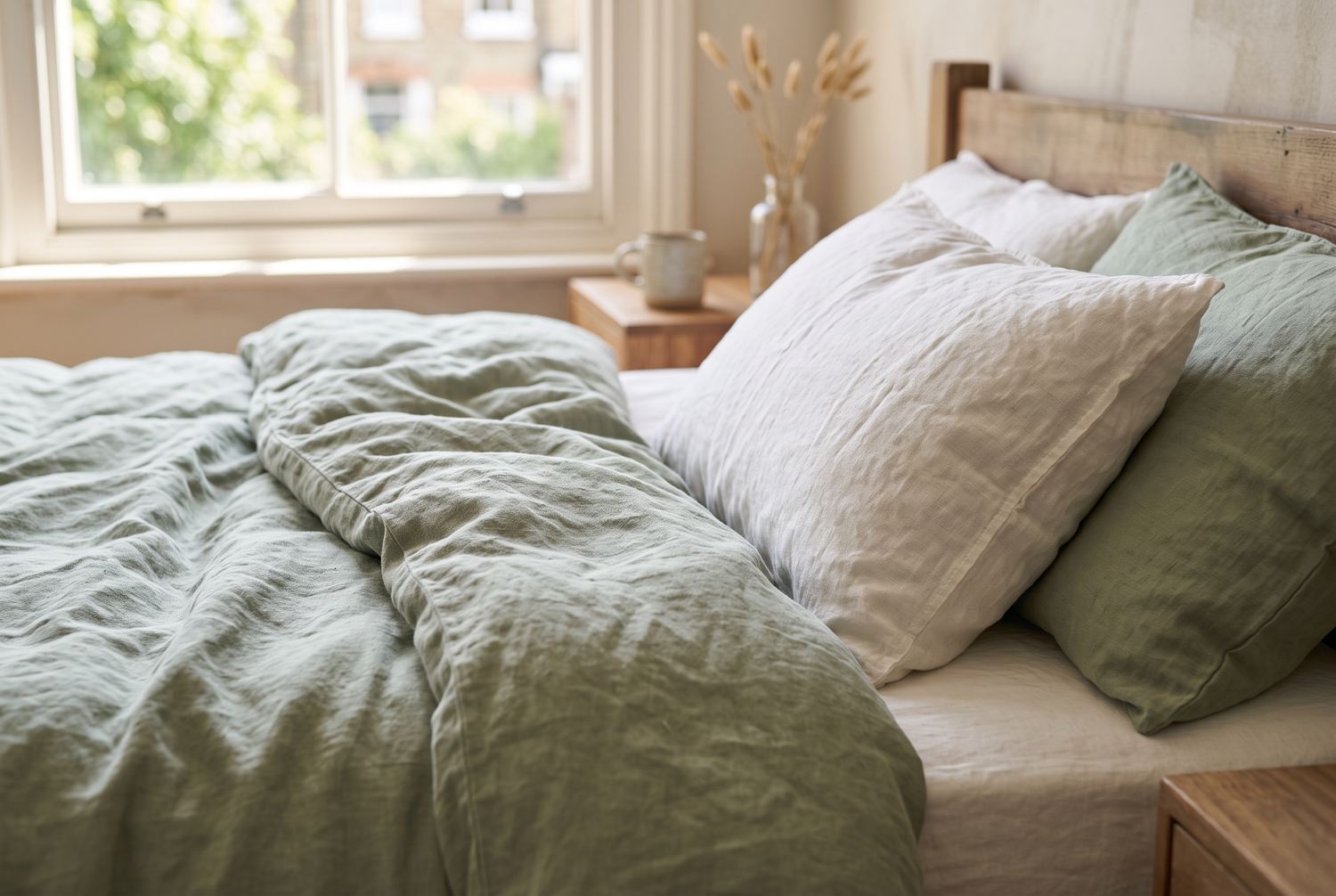
Tropical nights with temperatures over 20 °C are no longer a rarity in Switzerland – meteorologists now count several per summer in Basel and Ticino. If you then lie under a winter duvet and microfiber bedding, you wake up drenched in sweat. This is because the body needs to lower its core temperature by about 0.5 to 1 °C to fall asleep, and this only works if heat and moisture can escape from the bed. The right summer bedding is an underestimated lever: there can be a perceived difference of several degrees between dense satin with polyester content and airy linen. This guide compares the most important materials with specific grammages, explains why duvets, fitted sheets, and mattresses also play a decisive role, and shows how to make your bed summer-ready in 15 minutes – without air conditioning.
The short answer: For hot nights, linen and cotton percale are the best bedding fabrics: both are breathable, absorb a lot of moisture, and feel cool. Seersucker scores with its wrinkle-free structure and minimal skin contact, while cotton satin is smooth and cool, but a bit denser. Microfiber and polyester blends should be avoided – they trap heat and moisture. This also includes a light summer duvet (reduced fill power or wild silk/cotton) and a breathable fitted sheet.
- Linen and percale (100–120 g/m²) are the coolest bedding fabrics; microfiber traps heat and should not be used in summer beds.
- The body releases 300–500 ml of moisture per night – significantly more in summer; natural fibers absorb up to a third of their weight in moisture without feeling wet.
- Summer duvets typically have a fill weight of 150–300 g (135×200 cm) compared to 600–900 g for winter duvets.
- Fitted sheets and mattresses also count: breathable materials and good under-ventilation prevent heat build-up from below.
- Wash bedding every 1–2 weeks at 60 °C in summer – sweat and dust mites thrive in warm and humid conditions.
Why bedding determines sleep quality in summer
To fall asleep, the body lowers its core temperature by releasing heat through the skin – especially through the hands and feet. If the room temperature is above 24 °C and the bed is additionally covered with dense synthetic fabrics, this heat cannot escape: the falling asleep process is delayed, the proportion of deep sleep decreases, and you wake up more often. Studies on the sleep environment show that even a slight increase in bed climate temperature measurably increases the number of awakenings. In addition, there is moisture: on warm nights, an adult easily sweats half a liter or more. If the bedding cannot absorb and wick away this amount, the familiar clammy feeling arises – and with it, restless sleep. The ideal sleeping temperature of 16–18 °C is difficult to achieve in midsummer; it is all the more important that bedding, duvet, and mattress support temperature regulation instead of hindering it. You can read about other ways to combat heat in the article Sleeping in hot weather.
Summer fabrics compared: Linen, percale, seersucker and co.
The differences between fabrics are greater than many think – fiber type, weave, and grammage (fabric weight per square meter) are crucial:
| Material | Grammage | Cooling effect | Special feature |
|---|---|---|---|
| Linen | 130–180 g/m² | very high | absorbs up to 35% moisture, feels cool, natural wrinkled look |
| Cotton percale | 100–120 g/m² | high | smooth, matte, crisp-fresh feel |
| Seersucker | approx. 120–140 g/m² | high | crepe structure only touches the skin at certain points, wrinkle-free |
| Cotton satin | 120–140 g/m² | medium to high | silky-smooth and supple, cool on initial contact |
| Jersey | 140–160 g/m² | medium | elastic and easy to care for, but warmer than percale |
| Microfiber/Polyester | variable | low | traps heat and moisture – unsuitable for summer nights |
A detailed comparison of all fabrics – also for winter and transition periods – can be found in the guide Comparison of bedding materials.

Duvet in summer: light, breathable – or omit entirely?
The most beautiful percale bedding is of little use if a winter duvet lies underneath. Summer duvets in 135 × 200 cm typically have a fill weight of 150–300 g – compared to 600–900 g for winter products. For down, it's worth looking at the fill power and fill quantity; for natural hair fillings, wild silk and camel hair are excellent moisture managers. Those who sweat heavily at night often do best with a thin cotton or linen blanket. Few people sleep well without any covering: the light weight on the body provides a sense of security, and the room often cools down towards morning. A proven trick for heat waves is to use the cover without an insert – simply use the empty duvet cover as a light blanket. More on choosing the right duvet throughout the year can be found in the article Duvet for summer and winter.
The underestimated role of fitted sheets and mattresses
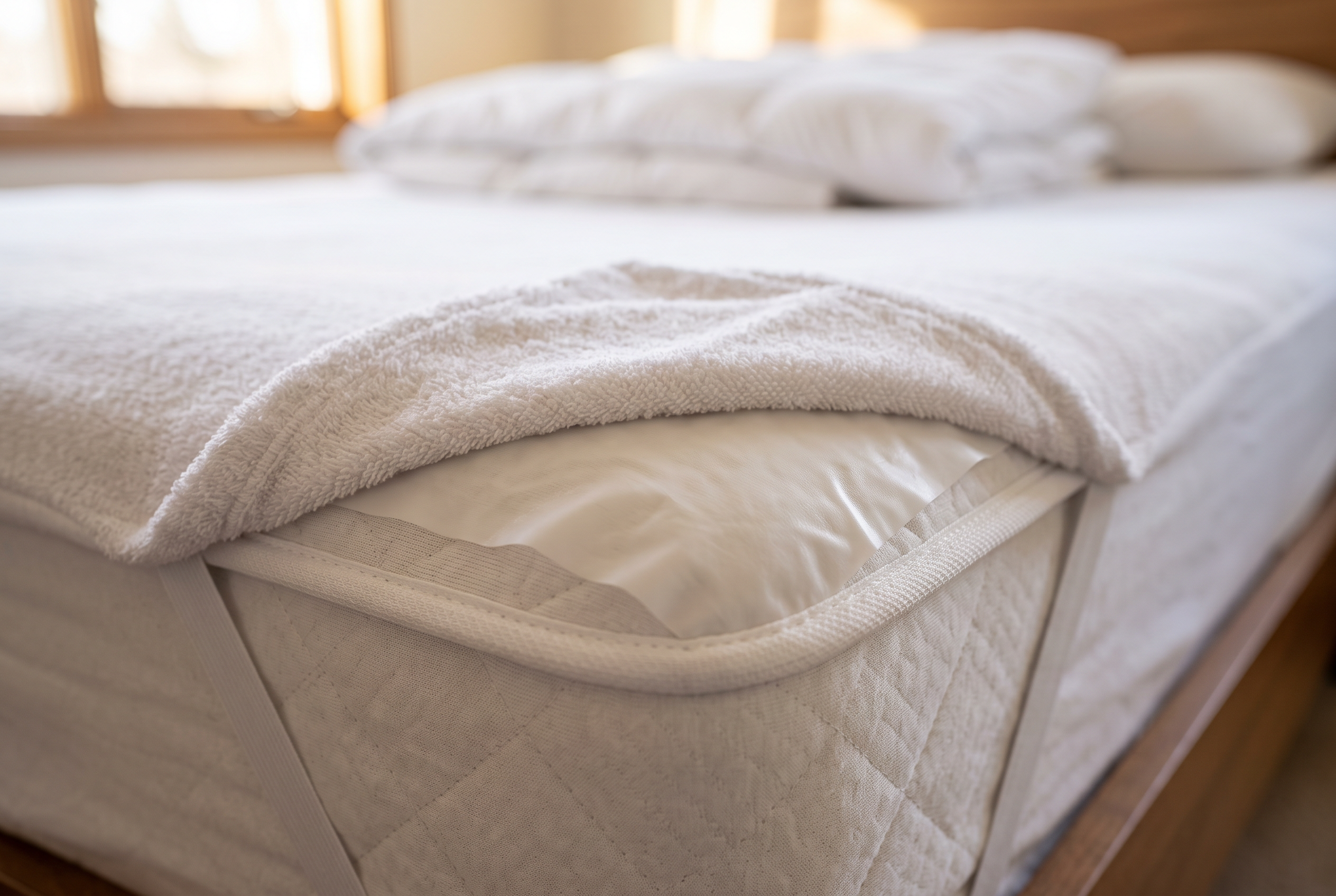
While covers and duvets receive a lot of attention, the underside of the sleeping climate is often forgotten. The fitted sheet lies directly under the body and must absorb most of the sweat: cotton jersey or percale are good here, while terry stretch with a high polyester content is rather unsuitable. The mattress itself also significantly influences the perception of temperature: an open-pored, breathable foam wicks heat and moisture downwards, while dense, closed materials trap it. Under-ventilation is also important – a slatted frame with sufficient gaps allows the mattress to dry overnight. If you frequently wake up on a damp sheet in the morning, you should occasionally uncover the mattress during the day (fold back the duvet instead of making the bed immediately) – this way, the nocturnal 300–500 ml of moisture evaporate more quickly. Further measures for a cool bedroom, from blind management to cross-ventilation, are described in the guide Cooling the bedroom in summer.
Common mistakes with summer bedding
The most common mistake: falling for "cooling" marketing promises for synthetic fabrics. Many covers advertised as "cooling" feel briefly cool in the store, but trap moisture in bed – the fiber is crucial, not the advertising text. Mistake two: ignoring the fitted sheet and only changing the cover. Mistake three: not washing often enough. In summer, sweat, skin flakes, and dust mite allergens accumulate much faster – changing every one to two weeks and washing at 60 °C are now advisable; how often it otherwise needs to be done is shown in the article How often to change bedding? Mistake four: drying dark bedding in sunlight and then putting it straight on – it stores heat; it's better to dry it in the shade. And mistake five: "parking" the duvet in the bed in summer. A winter duvet stored in the wardrobe makes the bed noticeably cooler and the room visually calmer.
Practice: making the bed summer-ready in 15 minutes
Firstly: remove the winter duvet, air it out, and store it in a vacuum bag or cotton cover. Secondly: cover a summer duvet or light cotton blanket – ideally with a percale or linen cover. Thirdly: switch the fitted sheet to cotton or linen and let the mattress air out for an hour when changing the laundry. Fourthly: check pillows – heavily filled down pillows store heat, a flatter pillow with a breathable cover sleeps cooler in summer. Fifthly: close blinds during the day, ventilate thoroughly in the evening, and the bedroom remains tolerable even during heat waves. Anyone who implements all this will lower the perceived bed temperature by several degrees – without spending a franc on electricity.
Get CHF 25 discount
Subscribe to the newsletter and receive a one-time CHF 25 discount. ✓ 200 nights trial sleep ✓ 10 years warranty

Frequently asked questions about summer bedding
Which bedding is the coolest in summer?
Linen and cotton percale are considered the coolest materials: both are breathable, absorb a lot of moisture, and feel fresh. Seersucker is also a good choice thanks to its crepe structure, as it only touches the skin at certain points.
Is satin bedding suitable for summer?
Cotton satin yes – it feels cool and smooth on initial contact and is breathable. Polyester satin, on the other hand, traps heat and moisture. The fiber is crucial: 100 percent cotton or linen instead of synthetics.
How often should bedding be changed in summer?
Every one to two weeks, or weekly if you sweat a lot. Ideally, wash covers and fitted sheets at 60 °C to reliably remove sweat residues and dust mite allergens.
Which duvet is needed in summer?
A light summer duvet with about 150–300 g fill weight (for 135 × 200 cm) or a thin cotton or linen blanket. Wild silk and camel hair are particularly good moisture managers for people who sweat at night.
Why do I wake up sweaty despite light bedding?
Often, it's due to the fitted sheet, mattress, or room climate: synthetic sheets and dense, poorly ventilated mattresses trap heat from below. Also check room temperature and ventilation routine – and let the bed air out openly in the morning.
Does it help to sleep without a duvet?
Usually not permanently: the light weight of a blanket provides a sense of security for many people, and the room cools down towards morning. A very light blanket or the trick of using only the empty duvet cover as a blanket is better.









Leave a comment
This site is protected by hCaptcha and the hCaptcha Privacy Policy and Terms of Service apply.