
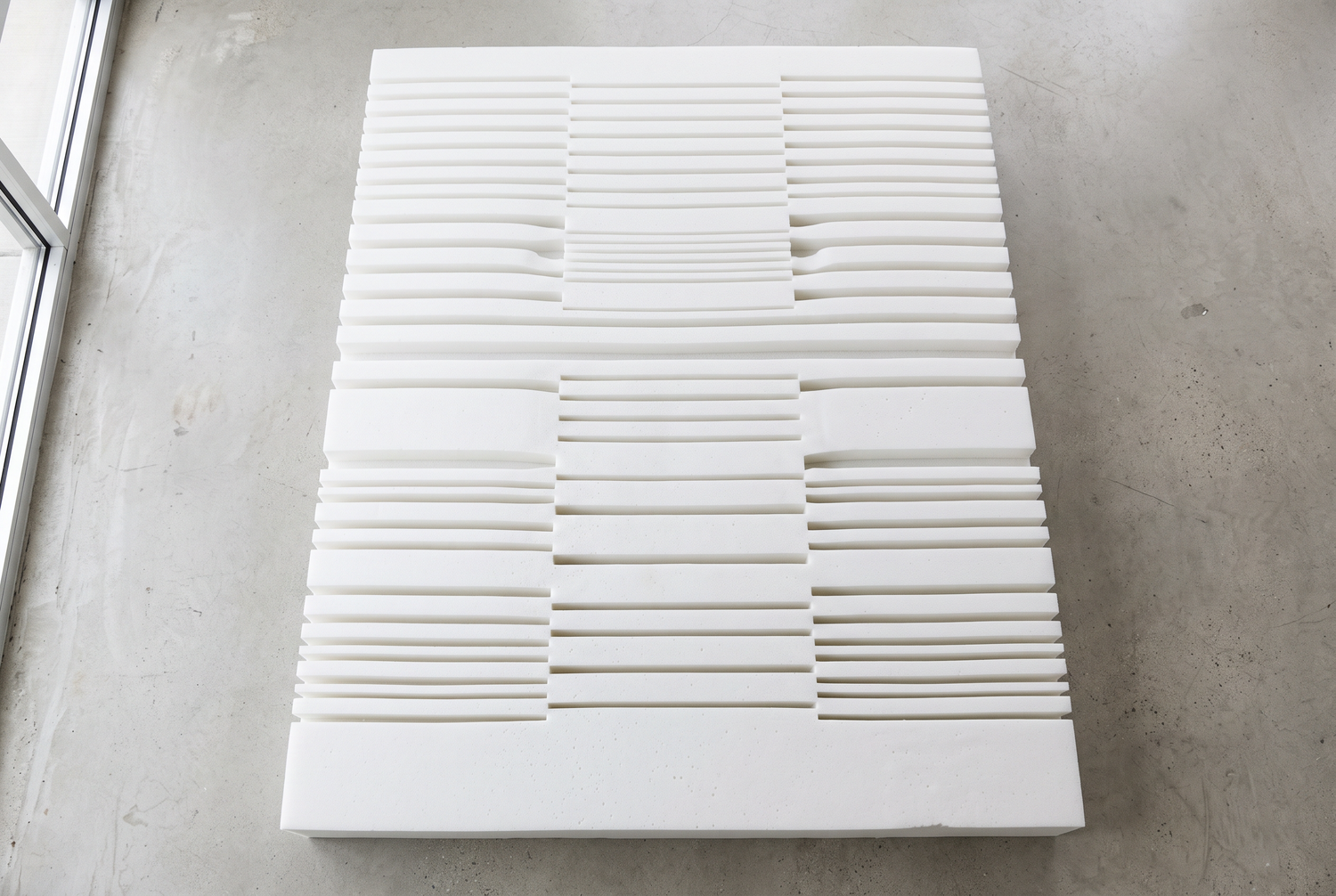
Hardly any mattress description comes without it: the 7-zone division. Head, shoulders, lumbar, pelvis, thighs, calves, feet – each area should react with a different firmness to optimally support the spine. Some manufacturers advertise with five zones, others with nine, and some even with eleven. This range alone indicates that there is no technical necessity behind it, but rather a design decision. Because there is no binding definition of where a zone begins and ends. The crucial question is therefore not how many zones a mattress has, but whether the zones even fit your body. This article categorizes zone technology and shows what really matters instead.
The short answer: Lying zones are areas of varying resilience, usually created by different depths of cuts in the foam or different spring strengths. The idea is sensible, the implementation often not: the zone positions are designed for an average person of about 170 to 180 cm in height. If you are significantly taller or shorter, the shoulder zone will be under your neck or your chest – and will then be more disruptive than helpful. There is no standard for zone number or position. More zones do not mean higher quality. Materials that adapt continuously solve the problem more elegantly.
- There is no standard for the number, position, or strength of lying zones.
- Zones are designed for an average height of around 170–180 cm.
- If your body height deviates, the zones will be in the wrong place.
- More zones are not better – 5, 7, or 9 are design decisions.
- Zoned mattresses must not be rotated head-to-foot, only flipped.
How lying zones are technically created
For foam mattresses, zones are created by cuts of varying depth and width in the core. A cube cut in the shoulder zone – i.e., cuts in both directions – makes the material significantly more flexible because individual foam blocks can sink in more independently. A pure cross-cut in the pelvic zone retains more support. Some manufacturers also vary the foam density per zone, which is more complex and expensive. For pocket spring mattresses, different wire gauges or spring heights are used along the length of the mattress. For latex, pin diameters and perforation patterns are varied. The usual division from top to bottom is: head, shoulder (softer), lumbar (firmer), pelvis (firm), thighs, calves, feet. The two zones that make a noticeable difference are the shoulder and pelvis – in a side-lying position, approximately 30 to 35 percent of body weight rests there. All other zones contribute barely measurably to spinal alignment. For more on this, see the article Mattress types compared.
The fundamental problem: zones are rigid, bodies are not
The zone positions are fixed ex-works. On a 200 cm long mattress, the shoulder zone typically lies between 30 and 55 cm from the head end. This division suits a person of about 170 to 180 cm in height. If you are 195 cm tall, your shoulder will shift about 8 to 12 cm downwards – it will then partly rest on the firmer lumbar zone. If you are 158 cm tall, your shoulder will be more in the head area, and the soft shoulder zone will support your chest, which can lead to an unstable lying feeling. In addition, those who do not sleep in the middle but rather towards the edge or lie diagonally will deviate from the zone logic anyway. And when changing from a side to a back position, the pressure points change completely, while the zones remain unchanged. An adult changes position 20 to 60 times per night – the mattress remains rigid. Incidentally, the same criticism applies to firmness levels, as our article Why firmness levels are outdated shows.

Myths fact-checked
"More zones mean better adaptation"
False. Beyond about three to five appropriately placed zones, any further subdivision provides practically no measurable additional benefit. Nine or eleven zones are primarily a sales argument. What matters is how strongly the shoulder and pelvic areas actually differ – not how many lines are drawn on the foam.
"Zones are standardized"
No. Neither the number of zones, their position, nor their firmness differences are bindingly defined anywhere. Two 7-zone mattresses can have completely different zone patterns.
"A zoned mattress can be turned in any direction"
No. Zoned mattresses can only be flipped lengthwise or rotated 180 degrees if the zones are symmetrically arranged. With asymmetrical zoning, the shoulder zone would end up at the foot end. What makes sense when is explained in Turning or flipping a mattress.
"No ergonomic support without zones"
No. A point-elastic material creates its "zones" where pressure actually occurs – regardless of body size and sleeping position.
Zone concepts compared
| Concept | How it works | Strength | Weakness |
|---|---|---|---|
| No zones | Uniform core | Can be rotated any way, uncomplicated | Dependent on point elasticity of the material |
| 3–5 zones | Shoulder softer, pelvis firmer | Covers the relevant areas | Position remains rigid |
| 7 zones | Finer division | Effective marketing | Hardly any additional benefit compared to 5 zones |
| 9–11 zones | Very fine division | Visually complex | No measurable advantage |
| Adaptive material | Continuous deformation | Adapts independently of body size | Higher material requirements |
How to check if the zones fit you
Step 1: Make zone boundaries visible. For foam mattresses, you can see the cuts after removing the cover. Use a tape measure to determine where the shoulder zone begins and ends – typically between 30 and 55 cm from the head end. Step 2: Measure your own shoulder position. Lie down normally and have someone mark where your shoulder joint rests, measured from the head end of the mattress. If the values differ by more than 8 to 10 cm, the zoning is not working for you. Step 3: Spinal test. When lying on your side, your spine should form a straight line. If your hips sag or there is a gap between your waist and the mattress, the alignment is incorrect. Step 4: Test position changes. Turn several times from your side to your back and vice versa. If you feel edges or sagging at the zone transitions, the zoning is too coarsely implemented. Step 5: Assess over several weeks. Allow 14 to 30 nights for getting used to it. For couples, additionally: if both are of different heights, zoning can only be correct for one person – see Mattress for couples.
The alternative: adaptation instead of predefined settings
The actual flaw in the zoning technique lies in the order of operations. It dictates where a body should yield before the body even lies on it. A point-elastic, adaptive material reverses this: it reacts where pressure actually occurs. If a 195 cm tall person lies on it, the soft spot forms under their shoulder – not 12 cm above it. If someone shifts from their side to their back, the deformation moves with them. If a couple with a 20-kilogram weight difference sleeps in the same bed, each side gets its own deformation. No zone cut in the world can achieve this, because it is physically fixed. This is practically relevant for a large group: everyone under 165 cm and over 185 cm tall, everyone with a pronounced shoulder-waist ratio, all position changers, and all couples with different body types. The question of durability remains – here, material density is still the decisive factor, see Foam density explained and Mattress lifespan. A zoned foam with RG 30 doesn't last longer just because it has seven strips.

Get CHF 25 discount
Subscribe to the newsletter and receive a one-time CHF 25 discount. ✓ 200 nights trial sleep ✓ 10 years warranty
Frequently asked questions about 7-zone mattresses
What are lying zones on a mattress?
Lying zones are areas of varying resilience along the length of the mattress. They are created by cuts of different depths in the foam, different spring strengths, or varying perforation patterns in latex. The goal is to allow the shoulder and pelvis to sink in differently.
Are 7 zones better than 5 zones?
No. Beyond about three to five appropriately placed zones, any further subdivision provides hardly any measurable additional benefit. The number of zones is a design decision and is not standardized anywhere – it is not suitable as a quality comparison between mattresses.
What body height are zones designed for?
The usual zone positions are based on a person of about 170 to 180 cm. If you are significantly taller or shorter, your shoulder will no longer be in the soft zone intended for it – the zoning will then be more disruptive than helpful.
Can I rotate a 7-zone mattress?
Flipping it lengthwise is usually possible, provided both sides are designated as sleeping surfaces. Rotating it 180 degrees is only sensible with symmetrical zoning – otherwise, the shoulder zone would end up at the foot end. Check the manufacturer's specifications.
Are zones necessary for ergonomic support?
Not necessarily. A point-elastic, adaptive material creates its resilience precisely where pressure occurs – regardless of body size and sleeping position. For many people, this is more practical than a factory-fixed zone division.
How do I know if the zones don't suit me?
Typical signs include sagging hips in a side-lying position, a noticeable gap between your waist and the mattress, or feeling edges and steps when changing position. Morning tension in the shoulder and neck area can also be an indication.









Leave a comment
This site is protected by hCaptcha and the hCaptcha Privacy Policy and Terms of Service apply.