
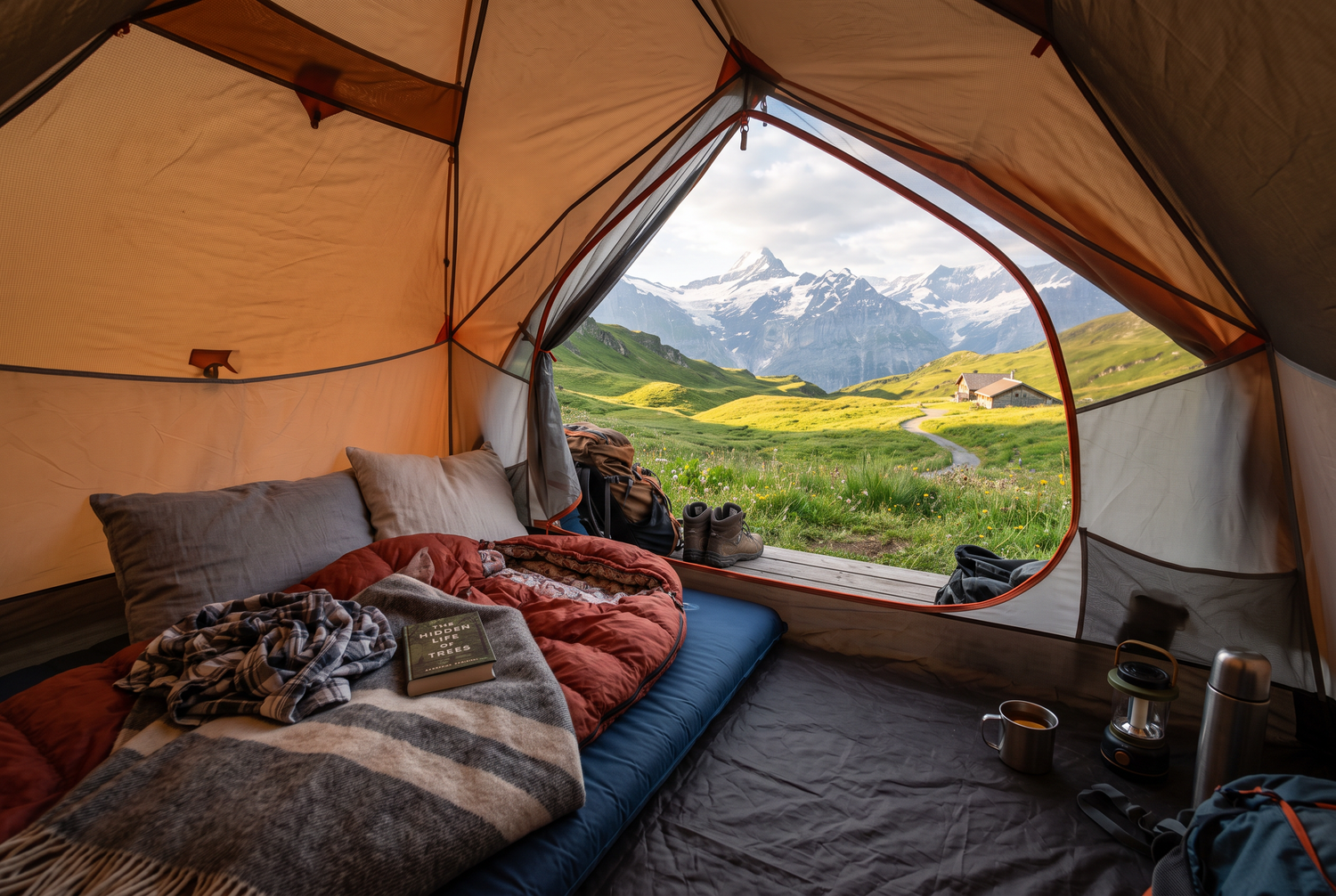
Camping promises closeness to nature – and often delivers one thing above all: bad nights. The ground radiates cold, the sleeping pad is too thin, at three o'clock the bladder wakes you up, at five the bird choir, and in the morning your back feels like after a moving day. Yet, experienced campers know: sleep in a tent can be really good – if the sleeping system is right. Because outdoors, the same basic rules apply as in the bedroom (insulation, support, darkness, quiet), only they have to be met with different means. The other side is also interesting: studies show that camping nights resynchronize the internal clock because natural light sets the rhythm. This guide explains how to set up your camp so that natural recovery doesn't fail due to equipment.
The short answer: Good camping sleep rests on three pillars: insulation from below (sleeping pad with a suitable R-value – for summer from 2, for spring/autumn from 3 to 4), warmth around the body (sleeping bag with a comfort temperature below the expected night temperature), and a good ground (level, wind-protected tent site without hollows and roots). Plus earplugs and a sleep mask against early brightness – then 7 to 8 hours of restful sleep are realistic even in a tent.
- The cold comes from below: the R-value of the sleeping pad is more important than the thickness of the sleeping bag.
- Choose a sleeping bag according to its comfort temperature – the extreme temperature on the label is a survival value, not a comfort value.
- The location matters: level, wind-protected, not in depressions (cold air pockets!) and with your head slightly uphill.
- In the tent, it quickly gets bright and warm after sunrise – a sleep mask and earplugs noticeably extend the night.
- Camping nights reset the internal clock: without artificial light, the sleep rhythm naturally shifts forward.
Insulation from below: the R-value decides
The most common beginner's mistake when camping is focusing on the sleeping bag while neglecting the pad. Yet, the body loses most heat downwards when lying down: its own weight compresses the sleeping bag filling under the back to just a few millimeters – there, practically only the pad insulates. Its insulation performance is indicated as an R-value: R 1 to 2 is sufficient for warm summer nights from about 15 °C ground temperature, R 3 to 4 covers spring and autumn, and from R 5, winter camping is also possible. Inflatable mats with 5 to 10 cm thickness also offer noticeable sleeping comfort and compensate for small unevennesses in the ground; self-inflating mats are more robust but heavier. For car campers without weight limits, thick camping mattresses or double air beds with toppers are the comfort solution. Important in cold weather: two mats on top of each other add their R-values – a cheap foam mat under the air mat works wonders and also protects against punctures.
Sleeping bag and clothing: the onion principle for the night
When it comes to sleeping bags, the comfort temperature matters – not the prominently advertised extreme temperature, which merely indicates at what cold a standard woman can survive 6 hours without cold damage. Choose the comfort temperature about 5 °C below the expected night temperature – in Swiss mountain regions, it cools down to 5 to 10 °C even in summer, and at 2000 meters, often towards freezing point. Down fillings insulate best per gram but lose their effectiveness when wet; synthetic fiber tolerates moisture and is easier to care for. Plus the onion principle: long merino underwear, warm socks, and a hat for cold nights – a lot of heat escapes through the uncovered head. Two proven tricks: a bottle filled with hot water in the foot area pre-warms the sleeping bag, and the clothes for the next morning sleep in the sleeping bag – so they are warm when you put them on. Not recommended: sleeping in a down jacket in the sleeping bag, as it compresses the filling and can even worsen insulation.

The tent site: small choice, big impact
Ten minutes of searching for a spot saves eight hours of bad sleep. Look for a level surface and clear away stones, cones, and branches – every unevenness you ignore during setup will find your hip at night. Slight slope? Then sleep with your head uphill, otherwise, you risk pressure in your head. Avoid depressions and hollows: cold air collects there at night (up to 5 °C colder), and in case of rain, water collects there first. Wind protection from bushes or terrain edges reduces cooling and tent flapping – but never camp directly under large trees with dead branches. Orient the tent entrance away from the wind and ventilate the tent briefly before sleeping: two people release up to a liter of moisture per night, which would otherwise drip as condensation from the tent wall. On campsites, also: keep your distance from sanitary buildings (light, slamming doors) and thoroughfares – the quietest pitches are usually at the edge.
Noise, light and early birds: taming the environment
A tent has zero sound insulation and hardly any light insulation – the same tools help here as in a hotel: earplugs dampen campsite noises, rustling neighbors and the morning bird chorus by 25 to 33 decibels; a sleep mask bridges the early brightness, because in midsummer it gets bright and quickly warm in the tent from 5:30 am. Those who are sensitive to unfamiliar noises benefit from quiet white noise via headphones – it covers the cracking in the undergrowth that otherwise keeps the brain on high alert; how this works is explained in the article on white noise. The opposite effect is interesting: without artificial light, natural light sets the rhythm – studies by the University of Colorado showed that after a few days of camping, melatonin onset shifts by about 2 hours earlier, and subjects became tired earlier and woke up earlier. Camping thus acts as a natural reset for the internal clock – an effect that particularly benefits people with shifted rhythms.
Camping sleeping systems in comparison
| System | Comfort | Weight/Pack Size | Suitable for |
|---|---|---|---|
| Foam sleeping pad (R 1–2) | low | 300–500 g, bulky | Summer, budget, as second layer |
| Inflatable mat 5–10 cm (R 2–4) | medium to high | 400–800 g, small | Trekking, 3 seasons |
| Self-inflating mat (R 3–5) | medium | 800–2000 g | Campsite, robust use |
| Camp bed + thin mat | high | 5–10 kg | Car camping, back problems |
| Camping mattress / air bed with topper | very high | from 3 kg, large | Car and permanent camping, families |
Secure a CHF 25 discount
Subscribe to our newsletter and receive a one-time CHF 25 discount. ✓ 200 nights trial sleep ✓ 10 years warranty
Common mistakes in camping sleep
Mistake one: skimping on the mat and investing in an expensive sleeping bag – the cold comes from below, not from above. Mistake two: relying on the extreme temperature of the sleeping bag; this is a survival value, not a comfort value. Mistake three: crawling into the sleeping bag with thick clothing that compresses the filling – better thin, dry merino layers. Mistake four: using an evening beer as a sleep aid; alcohol dilates blood vessels, causes the body to cool down faster, and also drives you out of the tent at night. Mistake five: drinking liters of liquid just before bed – better to hydrate throughout the afternoon and reduce fluid intake 2 hours before night. Mistake six: completely sealing the tent; without ventilation, breath moisture condenses and everything becomes damp. And mistake seven: giving up after the first mediocre night – just like in a hotel, there's a first-night effect in a tent that significantly diminishes from night two, once the brain has deemed the environment safe.

Frequent questions about sleeping while camping
Which R-value for a sleeping pad is correct for camping?
For warm summer nights, R 1 to 2 is sufficient; for spring and autumn, it should be R 3 to 4, and for winter camping, R 5 or higher. Two mats stacked add their R-values.
Why do I freeze in my sleeping bag, even though it should be warm enough?
The cold usually comes from below: your body weight compresses the sleeping bag filling under your back, so almost only the sleeping pad insulates there. A mat with a higher R-value often solves the problem better than a thicker sleeping bag.
What does the comfort temperature on a sleeping bag mean?
It indicates the ambient temperature down to which an average person can sleep comfortably warm. The extreme temperature, also indicated, is merely a survival value – for purchasing decisions, the comfort temperature is what matters.
Where is the best place to pitch a tent for good sleep?
On level, cleared ground, sheltered from the wind, but not in hollows where cold air and rainwater collect. If there's a slight slope, sleep with your head uphill and orient the entrance away from the wind.
Does camping really help with a shifted sleep rhythm?
Yes, studies show that without artificial light, daylight sets the pace, and melatonin onset shifts forward by about 2 hours within a few days. Many campers get tired earlier in the evening and wake up naturally earlier.
What helps against waking up early in a bright tent?
A sleep mask and earplugs: In midsummer, it gets bright and loud in the tent from about 5:30 AM. The mask blocks out the early light, and earplugs dampen bird chorus and campsite noises.








Leave a comment
This site is protected by hCaptcha and the hCaptcha Privacy Policy and Terms of Service apply.