
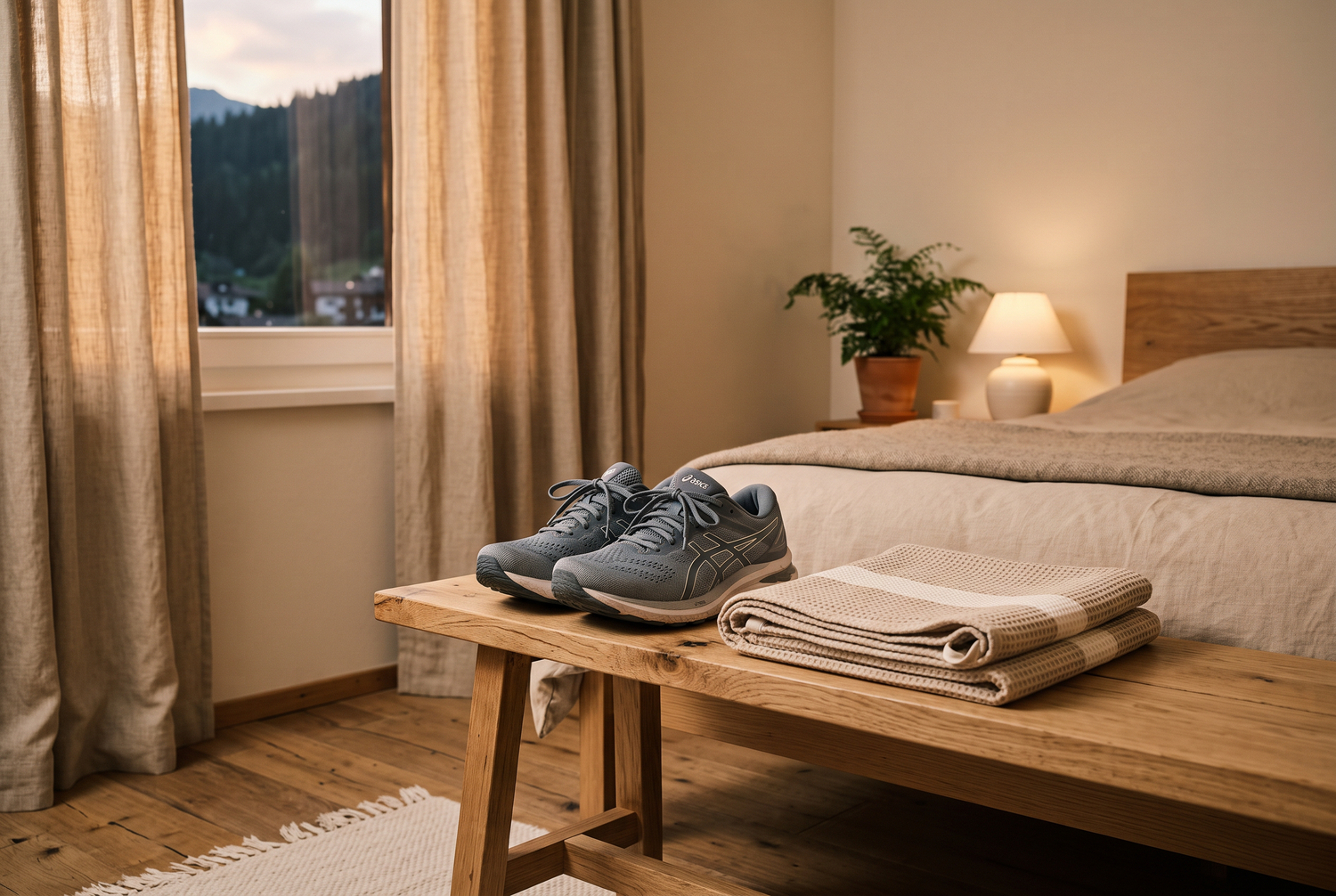
After a long day at work, many people only have time for exercise in the evening: the gym at 8 PM, a run after dinner, or a yoga mat before bed. At the same time, the warning that evening exercise disturbs sleep and that one should not train after 6 PM persists. Those who lie awake long after exercising rightly wonder if the movement is to blame. Research in recent years paints a much more relaxed picture than this old advice. The crucial factors are not the time of day alone, but rather the intensity, the time difference until falling asleep, and how well you wind down afterward. This article shows what is known about evening exercise and sleep and how to plan your evening workout so that it benefits rather than harms your night.
The short answer: Evening exercise does not disturb sleep for most people. On the contrary: regular physical activity shortens the time it takes to fall asleep and measurably improves sleep quality. Problems mainly arise with very intensive sessions in the last hour before bedtime. A practical rule of thumb is a gap of about 60 to 90 minutes between the end of the workout and lights out. Moderate exercise such as a brisk walk, gentle cycling, or calm stretching is unproblematic even shortly before bed.
- The blanket rule "no exercise after 6 PM" is not scientifically tenable.
- Plan a buffer of 60 to 90 minutes between intensive training and bedtime.
- Only very strenuous sessions shortly before bed significantly prolong the time it takes to fall asleep.
- Regular exercise improves deep sleep duration and continuous sleep – regardless of the time of day.
Why evening exercise was long considered a sleep killer
The recommendation comes from a time when the acute effect of exertion was primarily considered: during exercise, heart rate, core body temperature, and the release of adrenaline and cortisol all increase. All three factors are considered antagonists to falling asleep. From this, the simple conclusion was drawn that evening exercise puts the body into an awakened state from which it cannot recover in time. What was overlooked: these effects subside much faster than long assumed. With moderate exertion, heart rate usually normalizes within 20 to 30 minutes, and body temperature within about an hour. Only when there is practically no time between the last intense exertion and bedtime does the body remain measurably activated.
What research on evening exercise and sleep shows today
Summary evaluations of several studies largely come to the same conclusion: evening exercise on average does not worsen sleep but rather slightly improves it. Participants tend to fall asleep faster after evening exercise sessions and spend a slightly higher proportion of the night in deep sleep. The only consistently found disruptive effect concerns high-intensity training that ends less than an hour before bedtime – in these cases, the time it takes to fall asleep is prolonged by a few minutes on average, and the resting heart rate remains elevated during the first half of the night. The perspective is important: these effects are small compared to the benefits of regular exercise. Those who cancel their exercise because they only have time in the evening trade a minimal disadvantage for a significantly greater loss.

The role of body temperature
For you to fall asleep, your core body temperature must drop by a few tenths of a degree. Precisely this drop is one of the most important starting signals for sleep. Exercise briefly raises core temperature – and this can even be helpful: after training, a counter-regulation occurs, in which the body releases more heat than usual. So, if you plan a 90-minute buffer, you benefit from a particularly pronounced cooling down at the time of falling asleep. A cool bedroom helps: for most people, the ideal sleep temperature is between 16 and 19 degrees Celsius. A lukewarm, not hot, shower after exercise further accelerates cooling by promoting blood circulation to the skin.
Which type of sport when? A guide
Not all types of exercise have the same effect. As a rough guideline: the higher your heart rate and the more competitive the activity, the more buffer time you need. Quiet, rhythmic movements, on the other hand, tend to have a calming effect and can be part of a good evening routine.
| Activity | Recommended time before bedtime | Effect on sleep |
|---|---|---|
| Walk, quiet yoga, stretching | 0–30 minutes | Rather beneficial, reduces tension |
| Gentle cycling, swimming | approx. 60 minutes | Neutral to slightly positive |
| Strength training, steady-state running | 60–90 minutes | Neutral, if buffer time is maintained |
| Interval training, competition, team sports | at least 90–120 minutes | Can prolong the time it takes to fall asleep |
If you still lie awake after evening exercise
If sleep remains restless despite a buffer, it's worth looking at the circumstances rather than the sport itself. Common causes include a very late, heavy dinner, a protein shake with caffeine or guarana, bright gym lighting until shortly before driving home, and the habit of spending an hour on your phone immediately after training. Mental activation also plays a role: those who meticulously analyze their training data afterward keep their minds in performance mode. A conscious transition is helpful: warm shower, dimmed lights, a few minutes of calm breathing. Those who generally find it difficult to unwind can find the most important adjustments in our article on sleep hygiene.
How to integrate evening exercise sensibly into your daily routine
Start with your bedtime and work backward. If you want to sleep at 11 PM, an intense workout ideally ends at 9:30 PM, followed by a shower and dinner until about 10:15 PM. Keep dinner after exercise light and carbohydrate-focused, rather than eating very fatty foods. Dim the lights in the last hour and avoid caffeine from late afternoon onwards – you can find details on this in the article on caffeine and sleep. Test your personal limit over two to three weeks, instead of over-interpreting individual bad nights. And finally: without a comfortable sleeping surface, even the best schedule is of little use – recovery after sport happens on the mattress.

Get CHF 25 discount
Subscribe to our newsletter and receive a one-time CHF 25 discount. ✓ 200 nights trial sleep ✓ 10 years warranty
Frequently Asked Questions about Evening Exercise and Sleep
How long before bed should I stop exercising?
For intense training, a gap of about 60 to 90 minutes is recommended. After very strenuous sessions like interval training or competitions, it can be 90 to 120 minutes. Moderate exercise like a walk or gentle stretching can be done right before bed.
Is it true that you shouldn't exercise after 6 PM?
No, this rule is outdated. Studies show that evening exercise does not worsen sleep on average and can even slightly shorten the time it takes to fall asleep. The crucial factor is the time difference until bedtime and the intensity, not the clock time.
Why am I sometimes wide awake after evening exercise?
This is usually due to an elevated core body temperature, an active stress hormone system, and mental activation. Often, accompanying factors contribute: bright lights in the gym, caffeinated drinks, a late heavy dinner, or screen time immediately after exercise.
Does exercise improve deep sleep?
Regular physical activity in studies is associated with a higher proportion of deep sleep and less nocturnal awakening. This effect is particularly evident with continuous training over weeks, less so after a single session.
Is yoga in the evening better than strength training?
Quiet yoga with a focus on breathing and stretching has a calming effect and can easily be incorporated shortly before sleep. Strength training is not worse for sleep but requires more buffer time because heart rate and body temperature rise more significantly.
This article is for general information purposes only and does not replace medical advice.




Leave a comment
This site is protected by hCaptcha and the hCaptcha Privacy Policy and Terms of Service apply.