
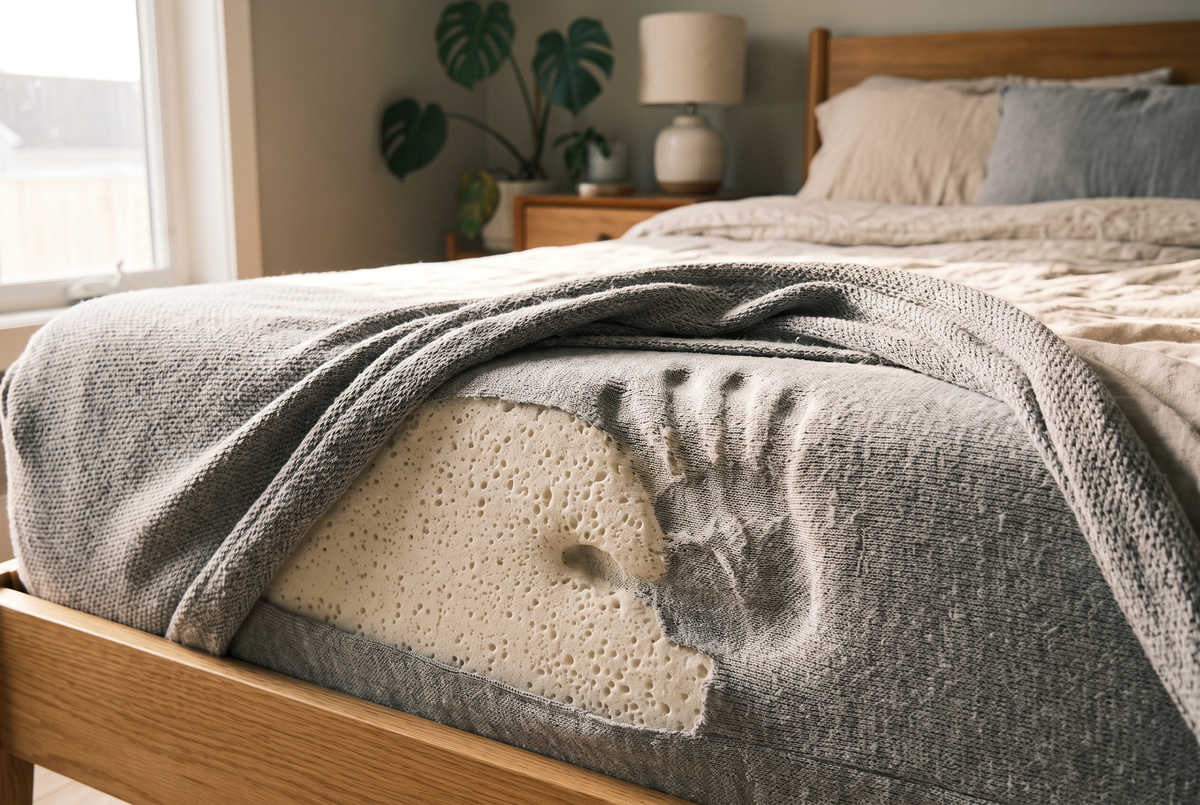
Scoliosis means that the spine is curved laterally and also twisted around its longitudinal axis. In Switzerland, depending on the definition, two to four out of a hundred people are affected, mostly with mild forms. Those who live with it know the problem: a mattress that suits others can lead to pressure points and morning stiffness in an asymmetrical back – because the support surface is simply not symmetrical. At the same time, there is a lot of misinformation circulating: everything from "as hard as possible" to "special orthopaedic mattress" can be heard. This guide clarifies what really matters with scoliosis – and what a mattress can and cannot do.
The short answer: With scoliosis, the point elasticity of a mattress is more important than its firmness – meaning its ability to yield only where pressure actually occurs. Because a scoliotic back rests asymmetrically, the mattress must accommodate protruding areas like rib humps and iliac crests without leaving hollows unsupported. Mattresses that are too firm create pressure peaks, while those that are too soft allow the spine to sag. Important: A mattress does not correct scoliosis – but it can reduce discomfort and significantly improve sleep quality.
- Point elasticity is more important than firmness – the mattress must react locally.
- A mattress does not correct scoliosis, but it can reduce pressure peaks.
- Lying on your side with a pillow between your knees often provides the most relief.
- Pillow height must match shoulder width – often asymmetrical with scoliosis.
- In case of increasing pain or progression, medical clarification is necessary.
What scoliosis means for the sleeping surface
A healthy spine forms a straight line when lying on its side and a gentle S-profile when lying on its back. With scoliosis, a lateral curvature is added, often with a rotation of the vertebral bodies. This causes one side of the rib cage to protrude further – the so-called rib hump – and the pelvis may be slightly tilted.
For the mattress, this means that the body does not lie evenly. There are points that press more strongly, and areas that have no contact. A flat, firm surface concentrates the entire body weight on the few protruding points. This creates pressure peaks that lead to tossing and turning at night and morning pain.
Conversely, a very soft mattress is also not a solution. If heavy body regions like the pelvis sink too deeply, the lateral deviation is further exacerbated. What is needed is a material that differentiates locally: yielding where pressure occurs, supporting where weight is applied. This is exactly what point elasticity describes.
Point elasticity instead of firmness level
The term firmness level appears in every mattress search and is particularly misleading for scoliosis. Firmness levels are not standardized: what one manufacturer calls medium can be significantly firmer or softer with another. Furthermore, a single number does not describe how the material behaves across the surface.
Point elasticity, on the other hand, describes exactly what matters with asymmetrical support: How small is the area that reacts to local pressure? With a point-elastic foam, the deformation is practically limited to the loaded area – the rib hump sinks in, while the waist next to it continues to be supported. With area-elastic materials like a classic Bonnell spring core, an entire zone yields, leaving the hollow at the waist unsupported.
In practical terms, this means: When test sleeping, pay less attention to whether the mattress "feels firm enough" and more attention to whether you feel pressure points after waking up and how often you had to change position at night. More background on the topic in the article Mattress firmness level.

Materials in comparison
| Material | Point elasticity | For scoliosis |
|---|---|---|
| Memory/Visco foam | Very high | Accommodates protruding areas well |
| Cold foam | High | Good alternative, a little more direct |
| Latex | High | Supportive, but heavy and with rebound force |
| Pocket spring | Medium to high | Depends on number of springs and padding |
| Bonnell spring | Low | Mostly unsuitable, yields over a wide area |
An additional note on construction: A pure comfort layer of 2 cm on a firm core is often not enough for pronounced asymmetry. Multi-layer constructions with 4 to 7 cm of adaptable top layer over a supporting core are sensible. An overview is provided by the comparison of mattress types.
Finding the right sleeping position
There is no universally correct position for scoliosis, as the curvature is individual. Three approaches have proven effective in practice.
Side sleeping with a knee pillow. A firm pillow 10 to 15 cm thick between the knees prevents the upper leg from tilting forward and pulling the pelvis with it. This noticeably reduces rotation in the lumbar region. Many sufferers prefer to lie on the convex side of the curvature – try both sides for several nights each.
Back sleeping with a knee roll. A flat pillow or roll under the knees flattens the lumbar lordosis and relaxes the hip flexors. For scoliosis, a thin, folded towel under the sunken side can additionally provide compensation – it's worth experimenting with small steps here.
Avoid stomach sleeping. Stomach sleeping exacerbates rotation and forces the head into a permanent sideways turn. With scoliosis, it is usually the least favorable position. Further information under Back pain and sleeping position.
Don't forget the pillow
With scoliosis, the shoulder area is often asymmetrical. One shoulder is higher, and the distance from the head to the mattress differs depending on which side you lie on. This means that a pillow that fits on one side may be too high or too flat on the other.
Practical solution: Use a pillow with removable filling that you can adjust in small increments. Or keep two pillows of different heights ready and switch depending on which side you lie on. This sounds cumbersome, but it solves a problem that many never identify. You can find the basics of pillow height under Choosing the right pillow.
Common mistakes and myths
Myth: "With scoliosis, you need the hardest possible mattress." The opposite can be true. A very firm surface concentrates weight on protruding points and creates pressure peaks. Adaptability, not hardness, is what's needed.
Myth: "An orthopaedic mattress corrects the curvature." No. The term orthopaedic mattress is not legally protected and does not describe any medical effect. A mattress can reduce discomfort but cannot change a structural curvature. Details under orthopaedic mattress.
Myth: "A board under the mattress helps." A board deprives the mattress of the ability to work in a differentiated way. With scoliosis, this usually worsens pressure distribution.
Mistake: Giving up too early. The body needs time to adjust to a changed pressure distribution. Two to four weeks is a realistic adjustment period for asymmetrical support – see getting used to a mattress.
Mistake: Seeing the mattress as the sole solution. Movement, targeted physiotherapy, and, if necessary, a brace are the actual pillars of treatment. The mattress supports – it does not replace therapy.

How to test a mattress for scoliosis
Step 1 – Record baseline. For a week, note how often you wake up at night, where you experience discomfort in the morning, and how stiff you feel when getting up. Without a baseline, improvement cannot be assessed.
Step 2 – Check for pressure points. In the morning, look for red or numb areas on your shoulder, rib cage, and hip. These are a direct indication of insufficient point elasticity.
Step 3 – Do a line check. Have someone photograph you from behind while you are lying on your side. The spine line should roughly correspond to your standing position – not sag or arch additionally.
Step 4 – Systematically test positions. Stay in one configuration for three to four nights before changing anything. Do not change multiple things at once.
Step 5 – Use the trial period. A serious trial sleep phase gives you the necessary room for manoeuvre. We describe how to structure it effectively in Mattress trial sleep.
Step 6 – Seek professional feedback. If pain increases, radiates into a leg, or is accompanied by sensory disturbances, medical clarification is important – regardless of the mattress.
Secure a CHF 25 discount
Subscribe to our newsletter and receive a one-time CHF 25 discount. ✓ 200 nights trial sleep ✓ 10-year warranty
Frequently Asked Questions about Scoliosis and Mattresses
Which mattress is right for scoliosis?
High point elasticity is crucial: The mattress should only yield where pressure occurs and continue to support next to it. Memory and cold foam achieve this well. A specific firmness level is not decisive, as firmness levels are not standardized and do not describe the adaptation behavior.
Should the mattress for scoliosis be particularly firm?
No. A very firm surface concentrates body weight on the few protruding points like the rib hump and iliac crest, creating pressure peaks there. Adaptability is required so that the support surface increases and pressure is distributed.
Can a mattress correct scoliosis?
No. Scoliosis is a structural change in the spine that cannot be altered by a sleeping surface. However, a suitable mattress can reduce pressure points, lessen tossing and turning at night, and thereby improve sleep quality.
Which sleeping position is favorable for scoliosis?
Lying on your side with a firm pillow between your knees often proves effective because it reduces rotation in the pelvic area. Lying on your back with a roll under your knees is a good alternative. Lying on your stomach is considered unfavorable because it increases rotation and head rotation.
Do I need a special pillow for scoliosis?
Not a special model, but often an individually adjustable height. Because the shoulder area is often asymmetrical with scoliosis, the same pillow height might fit on one side but be too high on the other. Pillows with removable filling are therefore practical.
Does a board under the mattress help with scoliosis?
Generally not. A board prevents the mattress from yielding in a differentiated way and usually further worsens pressure distribution with asymmetrical support. A slatted frame with sufficient elasticity and a point-elastic mattress are more sensible.
This article is for general information and does not replace medical advice.







Leave a comment
This site is protected by hCaptcha and the hCaptcha Privacy Policy and Terms of Service apply.