
"Orthopedic mattress" sounds like medicine, like proven effectiveness, like something a doctor would recommend. That's exactly what the term aims for. But here's the thing: it's not legally protected. Any manufacturer can call their mattress that, without submitting a single study or undergoing a testing procedure. This doesn't mean that all products labelled this way are bad – many are good. It just means that the word on the label tells you nothing about the quality. This guide explains what an orthopedic mattress should ideally achieve, what properties you can actually use to determine this, and when it's better to seek medical advice than to buy a new mattress.
The short answer: An orthopedic mattress is not a product category with defined requirements, but a marketing term for mattresses that are supposed to keep the spine in a neutral position. This is a sensible goal – but it is achieved not by a designation, but by high point elasticity, sufficient core height, good density, and adaptation to individual body shape. Neither a particularly firm mattress nor a printed zone pattern makes a product orthopedic. What matters is whether your spine remains straight when lying down.
- The term "orthopedic" is not protected for mattresses – there is no testing procedure and no minimum requirement.
- What counts: neutral spinal alignment, pressure relief at the shoulder and hip, point elasticity, and adaptation to changes in position.
- Firm is not the same as orthopedic – overly firm mattresses create exactly the pressure points they are supposed to prevent.
- For chronic conditions, no mattress replaces medical or physical therapy evaluation.
What the term promises – and what it's allowed to do
Orthopedics is the medical study of the musculoskeletal system. Applied to a mattress, "orthopedic" should mean: The mattress supports the musculoskeletal system so that it can recover at night. In practice, there is no definition, no certification, and no approval body for this. A manufacturer can take a simple foam mattress, add a printed zone pattern, and sell it as orthopedic. The situation is different for medical aids – such as anti-decubitus systems for care – which are actually tested and sometimes prescribable. However, these are intended for immobile patients, not for healthy people with tension.

The four properties that actually matter
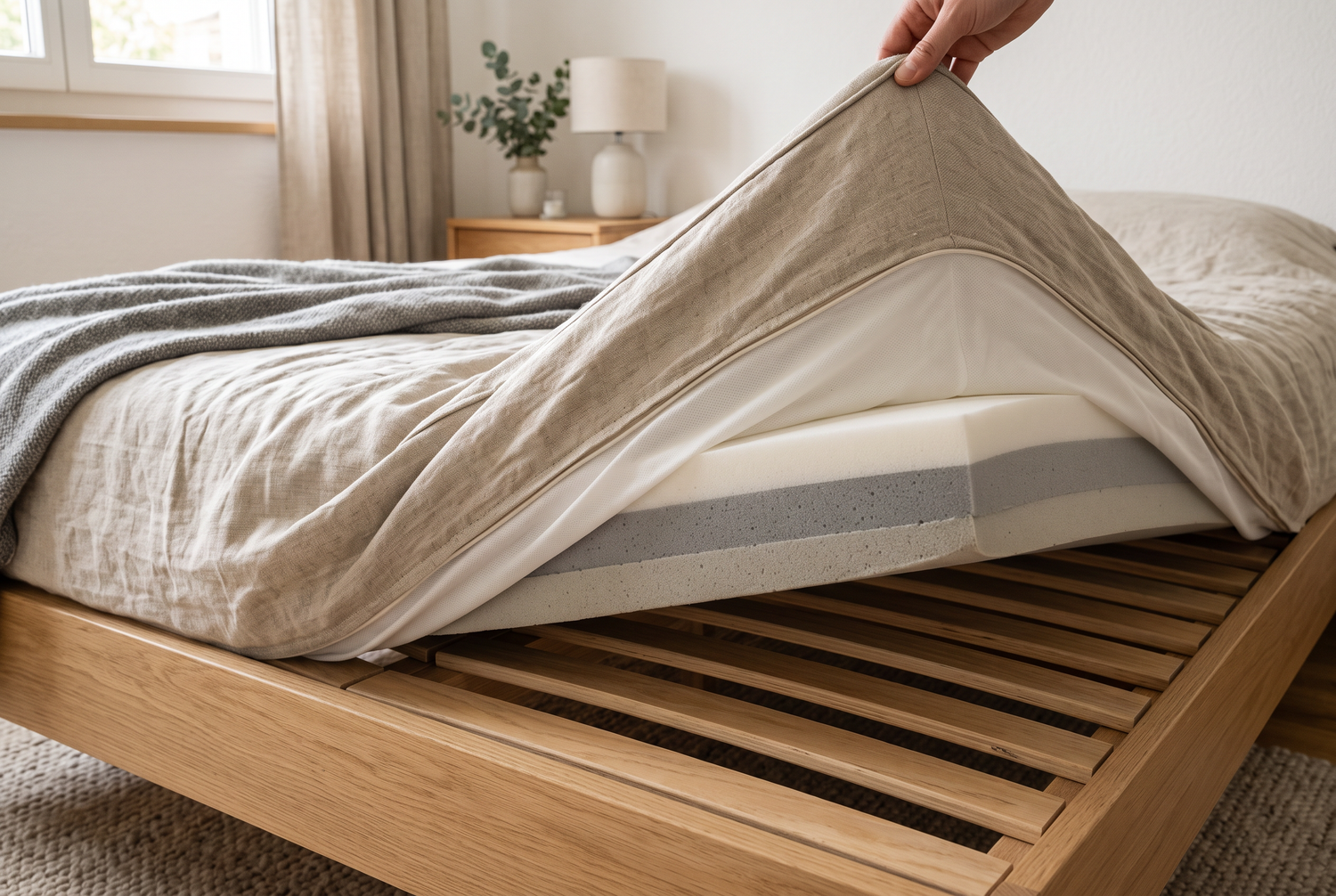
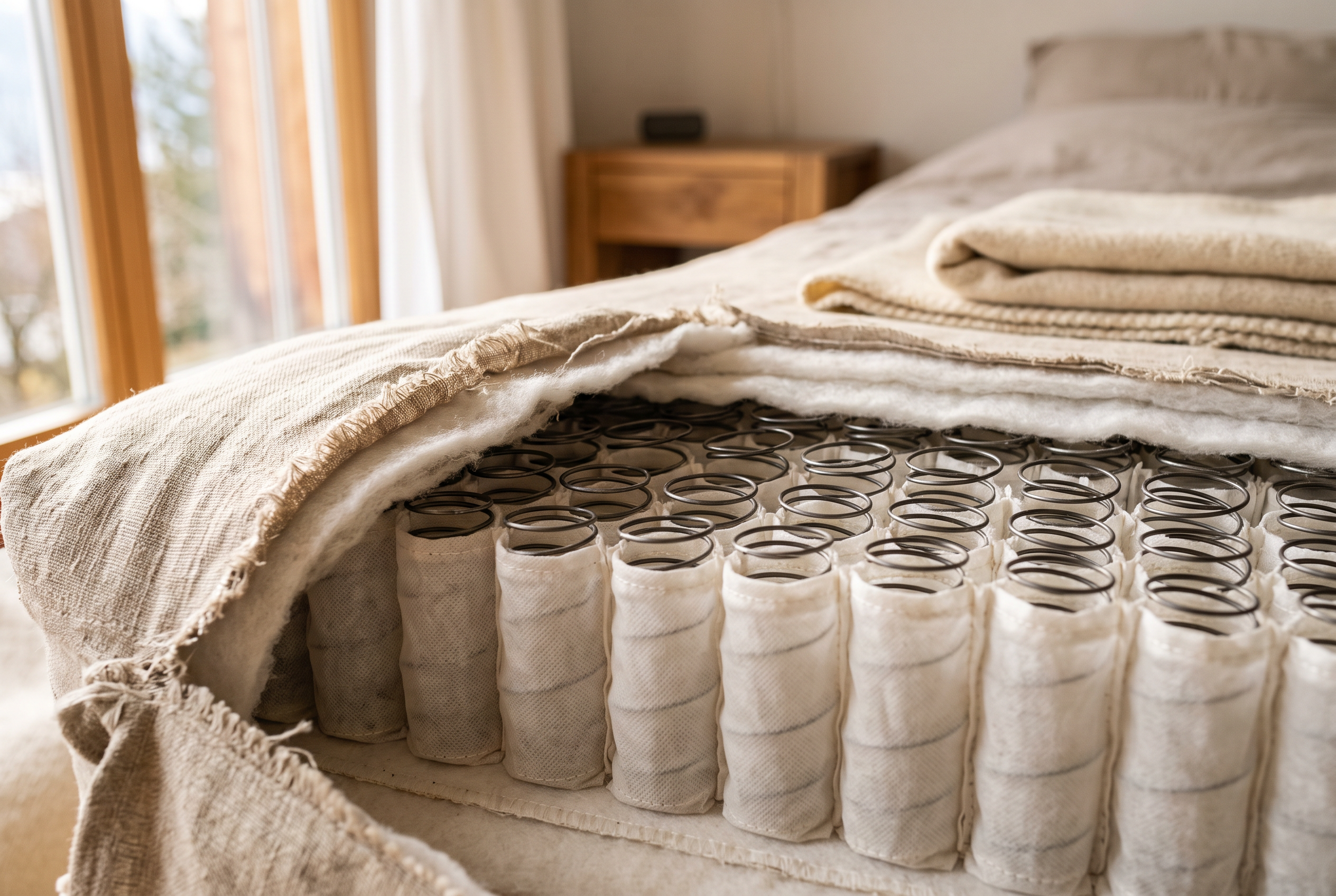
If a mattress is supposed to relieve your back, four things are measurable or verifiable. First, point elasticity: Does the material yield exactly where pressure occurs, without the neighboring areas sinking in as well? Second, pressure distribution: How large is the contact area? The larger it is, the lower the pressure per square centimeter – and the less often you have to turn over at night. Third, core height: Below 14 centimeters, hardly any material can provide the necessary sink-in depth. And fourth, density for foam: Below 40 kg/m³, the support effect is lost within a few years, regardless of what was on the label. The following overview summarizes what you should look for.
| Advertising promise | What it really means | Verifiable criterion instead |
|---|---|---|
| "orthopedic" | unprotected term, no proof required | Check spinal alignment when lying down |
| "back-friendly" | Manufacturer's own statement | Point elasticity and sink-in depth |
| "with lying zones" | Cuts in the foam, effect strongly model-dependent | Behavior when changing position |
| "particularly supportive" | usually simply: firm | Density and core height |
The misconception about firmness
The most common misconception is: Anyone with back problems needs a firm mattress. This idea dates back to a time when the alternative was a saggy wool blanket mattress. Today, the rule is: An overly firm surface prevents the shoulder from sinking in when lying on your side. The spine kinks upwards, body weight concentrates on a few points, and the muscles work against the incorrect posture all night long. This is exactly what causes morning tension. A too-soft mattress has the opposite problem: The heavy pelvis sinks, and the lumbar spine is bent. More on this in the article about the correct sleeping position for back pain.
When the mattress is really the problem
Not all back pain comes from the bed. A useful test: Are the symptoms strongest in the morning immediately after getting up and do they significantly improve after twenty to thirty minutes of movement? Then there's a strong case for the sleeping situation. If the pain remains constant throughout the day, worsens with strain, or radiates into the legs or arms, the cause is very likely elsewhere. A second clue: Do you sleep significantly better in a foreign bed on vacation? Then your mattress is a candidate. Further classification can be found under Mattress and Back Pain as well as for Sciatica and Herniated Disc Complaints.
What else matters besides the mattress
A good mattress on a bad slatted frame remains a bad sleeping surface. Therefore, check whether the slats provide enough support, whether the distance between them is no more than four centimeters, and whether the frame isn't sagging – details on this in the article about slatted frame and mattress. The pillow is just as important: A pillow that is too high will kink the cervical spine and negate any good mattress, see Pillow Guide. And finally, the sleeping position itself: sleeping on your stomach is unfavorable for the cervical spine because the head is constantly turned. If you want to break this habit, you can use a supportive pillow at your side.

Get CHF 25 discount
Subscribe to our newsletter and get a one-time CHF 25 discount. ✓ 200 nights trial sleep ✓ 10 years warranty
Frequently asked questions about orthopedic mattresses
Is "orthopedic mattress" a protected term?
No. There is no legal definition or mandatory testing procedure. Any manufacturer can label a product as such. Therefore, the term says nothing about the actual support effect. Instead, orient yourself by verifiable properties such as point elasticity, core height, and density, as well as a sufficiently long trial sleep period.
Can I claim an orthopedic mattress through my health insurance?
Generally not. Normal mattresses for home use are not considered medical aids in Switzerland and are not covered by basic insurance. Exceptions concern special systems in care, such as anti-decubitus mattresses for immobility. Whether something is possible in your case is best clarified directly with your doctor and health insurance company.
Do I need a firm mattress for back pain?
No. An overly firm mattress prevents the shoulders and pelvis from sinking in, creating exactly the pressure points and tension it is meant to avoid. A good mattress is one that keeps your spine in a neutral, straight line – regardless of how firm it feels when you first lie on it.
Do lying zones really help?
Zones are cuts in the foam designed to make certain areas softer or firmer. They can be effective, but only if your body proportions match the predetermined zone lengths. For a person of 1.60 meters, the shoulder zone is simply in a different place than for someone of 1.90 meters. A material that adapts independently of fixed zones is more reliable in everyday use.
When should I see a doctor instead of buying a new mattress?
If pain persists for more than six weeks, radiates into your arms or legs, is accompanied by numbness, loss of strength, or fever, or regularly wakes you up at night, you should seek medical evaluation. A mattress can alleviate or worsen symptoms, but it does not treat a structural cause.
This article is for general information only and does not replace medical advice.








Leave a comment
This site is protected by hCaptcha and the hCaptcha Privacy Policy and Terms of Service apply.