
In Switzerland, osteoporosis affects about one in four women and one in twenty men over 50 – and for many sufferers, the bed becomes a place where they no longer feel safe. Vertebral fractures can occur even from everyday stress, getting out of a low bed becomes a fall hazard, and a rounded back makes lying flat uncomfortable. The question of which mattress is right for osteoporosis is often answered with a blanket "as hard as possible," which is not medically sound and can even promote pressure points and pain. This guide explains what fragile bones really need during sleep: a mattress with good pressure distribution and a stable edge, a safe bed height, a sleeping position that protects the spine, and a bedroom that prevents falls. All this as a complement to medical osteoporosis therapy.
The short answer: For osteoporosis, an ideal mattress distributes body weight over a large area, yields at the sacrum, hips, and shoulders, yet provides support when sitting up. A stable edge is more important than for healthy sleepers because sitting on the edge of the bed must be safe for getting up. The bed height should be chosen so that the knees form a right angle when sitting – usually 50 to 60 cm. Board-hard mattresses are counterproductive; very soft ones make getting up difficult.
- Pressure distribution protects against pain in the sacrum, hips, and ribs in osteoporosis – hard mattresses do not protect bones.
- A stable mattress edge and an entry height of 50 to 60 cm make sitting down and getting up safer.
- Getting up via the side position ("en bloc technique") avoids bending and twisting the spine.
- For a rounded back, the head needs a higher pillow in the supine position, and a pillow between the knees in the side position.
- Fall prevention in the bedroom (night light, clear paths, no loose rugs) is as important for bones as the mattress itself.
What osteoporosis means for lying down
In osteoporosis, bone density decreases, the internal structure of the bones becomes more porous, and fracture resistance decreases. The vertebral bodies are particularly affected: they can slowly compress under stress or break with a sudden movement, often without a fall. About a third of those affected have at least one vertebral fracture, many of them unnoticed. The consequences are chronic back pain, a loss of several centimeters in height, and the typical rounded back, which makes lying flat difficult.
For the bed, this means three things. First, the mattress must distribute pressure because protruding bones – sacrum, iliac crest, shoulder blades, ribs – hurt more quickly with thinning muscles and subcutaneous fatty tissue, and in extreme cases, can develop pressure sores. Second, the spine should lie in its natural form, without sagging in the lumbar region, so that no additional stress acts on weakened vertebral bodies. Third, getting into and out of bed must be safe, because a fall is the most common cause of hip and wrist fractures in osteoporosis. How sleep generally changes in old age is described in our article Sleep in old age.
The right mattress for osteoporosis
The recommendation "sleep hard, sleep healthy" persists, but it is unfavorable for osteoporosis sufferers. A hard mattress distributes weight over a few contact points – in the supine position, the back of the head, shoulder blades, sacrum, and heels. It is precisely at these points, with thin soft tissue, that pressure pain arises, and in the side position, the mattress presses on the iliac crest and greater trochanter. What helps, however, is a mattress with high point elasticity that yields at protruding bones and distributes the weight over the surrounding area. Adaptive foams do this particularly well because they adapt to the body contour without the pelvis sinking deeper than the spine can tolerate.
At the same time, the mattress must not be so soft that you "sink into it" when getting up. Anyone who has to support themselves with their hands to sit up needs a surface that provides counterforce. Therefore, two details are more important than for healthy sleepers: good resilience of the core and a stable edge. The edge bears the weight when sitting on the edge of the bed; if it sags 8 to 10 cm, the upper body tips forward, and the moment of getting up becomes a risk. Mattresses with a reinforced edge zone or a dense core right up to the edge are clearly at an advantage here. If you are wavering between types when buying, you can find guidance in the mattress type comparison.
| Criterion | Recommendation for osteoporosis | Why |
|---|---|---|
| Pressure distribution | High, point-elastic | Protects sacrum, hips, ribs from pressure pain |
| Resilience | High | Facilitates repositioning and sitting up |
| Edge | Stable, little sinking | Safe sitting on the edge of the bed |
| Bed height (top edge of mattress) | 50–60 cm, knees at 90° when sitting | Getting up without bending or pushing up |
| Mattress height | From 18–20 cm | Sufficient material for pressure distribution |

Bed height and bed frame: Safety when getting up
For osteoporosis, bed height is not a comfort detail, but fall prevention. Measure the height from the back of your knee to the floor while sitting with flat shoes – for most adults, 45 to 55 cm. The top edge of the mattress should be approximately at this height; slightly higher is better than lower. With a bed that is too low (under 45 cm), you have to bend far forward and push up from your knees when getting up, which bends and strains the spine; with a bed that is too high (over 65 cm), your feet dangle, and you slide down uncontrollably. Our article on the ideal bed height shows how to calculate the height with a slatted frame and mattress.
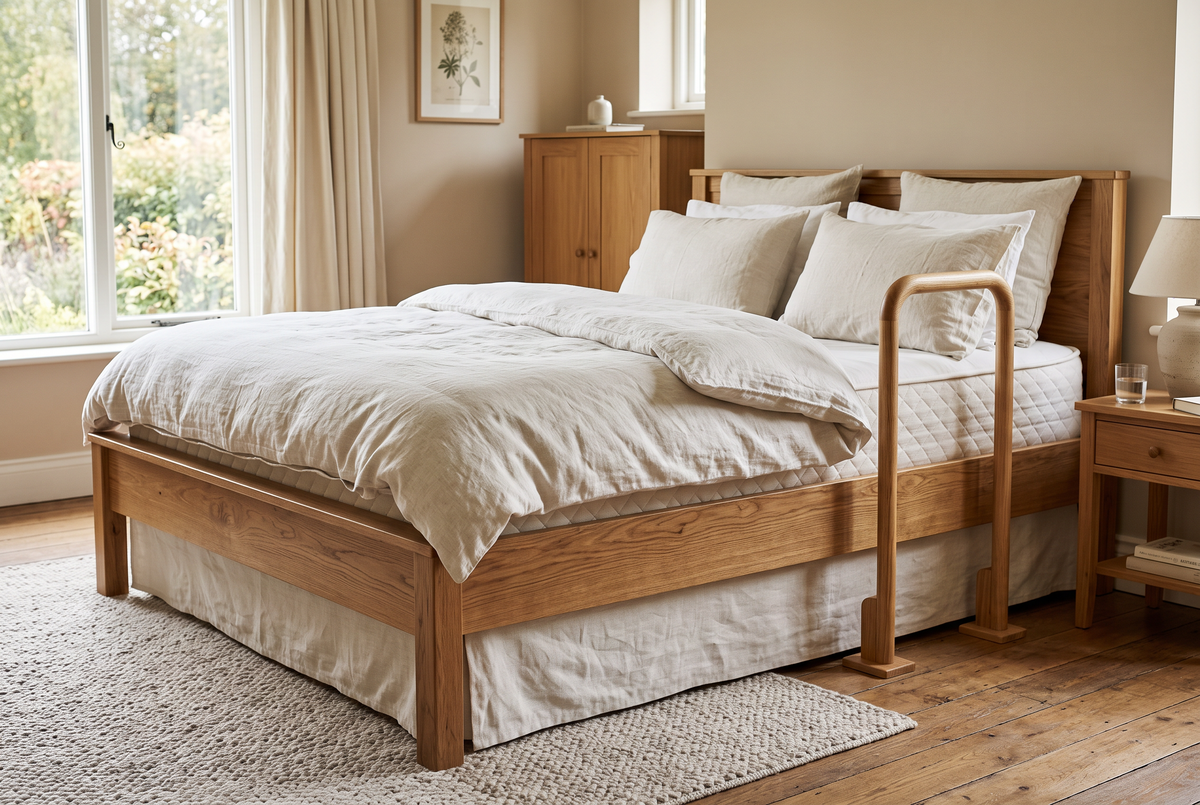
For the bed frame, stability counts: a solid frame that doesn't move when you lean on it, a headboard to hold onto, and no sharp edges. A bed rail – a bar or grab pole clamped between the mattress and the slatted frame – provides additional safety and is often recommended by occupational therapists. In advanced osteoporosis or after vertebral fractures, an electrically adjustable bed can facilitate sitting up because the upper body is raised by motor and the torso does not have to be bent by one's own strength. We have explained separately how to choose the right bed frame.
Sleeping position and pillow for osteoporosis
The supine position is usually the gentlest position for osteoporosis because the weight is distributed over the largest area. However, with a pronounced rounded back, the head no longer lies flat but hovers – then a higher pillow, often 10 to 14 cm, or a wedge pillow that raises the entire upper body by 10 to 20 degrees, is needed. A roll under the knees of 8 to 12 cm additionally relieves the lumbar spine. In the side position, a pillow should be placed between the knees so that the pelvis does not tilt and the hip does not rotate. The prone position should be avoided: it hyperextends the cervical spine and pushes the lumbar spine into a hollow back – an unnecessary strain on weakened vertebral bodies.
Equally important is the technique for lying down and getting up. Physical therapists teach the so-called en bloc technique: To get up, first turn to your side, moving shoulders and pelvis simultaneously, then slide your legs over the edge of the bed and simultaneously push yourself up with your lower arm. This keeps the spine straight, without bending or twisting under load. When lying down, reverse the order. This technique takes a few seconds longer, but it prevents precisely the movement – bent sitting up from the supine position – that can trigger vertebral fractures in osteoporosis.
Fall prevention in the bedroom
About 30 percent of people over 65 fall at least once a year, and a large proportion of these falls occur at night on the way to the toilet. In osteoporosis, such a fall results in a fracture more often than average. Therefore, the room is always part of the mattress question. A night light with a motion sensor on the way to the bathroom, a clear path free of cables and rug edges, non-slip socks or slippers with a firm edge, and a bedside lamp that is reachable while lying down measurably reduce the risk. Loose rugs are a classic tripping hazard – either secure them with an anti-slip mat or remove them.
A second point is the duvet: a heavy duvet that wraps around the legs makes it difficult to get up and is a tripping hazard when getting out. Lightweight duvets with 600 to 900 g filling are better. And anyone who has to get up several times at night should slightly reduce fluid intake in the evening and avoid caffeinated drinks from late afternoon onwards. Sleeping pills also play a role: they significantly increase the risk of falling at night, which is why it should be carefully considered whether and which ones are used in osteoporosis – a topic for the general practitioner's office, not for self-medication.
Common mistakes and myths in the fact check
"With osteoporosis, the mattress must be hard." False: Hardness does not protect the bones, but creates pressure points on the sacrum and hips. The mattress should support and distribute. "A low bed is safer because you don't fall far." The opposite is true: getting out of a low bed requires bending and strength, which promotes vertebral fractures and falls. "Calcium in the evening helps the bones during sleep." Bone regeneration does occur at night, but the effect of calcium depends on the overall supply, not the timing – and without sufficient vitamin D, it is hardly absorbed. "Anyone who already has vertebral fractures should move as little as possible in bed." This is also not true: repositioning is important against pressure sores and stiffness, only the technique must be right. And finally: sleep deprivation itself is now considered a risk factor for low bone density, because growth hormone and bone remodeling are linked to deep sleep – a good night's sleep is therefore also bone care. You can read how to increase deep sleep in our article.

Get CHF 25 discount
Subscribe to newsletter and receive a one-time CHF 25 discount. ✓ 200 nights trial sleep ✓ 10 years warranty
Frequently asked questions about osteoporosis and mattresses
Is a hard mattress better for osteoporosis?
No. A hard mattress distributes weight over few contact points and causes pressure pain in the sacrum, hips, and shoulder blades. A point-elastic mattress that yields but supports the pelvis is better.
How high should the bed be for osteoporosis?
The top edge of the mattress should be approximately at knee height, usually 50 to 60 cm. Beds that are too low force you to bend when getting up, while beds that are too high leave your feet dangling and increase the risk of falls.
Which sleeping position protects the spine with osteoporosis?
The supine position with a knee roll, and with a rounded back, a higher pillow or wedge pillow. The side position with a pillow between the knees is also good. The prone position should be avoided.
How do I safely get out of bed with osteoporosis?
Using the en bloc technique: first turn to your side, moving shoulders and pelvis simultaneously, then slide your legs over the edge of the bed and push yourself up with your lower arm. This keeps the spine straight.
Why is a stable mattress edge important for osteoporosis?
Because sitting on the edge of the bed to get up must be safe. If the edge sags 8 to 10 cm, the upper body tips forward, and getting up becomes a fall hazard.
Does sleep affect bone density?
Yes. Growth hormone and bone remodeling are linked to deep sleep, and chronic sleep deprivation is considered a risk factor for low bone density. Good sleep is therefore part of osteoporosis prevention.
This article is for general information purposes only and does not replace medical advice.




Leave a comment
This site is protected by hCaptcha and the hCaptcha Privacy Policy and Terms of Service apply.