
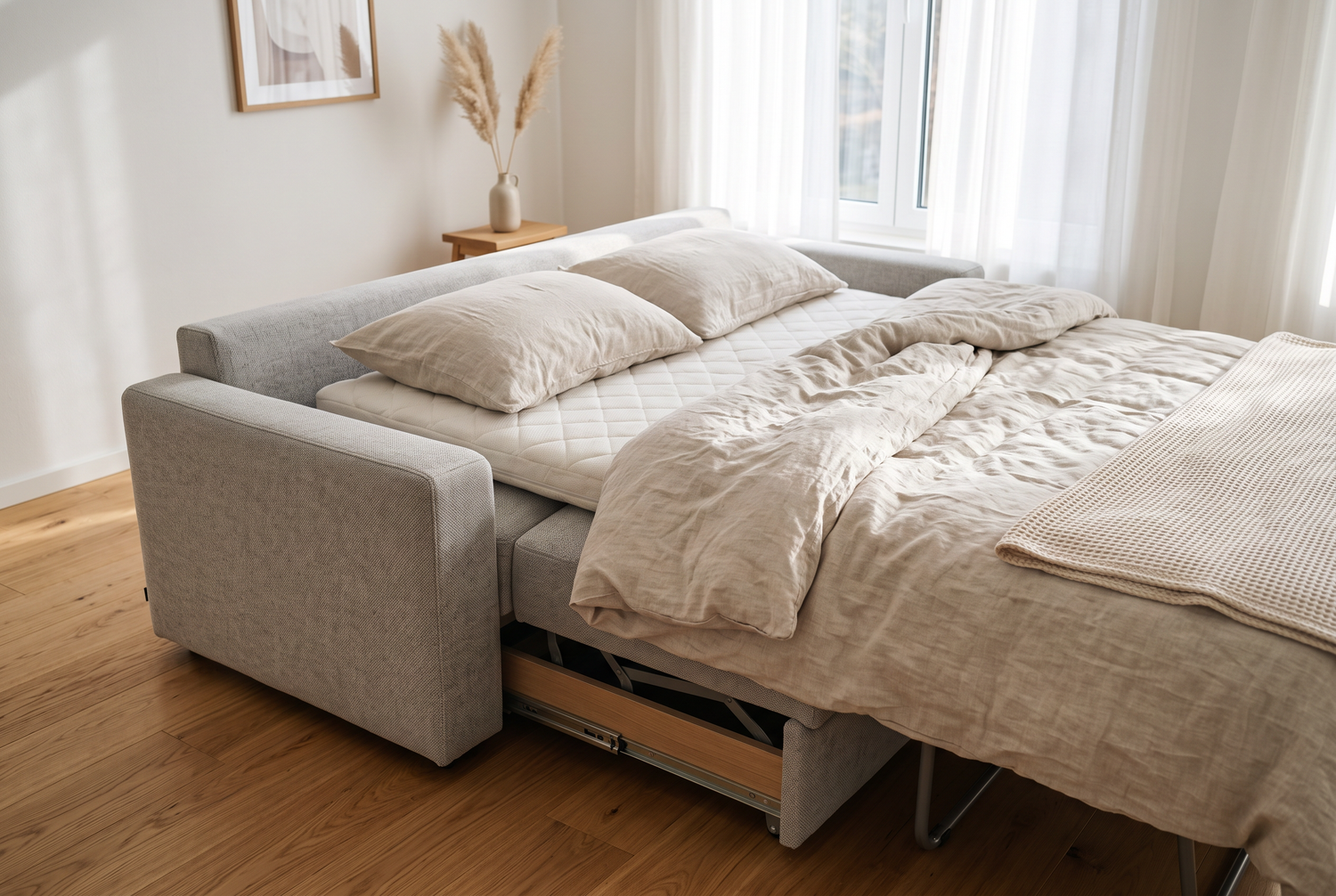
In Swiss cities, living space is scarce and expensive: A 1.5-room apartment in Zurich or Geneva often leaves no room for a separate bedroom, and the sofa bed becomes a permanent solution rather than a temporary fix. Sofa by day, bed by night – that sounds efficient, but most sofa beds are built for occasional guests, not for 365 nights a year. Those who sleep on one every night often notice it after a few weeks, affecting their back, neck, and sleep quality. The good news: With the right model, a sufficiently thick mattress, and a few targeted adjustments, a sofa bed can function as a permanent solution. In this guide, you will learn which constructions are suitable, what mattress height you need at a minimum, where the typical weak points lie, and when a real bed is simply the better choice.
The short answer: Yes, a sofa bed can be a permanent solution – but only if it is designed for regular sleeping. Crucial factors are a continuous mattress at least 12 to 14 cm thick without a fold in the sleeping area, a flat slatted base, and a stable frame. Classic folding sofas with 6 to 8 cm thin, multi-folded cushions are only suitable for guests. A high-quality topper can absorb weaknesses but does not replace a supporting mattress.
- Sofa beds for regular sleepers have a continuous mattress of at least 12–14 cm; guest sofas often have only 6–8 cm.
- The sleeping surface should measure at least 90 × 200 cm for one person and 140 × 200 cm or more for two people.
- Transverse folds, metal bars, and depressions in the sleeping area are the most common causes of back pain on a sofa bed.
- A 5–7 cm topper noticeably improves comfort but cannot fully compensate for a mattress that is too thin.
- Daybeds with a normal mattress are usually better for regular sleeping than folding or pull-out sofas.
Why most sofa beds are not permanent solutions
A sofa is primarily built for sitting. The seat height is 42 to 48 cm, the upholstery is designed for pinpoint pressure from the buttocks, and it must be able to fold or pull out in a few seconds. These requirements contradict what a good sleeping surface needs: an even, continuous surface that distributes body weight over 200 cm in length and keeps the spine in its natural shape. With folding sofas, a fold almost always appears in the middle, and with pull-out sofas with metal frames, a transverse bar often lies precisely under the pelvis. Both create pressure points that manifest as tension or numbness after 6 to 8 hours of lying down.
Then there's the material: Many sofa bed cushions consist of foam with a density of 20 to 25 kg/m³. This is sufficient for seating furniture, but far too little for daily full-body load – good mattress foams start at 40 kg/m³. The result is hollows that become permanently visible after 6 to 12 months. So, if you want to use a sofa bed as a permanent solution, you need to specifically look for models that are expressly declared by the manufacturer as "permanent sleepers." While this designation is not standardized, it generally indicates a thicker mattress and a more load-bearing substructure.
The three types of construction compared
Sofa beds can roughly be divided into three categories, which are very different in their suitability for permanent sleeping. Folding sofas (also known as click-clack sofas) have a backrest that folds down. The sleeping surface consists of two cushions with a fold in the middle, and the mattress height is usually 8 to 12 cm. Pull-out sofas hide a metal frame with a folded mattress under the seat, which is pulled out and unfolded. The mattress here is often only 6 to 10 cm thick because it has to fit into the sofa construction. Daybeds and sofa beds with a bed box, on the other hand, use a normal, continuous mattress that becomes a sofa with back cushions during the day.
| Construction type | Typical mattress height | Fold in sleeping area | Suitability for regular sleeping |
|---|---|---|---|
| Folding sofa (click-clack) | 8–12 cm | Yes, in the middle | Low |
| Pull-out sofa with metal frame | 6–10 cm | Yes, often double | Low to medium |
| Permanent sleeper sofa bed | 12–16 cm | No or outside sleeping area | Good |
| Daybed with normal mattress | 18–25 cm | No | Very good |

What a sofa bed for every night needs to have
If you are planning to use a sofa bed as a permanent solution, check five points when buying. First, the mattress height: Below 12 cm, the material is not sufficient to permanently cushion body weight – for body weights over 80 kg, it should be 14 cm or more. Second, the sleeping surface: 80 × 190 cm may be enough on paper, but in practice, it means you can't turn freely at night. 90 × 200 cm for one person and 140 × 200 cm for two people are the minimum, more on this in our guide to mattress sizes in Switzerland. Third, the suspension: A slatted frame or a solid wooden board with ventilation slots is better than a sagging metal grid.
Fourth, the foam material: Ask about the density. From 35 kg/m³ upwards, the mattress is reasonably durable; from 40 kg/m³ upwards, it is solid. Fifth, the mechanism: A sofa that you pull out every evening and fold up every morning is moved 700 times a year. Cheap hinges and thin metal tubes rarely last longer than two years. Test in the store whether the mechanism can be operated with one hand and whether nothing wobbles or creaks when unfolding. What applies to beds also applies here: stability comes before optics, as our article on choosing a bed frame shows.
Back pain from a sofa bed: the typical causes
Those who wake up with a stiff back after a few weeks on a sofa bed usually have one of three problems. The first is the hollow: thin upholstery with low density gives way under the pelvis, the hips sink deeper than the shoulders and legs, and the lumbar spine is forced into a hollow back or lateral tilt position. The second problem is the fold or transverse bar: in many models, it lies precisely in the area between the shoulder blades and the pelvis and acts like a hard edge that exerts pressure on the spine and muscles. The third problem is a sleeping surface that is too short or too narrow, which forces a curled sleeping position and restricts freedom of movement.
Unlike a normal mattress, these problems cannot be remedied on a sofa bed by turning or rotating it, because the construction is asymmetrical. What helps is a topper that levels the surface and a conscious sleeping position: sleeping on your back and side is usually more tolerable on a sofa bed than sleeping on your stomach, because the pelvis sinks less deeply. If the symptoms persist or radiate into the legs, it is worth taking a look at our article on back pain and sleeping position – and if in doubt, seek medical clarification.
Practical guide: How to make your sofa bed permanently suitable for sleeping
Do you already own a sofa bed and want to upgrade it instead of buying a new one? Then proceed in this order. Step 1: Unfold the sofa and use a straight lath or broomstick to check if the sleeping surface is even. Depressions deeper than 2 cm or edges at the fold are a warning sign. Step 2: If the substructure is a metal grid, place an 8 to 10 mm thick, perforated plywood or MDF board the size of the sleeping area on top – this distributes the pressure and prevents sagging. Step 3: Add a topper of 5 to 7 cm height made of high-quality foam, ideally with a density of 45 kg/m³ or more. It evens out the fold and significantly improves pressure distribution. Our mattress topper guide explains the different topper variants.
Step 4: Use a fitted sheet in the size of the sleeping area that encloses both the topper and the sofa mattress – this prevents anything from slipping at night. Step 5: Air out the sofa in the unfolded state for 15 to 30 minutes in the morning before folding it up. A person releases 0.3 to 0.5 liters of moisture per night, and this cannot escape in a folded sofa. Step 6: Rotate the topper 180 degrees every 4 to 6 weeks so that the load is distributed evenly. With these measures, you can get an astonishing amount out of a mediocre sofa bed – but only if the base is at least 10 cm thick. Below that, even the best topper won't help.
Daybed instead of sofa bed: the better permanent solution?
For many small apartments, a daybed is the smarter choice. It consists of a bed frame measuring 90 × 200 cm or 120 × 200 cm with a normal mattress, and during the day, it becomes a sofa against the wall with large back cushions. The crucial advantage: you sleep every night on a real mattress with a height of 18 to 25 cm, which you can choose freely, and the base is a normal slatted frame. There is no mechanism to wear out and no fold. Many daybeds also have a bed box for bed linen and duvets. The disadvantage is the appearance: A daybed always looks a bit like a bed, and the seat depth of 90 cm is comfortable for watching TV but rather too deep for upright sitting.
A second alternative is a high bed or loft bed with living space underneath, which is an option for ceiling heights of 2.50 m or more. And for apartments where the night is flexibly arranged, a high-quality mattress directly on a foldable slatted frame or a low platform can work, as described in our article on sleeping solutions for small apartments. All these options have in common that the mattress does not have to take the sofa construction into account – and that is precisely the point where sleep quality is decided.
Common mistakes when using a sofa bed as a permanent solution
The most common mistake is buying a guest sofa for 400 to 700 francs and hoping it will "just work". After 6 to 12 months, hollows and back pain are almost guaranteed, and the money is lost. The second mistake is omitting morning ventilation: a damp cushion that is folded up daily is an ideal breeding ground for mold and dust mites. The third mistake is a too-thin topper of 2 to 3 cm made of soft foam, which feels pleasant but does not change the pressure distribution. The fourth mistake is giving too much weight to optics: a narrow, elegant sofa with a lying width of 75 cm looks good, but offers no freedom of movement. And the fifth mistake is confusing the lying surface with the seating surface – with many pull-out sofas, the lying surface is 10 to 15 cm shorter than the sofa width would suggest. Always measure the actual lying surface.

Secure CHF 25 discount
Subscribe to our newsletter and receive a one-time CHF 25 discount. ✓ 200 nights trial sleep ✓ 10 years warranty
Frequently asked questions about sofa beds as a permanent solution
Can you sleep on a sofa bed every night?
Yes, if it is designed for regular sleeping: with a continuous mattress of 12 cm height or more, without a fold in the sleeping area, and with a stable suspension. Classic guest sofas with thin 6 to 8 cm cushions are not suitable for daily use.
How thick should a sofa bed mattress be?
For regular sleeping, at least 12 cm; for body weights over 80 kg, preferably 14 cm or more. The foam density should be at least 35 kg/m³ to prevent hollows from forming.
Does a topper on a sofa bed help with back pain?
A 5 to 7 cm thick topper made of high-quality foam significantly evens out folds and improves pressure distribution. However, it cannot fully compensate for a base that is too thin or worn down below 10 cm.
Is a daybed better than a sofa bed?
For daily sleep, usually yes: A daybed uses a normal mattress of 18 to 25 cm height on a slatted frame, has no mechanism, and no fold. The disadvantages are the deeper seating surface and the bed-like appearance.
How often should you air out a sofa bed?
Ideally, every morning for 15 to 30 minutes in the unfolded state before folding it up. This allows the nightly moisture of 0.3 to 0.5 liters to escape and prevents mold.
What sleeping surface does a sofa bed for two people need?
At least 140 × 200 cm, preferably 160 × 200 cm. Many pull-out sofas have a sleeping surface that is 10 to 15 cm shorter than the sofa width suggests – therefore, always measure the actual sleeping surface.








Leave a comment
This site is protected by hCaptcha and the hCaptcha Privacy Policy and Terms of Service apply.