
A herniated disc often makes the night the most difficult time of the day. During the day, movement helps, but as soon as you lie down, the pain returns – and every position seems wrong after twenty minutes. The good news: your sleeping position can be intentionally influenced, and even small adjustments with an extra pillow can noticeably reduce the strain on the affected disc. This guide explains which positions relieve discomfort in the lumbar and cervical spine, how to use pillows correctly, and what role the mattress really plays. Important beforehand: A herniated disc requires medical treatment – these tips supplement it but do not replace it.
The short answer: The most common relieving positions are the elevated leg position on your back – lower legs on a cube or pillow, hips and knees bent at about 90 degrees – and lying on your side with a firm pillow between your knees. Lying on your stomach is usually unfavorable for most disc problems because it pushes the lumbar spine into a hollow back and keeps the head twisted for extended periods. The mattress should allow the shoulders and pelvis to sink in without the lumbar spine sagging. In cases of severe pain, numbness, or loss of strength, immediate medical evaluation is necessary.
- Elevated leg position on your back is considered one of the most relieving positions for lumbar spine discomfort.
- When lying on your side, a firm pillow should be placed between the knees to prevent the upper pelvis from tilting forward.
- Avoid lying on your stomach if possible – it exacerbates lordosis and additionally strains the cervical spine.
- Warning signs for immediate medical help: numbness in the genital area, bladder or bowel dysfunction, increasing paralysis.
The elevated leg position: A classic for good reason
For a herniated disc in the lumbar spine, the elevated leg position is considered one of the most reliable relief positions. Here's how it works: Lie on your back, with your lower legs resting horizontally on a stable stack of pillows, a positioning cube, or a seat. Both hip and knee joints should be bent at approximately 90 degrees. This position flattens the lumbar lordosis, slightly opens the intervertebral spaces, and reduces the pull on the sciatic nerve. Many sufferers feel relief within minutes. However, this position is only partially suitable for the entire night, as one naturally moves in sleep – but it is very valuable as a sleeping position and for pain phases during the day.

Setting up side sleeping correctly
Side sleeping is the most practical night position for most people. It is crucial that the upper leg does not tilt forward over the lower leg – otherwise, the pelvis twists against the rib cage, and precisely this rotation strains the intervertebral discs. Therefore, place a firm pillow between your knees, ideally high enough so that the upper and lower thighs of the upper leg lie horizontally. An additional pillow in front of your abdomen prevents your upper body from rolling forward. The head pillow should exactly fill the gap between your head and the mattress dictated by your shoulder width – too high kinks the cervical spine, too flat does likewise. More details on this can be found in the Pillow Guide and the article on side sleeper and body pillows.
Overview of positions
| Position | Aids | Suitability |
|---|---|---|
| Elevated leg position (back) | Positioning cube or stack of pillows | very good for lumbar spine complaints, especially for falling asleep |
| Flat on back | flat knee roll pillow | good if the lumbar spine remains supported |
| Side lying | Pillow between knees | good, most practical for the whole night |
| Fetal position | Knee and belly pillow | can relieve spinal canal stenosis |
| Stomach lying | – | usually unfavorable, hollow back and head rotation |
The role of the mattress
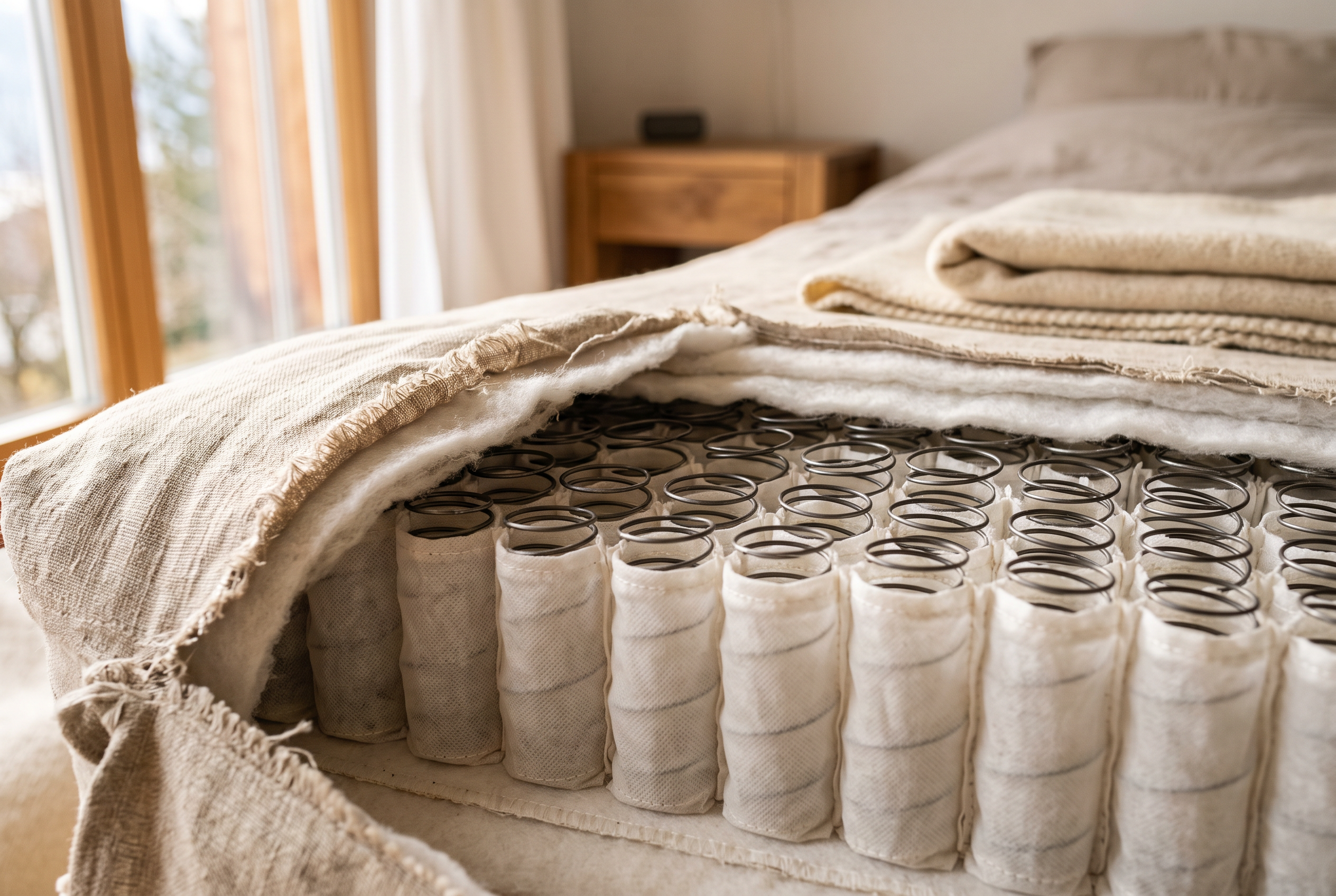
A mattress won't heal a herniated disc, but it can make the night significantly more bearable or significantly worse. Balance is key: shoulders and pelvis must be able to sink in enough so that the spine forms a straight line when lying on your side – at the same time, the heavier pelvis must not sink so deep that the lumbar spine sags. The common reflex to choose a particularly firm mattress for disc problems is counterproductive: on a surface that is too firm, pressure points arise and the spine kinks upwards. More on this connection can be found in the article Mattress for Sciatica and Herniated Disc as well as under Mattress and Back Pain.
Getting in and out of bed without pain
Many affected individuals report that the worst moment is not lying down itself, but the transition. Use the so-called block technique: To get up, first turn your entire body to the side, without twisting your upper body against your pelvis. Then let both lower legs glide over the edge of the bed and simultaneously push yourself up with your lower arm – the weight of your legs helps to raise your upper body. To lie down, do it in reverse order. A higher bed noticeably eases this process; an entry height of about 50 to 60 centimeters is considered comfortable. Information on this can be found under Choosing a Bed Frame.
When you shouldn't wait
Certain symptoms require immediate medical attention, regardless of the time: numbness in the genital or buttock area, difficulties with urination or bowel movements, increasing weakness or paralysis in one leg, as well as severe, sudden pain with fever. These signs can indicate compression of nerve structures that require prompt treatment. Even without such warning signs, if pain persists for more than six weeks, radiates into a leg, or regularly wakes you up at night, it should be medically examined. Physiotherapy and targeted exercise are generally more effective than rest for disc problems – and good sleep also supports regeneration, as shown in the article on Sleep and the Immune System.

Get CHF 25 discount
Subscribe to newsletter and receive a one-time CHF 25 discount. ✓ 200 nights trial sleep ✓ 10 years warranty
Frequently Asked Questions about Lying with a Herniated Disc
Which sleeping position is best for a herniated disc?
There is no one position that suits everyone, as the location and extent of the herniation determine this. Often relieving positions include the elevated leg position on your back with hips and knees bent at a right angle, and lying on your side with a firm pillow between the knees. Try both and stick with the variant that noticeably reduces your pain. Your physiotherapist or doctor can adjust your positioning to your specific findings.
Can I sleep on my stomach with a herniated disc?
It is generally not advisable. Lying on your stomach increases the curvature of the lumbar spine and forces your head into a twisted position for hours, which further strains the cervical spine. If you cannot avoid stomach sleeping, a flat pillow under your pelvis can somewhat alleviate the lordosis. Discuss this with your treating specialist.
Do I need a firm mattress for a herniated disc?
No, this is a common misconception. A mattress that is too firm prevents your shoulders and pelvis from sinking in, causing your spine to kink and creating pressure points. Conversely, a mattress that is too soft allows your pelvis to sink too much. A good mattress keeps your spine in a neutral alignment and adapts as you change positions.
Does a pillow between the knees really help?
Yes, and it is one of the simplest effective measures. Without a pillow, the upper leg tilts forward, the pelvis twists against the torso, and the intervertebral discs are subjected to additional rotational stress. A firm pillow keeps the upper and lower legs horizontal, thereby keeping the pelvis and spine aligned. A normal pillow is usually too soft – a firmer knee or side sleeper pillow is better suited.
When do I need to see a doctor immediately for back pain?
Immediate medical help is necessary if you experience numbness in the genital or buttock area, difficulties with urination or bowel movements, increasing weakness or paralysis in one leg, or severe pain with fever. These symptoms can indicate a serious nerve compression. Also, persistent pain for more than six weeks or pain radiating into the leg should be medically evaluated.
This article serves as general information and does not replace medical advice.







Leave a comment
This site is protected by hCaptcha and the hCaptcha Privacy Policy and Terms of Service apply.