
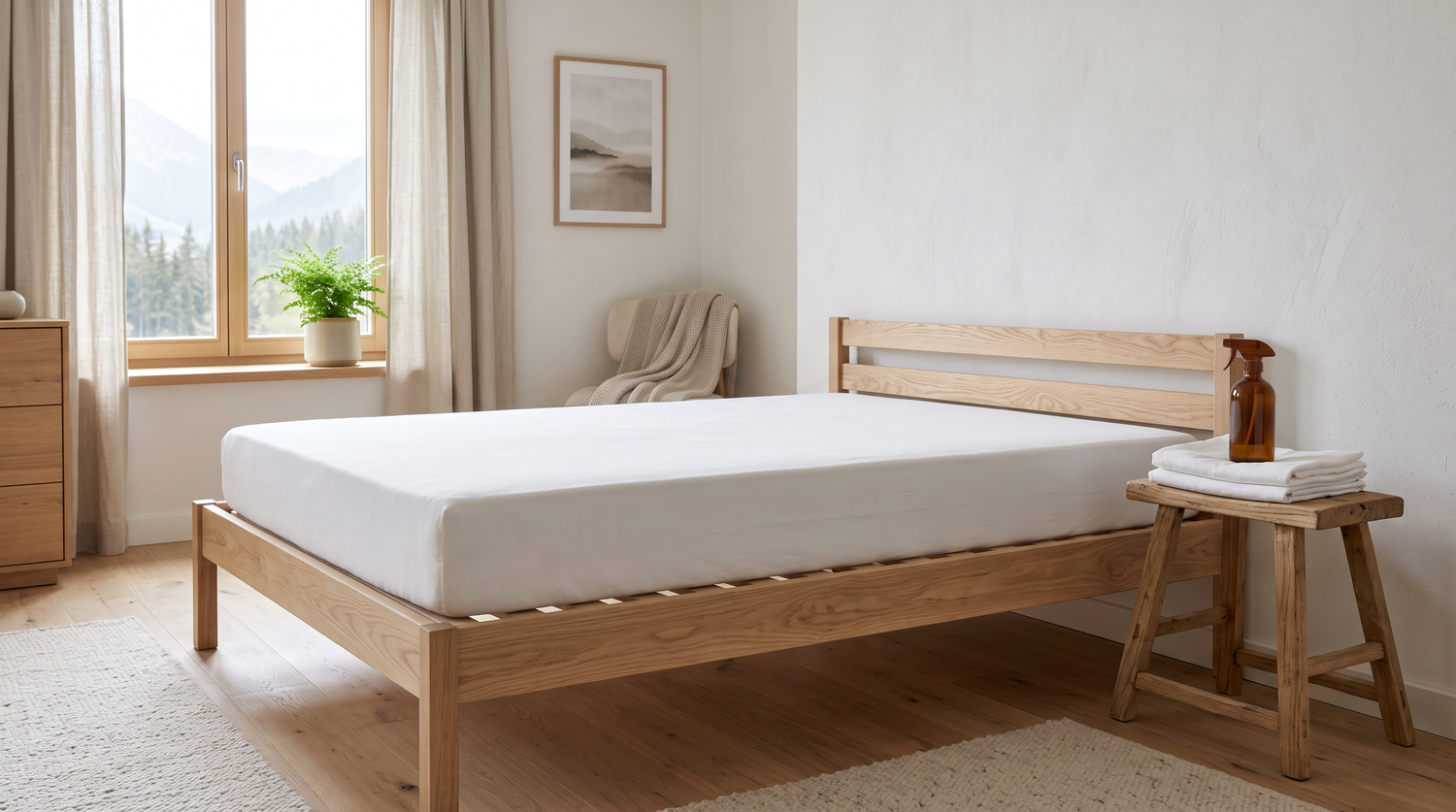
A spilled glass, night sweats, or a little mishap from the kids – stains on a mattress can happen quickly. Since a mattress can't simply be thrown into a washing machine, the right technique is needed: gentle, with little moisture, and the appropriate household remedy for each specific stain. We show you how to remove stains from your mattress without damaging the material.
The quick answer: Immediately blot fresh stains with a dry cloth (never rub), then treat with the appropriate household remedy: cold water for blood, diluted vinegar for urine, baking soda paste for yellow sweat stains, mild dish soap for coffee and grease. Always use liquid sparingly and allow the mattress to dry completely before putting on new bedding.
- Blot instead of rub: Rubbing pushes the stain deeper into the fabric and enlarges it.
- Only treat blood stains with cold water – warm water will coagulate the protein and set the stain.
- Use as little moisture as possible and always let the mattress dry completely.
- A washable mattress protector prevents most stains from occurring in the first place.
The basic rules for mattress stain removal
Before we get to the individual types of stains, here are three principles that apply to every treatment. First: Speed pays off – fresh stains can almost always be removed completely, while dried-in stains can only be removed partially. Second: Always work from the outside in, so the stain doesn't spread. Third: Moisture is the mattress's biggest enemy. A soaked mattress core dries extremely slowly – there's a risk of mildew and unpleasant odors. Therefore, only use slightly dampened cloths and never a steam cleaner directly on the foam.
Which stain, which household remedy? An overview
| Stain type | Household remedy | Procedure |
|---|---|---|
| Blood | Cold water, a little salt | Blot with cold water; for dried-in stains, apply salt paste, let it sit, then blot |
| Urine | Water-vinegar mixture (3:1) | Sop up liquid, blot with mixture, let dry, then use baking soda for residual odor |
| Yellow sweat stains | Baking soda paste | Mix baking soda with a little water to form a paste, apply, let dry, then vacuum |
| Coffee & Tea | Lukewarm water with mild dish soap | Absorb immediately, blot with dish soap solution, blot again with clear water |
| Grease & Cosmetics | Cornstarch or baking soda, then dish soap | Sprinkle powder, let it absorb grease, vacuum, blot remainder with dish soap solution |
| Red wine | Salt, then mineral water | Immediately sprinkle with salt, vacuum, blot with sparkling water |

Step by step: How to tackle every stain
- Act immediately: Absorb liquid with paper towels or a dry cotton cloth – only blot, never rub.
- Remove cover: If the stain has soaked through the cover, wash the cover according to the care label and treat the core separately.
- Apply household remedy: Apply the appropriate remedy from the table sparingly and work from the outside in.
- Post-treatment: Blot with a slightly damp cloth to remove any residue.
- Allow to dry completely: Ideally with an open window or a fan – only then put on fresh bedding.

Stubborn and old stains
Dried-in stains require patience: repeat treatment instead of intensifying it. It's better to work gently twice with baking soda paste or vinegar solution than to scrub aggressively once. We advise against harsh chemicals such as chlorine bleach – they can damage foam and fibers and often leave light rings that are more noticeable than the original stain. If a shadow remains, it's primarily a visual issue: As long as the mattress is hygienically clean and dry, it won't affect your sleep. A comprehensive guide to basic cleaning can be found in our guide Cleaning a mattress.
Prevention: The best stain is the one that never happens
Anyone who has ever removed a large stain from a mattress knows that prevention is much more relaxing. A waterproof, breathable mattress protector catches mishaps and simply goes into the washing machine. This includes regular routines: changing bedding, airing the mattress briefly when changing it, and rotating it every three months. A removable, washable mattress cover is also practical: With the Ora Ultra, the cover can be completely removed and washed – so the mattress stays hygienically fresh, while the EvoPoreHRC Premium Memory Foam automatically adapts to your body and sleeping position.
Get CHF 25 discount
Subscribe to our newsletter and receive a one-time CHF 25 discount. ✓ 200 nights trial sleep ✓ 10 years warranty
Hygiene made easy: The Ora Ultra mattress has a removable, washable cover and automatically adapts to every body thanks to EvoPoreHRC Premium Memory Foam – no guessing firmness levels. The Ora Ultra topper additionally protects the mattress from stains and wear.
Frequently asked questions about removing mattress stains
How do I remove old, dried-in blood stains from the mattress?
With a paste of salt or baking soda and cold water: apply, let dry, vacuum, and blot with cold water. Important: never use warm water, as the protein in the blood will coagulate and set permanently.
Can I treat the mattress with a steam cleaner?
We advise against it. Hot steam introduces a lot of moisture deep into the mattress core, which dries slowly – increasing the risk of mildew and odor formation. Targeted treatment with little liquid is the safer method.
Where do yellow stains on the mattress come from?
Mostly from sweat and skin oils that migrate into the fabric over months and oxidize. A baking soda paste will lighten the stains. A washable protector and regular airing of the mattress help long-term.
When is professional mattress cleaning still worthwhile – and when is it no longer?
For large-scale soiling of an otherwise intact, younger mattress, the service can be worthwhile. However, if the mattress is older than eight to ten years, saggy, or constantly smells, a new purchase is usually the more hygienic and economical solution.










Leave a comment
This site is protected by hCaptcha and the hCaptcha Privacy Policy and Terms of Service apply.