
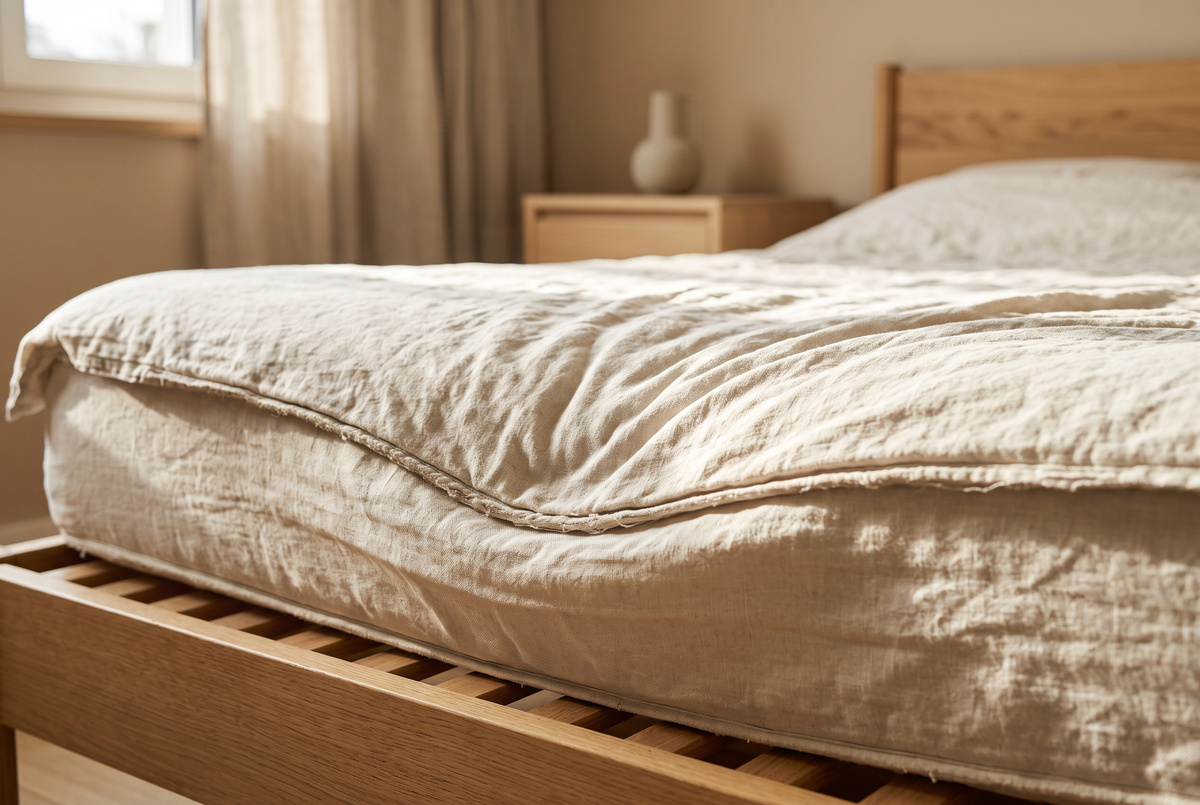
A mattress that is too soft feels wonderful when you lie down – and that's precisely what makes it insidious. The problem only becomes apparent in the morning, with a dull ache in the lower back that slowly dissipates after getting up. Unlike a mattress that is too firm, where the pressure is immediately noticeable, here the poor posture creeps in over hours. To make matters worse, a sagging mattress feels exactly the same as one that was too soft from the start – but the solutions are fundamentally different. This guide will help you distinguish between the two and choose the right measure.
The short answer: A mattress is too soft if your heavier pelvis sinks deeper than your shoulders and legs, causing your lumbar spine to sag downwards. Typical signs include lower back pain in the morning, the feeling of having to work your way out of a hollow when turning over, and difficulty getting up. First, use the ruler test to check if the mattress is sagging. If it is, only replacement will help – no topper and no board underlay. If it was too soft from the start, a firmer slatted frame can provide some compensation.
- The main symptom is lower back pain in the morning, which improves after 20–30 minutes of movement.
- Ruler test: If there is a dip of 2 cm or more in the lying zone, the mattress is sagging and must be replaced.
- A topper does not make a too-soft mattress firmer – it usually even exacerbates the problem.
- Boards or plywood sheets under the mattress are not a solution: they block ventilation and promote mold.
How to recognise a mattress that is too soft
The most important sign is the location of the pain. With mattresses that are too soft, it typically sits in the lower back, in the sacral and lumbar region, sometimes also in the pelvis. It is strongest in the morning and significantly improves after twenty to thirty minutes of movement. Secondly: you feel resistance when turning over, as if you have to work your way out of a hollow. Thirdly, getting up is more difficult because you first have to push yourself up out of the depression. Fourthly, you sleep noticeably better in other beds – in a hotel, at friends' houses. A practical self-test: Lie on your back and slide your flat hand under your lumbar spine. If it can be moved effortlessly back and forth, your pelvis is sinking too deeply.

The crucial difference: too soft or sagging?
This distinction determines which measure is appropriate. Remove the bedding, place a straight slat, an aluminium ruler, or a spirit level across the mattress and measure the greatest distance to the surface in the lying zone. Up to one and a half centimetres is unremarkable. Between one and a half and two centimetres, the critical zone begins. From two centimetres, the mattress is sagging. Important: Measure in an unloaded state and preferably in the morning, before the foam has fully returned – this is how you will see the condition most realistically. You can read how material quality affects this wear and tear under When to change your mattress: how often?.
Measures in a reality check
There are many home remedies for mattresses that are too soft. Few of them work. The following overview classifies them.
| Measure | Does it help? | Note |
|---|---|---|
| Adjust slatted frame more firmly | yes, limited | only with adjustable models, especially in the pelvic area |
| Turn mattress | yes, short-term | distributes the load, does not fix an existing hollow |
| Add a topper | no | makes the surface even softer, hollow remains |
| Place board or sheet underneath | no | blocks ventilation, risk of mould |
| Replace mattress | yes | only real solution for a 2 cm hollow or more |
Why a topper doesn't help here
The reflex is understandable: if a topper makes a too-firm mattress softer, there should also be a solution in reverse. But there isn't. A topper adds an additional soft layer on top – the support underneath remains unchanged. With a too-soft mattress, your pelvis will sink just as deeply, only with more padding in between. If there's a hollow, the topper adapts to its shape and doesn't fill it. While there are very firm toppers made of high-density foam, their effect on the spinal alignment is minimal. Read more about the limitations in the Topper Guide.
What to do better with the next one
If a replacement is due, it's worth looking at the cause. If the mattress was too soft from the start, the firmness rating was probably misleading – a known problem, see Mattress Firmness Levels. If it only became soft over time, it was almost always due to the material: cold foam with a density of less than 40 kg/m³ noticeably loses its elasticity within two to four years. So, with the next one, pay less attention to the firmness rating and more to density, core height, and a long trial sleep phase. And check the slatted frame at the same time – a sagging frame will also cause even the best new mattress to sag, see Slatted Frame and Mattress. You can find a price classification under what a good mattress costs.

Get CHF 25 discount
Subscribe to our newsletter and receive a one-time CHF 25 discount. ✓ 200 nights trial sleep ✓ 10 years warranty
Frequent questions about a mattress that is too soft
When is a mattress considered sagging?
As a guideline, a permanent hollow of two centimetres or more in the lying zone, measured in an unloaded state with a straight slat across the mattress, is considered sagging. Between one and a half and two centimetres is the critical range. Many manufacturers state similar values in their warranty conditions – it's worth checking the documents before buying new.
Can I make a too-soft mattress firmer with a board?
This is not advisable. A plywood board or planks under the mattress block air circulation from below. The moisture released overnight cannot escape, which encourages mould formation in the mattress core. In addition, an unnaturally rigid base is created, which creates new pressure points. A more sensible option is an adjustable slatted frame that you can adjust more firmly in the pelvic area.
Why does my lower back hurt on a soft mattress?
The pelvis is the heaviest part of the body. On a too-soft surface, it sinks deeper than the shoulders and legs, causing the lumbar spine to sag downwards. The muscles try to compensate for this misalignment throughout the night and are consequently tense in the morning. That's why the pain is strongest immediately after getting up and improves with movement.
Does a new mattress get softer over time?
Yes, a certain amount of softening is normal. In the first few months, the upholstery layer in particular loses some elasticity, followed by the core very slowly. How much and how quickly depends on the density: foam under 40 kg/m³ often becomes noticeably softer after just two to four years, while high-quality foam from 50 kg/m³ retains its support for eight years or more.
Is a soft mattress fundamentally bad for back pain?
No. It depends on whether the spine remains in a neutral alignment. A mattress that feels soft but still supports the pelvis can be a very good fit – especially for side sleepers with prominent shoulders. The problem only arises when support is lacking. For persistent discomfort, a medical or physiotherapeutic examination is advisable.
This article is for general information purposes only and does not replace medical advice.








Leave a comment
This site is protected by hCaptcha and the hCaptcha Privacy Policy and Terms of Service apply.