
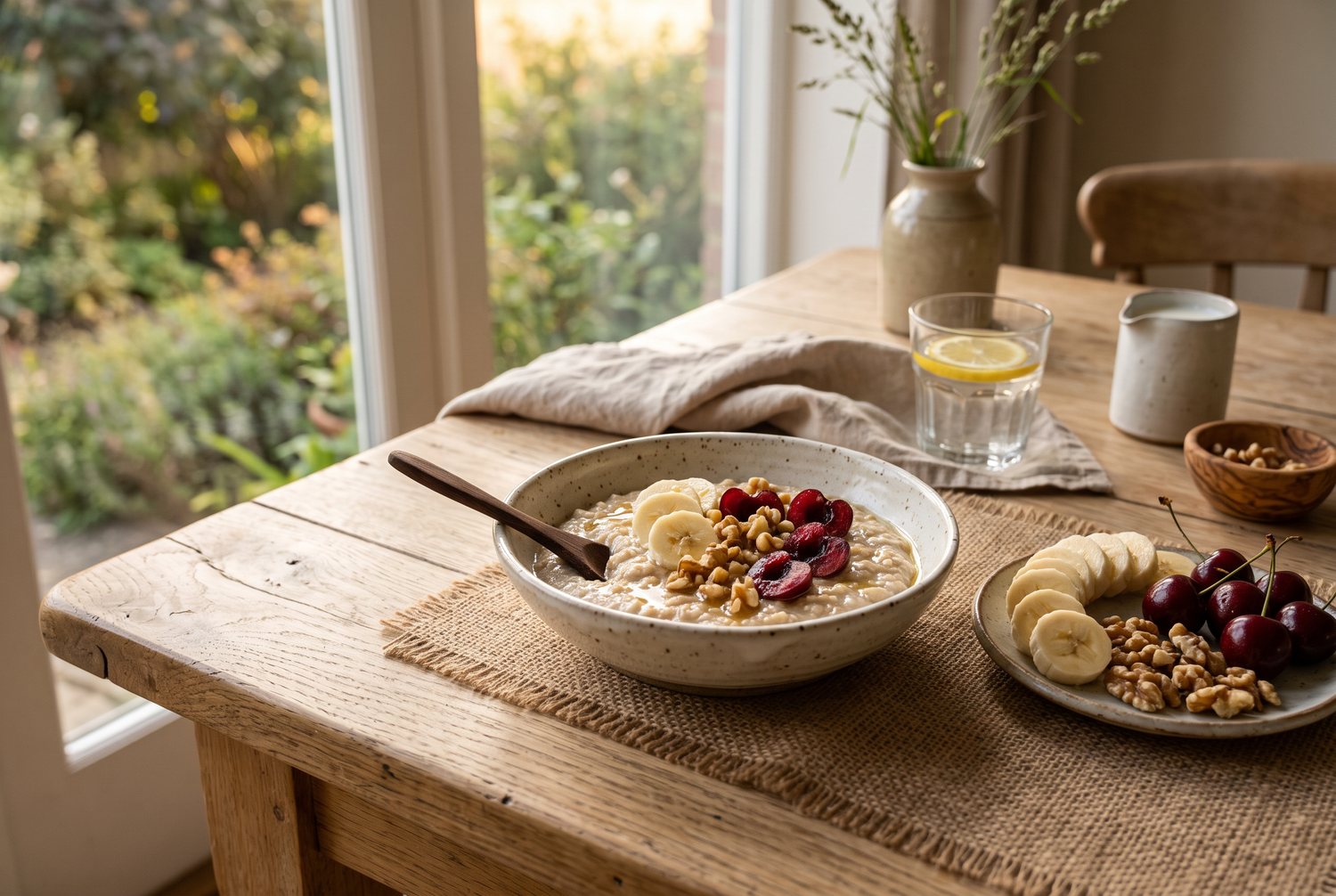
What lands on your plate plays a role in how your night unfolds. This isn't nutritional esotericism, but rather easily comprehensible biochemistry: the neurotransmitter serotonin and the sleep hormone melatonin are produced from an amino acid that we absorb exclusively through food. At the same time, late, heavy, or spicy meals can significantly disrupt sleep. The good news: it doesn't require special products or supplements, but primarily the right combination and timing. This article shows which foods genuinely contribute to good sleep – and which popular recommendations are overestimated.
The short answer: The most helpful approach is a light meal two to three hours before bedtime, combining complex carbohydrates with a moderate amount of tryptophan-rich protein. Tryptophan is the precursor to serotonin and melatonin and is found in oatmeal, dairy products, eggs, nuts, seeds, legumes, poultry, and fish. Carbohydrates help because they facilitate the transport of tryptophan to the brain via insulin release. Magnesium, calcium, and B vitamins also have complementary effects. In the evening, you should avoid caffeine, alcohol, very fatty and spicy foods, and large portions just before bed.
- Tryptophan plus complex carbohydrates is the most effective combination in the evening.
- Last large meal 2–3 hours before bedtime – but sleeping on an empty stomach is also poor.
- Caffeine has a half-life of 5–6 hours; caution is advised from 2 PM onwards.
- Alcohol facilitates falling asleep but destroys the second half of the night.
Tryptophan: the raw material for sleep
The body cannot produce tryptophan itself – we must consume it. This amino acid first forms serotonin, and from that, in darkness, melatonin, which signals night to the body. The catch: tryptophan competes with other large amino acids for the same transport pathways into the brain and usually loses out. This is where carbohydrates come in. They trigger a moderate insulin release, which shunts the competing amino acids into the muscles – tryptophan remains behind and reaches the brain more easily. This is why a bowl of oatmeal with milk or a slice of whole-grain bread with cheese promotes sleep more effectively than a plain steak. Practically, this means: not just eating tryptophan-rich foods, but combining them cleverly. More background in the article on naturally boosting melatonin.

The best foods in the evening
Oatmeal provides complex carbohydrates, magnesium, and tryptophan all in one – as porridge with milk or a plant-based drink, it's perhaps the best dinner ever. Dairy products like quark, yogurt, and cheese are also rich in tryptophan and additionally provide calcium, which is involved in the conversion of tryptophan to melatonin. Pumpkin seeds, almonds, and walnuts combine magnesium with healthy fats; walnuts also contain small amounts of melatonin themselves. Tart cherries and tart cherry juice are one of the few natural sources of melatonin with studies suggesting a slightly prolonged sleep duration. Bananas provide potassium, magnesium, and vitamin B6. Fatty fish like salmon or trout offer omega-3 fatty acids and vitamin D. Chickpeas, lentils, and beans complete the picture. For drinks: chamomile, lemon balm, or lavender tea – but not liters of it, otherwise your bladder will wake you up.
| Food | Ingredient | Ideal Evening Portion |
|---|---|---|
| Oatmeal with milk | Tryptophan, magnesium, carbohydrates | 40–60 g flakes |
| Tart cherry juice | natural melatonin | 1 glass, approx. 2 hrs before |
| Walnuts, almonds | Magnesium, Omega-3, melatonin | a small handful |
| Quark or yogurt | Tryptophan, calcium | 150–200 g |
| Banana | Potassium, magnesium, vitamin B6 | 1 piece |
What to better avoid in the evening
Caffeine is the most obvious disturbance, but its duration is underestimated: the half-life is five to six hours, and for some people significantly longer. An espresso at 4 PM still has half its effect at midnight. Also think of black tea, green tea, cola, energy drinks, and dark chocolate. Although alcohol shortens the time it takes to fall asleep, it suppresses REM sleep and leads to frequent awakenings in the second half of the night – overall, the balance is clearly negative. Very fatty meals delay gastric emptying and promote reflux, especially when lying down. Spicy foods increase core body temperature, which should actually decrease to fall asleep. And large portions just before bedtime force the body to digest when it wants to shut down. Details can be found under Caffeine and Sleep as well as Alcohol and Sleep Quality.
The right timing
Two to three hours between the last large meal and bedtime is a good guideline. During this time, the heaviest part of the stomach's work is done, without blood sugar having already dropped. Going to bed hungry is also unfavorable: falling blood sugar triggers a release of stress hormones that can wake us up at night. If you come home late, it's better to eat a small, carbohydrate-focused portion than nothing at all – a yogurt with oatmeal or a slice of whole-grain bread is sufficient. Regularity is also important: fixed meal times are, next to light, the second most important synchronizer of the internal clock. Eating at a different time every day sends conflicting signals to the body, as the article on the internal clock shows.
Realistic Expectations
Nutrition is one of several levers – and rarely the strongest. The effects of individual foods on sleep quality are usually small in studies, and anyone expecting a completely different night after a glass of tart cherry juice will be disappointed. A stable rhythm, daylight in the morning, a cool sleeping environment, and avoiding late caffeine have a much greater impact. Conversely, however: ignoring nutrition means missing out on an easy contribution. An inappropriate meal can reliably ruin an otherwise good night, while the right combination paves the way to sleep. Therefore, consider dinner as part of your evening routine, not an isolated measure. Anyone suffering from persistent sleep problems will find more effective approaches in the article on insomnia.

Get CHF 25 discount
Subscribe to our newsletter and receive a one-time CHF 25 discount. ✓ 200 nights trial sleep ✓ 10 years warranty
Frequently Asked Questions about Foods for Good Sleep
Which food helps best with falling asleep?
There is no single miracle cure. The best-documented combination is complex carbohydrates and tryptophan-rich protein – such as oatmeal with milk or whole-grain bread with cheese. This combination facilitates the transport of tryptophan to the brain.
How long before bed should I eat my last meal?
Two to three hours is a good guideline for a large meal. A small, carbohydrate-focused portion can still be beneficial an hour beforehand – going to bed hungry also disrupts sleep.
Does a glass of warm milk help with falling asleep?
Milk does contain tryptophan and calcium, but in quantities that are barely pharmacologically significant. The greater part of the effect is likely due to warmth, ritual, and expectation – which does not diminish its benefit.
When should I stop consuming caffeine during the day?
As a rule of thumb: six to eight hours before bedtime, and for sensitive people, from early afternoon. The half-life is five to six hours, but it is metabolized very differently by individuals.
Is alcohol useful as a nightcap?
No. Although alcohol shortens the time it takes to fall asleep, it suppresses REM sleep and leads to increased awakenings in the second half of the night. Overall sleep quality significantly decreases, even if falling asleep is easier.






Leave a comment
This site is protected by hCaptcha and the hCaptcha Privacy Policy and Terms of Service apply.