
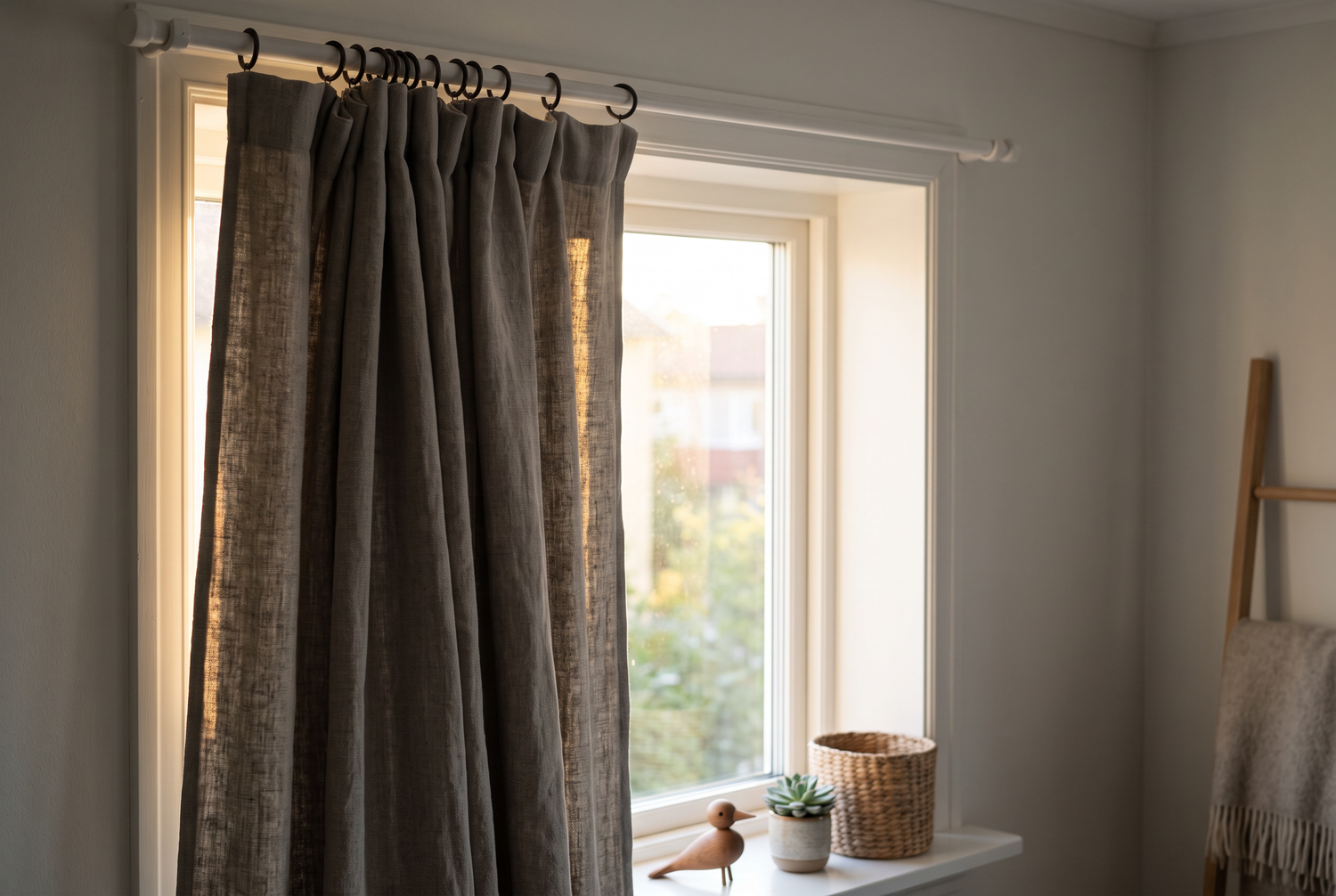
At 7:30 PM, the child should be asleep – but in June, the sun is still shining into the room at that time, and at 5:40 AM, the first daylight wakes up the whole family. Light is the strongest pacemaker of the internal clock, and children's eyes are particularly receptive to it: their pupils are larger and their eye lenses clearer than adults', allowing significantly more light to reach the retina. A children's room that is too bright delays the release of the sleep hormone melatonin, prolongs the time it takes to fall asleep, and promotes early waking. The good news: hardly any sleep measure offers such a measurable effect for so little money as good blackout. This guide shows how dark a child's room really should be, which solutions are suitable for rental apartments, skylights, and summer holidays – and how to balance blackout with the fear of darkness.
The short answer: For ideal falling asleep and sleeping through the night, a room should be so dark that you can only vaguely make out your own hand in front of your face at night. The most reliable way to achieve this is with blackout blinds with side guide rails or opaque blackout curtains that extend 15 to 20 cm beyond the window on the sides and top. If your child is afraid of the dark, a warm white night light with a maximum of 5 to 10 lumens near the floor is the best compromise – it calms without significantly disturbing melatonin production.
- Children's eyes let in more light than adults' eyes – blackout therefore has a particularly strong effect on children's sleep onset time and morning sleep.
- Target value: so dark that your hand is only vaguely visible in front of your face; cover residual light sources such as standby LEDs.
- Most effective solutions: blinds with guide rails or blackout curtains with a generous overlap; suction cup blinds for rentals and travel.
- For fear of the dark: warm white night light (max. 5–10 lumens, below 2700 K) near the floor instead of bright ceiling lighting.
- The opposite applies in the morning: after waking up, plenty of daylight helps keep the internal clock stable.
Why darkness is so important for children's sleep
The internal clock is reset daily via the retina: special sensory cells report brightness to the brain area that controls melatonin secretion. In darkness, the sleep hormone increases; in light, it is suppressed – and significantly more so in children: studies show that even moderate room lighting in the evening can massively dampen melatonin production in preschoolers, sometimes by more than half. Many parents know the consequences: the child is "wide awake again" at 8 PM, even though they should be tired. The mechanism also works in the morning: twilight from 5:30 AM ends the last, light sleep phase – in summer, children quickly lose 60 to 90 minutes of sleep this way. And for naps, the darkening often determines whether they fall asleep at all. The dual strategy is important: dark in the evening and at night, plenty of light during the day. A child who comes into bright daylight in the morning stabilizes their internal clock – more on this in the article about the circadian rhythm.
How dark is dark enough? The practical test
Absolute numbers are of little help in everyday life – instead, use two simple tests. The hand test: at night, with the blackout in place, stand in the middle of the room and hold your hand 30 cm in front of your face. If you can see your hand clearly, it's too bright for sensitive children to sleep through the night; if you can only vaguely make it out or not at all, the level is good. The morning test: go into the room at 6 AM in the summer – does it feel like deep night or like twilight? Twilight is enough of a wake-up stimulus for many early risers. Frequently overlooked residual light sources: the light gap at the side of the blind (up to 2 cm bright strips move across the bed in the morning), standby LEDs from humidifiers, baby monitors, or power strips (cover with an adhesive dot), the light gap under the door (draft stopper helps), and streetlights shining directly at head height. By the way: a completely darkened room is also useful for naps – unless you are in the process of weaning off naps; then the quiet break may consciously take place in semi-darkness.

Comparing the solutions
| Solution | Blackout | Cost (approx.) | Suitable for |
|---|---|---|---|
| Blackout Curtain | Very good (with overlap) | CHF 40–150 | Standard windows, rental apartments |
| Blackout Blind with Side Channels | Excellent | CHF 80–250 | Skylights, early risers |
| Suction Cup/Velcro Travel Blind | Good | CHF 20–60 | Rentals, holidays, travel cot |
| Shutters/Blinds | Very good | Structurally present | Own home, combination with curtains |
| Aluminum Foil/Cardboard (Emergency Solution) | Very good, but impractical | Under CHF 10 | Temporary, heat protection |
General rules for installation: Install curtain rods 15 to 20 cm above the window frame and extending 20 cm on both sides; choose blinds with side guide rails if possible, as free-hanging blinds always leave light gaps. Further models and fabric details can be found in the guide to curtains and blackout.
Night light despite blackout: the right dosage
Many children develop a fear of the dark between the ages of 2 and 6 – precisely when their imagination awakens. Forcing a completely black room against the child's will is counterproductive: fear is a stronger sleep robber than a dim light. The solution is light in homeopathic doses: a night light with a maximum of 5 to 10 lumens – equivalent to about a candle flame – warm white to amber (below 2700 Kelvin), placed near the floor and not in the line of sight of the bed. Red or orange light suppresses melatonin the least; blue and cool white light are the worst choices. Models with a timer that switch off automatically after 30 to 60 minutes when the child is asleep are practical. For parents' nocturnal interventions – tucking in, comforting, changing nappies – the same principle applies: dim, warm light instead of a ceiling lamp, so that neither child nor parents are jolted out of sleep mode. And for waking up in the morning, it can consciously be bright – a light alarm clock can achieve this gently.
Common mistakes when blacking out
Mistake 1: The curtain ends flush with the window frame – lateral light strips travel directly across the child's bed from 5:30 AM in summer. Always install with an overhang. Mistake 2: dark fabric without a blackout coating. Even dense, dark blue fabric often lets through 5 to 10 percent of light; real blackout fabrics have a coated backing. Mistake 3: the room becomes a cave – even during the day. If the blackout remains permanent, the child lacks the daylight signal, and the internal clock flattens; consistently open in the morning. Mistake 4: screen replaces night light. A tablet as a "sleep light" provides exactly the cool white spectrum that wakes you up – more on this in the article about blue light in the evening. Mistake 5: ignoring overheating. Closed blinds plus closed windows trap heat in summer; black out externally during the day (shutters, blinds) and ventilate across in the evening before the child goes to bed – 17 to 19 °C in the child's room is ideal.
Special cases: skylights, holidays, shared room
Skylights are the toughest discipline: they are often directly above the bed and also heat up the room. Here, original blackout blinds with guide rails from the window manufacturer are worthwhile – cheaper universal blinds with suction cups work but tend to lose their grip in the heat. On holiday, a foldable travel blind or, if necessary, the combination of a bin bag and masking tape can save the sleep rhythm – especially for children who are used to darkness at home. If siblings share a room, the rule is: adjust the blackout to the child with the lightest sleep and negotiate night light compromises – a dimmable model with two settings resolves most conflicts. For babies, a special rule applies: newborns may consciously sleep in the light during the day so that the day-night rhythm can develop; consistent blackout is worthwhile from about 3 to 4 months, when the internal clock starts working.

Get CHF 25 discount
Subscribe to the newsletter and receive a one-time CHF 25 discount. ✓ 200 nights trial sleep ✓ 10 years warranty
Frequently asked questions about blacking out a child's room
How dark should a child's room be for sleeping?
So dark that you can only vaguely make out your own hand 30 cm in front of your face. This level supports melatonin production and prevents early waking due to morning light.
Is a night light okay despite blackout?
Yes – in cases of fear of the dark, it is even the better choice. Choose a warm white to amber model with a maximum of 5 to 10 lumens, placed near the floor and not directly in the bed's line of sight.
Which blackout solution works best?
Blackout blinds with side guide rails achieve the best blackout, followed by blackout curtains with a 15 to 20 cm overlap above and to the sides of the window. Suction cup blinds are suitable for rental apartments and travel.
Should naps also take place in a darkened room?
Yes, darkening significantly facilitates falling asleep during naps. Exception: newborns in the first few months may sleep in the light during the day so that their day-night rhythm can develop.
Does too much darkness harm the rhythm?
Only if it extends into the day. Consistently open the blackout after waking up – bright morning light stabilizes the internal clock and makes falling asleep easier in the evening.
What helps against light strips at the edge of the blind?
Side guide rails, a wider curtain above it, or self-adhesive light strips on the window frame. You should also cover small LED light sources in the room – they appear surprisingly bright in dark rooms.








Leave a comment
This site is protected by hCaptcha and the hCaptcha Privacy Policy and Terms of Service apply.