
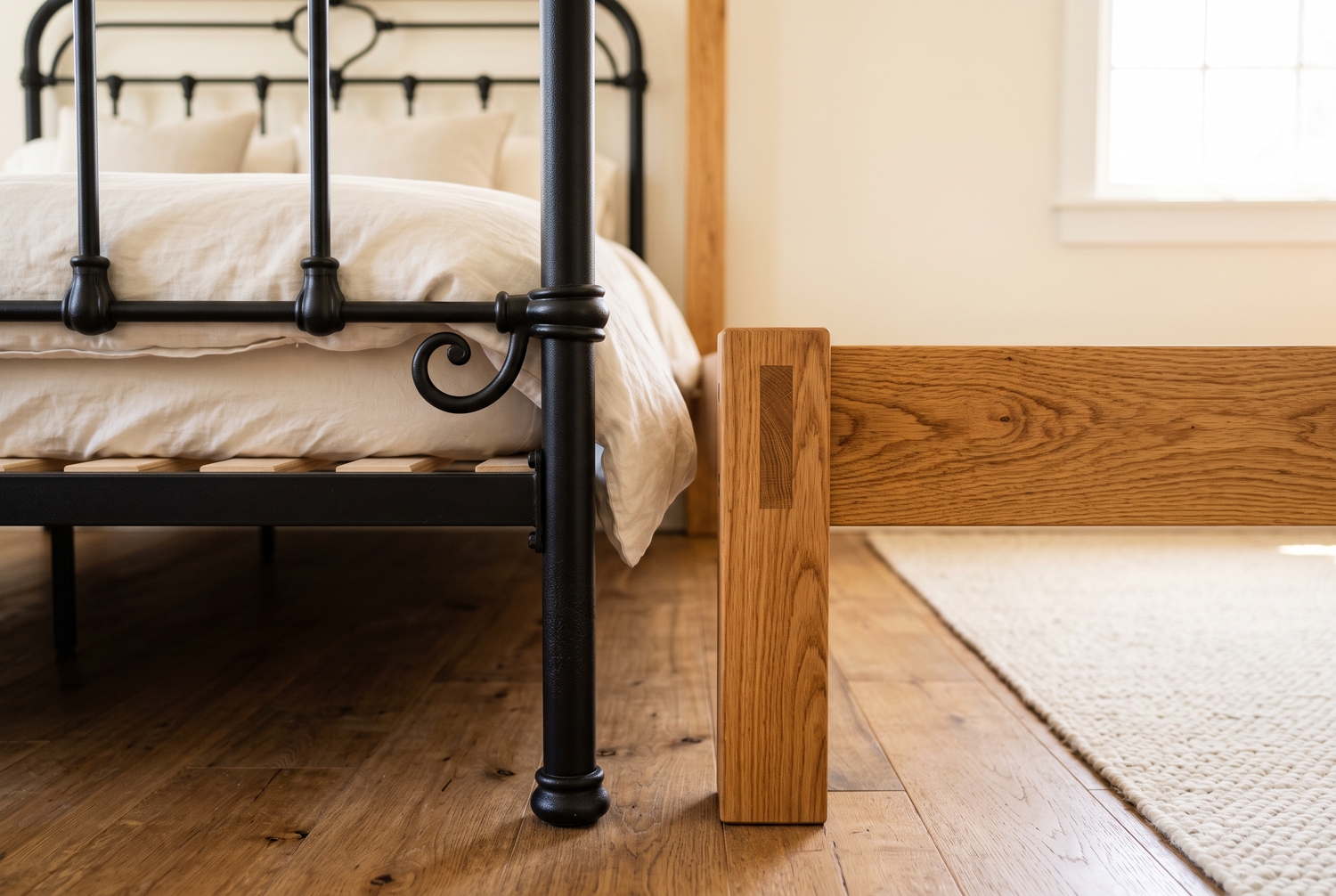
When it comes to a new bed, almost everything revolves around the mattress – but the bed frame also determines how peacefully, stably, and beautifully you'll sleep for the next 10 to 20 years. The fundamental question usually is: metal or wood? The delicate metal bed promises lightness and a touch of vintage, while the wooden bed offers warmth, mass, and natural appeal. Both materials have tangible technical differences: in the stability of their joints, their propensity to creak, their weight, and their lifespan. And both are available in qualities ranging from wobbly to rock-solid – the material alone doesn't make a good bed. In this guide, we compare metal and wooden beds point by point, show what really matters in terms of joints and workmanship, and provide you with a checklist for buying – so that the frame lasts as long as your best mattress.
The short answer: Technically, both materials can be impressive – the workmanship is crucial. Solid wood beds score points with their mass, warm appeal, and easily retightenable joints; high-quality metal beds are lighter, sleeker, and unaffected by climate fluctuations. Both can creak: metal at loosened screw points, wood at working tenons and supports. As a rule of thumb: A heavy solid wood bed weighing around 40 kg or more with metal corner connectors is the safest choice for lasting peace and quiet, while a good metal bed is right for small spaces, frequent moves, and a delicate aesthetic. Cheap goods under 200 Swiss francs will sooner or later become wobbly – no matter the material.
- Solid wood beds (oak, beech) are heavy, durable, and exude warmth – good models last 20 years or more.
- Metal beds are light (15–30 kg), sleek, and ideal for small rooms and moving – quality is evident in wall thickness and welds.
- Creaking is a matter of joints, not material: metal corner fittings and annual retightening keep both quiet.
- For the mattress, the foundation matters: stable support slats, an even slatted frame, and a center support from 140 cm width.
- Price orientation: solid metal beds from approx. CHF 300, good solid wood beds from approx. CHF 500–800.
The Metal Bed: Light, Delicate, Durably Coated
Metal beds usually consist of powder-coated steel tubing or – for high-quality models – forged solid steel. Their strengths: At 15 to 30 kg, they are significantly lighter than wooden beds, easy to transport, and appear airy due to thin struts – a real advantage in small rooms. Metal does not react to the room climate: it neither warps in dry winter air nor in humid summer, and mites or woodworms are not interested in it. The powder coating of modern frames is scratch-resistant and easy to clean. The weaknesses: Thin-walled tubes under 1.5 mm wall thickness can spring back under load and appear unstable; cheap plug connections wear out and start to rattle. The feel is also a matter of taste – metal feels cool, and the delicate construction offers less surface area for pillows when reading. When buying, look for welded instead of just plugged corner connections, wall thicknesses of 1.5 mm or more, and a load capacity of at least 150 kg per sleeping surface. Then a metal bed will also remain quiet for decades.
The Wooden Bed: Warm, Solid, Repairable
When it comes to wooden beds, quality is determined by one question: solid wood or engineered wood panel? Solid beds made of oak, beech, ash, or core beech weigh 40 to 80 kg – this mass dampens vibrations and stands firmly on the floor. Wood ages gracefully: scratches can be sanded down, oiled surfaces refreshed, and even after 20 years, a solid bed can be completely disassembled and re-screwed. Added to this is the warm appeal and a biological living bonus: oiled solid wood can buffer small amounts of moisture and contributes to a pleasant room climate. The weaknesses: Wood works – with strongly fluctuating humidity, mortise and tenon joints can creak, and veneered particle board beds only look like wood at first: their screw threads in particle board wear out after a few assemblies and disassemblies. Weight also has two sides: stable when standing, cumbersome when moving. What you should generally look for in frames, support slats, and center supports is summarized in the guide Choosing a Bed Frame.

Metal Bed vs. Wooden Bed: The Direct Comparison
| Criterion | Metal Bed | Solid Wood Bed |
|---|---|---|
| Weight | 15–30 kg, easy to transport | 40–80 kg, very stable |
| Stability | Good with wall thickness from 1.5 mm and welds | Very good, mass dampens vibrations |
| Noise tendency | Rattling with loose plug connections | Creaking with working wood joints |
| Durability | Very high (rust only with damaged coating) | Very high, additionally repairable |
| Room Climate/Feel | Cool, neutral | Warm, moisture-buffering |
| Price (solid quality) | from approx. CHF 300 | from approx. CHF 500–800 |
Stability and Noise: What Really Matters
Whether a bed remains quiet depends on three areas. First, the corner joints: for wooden beds, solid metal corner fittings with threaded screws are the gold standard – they can be retightened repeatedly over the years. Pure wooden tenons are traditionally beautiful but require precision fitting; for metal beds, load-bearing parts should be welded and only the mounting points screwed. Second, the center support: From a bed width of 140 cm, a longitudinal support with one or two support legs is mandatory, otherwise the slatted frame and mattress will sag in the middle – this creates noise and shortens the mattress's lifespan. Third, the supports: Where the slatted frame rests on the frame, felt or rubber supports prevent wood on wood or metal on wood from working against each other. If your current bed is already making noise, a systematic troubleshooting is worthwhile – a step-by-step guide can be found in the article Squeaky Mattress: Causes and Solutions. And remember ventilation: Both materials are uncritical as long as the slatted frame allows air to reach the underside of the mattress – more on this under Mattress Ventilation.
Style and Room Impact: What Suits Your Bedroom?
Beyond technical aspects, aesthetics determine well-being for years. Metal beds excel in two style worlds: as delicate black frames in an industrial or Scandinavian look, and as romantic, curved brass or iron beds in a vintage style. Due to their slim profiles, they appear less dominant in small rooms – the eye sees more floor, making the room seem larger. Wooden beds, on the other hand, dominate in natural tones: light ash and oak for a Scandinavian-Japanese look, walnut for elegant warmth, oiled core beech for rustic presence. A solid wooden bed is a visual statement and anchors the room – ideal in larger rooms with a calm color palette. You should also consider the headboard practically: those who read in bed sit more comfortably against a padded or wide wooden headboard than against thin metal struts – a pillow as a buffer helps with metal beds. The height also varies: metal beds are often lower (entry height around 45–50 cm), wooden frames with box profiles are higher. The article Ideal Bed Height clarifies which entry height is comfortable for you.
Common Mistakes When Buying a Bed Frame
Mistake one: Buying solely based on appearance. A bed is subjected to stress for 3000 nights – check connections, material thicknesses, and load capacities, not just photos. Mistake two: Mistaking veneer for solid wood. Explicitly ask for "solid"; terms like "oak decor" or "wood-colored" mean coated particle board. Mistake three: Ignoring the center support. Especially inexpensive 160cm and 180cm beds skimp here – without support legs, the middle will sag after a year. Mistake four: Smiling away wobbliness in the store. Shake the headboard of the display model; what gives way when new won't improve at home. Mistake five: Overlooking the slatted frame support on metal beds – some models only have narrow angles on which common slatted frames barely rest; measure the support depth (at least 25–30 mm). Mistake six: Too tight internal dimensions. The frame should allow the mattress 1–2 cm of play, otherwise it will jam and the cover will chafe. And mistake seven: Underestimating transport and assembly – a 70kg oak bed needs two people to carry and torque to assemble, otherwise the threads will suffer during the first setup.

Get CHF 25 discount
Subscribe to our newsletter and receive a one-time CHF 25 discount. ✓ 200 nights trial sleep ✓ 10 years warranty
Frequently Asked Questions about Metal Beds and Wooden Beds
Which is more stable: metal bed or wooden bed?
Both can be very stable – the workmanship is crucial. Solid wood beds score points with their mass and retightenable metal corner fittings, while high-quality metal beds impress with welded joints and wall thicknesses of 1.5 mm or more. Cheap models are wobbly in both material categories.
Do metal beds creak less than wooden beds?
Not necessarily: Metal beds can rattle due to loosened plug and screw connections, while wooden beds creak at working tenons and supports. Annual retightening of all screws and felt pads at contact points keep both types quiet.
How heavy is a wooden bed frame compared to metal?
Metal beds usually weigh 15 to 30 kg, while solid wood beds weigh 40 to 80 kg. The higher weight makes wooden beds more stable, but metal beds are significantly easier to transport – relevant for frequent moves.
How do I recognize a good solid wood bed?
By solid wood throughout instead of veneered particle board, metal corner connectors with threaded screws, a center support with support legs from 140 cm width, and cleanly oiled or lacquered surfaces. Explicitly ask for the declaration "solid."
Does a metal bed rust?
Not with an intact powder coating – it reliably protects the steel. Rust can only occur if the coating is damaged by deep scratches and moisture is present; minor damage can be repaired with a paint pen.
Which bed frame is suitable for a foam mattress?
Both materials are suitable, as long as the slatted frame is even and intact, has sufficient support depth, and allows air to reach the underside of the mattress. It is also important to have 1 to 2 cm of clearance in the internal dimensions so that the mattress does not jam.






Leave a comment
This site is protected by hCaptcha and the hCaptcha Privacy Policy and Terms of Service apply.