
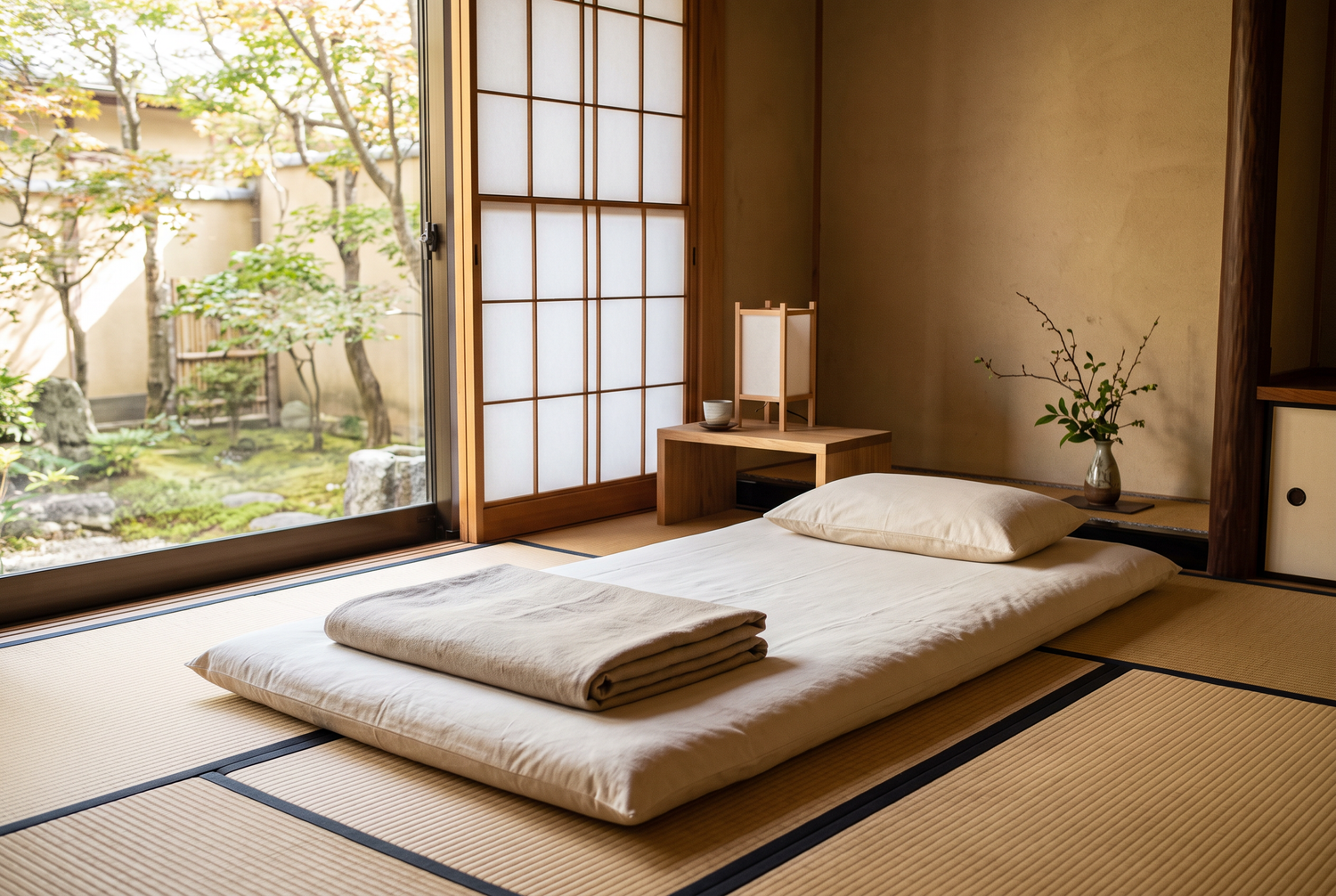
Minimalist, close to the ground, tidy: The Japanese bedroom holds a great fascination for many people. Instead of a bulky bed, there is a futon – a thin, quilted mat – on springy tatami mats made of rice straw and rush grass, and during the day, the entire bedding is rolled up and stored in the closet. With the Japandi interior design trend, this sleeping culture has also arrived in Swiss homes. But between aesthetics and everyday life lie a few crucial questions: Is sleeping hard and close to the ground ergonomically sound? What does moisture do to the futon and the floor? And does the concept even work if you don't put the futon away every day as in Japan? In this guide, we soberly examine the tradition, technology, and suitability of Japanese sleeping – and show the middle ground that combines aesthetics and ergonomics.
The short answer: A traditional futon, with 5 to 10 cm of cotton filling, is significantly thinner and firmer than Western mattresses and only works as a system: tatami as a springy, moisture-regulating base plus daily rolling up and regular airing of the futon. Those who consistently live this way get a space-saving, minimalist sleeping system – those who leave the futon permanently lying risk mold and uncomfortable nights. For side sleepers and people with shoulder or hip problems, the shallow sink-in depth is usually ergonomically unsuitable; the popular compromise is a low bed frame in Japandi style with a modern, point-elastic mattress.
- A traditional Japanese futon (Shikibuton) is 5–10 cm thick, filled with cotton, and rolled up daily.
- Tatami mats made of rice straw and rush grass are slightly springy, regulate moisture, and have a characteristic scent.
- Advantages: extremely space-saving, minimalist, inexpensive, very firm sleeping comfort for enthusiasts.
- Limitations: low pressure relief for shoulders and hips, high maintenance, risk of mold if left permanently on the floor.
- Japandi compromise: low bed frame (15–25 cm) with a modern point-elastic mattress – look without ergonomic disadvantages.
What are futon and tatami? Origin and construction
The Japanese sleeping system consists of several layers. The base is made of tatami mats: panels about 5.5 cm thick with a core of pressed rice straw (today often wood fiber or foam), covered with woven igusa rush grass. A standard mat measures around 90x180 cm and in Japan even serves as a unit of measurement for rooms. Tatami is slightly springy, insulates against cold from the floor, and can absorb and release moisture. On top of this lies the Shikibuton, the actual sleeping futon: a 5 to 10 cm thick, quilted mat filled with cotton (sometimes wool or latex components). It is covered with the Kakebuton, a light quilted blanket, and the head traditionally rests on a small, firm pillow – formerly filled with buckwheat hulls. Important for distinction: What is sold in Europe as a "futon" is often a 15 to 20 cm thick mixed mattress for futon beds – which only shares the name with the Japanese original. Our overview Comparison of mattress types shows where these variants fit in.
Japanese sleeping: How the system traditionally works
The core of Japanese sleeping culture is not the material, but the routine. Every morning, the futon is rolled or folded and stored in the oshiire, the deep built-in closet – the room becomes a living space during the day. This daily tidying away is not folklore, but moisture management: The body releases 0.3 to 0.5 liters of moisture per night, which a thin futon largely absorbs. When rolled up and stored, it can dry, and the tatami underneath also breathes. In addition, there is regular sun-airing: Once or twice a week, Japanese people hang their futons over balcony railings in the sun and beat them – UV light and ventilation work against moisture and dust mites. Every few years, the cotton filling is traditionally reprocessed because it compacts over time and loses height. So, whoever wants to sleep Japanese adopts a care system – just buying the mat is not enough. You can read what good ventilation routines generally achieve in the article Proper ventilation for a good sleep climate.

The advantages: What speaks for futon and tatami
The Japanese system has real strengths. First, space-saving: A rolled-up futon takes up less than half a square meter of closet space – in a studio apartment, the bedroom becomes a living room during the day. Second, cost: A good Shikibuton costs 150 to 400 Swiss francs, significantly less than a complete bed system. Third, indoor climate: Tatami mats regulate moisture, dampen sound, and emit a mild grassy scent that many find calming. Fourth, flexibility: Guests get a full-fledged bed with a second futon, which then disappears again. And fifth, the firm lying sensation itself: People who prefer very firm surfaces – often back sleepers with a balanced body build – find the close-to-the-ground, stable lying position to be beneficial. In addition, there is a psychological aspect: The daily routine of setting up and taking down creates a conscious ritual around sleep, similar to what sleep hygiene research recommends for evening routines. Those who want to live minimalism not only aesthetically but also practically will find a consistent concept here.
The limitations: Ergonomics and suitability for everyday use
Now, the other side. A 5 to 10 cm thin cotton futon offers little sink-in depth – which is critical for side sleepers, as the shoulder needs 4 to 7 cm of space to keep the spine straight. On a hard surface, the cervical spine will bend, and pressure points on the shoulder and hip will disturb sleep. For people with osteoarthritis, hip or shoulder problems, and pregnant women, the low pressure relief is usually unsuitable; a point-elastic mattress is often the better choice here – more on this in the guide Mattress for side sleepers. Sleeping close to the ground itself has practical disadvantages: close to the ground means cooler, dustier air layers – unfavorable for house dust allergy sufferers – and getting up from the floor strains knees and hips, which becomes relevant with age. However, the biggest everyday mistake is continuous placement: Those who leave the futon on tatami or even directly on parquet for weeks will cultivate moisture buildup – mold and mildew are then not a question of if, but when. Why this also applies to Western mattresses is explained in the article Mattress on the floor.
Futon vs Western Mattress: A direct comparison
| Criterion | Japanese Futon on Tatami | Modern Mattress in Bed |
|---|---|---|
| Sleeping comfort | Very firm, low sink-in depth | Point-elastic, pressure-relieving |
| Ergonomics for side sleepers | Mostly insufficient | Good to very good |
| Space requirement during the day | Minimal (stored away) | Bed area remains occupied |
| Maintenance effort | High: roll daily, air weekly | Low: rotate, wash cover |
| Purchase costs | CHF 150–400 (plus Tatami) | From approx. CHF 500–1500 with bed |
| Lifespan | 3–5 years (filling compacts) | 8–10 years with good quality |
Common mistakes when sleeping Japanese style
Mistake one: Buying a futon, skipping the routine. Without daily rolling up and regular airing, the minimalist dream turns into a moisture trap. Mistake two: Placing the futon directly on parquet, laminate, or carpet. These floors don't breathe – the underside stays damp, and condensation can collect under the futon. At least a slatted frame-like substructure, or better yet, real tatami, is a must. Mistake three: Placing a thick Western mattress on the floor as a "futon" – this combines the disadvantages of both worlds: no ventilation from below, but also no system that can be put away. Mistake four: Keeping the pillow, ignoring the lying height. On a very firm surface, the shoulder is higher – side sleepers then need a higher pillow, otherwise, the neck will bend. Mistake five: Wiping tatami wet. The grass mats can only tolerate damp wiping and must then dry thoroughly. Mistake six: Forgetting the climate – in poorly ventilated, cool rooms with over 60 percent humidity, the risk of mold significantly increases; how to keep this under control is shown in the article Avoiding mold.
Japandi: the compromise between look and sleeping comfort
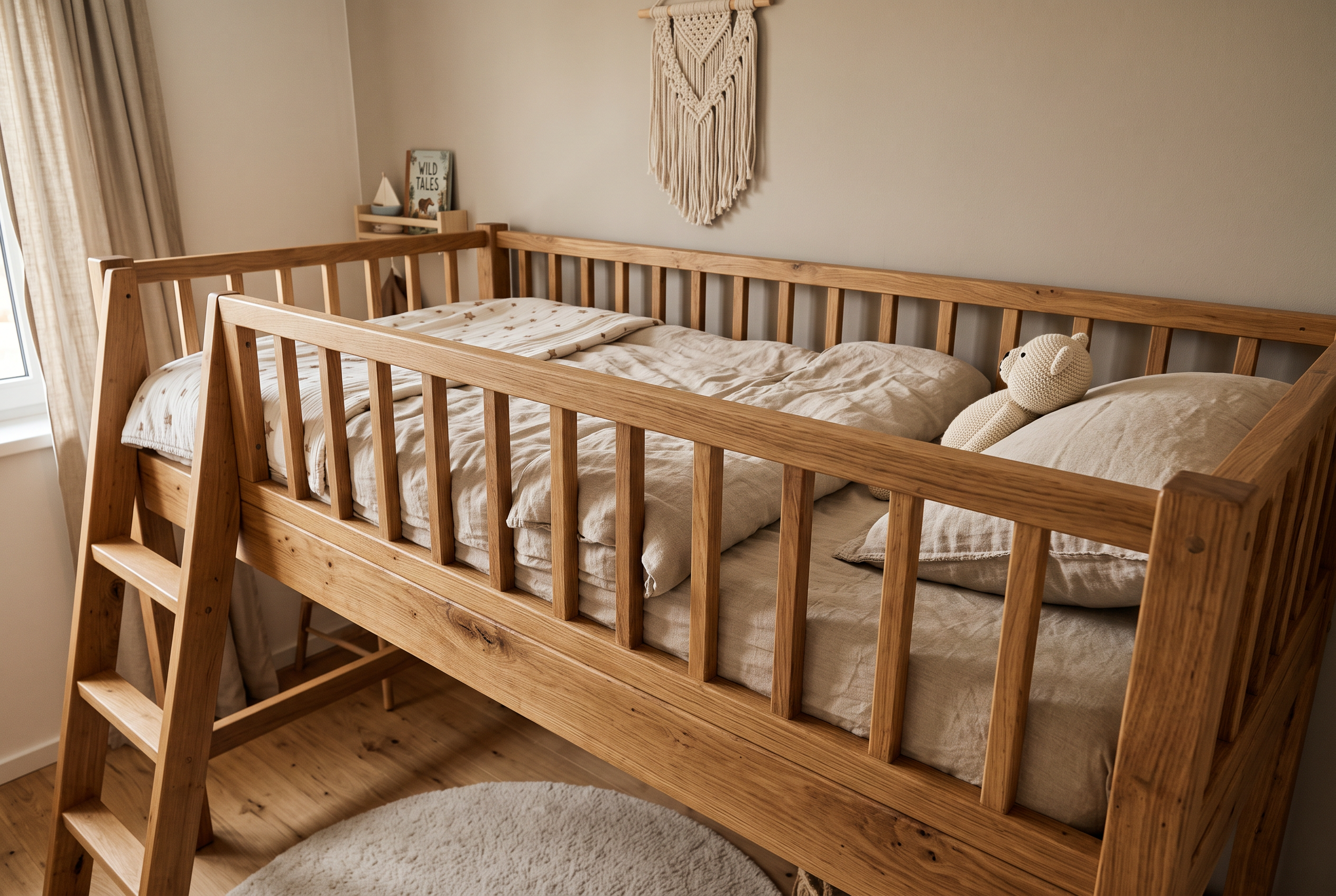
For those who love Japanese aesthetics but don't want to compromise on ergonomics, the Japandi compromise is best: a low bed frame with a 15 to 25 cm frame height – preferably made of light wood with clean lines – combined with a modern, point-elastic mattress. This creates the close-to-the-ground look with a sleeping surface at 35 to 45 cm height, while the mattress allows shoulders and hips to sink in specifically and supports the spine. The slatted frame provides the ventilation that a floor futon lacks, and there's no need for daily tidying. Aesthetically, the Japanese principles are maintained: a reduced color palette in beige, sand, and earthy tones, natural materials like linen and wood, minimal but carefully chosen furniture, and plenty of free floor space. A tatami mat can complement the sensory experience as a rug or yoga area. You can read about which sleeping height is practical for you – especially when getting up – in the guide Ideal bed height. This way, Japanese sleeping transforms from a compromise into the best combination of both worlds.

Get CHF 25 discount
Subscribe to our newsletter and receive a one-time CHF 25 discount. ✓ 200 nights trial sleep ✓ 10 years warranty
Frequently Asked Questions about Futon and Tatami
How thick is a Japanese futon?
A traditional Shikibuton is 5 to 10 cm thick and filled with cotton. It is therefore significantly thinner than Western mattresses – the firm sleeping sensation and daily rolling up are part of the concept.
Do I really have to put the futon away every day?
Yes, daily rolling up is part of moisture management: the futon absorbs body moisture at night and can only dry properly when stored. If it remains lying permanently, there is a risk of mildew and mold.
Is sleeping on a futon good for your back?
That depends on your build and sleeping position: some back sleepers find the firm lying comfortable, but for side sleepers, the sink-in depth for the shoulders and hips is usually insufficient. For existing complaints, a point-elastic mattress is generally the better choice.
Can I place a futon directly on parquet flooring?
We advise against this – moisture accumulates under the futon because the floor does not breathe. Place it on tatami mats or a ventilated sub-structure and allow the underside to dry regularly.
How do I care for tatami mats properly?
Regularly vacuum in the direction of the fibers, wipe only with a damp cloth and let dry thoroughly, avoid direct continuous sunlight, and keep the room at 40 to 60 percent humidity. This way, tatami will last for many years and retain its characteristic scent.
What is the best compromise between futon aesthetics and comfort?
A low Japandi-style bed frame with a 15 to 25 cm frame height combined with a modern, point-elastic mattress. This retains the close-to-the-ground aesthetic, while ventilation and ergonomics meet Western standards.







Leave a comment
This site is protected by hCaptcha and the hCaptcha Privacy Policy and Terms of Service apply.