
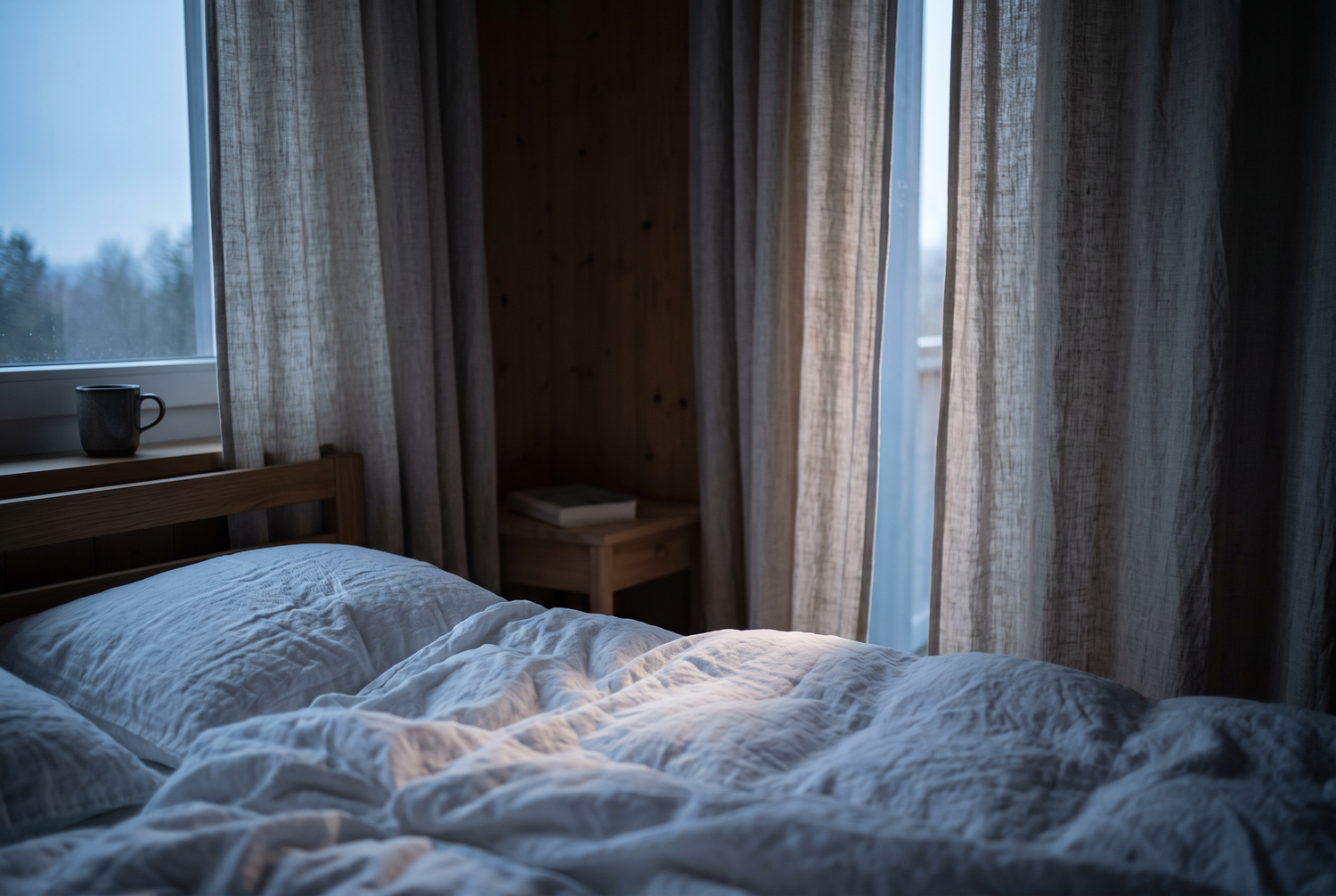
The alarm clock isn't set to ring until six, but you've been awake since four – mind clear, with a subtle sense of unease in your stomach. And the longer it goes on, the more certain it seems that this night is a write-off. Early waking is the third major form of sleep disturbance, alongside problems with falling asleep and staying asleep, and it feels particularly grueling: it's too late to sleep, too early to get up. The causes are diverse but can be neatly categorized – from an advanced internal clock, to alcohol and light, to mood changes that should be taken seriously. The difference between "I'm just an early bird" and "something isn't right" is less about the time of day and more about whether you feel rested.
The short answer: Early morning waking is considered problematic if you wake up at least 30 minutes before your planned wake-up time, cannot fall back asleep, and consequently get insufficient total sleep. The most common causes are an advanced internal clock, alcohol in the evening, going to bed too early, morning light, noise, and age-related changes in sleep architecture. For some affected individuals, early waking is also a known accompanying symptom of depressive mood – especially when mood is worst in the morning. Those who identify the trigger can, in most cases, achieve significant improvement within two to four weeks.
- It becomes problematic from 30 minutes of lying awake before the planned wake-up time, combined with insufficient total sleep duration.
- The strongest self-test: Are you rested? Then you are an early riser, not sleep-disturbed.
- Going to bed too early is the most common avoidable cause – if you go to bed at 9:30 PM, you'll be done by 4:30 AM.
- Alcohol systematically shifts waking forward; two alcohol-free weeks quickly clarify this.
- Morning light from 4:30 AM in the Swiss summer biologically ends the night – darkening is not mere cosmetic.
When early waking is a problem
The time alone says little. A farmer who goes to bed at 9 PM and gets up at 5 AM has slept eight hours and is perfectly healthy. Early waking only becomes problematic when three characteristics combine: you wake up at least 30 minutes before your planned wake-up time, you cannot fall back asleep, and your total sleep duration is less than what you need.
The best self-test is recovery. If you wake up at five and feel fresh, your internal clock is simply set early. If you wake up at four, lie there with your heart pounding and thoughts racing, and then drag yourself through the day, that's different. For two weeks, note your bedtime, wake-up time, whether you fell back asleep, and rate your recovery in the morning on a scale of 1 to 5. This log reliably distinguishes between the two cases.
The course of events is also important. A sudden onset within a few weeks is more indicative of a specific trigger – new medication, stress, changed light conditions. A gradual change over years is more consistent with an age-related shift.
The internal clock: advanced sleep phase
The circadian rhythm determines when melatonin is released and when core body temperature reaches its minimum – typically about two hours before natural waking. If this rhythm is shifted forward, one becomes tired very early in the evening and wakes up correspondingly early in the morning. This is referred to as an advanced sleep phase, in contrast to the delayed phase in classic owls.
This shift increases with age. From about 60 years of age, the rhythm shifts forward by one to two hours in many people, while the proportion of deep sleep decreases and sleep architecture becomes more fragile. This is not a disease, but it becomes a problem if bedtime does not shift with it. Background information can be found in the article on sleep in old age.
The most effective lever against an excessively advanced clock is light in the evening – not in the morning. Anyone who wakes up at four should seek bright light between 7 and 9 PM: go for a walk outside, sit in the brightest room of the apartment, or use a daylight lamp if necessary. Conversely, you should avoid bright light in the first hours after early waking, because it further reinforces the shift. The systematics behind this are explained in the article on the internal clock.

Overview of the most common causes
| Cause | Identifying feature | First measure |
|---|---|---|
| Too early bedtime | 8.5 h or more in bed, 1 h awake | Shift bedtime back by 30–60 min |
| Alcohol in the evening | Waking 4–6 h after falling asleep | Try two alcohol-free weeks |
| Morning light | Worse in summer than in winter | Blackout with side sealing |
| Advanced internal clock | Very tired early in the evening, rested in the morning | Bright light between 7 and 9 PM |
| Noise and traffic | Waking up at the exact same minute | Earplugs, white noise, check windows |
| Depressed mood | Mood worst in the morning, lack of drive | Consult a doctor |
| Pain or bladder | Waking up due to physical trigger | Clarify cause, adjust evening fluid intake |
| Medication | Temporal connection to new medication | Consult prescribing physician |
Work through the list from top to bottom. The first three points usually explain the majority of cases and can be tested without any effort.
Alcohol, light, and noise: the three classics
Alcohol initially promotes sleep, but it is broken down within a few hours. During its breakdown, a rebound effect occurs with increased sympathetic activity, typically four to six hours after falling asleep. So, someone who falls asleep at 10:30 PM will wake up around 3:30 AM. Two glasses of wine are often enough for this. More background can be found in the article on alcohol and sleep quality.
Light is the second classic, and it's highly seasonal in Switzerland: in June, twilight in the Mittelland begins before 4:30 AM. Even small amounts of light on the retina suppress melatonin secretion and signal morning to the brain. Crucially, it's not just the curtain fabric that matters, but the sealing at the edges: a blackout curtain that lets 10 centimeters of light through at the sides is significantly less effective than a slightly thinner fabric with a clean seal. Practical solutions can be found in the article on darkening the bedroom.
Noise is the third factor and usually the easiest to identify: if you wake up almost to the minute, there's an external trigger – the first bus, a neighbor, a garbage collection. Earplugs or consistent background noise effectively mask these signals, because it's not the volume itself that wakes you, but the sudden contrast. Details in the article on white noise.
When mood plays a role
Early morning waking is a well-documented accompanying symptom of depressive disorders – often even one of the first. A specific pattern is characteristic: you wake up two to three hours too early, feel worst in the morning, and your mood improves during the day. This is often accompanied by rumination, lack of drive, loss of interest, and the feeling that nothing brings joy anymore.
This pattern is not a cause for panic, but a reason for action. Depressive disorders are highly treatable, and sleep disturbances generally improve with the underlying condition. If you notice this combination in yourself – early waking plus depressed mood for more than two weeks – talk to your family doctor. Persistent stress and anxiety can also trigger early waking, often accompanied by palpitations and immediate thought-racing; the article on stress and rumination is helpful here.
Conversely: not every early waking signifies depression. Someone who is rested and manages their day well most likely simply has an early chronotype.
Common mistakes when dealing with early waking
Mistake 1: Going to bed earlier. The obvious reflex makes the situation worse. Someone who wakes up at 4 AM and therefore goes to bed at 9 PM extends their time in bed to seven hours with perhaps five and a half hours of sleep – and further trains themselves to lie awake. The opposite approach is correct: postpone bedtime by 30 to 60 minutes.
Mistake 2: Getting up immediately and starting the day. Someone who makes coffee at 4:15 AM and turns on the light further shifts their internal clock forward and stabilizes the pattern. Stay in bed for a while, keep it dark and quiet.
Mistake 3: Checking your phone. Screen light in the early morning is a strong signal for the internal clock – and messages or emails also activate you.
Mistake 4: Calculating. "Only 100 minutes left until the alarm" creates pressure and prevents the very falling back asleep that you want to force. Turn the alarm away.
Mistake 5: Compensating with a nap. A 20-minute nap before 3 PM is unproblematic. Longer or later sleeping reduces the sleep pressure needed in the evening and exacerbates the problem the next morning.
The concrete plan for four weeks
Week 1 – Correct bedtime: Shift your bedtime back by 30 minutes and keep your wake-up time consistent, seven days a week. The goal is a sleep efficiency of over 85 percent, meaning sleep time divided by time in bed. Completely cut out alcohol.
Week 2 – Control light: Seek bright light in the evening between 7 PM and 9 PM. From bedtime onwards, consistent darkness, including side sealing of curtains and taping off standby LEDs. No bright light in the first two hours after early waking.
Week 3 – Environment and body: Room temperature at 16 to 19 degrees Celsius, humidity 40 to 60 percent. Reduce fluid intake after 8 PM. Check sleeping surface: sagging, age of mattress, condition of slatted frame.
Week 4 – Behavior during waking moments: If you wake up, lie still for 20 minutes and use a relaxation technique. If you're still awake afterward, get up in dim light, do something quiet, and lie down again when you feel tired. The key point: the bed remains a place for sleeping, not for waiting.
At the end of each week, evaluate your recovery and wake-up time. Experience shows that the greatest improvement comes from combining a later bedtime with consistent blackout. The remaining basics are summarized in the article on sleep hygiene.

When you should seek medical advice
Seek a discussion with your family doctor if early waking occurs on three or more nights per week for more than three months and impairs your daily performance or mood. You should act sooner if you experience a depressed mood for more than two weeks, loss of interest, pronounced lack of drive, or if you struggle with microsleep while driving or working.
Also requiring clarification are a temporal connection to new medication, nocturnal pain, frequent urination, and observed breathing pauses during sleep. Never stop prescribed medication on your own. Bring your two-week log – times, recovery values, and accompanying circumstances on one sheet significantly shorten the diagnostic process. An overview of treatment options for persistent sleep disorders can be found in the article on insomnia.
Get CHF 25 discount
Subscribe to our newsletter and get a one-time CHF 25 discount. ✓ 200 nights trial sleep ✓ 10 years warranty
Frequently asked questions about early waking
When does early waking require treatment?
It becomes problematic if you wake up at least 30 minutes before your planned wake-up time, cannot fall back asleep, and consequently get insufficient total sleep. The pattern is clinically relevant if it occurs on three or more nights per week for more than three months and affects your mood or performance during the day.
Why do I wake up particularly early after drinking alcohol?
Alcohol initially promotes sleep, but it is broken down within a few hours. During its breakdown, a rebound effect occurs with increased sympathetic activity, typically starting four to six hours after falling asleep. Therefore, someone who falls asleep at 10:30 PM often wakes up around 3:30 AM. Two alcohol-free weeks reliably demonstrate this connection.
Should I go to bed earlier if I wake up too early?
No, that usually makes the problem worse. A longer time in bed with the same amount of sleep lowers sleep efficiency and reinforces the association between bed and lying awake. It is more effective to shift bedtime back by 30 to 60 minutes and keep the wake-up time consistent seven days a week.
Is early waking a sign of depression?
It can be one, but it is not mandatory. Typical for a depressive mood is the combination of waking up two to three hours too early, worst mood in the morning, listlessness, and loss of interest for more than two weeks. Anyone who, on the other hand, feels rested and manages the day well, most likely simply has an early chronotype.
Does darkening really help against early waking?
Yes, especially in summer. In the Swiss midlands, twilight begins before 4:30 AM in June, and even small amounts of light on the retina suppress melatonin. The crucial factor is the side seal: a curtain that lets 10 centimeters of light through at the edges works significantly worse than a thinner fabric with a clean finish.
What do I do the moment I wake up too early?
First, lie still for 20 minutes, without light and without looking at the clock, and use a relaxation technique. If you are still awake after that, get up with dim light, do something quiet in another room, and lie down again when you feel tired. Avoid screens and bright light, as both shift the internal clock further forward.
This article serves general information purposes and does not replace medical advice.









Leave a comment
This site is protected by hCaptcha and the hCaptcha Privacy Policy and Terms of Service apply.