
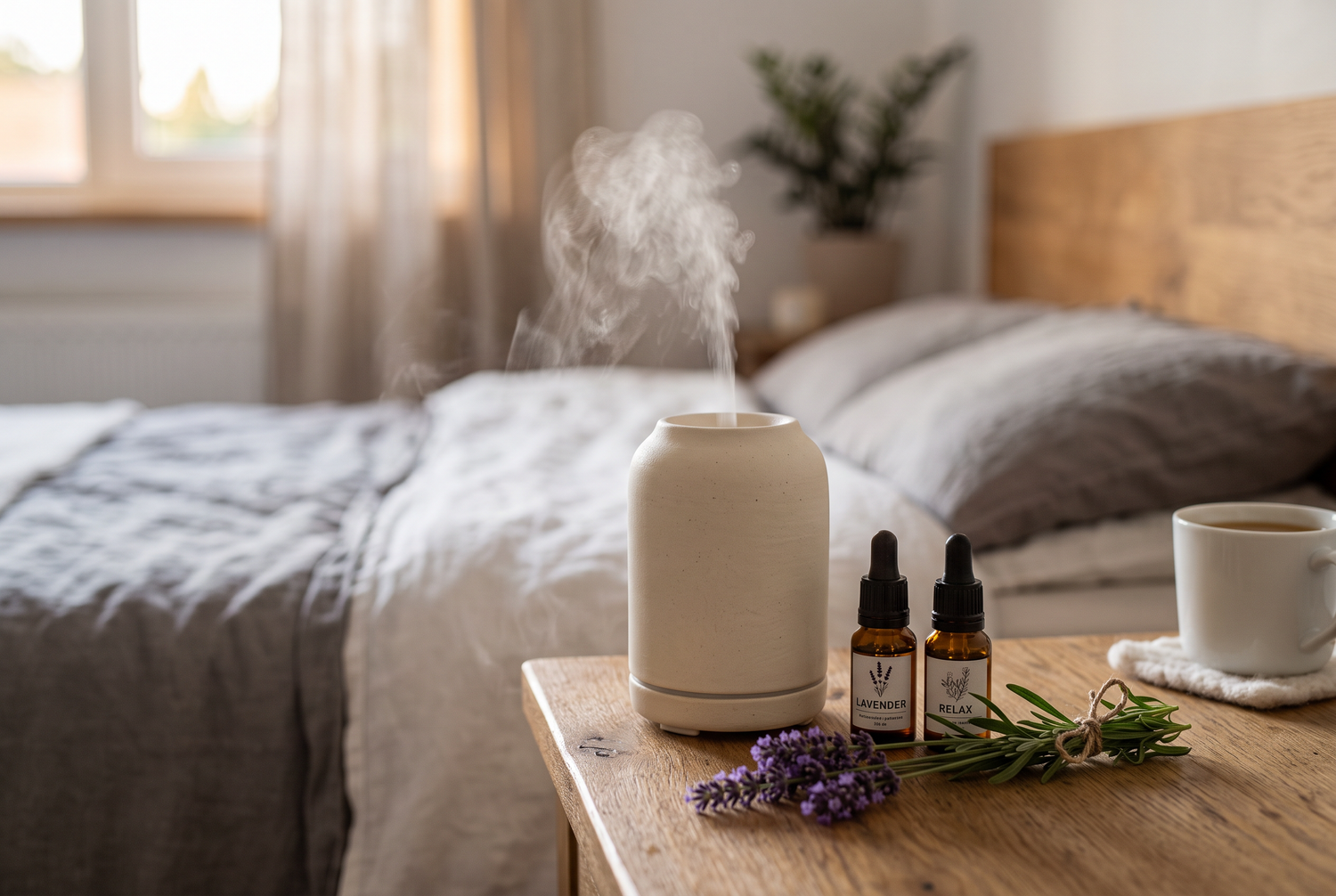
The sense of smell is the only sense that is directly connected to the limbic system, the part of the brain that controls emotions, memories, and stress responses, without a detour via the thalamus. This is precisely why a scent can calm or agitate within seconds. Aromatherapy utilizes this direct connection: essential oils such as lavender, bergamot, or cedarwood are supposed to switch the nervous system into relaxation mode, thus facilitating sleep. But what of this is scientifically proven, what is wellness marketing – and how does one use essential oils in the bedroom correctly and safely? This guide soberly assesses the scientific evidence, presents the most effective oils with specific dosages, and explains how a scent ritual can become a sleep aid without polluting the room air. Because, used correctly, aromatherapy is an inexpensive, low-side-effect complement to good sleep hygiene – but not a miracle cure.
The short answer: Lavender oil is the most thoroughly researched: several controlled studies and meta-analyses show a slight but measurable improvement in subjective sleep quality. Bergamot, Roman chamomile, and cedarwood also have a relaxing effect on many people. Aromatherapy does not replace treatment for a sleep disorder, but it can calm the nervous system as an evening ritual – ideally via a diffuser 30 minutes before bedtime, with 3–5 drops of oil and the device turned off when falling asleep.
- Lavender oil is the most researched sleep oil; studies show slight improvements in sleep onset time and subjective sleep quality.
- Diffuser dosage: 3–5 drops per 100 ml of water, run for 30 minutes before sleep, turn off when falling asleep.
- Never apply essential oils undiluted to the skin – for massages: a maximum of 1–2 percent oil in a carrier oil.
- Caution with asthma, allergies, pregnancy, infants, and pets – consult a doctor or veterinarian beforehand.
- The greatest effect comes from the ritual: the scent becomes a conditioned signal that tells the brain "bedtime."
How does aromatherapy affect sleep?
When inhaled, scent molecules reach the olfactory mucosa and trigger electrical signals that are processed directly in the amygdala and hippocampus – brain regions that also regulate fear and tension. Certain ingredients such as linalool and linalyl acetate (main components of lavender oil) also have a measurable effect on the autonomic nervous system: in studies, heart rate and blood pressure slightly decreased, and heart rate variability shifted towards the parasympathetic nervous system – the body's "rest and digest" nerve. In addition, there is a second, often underestimated mechanism: conditioning. Those who use the same scent every evening in the same context train their brain to associate this stimulus with relaxation and sleep – similar to a fixed evening routine. After two to three weeks, the scent itself is often enough to initiate sleep readiness. Our article on the perfect evening routine shows how such a ritual can be built.
These essential oils are best proven for sleep
Not every oil delivers on its promises. The research situation differs significantly:
| Essential oil | Effect | Research status | Suitable for |
|---|---|---|---|
| Lavender (Lavandula angustifolia) | calming, anxiolytic | good – several RCTs and meta-analyses | sleep onset problems, rumination |
| Bergamot | mood-lifting, relaxing | moderate – smaller studies | evening tension |
| Roman Chamomile | mildly sedating | moderate | restlessness, sensitive noses |
| Cedarwood | grounding, cedrol has a mild sedative effect | limited | those who dislike floral scents |
| Ylang-Ylang | blood pressure lowering, relaxing | limited | evening bath, massage |
| Valerian root oil | sedating, very intense smell | limited (as scent) | more useful as tea/extract |
Important to note: The effects in most studies are small to moderate and primarily affect subjective sleep quality. If you suffer from a pronounced sleep disorder, you will find the most important information on causes and effective treatments in the article on insomnia. More details on the classic sleep scent can be found in our article Lavender for better sleep.

Application: Diffuser, pillow spray, bath and massage
Diffuser and aroma lamp
An ultrasonic diffuser is the most practical method: 3–5 drops of essential oil to about 100 ml of water, turn on the device 30 minutes before bedtime and turn it off when you turn out the lights – continuous scenting throughout the night is unnecessary and can irritate the airways. Candle aroma lamps are not a good idea in the bedroom due to fire hazard.
Pillow spray
For a pillow spray, mix 10 drops of lavender oil with 50 ml of water and a teaspoon of alcohol (e.g., vodka) as an emulsifier in a spray bottle. One to two sprays on the underside of the pillow are sufficient – not directly on the area where the face lies, so that the mucous membranes are not irritated.
Bath and massage
A warm bath 60–90 minutes before sleep already promotes sleep onset due to the subsequent drop in temperature; 5–8 drops of oil, emulsified beforehand with a tablespoon of cream or honey, enhance the relaxing effect. For massages, the 1–2 percent rule applies: a maximum of 6–12 drops of essential oil per 30 ml of carrier oil such as almond or jojoba oil. Essential oils should never be applied undiluted to the skin.
Safety: For whom aromatherapy is not or only partially suitable
Essential oils are highly concentrated plant substances – natural does not automatically mean harmless. People with asthma or sensitive airways should test with a very low dosage to see if they tolerate scents. Many oils are not sufficiently studied during pregnancy and breastfeeding; here, the rule is to consult a midwife or doctor beforehand. For infants and young children under three years, essential oils are generally not recommended in the bedroom – especially menthol-containing oils can cause respiratory problems in young children. Pets also react sensitively: cats can poorly metabolize certain components (e.g., phenols and terpenes), which is why diffusers should not be used in rooms where animals sleep. And those prone to contact allergies should first test new oils diluted in the crook of the arm. Only buy 100 percent natural oils with the botanical name and origin on the label – synthetic "fragrance oils" often contain substances that can cause headaches.
Myth check
"The more drops, the better the effect" – false. The sense of smell adapts quickly; high concentrations only irritate the mucous membranes and can cause headaches. Less is actually more here. "Aromatherapy cures sleep disorders" – also false. For chronic insomnia, cognitive behavioral therapy (CBT-I) is the most effective treatment; scents are at best a supplement. "Lavender works the same for everyone" – no. Scent preferences are individual; anyone who associates lavender with unpleasant memories will not relax from it. In that case, try bergamot or cedarwood instead. "Essential oils can go into the humidifier water" – better not: oils can damage the membranes of many devices and are too finely atomized. Diffusers are built for this, humidifiers are not.
The evening scent ritual: Step by step
Here's how to effectively integrate aromatherapy into your evening: About 60 minutes before bedtime, dim screens and turn off bright lights. 30 minutes before, start the diffuser with 3–5 drops of lavender or bergamot oil and simultaneously begin a calming activity – reading, stretching, or a breathing exercise like the 4-7-8 method. When going to bed, turn off the diffuser, open the window briefly, and sleep at a room temperature of 16–18 °C. Use the same scent consistently for at least two to three weeks – only then will the conditioning effect develop, through which the scent itself becomes a signal for sleep. Further components for better sleep can be found in the guide sleep hygiene and in the article fall asleep faster.
Get CHF 25 discount
Subscribe to our newsletter and receive a one-time CHF 25 discount. ✓ 200 nights trial sleep ✓ 10 years warranty

Frequently Asked Questions about Aromatherapy for Sleep
Which essential oil is best for falling asleep?
Lavender oil from Lavandula angustifolia is the most studied and shows slight improvements in sleep onset time and sleep quality in studies. Alternatives include bergamot, Roman chamomile, and cedarwood – the key is that you find the scent pleasant.
How many drops of oil should be in the diffuser?
3–5 drops per 100 ml of water are sufficient. Let the diffuser run for about 30 minutes before bedtime and turn it off when you go to sleep – diffusing throughout the night is unnecessary and can irritate the airways.
Can the diffuser run all night?
Better not. The sense of smell adapts after a short time anyway, and continuous nebulization increases humidity and airway irritation. 30 minutes before sleep is enough for the relaxing effect.
Is aromatherapy allowed during pregnancy?
Many essential oils have not been sufficiently studied for pregnancy and breastfeeding, and some are considered unsuitable. Therefore, clarify the application with your midwife or doctor beforehand and, if in doubt, avoid it entirely in the first trimester.
Are essential oils dangerous for children and pets?
Essential oils are not recommended for children under three years in the bedroom; menthol-containing oils can cause breathing problems. Cats metabolize certain fragrances poorly – diffusers should therefore never be used in rooms where animals sleep.
Does aromatherapy replace treatment for sleep disorders?
No. For chronic sleep onset or maintenance problems, cognitive behavioral therapy for insomnia is the method of choice. Aromatherapy can be a useful component of an evening routine but does not replace medical clarification of persistent symptoms.
This article is for general information and does not replace medical advice.








Leave a comment
This site is protected by hCaptcha and the hCaptcha Privacy Policy and Terms of Service apply.