
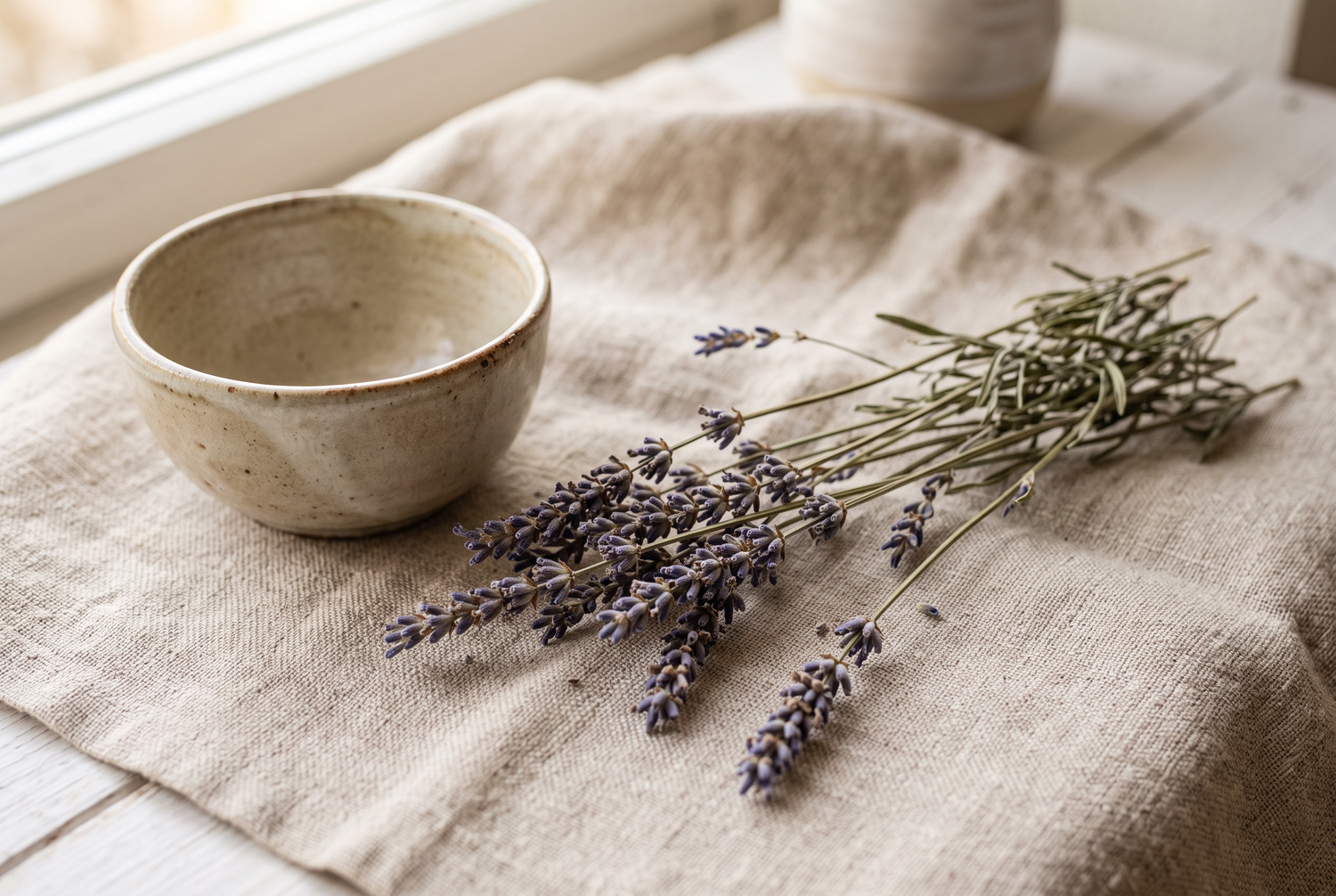
Few plants are as readily associated with sleep as lavender: scent sachets in the nightstand drawer, a few drops of oil on the pillow, lavender tea before bed. The only question is whether there is more to it than just a nice tradition. The short answer is: partly yes – but with clear limitations. There is a surprisingly robust body of research, albeit with very different effect sizes depending on the application method. Anyone using lavender as a substitute for untreated insomnia will be disappointed. Anyone using it as a building block of a reliable evening routine, however, can certainly benefit. This article clarifies what has been proven, how to use lavender correctly, and when you should avoid it.
The short answer: Lavender works most effectively through two channels: as a scent that has a calming effect on the autonomic nervous system via the olfactory brain, and as a standardized oral preparation that has been studied for internal restlessness. Studies on scent application usually find small to medium effects on subjective sleep quality – measured values like sleep latency and deep sleep percentage change less significantly. Lavender is therefore not a sleeping aid, but a relaxation helper. It works most reliably as a conditioned signal in a fixed evening routine. For chronic sleep disorders, it does not replace treatment.
- The main active ingredients are linalool and linalyl acetate – together they make up 50 to 70 percent of the essential oil.
- Scent application: 2 to 4 drops on a tissue next to the pillow, not directly on the skin.
- Effects on subjective sleep quality are better documented than effects on measured sleep parameters.
- Most effective as a conditioning signal 20 to 30 minutes before bedtime – daily, always the same.
- Essential oil should not be applied to the mattress, near babies, or undiluted to the skin.
What's in lavender
The active ingredient is not "lavender" itself, but a handful of volatile compounds. The most important are linalool and linalyl acetate, which together make up 50 to 70 percent of the essential oil of Lavandula angustifolia. Both are absorbed through the nasal mucous membrane and – when ingested – through the gastrointestinal tract, influencing receptor systems in animal models that also play a role in sedatives. However, the transfer of such findings to humans should be approached with caution.
Species differentiation is important. True lavender, Lavandula angustifolia, has the highest proportion of linalyl acetate and the mildest scent. Lavandin, a hybrid, contains significantly more camphor, smells sharper, and is primarily used for detergents and room fragrances – for sleep application, it is the poorer choice. Spike lavender is even richer in camphor and can even have a stimulating effect on sensitive individuals.
When buying, it's worth checking three pieces of information: the botanical name, the note "100 percent natural essential oil," and the country of origin. Fragrance oils or perfume oils with synthetic linalool are cheaper, but not suitable for an effect via the mechanisms described.
What the research says – and what it doesn't
Numerous smaller studies exist on the application of scent, many of them in hospitals, intensive care units, and nursing homes. The typical finding: Participants report a moderate improvement in sleep quality, sleep latency is reduced by a few minutes in some studies, and anxiety and inner restlessness levels decrease. Objective measurements with polysomnography show significantly weaker and more inconsistent effects.
This gap between subjective perception and measurement is not a flaw, but important information. It suggests that lavender primarily works through relaxation and expectation – and both are indeed relevant for sleep quality. However, one should not derive a pharmacological effect from this that does not exist in this form.
Methodologically, the studies have two problems that should be noted. First, a scent can hardly be blinded in practice – participants know if they are smelling lavender. Second, the sample sizes are often small and the observation periods short. The evidence is therefore useful, but not comparable to the data situation for methods like cognitive behavioral therapy. A broader classification of herbal options can be found in the article on herbal sleep aids.

Comparison of application forms
| Form | Application | Classification |
|---|---|---|
| Essential oil, scent | 2–4 drops on a cloth next to the pillow | Best studied, mild effect, very well tolerated |
| Scent lamp or diffuser | 20–30 min. before bed, then turn off | Good as a routine signal; don't leave on all night |
| Scented pillow, sachet | Dried flowers in cover, renew every 2–3 months | Weak dosage, but unproblematic and long-lasting |
| Massage oil | 1–2% in carrier oil, neck and shoulders | Combines scent with touch; never undiluted |
| Lavender tea | 1–2 tsp flowers, steep covered for 8 min. | Low active ingredient quantity; works primarily through the ritual |
| Capsules, standardized | According to package directions, usually 80 mg daily | Studied for internal restlessness; pharmacy consultation advisable |
| Bath additive | With emulsifier, 60–90 min. before bed | Effect mainly through warmth and subsequent cooling |
The comparison shows: The form of application determines the reliability of the application more than the strength of the effect. What you do consistently every evening works better than the theoretically most potent preparation you take irregularly.
The actual mechanism: conditioning
Probably the most important effect of lavender has little to do with chemistry. A consistent scent, present for 20 to 30 minutes every night before bedtime for weeks, is learned by the brain as a signal: the sleep phase is beginning now. This is the same mechanism that works for children with bedtime rituals – and it works just as well for adults.
For conditioning to take hold, three things are needed. First, consistency: the same scent, the same time, the same sequence. Second, coupling with other signals – dimmed lights, no screen time, maybe reading a few pages. Third, patience: two to three weeks of daily repetition before the effect sets in.
Precisely for this reason, the most common application error is also the most ineffective: only reaching for lavender when you're lying awake in bed at two in the morning, desperate. At that moment, the scent is not a learned signal, but an emergency measure – and the disappointment at the lack of effect only increases the tension. How a sustainable evening routine is built is described in the article on the perfect evening routine.
How to use lavender correctly
Step 1 – Choose product: Essential oil of Lavandula angustifolia, 100 percent natural, dark glass bottle, stored in a cool, dark place. Opened bottles last about one to two years; after that, the scent changes and skin compatibility decreases.
Step 2 – Find dosage: Start with two drops on a tissue placed next to your pillow – not on it. More is explicitly not better: for many people, an overly intense scent is activating rather than calming and can cause headaches.
Step 3 – Set timing: 20 to 30 minutes before your planned bedtime. Turn off diffusers afterwards; do not leave them running all night – the sense of smell adapts within minutes, the effect dissipates, and humidity rises unnecessarily.
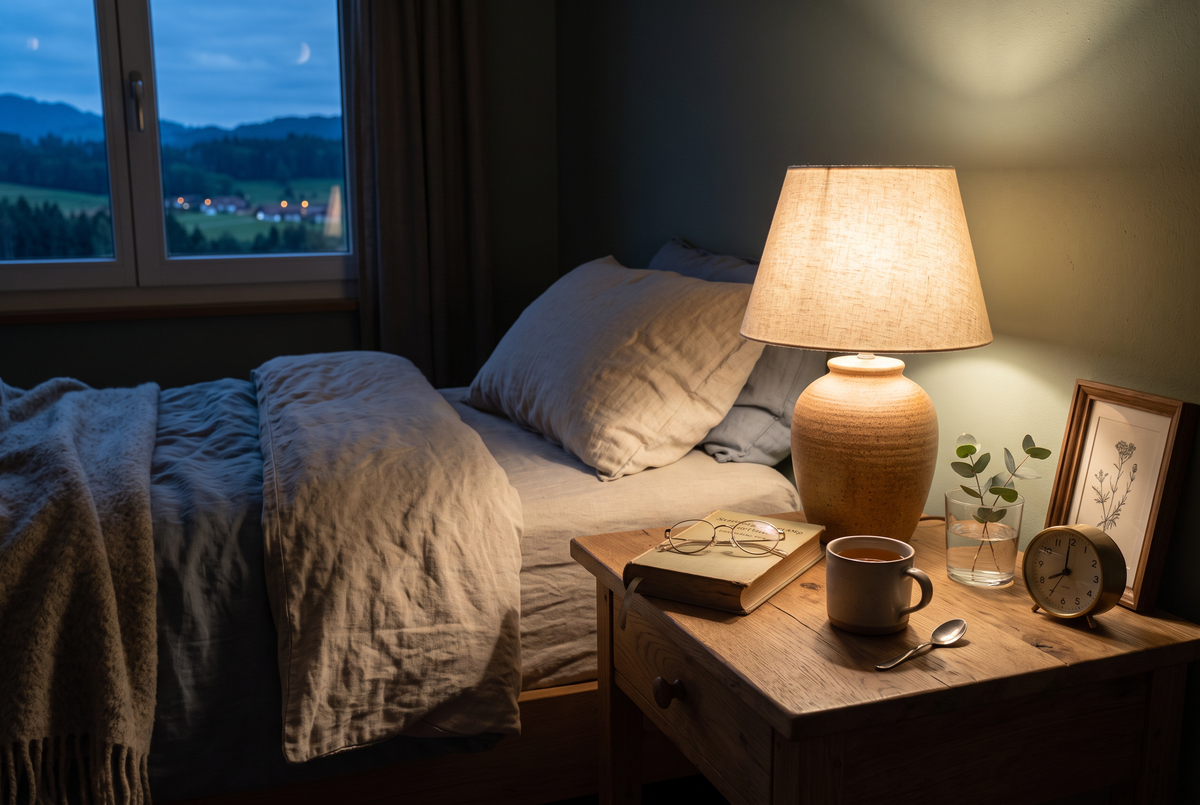
Step 4 – Combine: Link the scent with the other elements: dim lighting, room temperature between 16 and 19 degrees Celsius, no screens. The scent is the signal, the environment provides the conditions. The complete methodology is presented in the article on sleep hygiene.
Step 5 – Evaluate: Give yourself three weeks and each morning rate your recovery on a scale of 1 to 5. Without a before-and-after comparison, it's impossible to assess whether such a mild measure is effective.
Safety: what to watch out for
Lavender is generally considered well-tolerated, but it is not harmless in every situation. Essential oils should never be applied undiluted to the skin – even lavender can cause contact eczema, especially if the oil is older and has oxidized. For skin applications, dilute to 1 to 2 percent in a carrier oil, i.e., about 5 to 10 drops per 50 milliliters.
For infants and young children, essential oils should generally not be used in the sleeping area; their airways are more sensitive, and there is a known risk with camphor- or menthol-containing preparations. If you want something calming in the nursery, stick to a scent sachet with dried flowers out of reach – or do without it entirely.
During pregnancy and breastfeeding, as well as in cases of known allergy to Lamiaceae, consultation is advised. Those wishing to take standardized capsules should discuss this with a pharmacist – especially if already taking medication, as interactions have not been studied for all combinations. And: do not drip oil directly onto pillows or mattresses. The stain will remain, the material can suffer, and the dosage will be far too high for hours.

Fact-checking myths
"Lavender acts like a sleeping pill." No. The proven effects primarily concern relaxation and subjective sleep quality, not sleep architecture. Anyone trying to treat chronic insomnia with it will lose time.
"The more drops, the better." False, and practically relevant. Beyond a certain intensity, the perception shifts from pleasant to intrusive, and the calming effect turns into an activating one. Two to four drops is the sensible range.
"A diffuser all night long is most effective." No. The sense of smell adapts within minutes; after a short time, you'll barely notice the scent. Additionally, an ultrasonic diffuser increases humidity, which can be counterproductive in small bedrooms.
"Lavender scent in laundry detergent works just as well." Only to a limited extent – laundry detergents usually contain synthetic fragrances or camphor-rich lavandin. This is pleasant, but it's not the same as real essential oil from Lavandula angustifolia.
"Lavender plants in the bedroom improve the air." The air-purifying effect of houseplants in normal rooms is negligible. As an optical and olfactory element, however, they are still beautiful – classification in the article on houseplants in the bedroom.
Get CHF 25 discount
Subscribe to our newsletter and receive a one-time CHF 25 discount. ✓ 200 nights trial sleep ✓ 10 years warranty
Frequently Asked Questions about Lavender and Sleep
Does lavender really help with sleep problems?
Studies on scent application usually find small to medium improvements in subjectively experienced sleep quality, as well as lower levels of anxiety and internal restlessness. Objective measurements of sleep latency and sleep architecture show significantly weaker effects. Lavender is therefore a relaxation aid and not a sleeping pill – it does not replace treatment for chronic sleep disorders.
How many drops of essential lavender oil are appropriate?
Two to four drops on a tissue next to your pillow is the appropriate range. More is not better: above a certain intensity, the perception shifts from pleasant to intrusive, and the calming effect can turn into an activating one or cause headaches. Do not drop the oil directly onto pillows or mattresses.
Which type of lavender is best for sleep?
True lavender, botanically Lavandula angustifolia. It contains the highest proportion of linalyl acetate and has the mildest scent. Lavandin is a hybrid with significantly more camphor and a sharper scent, while spike lavender is even richer in camphor and can even have a stimulating effect on sensitive individuals. Pay attention to the botanical name on the bottle.
Should a diffuser run all night?
No. The sense of smell adapts within a few minutes, so you will soon barely perceive the scent, and the effect will dissipate. Additionally, an ultrasonic diffuser increases humidity, which is counterproductive in small bedrooms. It is more sensible to run it for 20 to 30 minutes before bedtime, then turn it off.
Is lavender suitable for children and babies?
For infants and young children, essential oils should generally not be used in the sleeping area, as their airways are more sensitive. A scent sachet with dried flowers placed out of reach is a milder alternative. If in doubt, discuss the application with your pediatrician.
How long does it take for lavender to work?
The immediate calming effect is mild and occurs within a few minutes. The more significant effect comes through conditioning: if the same scent is present daily for 20 to 30 minutes before bedtime for two to three weeks, the brain learns it as a sleep signal. That's why a consistent routine works better than occasionally reaching for the bottle in the middle of the night.
This article is for general information and does not replace medical advice.







Leave a comment
This site is protected by hCaptcha and the hCaptcha Privacy Policy and Terms of Service apply.