
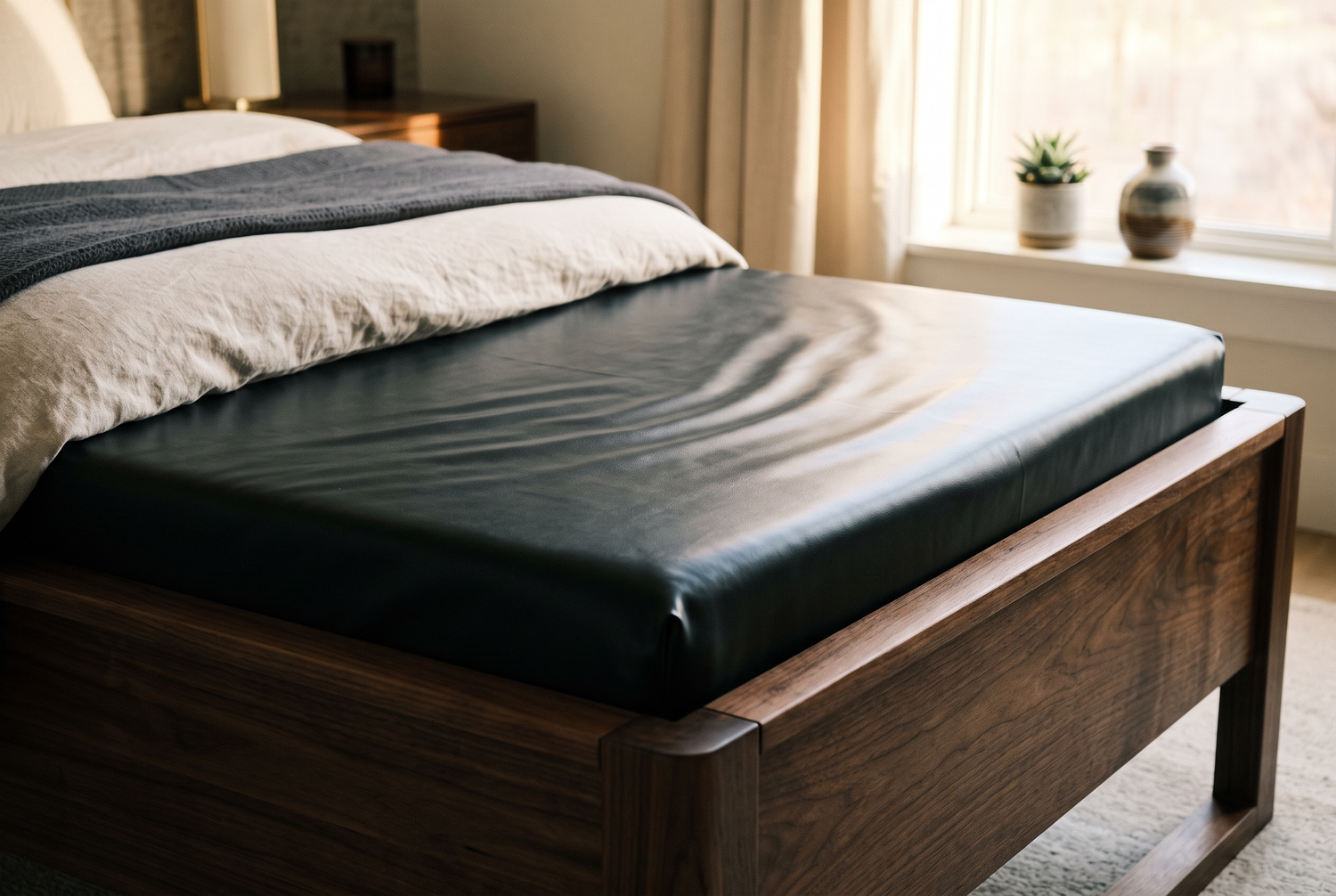
In the 1980s and 1990s, the waterbed was considered the epitome of luxury and modern sleeping – today it is seen much less frequently, but a loyal fan base continues to swear by it. Rightfully so? The question is worth asking, because the waterbed has undeniable strengths: perfect pressure relief, selectable warmth, and a hygienically wipeable surface. These are contrasted by tangible disadvantages – ongoing electricity costs, elaborate maintenance, a total weight of several hundred kilograms, and a move that becomes a major project. At the same time, alternatives have evolved: Modern adaptive foams now achieve much of what used to require water, without heating and conditioner. In this guide, we take an honest look at the technology, costs, and everyday usability of the waterbed – so you can decide if it fits your life.
The short answer: A waterbed offers excellent pressure relief and pleasant warmth, but has high running costs and demanding maintenance: Expect 100 to 250 Swiss francs in electricity per year for heating, annual conditioner additions, a total weight of 400 to 700 kg, and complex moves. For most people, modern point-elastic premium foams now provide comparable pressure relief without electricity, maintenance, and weight issues. The waterbed remains particularly useful for convinced lovers of the floating sleeping sensation – those making a new decision should try both options.
- Waterbeds distribute body pressure almost perfectly and can be heated to 26 to 30 degrees.
- Running costs: Heating electricity (approx. CHF 100–250/year), conditioner (approx. CHF 20–40/year), new covers and seals every few years.
- A filled double waterbed weighs 400 to 700 kg – check statics, moving only possible with pumping out.
- Stabilization levels from 90 to 100 percent almost completely reduce the previously typical after-waving.
- Modern adaptive foams achieve similar pressure relief without electricity, maintenance, and weight.
How does a waterbed work?
The heart of the waterbed is a vinyl water mattress that holds 200 to 400 liters, depending on its size. Two types of construction dominate: In the hardside waterbed, the water core lies in a stable wooden frame; in the softside model, which is common today, a foam frame encloses the core – the bed looks like a normal upholstered bed and allows comfortable sitting on the edge. In double beds, two separate cores (dual system) are usually installed, so that both sides can be filled, stabilized, and heated individually. To prevent the notorious after-waving, fleece layers are used in the core: The stabilization level ranges from 0 percent (free movement) to 100 percent (movement stops in less than a second). Underneath the core is a heating mat, typically with 150 to 300 watts of power, controlled by a thermostat set to usually 27 to 28 degrees – without heating, the water would draw an unpleasantly large amount of heat from the body. A safety liner catches any water in case of a leak. For a comparison of where the waterbed stands among different mattress types, see the overview Mattress types compared.
The advantages: What the waterbed does really well
Three strengths are undisputed. First, pressure relief: water supports the body hydrostatically, with practically no pressure points on the shoulders, hips, or heels – which is why water-like systems are also used in decubitus prophylaxis in nursing. Those who are very sensitive to pressure or struggle with circulatory problems will notice the difference significantly. Second, warmth: the constant bed temperature of 27 to 28 degrees relaxes muscles, which many people with tension find soothing – a definite plus, especially in cool bedrooms. However, note that the ideal room temperature for sleeping is 16 to 19 degrees; the article on ideal sleeping temperature explains how these two fit together. Third, hygiene: the vinyl surface can be wiped clean, and mites find no habitat in the core – only the textile cover needs to be washed. Added to this is the longevity of the water cores themselves: 12 to 15 years are realistic with good care, as water does not sag or form hollows.

The disadvantages: Costs, weight and maintenance in detail
Now to the other side of the balance sheet. The acquisition cost for a solid softside dual system ranges from 1500 to 4000 Swiss francs. In addition, there are running costs: heating consumes 300 to 900 kWh per year, depending on room temperature, insulation, and cover – at current Swiss electricity prices, this corresponds to approximately 100 to 250 francs annually. The water core needs conditioner once a year (20 to 40 francs) to prevent the water from spoiling and to keep the vinyl supple. New covers or seals are needed every few years. Weight is the second major point: a filled 180x200 dual system with frame weighs 400 to 700 kg – distributed over the area, most modern floor ceilings can easily bear this, but in old buildings, an inquiry is worthwhile. More practically relevant: every move and every repositioning requires complete pumping out and refilling, including several hours of heating up over one to two days. And finally, the dependence on electricity: if the heating fails, the bed becomes unpleasantly cold within hours.
Waterbed vs. modern foam mattress: a direct comparison
| Criterion | Waterbed | Premium foam mattress |
|---|---|---|
| Pressure relief | Excellent (hydrostatic) | Very good (point-elastic-adaptive) |
| Running costs | 100–300 CHF/year (electricity, conditioner) | None |
| Weight (180x200) | 400–700 kg filled | 30–45 kg |
| Moving/repositioning | Pumping out necessary, several hours of effort | Easily portable |
| Maintenance | Conditioner, de-aeration, vinyl care | Turning, washing cover |
| Trial sleeping | Rarely possible | Up to 200 nights at home |
Myths debunked
Myth one: "You get seasick on a waterbed." With modern stabilization levels of 90 to 100 percent, practically no after-waving occurs anymore – this cliché comes from the time of unstabilized cores. Myth two: "Waterbeds burst and flood the apartment." The vinyl of modern cores is 0.5 to 0.7 mm thick and very robust; small leaks drip slowly and are caught by the safety liner. A spontaneous "bursting" is practically impossible. Myth three: "The waterbed cures back pain." There is no reliable evidence for this – many people find the warmth and pressure relief pleasant, but water, by its very nature, provides less precise targeted ergonomic support for the spine than a zoned, point-elastic core. For chronic complaints, it's worth looking at our guide Mattress and Back Pain – and for persistent pain, always seek medical advice. Myth four: "The heating costs almost nothing." In reality, depending on the setup, it's 100 to 250 Swiss francs per year – over 10 years, that's an additional 1000 to 2500 Swiss francs on top of the purchase price.
Who is the waterbed still suitable for today?
A waterbed suits people who love the floating, warm sleeping sensation and are willing to bear the maintenance and fixed costs – for example, long-time waterbed sleepers who want nothing else, or very pressure-sensitive individuals who benefit from hydrostatic relief. It is less suitable for tenants who move frequently, for those who are frugal (electricity costs), for people with little time for maintenance, and for anyone who tends to sweat at night – the heated surface can promote heat build-up. Even for couples with very different preferences, a dual system is a solvable problem, but expensive; how modern mattresses solve this problem more elegantly can be read under Mattress for Couples. Technological development has reshuffled the cards: adaptive premium foams now automatically adjust to body shape and position and combine pressure relief with precise support – more on this in the article on adaptive mattresses. Anyone making a new decision today should therefore try both concepts in real life, ideally over several nights.
Practice: How to properly care for a waterbed
If you decide to get a waterbed or already own one, good care significantly extends its lifespan. First: Add conditioner to each water core once a year – it prevents algae and bacterial growth and keeps the vinyl supple. Second: Vent the cores once or twice a year with a hand pump; air bubbles form due to microorganism activity and cause gurgling noises. Third: Clean the vinyl surface every two to three months with a special vinyl cleaner and treat it with vinyl care product – household cleaners with alcohol make the material brittle. Fourth: Wash the textile hygiene cover every two to four weeks at 60 degrees. Fifth: Keep the heating temperature constant at 26 to 28 degrees; constant heating up and cooling down costs more electricity than a constant setting. Sixth: Annually check the safety liner and corner seams for moisture. And seventh: For repairing small leaks, there are vinyl patch kits – the area must be dry and grease-free; larger damages should be handled by professionals.

Get CHF 25 discount
Subscribe to newsletter and receive a one-time CHF 25 discount. ✓ 200 nights trial sleep ✓ 10 years warranty
Frequently Asked Questions about Waterbeds
What does a waterbed cost to maintain?
Expect 100 to 250 Swiss francs in electricity costs per year for heating, plus 20 to 40 francs for conditioner. Over ten years, the operating costs thus add up to 1200 to 3000 francs in addition to the purchase price.
How heavy is a filled waterbed?
A double waterbed measuring 180x200 cm weighs 400 to 700 kg when filled, including the frame. Distributed over the area, most modern floor ceilings can generally support this without problems; in old buildings, it is advisable to check the statics.
Can a waterbed burst?
Practically not – the 0.5 to 0.7 mm thick vinyl of modern cores is very robust, and small leaks only release water slowly. The safety liner underneath the core catches any escaping water before it reaches the floor.
Is a waterbed good for back pain?
Many people find the warmth and pressure relief pleasant, but there is no reliable evidence for curing back pain. A point-elastic, zoned core provides more precise targeted ergonomic support; for persistent pain, you should seek medical advice.
How often does conditioner need to be added to the waterbed?
Once a year per water core – the conditioner prevents algae and bacterial growth and keeps the vinyl supple. In addition, you should vent the cores once or twice a year to avoid gurgling noises.
How long does a waterbed last?
With good care, water cores last 12 to 15 years, as water neither sags nor forms hollows. However, heating, covers, and seals may need to be replaced during this time – these costs are part of the overall calculation.
This article is for general information and does not replace medical advice.





Leave a comment
This site is protected by hCaptcha and the hCaptcha Privacy Policy and Terms of Service apply.