
Tomorrow is the final exam, the job interview, or the important presentation – and precisely now you're lying wide awake in bed, your thoughts racing, and your gaze constantly returning to the clock. If you can't sleep before an exam, you're in good company: surveys among students show that over 60 percent sleep worse than usual the night before important exams. The insidious thing is: the more desperately you try to fall asleep, the more awake you become. However, this vicious cycle of tension and pressure to sleep can be broken – with the right evening techniques and a reassuring insight from sleep research. This article explains why the body switches to alarm mode before important appointments, which methods are proven to calm you down, and why even a short night will impair your performance the next day far less than you fear.
The short answer: Nervousness before an important day activates the stress system – sleep problems are then a normal reaction, not a defect. The best help is to stop studying early (at least 2 hours before bedtime), establish a fixed evening ritual, use relaxation techniques like the 4-7-8 breathing method, and avoid looking at the clock. And most importantly: a single bad night barely measurably lowers exam performance – the sleep of the days before counts much more. This certainty alone often takes enough pressure off to help you fall asleep.
- A single short night only slightly reduces cognitive performance – adrenaline and tension will carry you through the exam day. The sleep of the entire week before is crucial.
- Stop studying at least 2 hours before bedtime: The brain consolidates learned material during sleep on its own; last-minute cramming in bed worsens both.
- Worrying thoughts belong on paper: People who jot down worries and to-dos for 10 minutes in the evening are proven to fall asleep faster.
- If you're still awake after what feels like 20 minutes, get up and do something quiet in dim light instead of tossing and turning in bed.
- No caffeine after 2 p.m., no alcohol as a sedative – both worsen sleep quality on the crucial night.
Why can't we sleep before an exam?
Before a significant event, the brain perceives the situation as potentially threatening and activates the sympathetic nervous system: adrenaline and cortisol levels rise, heart rate and muscle tension increase, and thoughts race. Evolutionarily, this made sense – those who remained vigilant in the face of danger survived. Today, this state of alert is directed against a math exam. Added to this is a psychological intensifier: the pressure to sleep that one puts on oneself. Phrases like "I HAVE to sleep now, otherwise I'll mess everything up tomorrow" create performance pressure in bed – and performance pressure is the opposite of the relaxation that enables sleep. Sleep researchers also call this phenomenon the inverse placebo effect: the fear of a bad night becomes the cause of the bad night. Our article Stress, Rumination, and Sleep Problems explores how stress and rumination generally sabotage sleep.
The reassuring truth: One bad night ruins nothing
The most important information first, as it itself promotes sleep: studies on sleep deprivation show that a single shortened night only slightly reduces performance on demanding tasks the following day – the body compensates with stress hormones, which will keep you awake and focused on exam day anyway. Your knowledge is also already stored: memory consolidation happens in the nights during the learning phase, not on the last night. Anyone who has slept a solid 7 to 8 hours for a week has a stable foundation that an restless night won't break. Even completely sleepless nights before exams rarely lead to significantly worse grades in studies. So remember: even quiet lying awake with closed eyes has restorative value. The article Sleep, Memory, and Learning explains how sleep and learning are connected.
Preparation begins in the afternoon
Good sleep before the big day is laid hours in advance. From 2 p.m. onwards: no more caffeine – a half-life of 4 to 6 hours means that a coffee at 4 p.m. will still have a noticeable effect at midnight (more in the article Caffeine and Sleep). Exercise moderately in the late afternoon: a brisk 30 to 45-minute walk reduces stress hormones without activating your circulation as much as intense training late in the evening. Eat an early and light dinner, ideally 3 hours before bedtime. And set a clear study stop: put away your materials at least 2 hours before bedtime. Anything you cram after that will displace more than it adds – and keeps your brain in work mode. Instead, use the last hour for a relaxing ritual: a warm shower, quiet music, a few pages of a novel (not a textbook).
Techniques for the moment in bed
If your mind is still racing, proven tools can actively calm down your nervous system.
Externalize thoughts
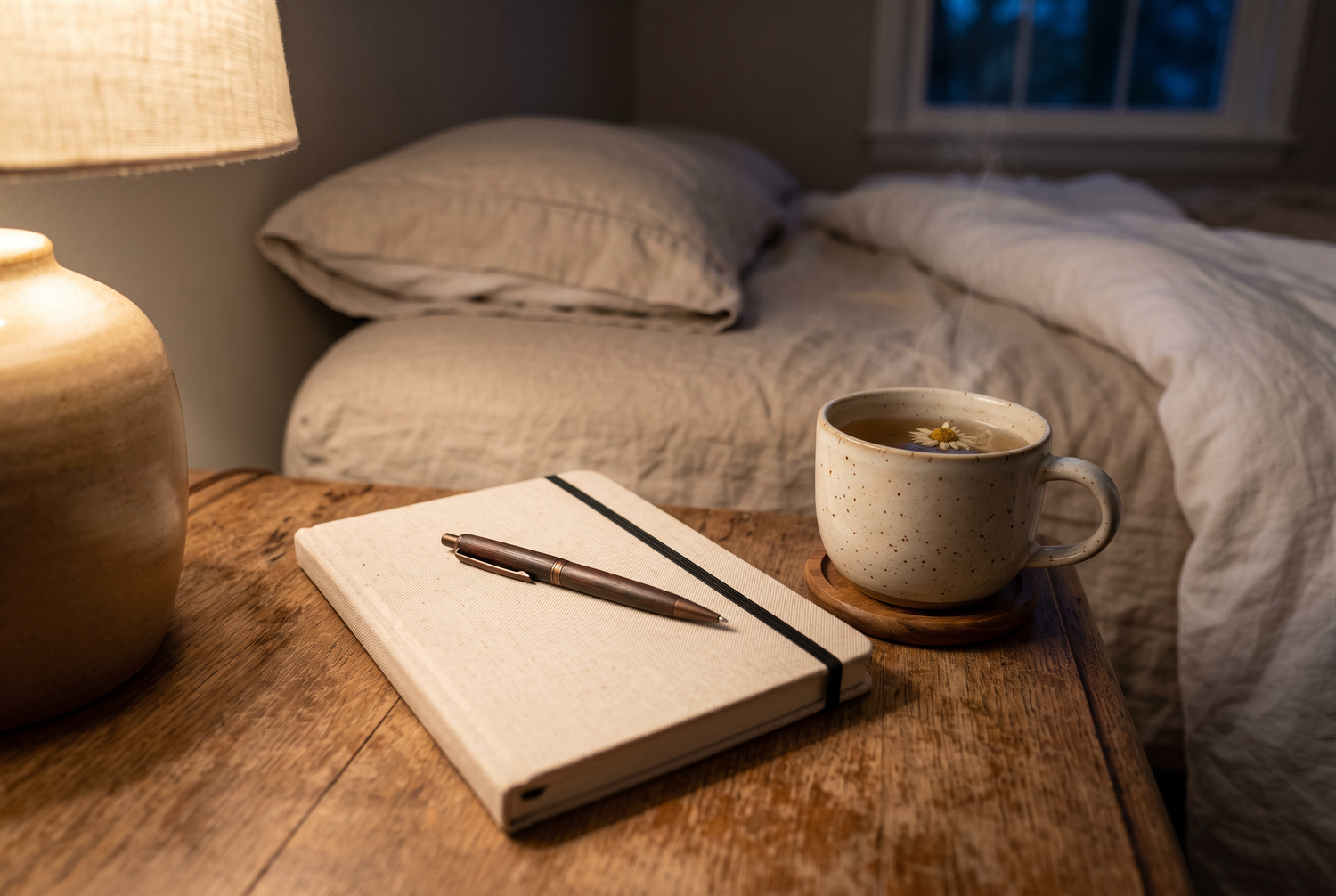
Place a notepad and pen on your nightstand. Before turning off the lights, write down everything that's on your mind for 10 minutes: worries, last thoughts about the exam, tomorrow's schedule. A study by Baylor University showed that people who wrote a concrete to-do list in the evening fell asleep an average of 9 minutes faster. The principle: what's on paper no longer needs to be held in the brain's working memory.
Breathing and body
The 4-7-8 breathing method – inhale for 4 seconds, hold for 7 seconds, exhale for 8 seconds, 4 to 8 repetitions – activates the parasympathetic nervous system and noticeably lowers the heart rate. Alternatively, the military method guides you through systematic muscle relaxation from face to toes. Jacobson's progressive muscle relaxation (tense, hold for 5 seconds, release) also works excellently while lying down.
Paradoxical Intention
It sounds strange, but it's effective: try to stay awake with your eyes open. This trick removes the pressure to fall asleep – and without pressure, sleep often comes on its own.
What to do if you're still awake at 2 AM?
First: turn the clock away. Every glance at the time triggers calculations ("only 4 hours and 23 minutes...") and new stress. Second: If you've been tossing and turning for what feels like more than 20 minutes, get up. Go to another room, dim the lights, and do something monotonous – a boring book, quiet music, a cup of herbal tea. Only when sleepiness returns should you go back to bed. This stimulus control prevents the brain from associating the bed with lying awake. Third: Stick to your planned wake-up time, even after a short night – sleeping in would only shift your rhythm for the next few days. And fourth: No reliance on sleeping pills or alcohol. Both may sedate you, but they worsen sleep architecture and can lead to grogginess in the morning – the last thing you need for an exam. More techniques can be found in the guide Fall asleep faster.
Common mistakes the night before an exam
Mistake 1: Studying until midnight and then expecting immediate sleep – the brain needs 1 to 2 hours of transition time. Mistake 2: Going to bed extra early. If you go to bed at 9 p.m. when you usually sleep at 11 p.m., you'll spend two hours lying awake and frustrated. Go to bed at your usual time. Mistake 3: Checking your phone in bed "just for a moment" – blue light and stimulating content act like a double dose of wakefulness. Mistake 4: A glass of wine to relax; alcohol fragments the second half of the night and suppresses REM sleep. Mistake 5: Catastrophizing ("Without 8 hours, I'll fail") – objectively wrong and the strongest sleep killer of all. Mistake 6: Trying new rituals or remedies for the first time on this particular night. Experiments belong on normal nights, not important ones.
| Time | Recommendation | Why |
|---|---|---|
| From 2 PM | No more caffeine | Half-life 4–6 hours |
| 5–6 PM | 30–45 min walk | Reduces stress hormones |
| 7 PM | Light dinner | Digestion otherwise disturbs falling asleep |
| 2 hours before bedtime | Stop studying, put away materials | Brain needs transition time |
| 1 hour before bedtime | Ritual: Shower, worry list, quiet music | Signals safety to the body |
| In bed | 4-7-8 breathing, turn away clock | Activates the parasympathetic nervous system |

Long-term: Planning sleep-friendly exam weeks
The best insurance against a sleepless night before an exam is a week of good sleep. During exam periods, plan for consistent sleep windows of 7 to 9 hours and treat them like study appointments – the material you cram at midnight will largely be lost without sleep, because consolidation into long-term memory primarily occurs during deep and REM sleep. Studies with students show that those who consistently sleep 7 hours or more during the study week achieve better results on average than short sleepers who study more hours. Also, maintain consistent bedtimes and wake-up times – a stable rhythm makes the night before the big day more predictable. And practice relaxation techniques beforehand: the 4-7-8 breathing method is most effective when it has become a familiar signal through daily practice.
Get CHF 25 discount
Subscribe to the newsletter and receive a one-time CHF 25 discount. ✓ 200 nights trial sleep ✓ 10 years warranty

Frequently Asked Questions about Sleeping Before Exams
How bad is a sleepless night before an exam really?
Significantly less bad than feared. A single short or bad night only slightly reduces cognitive performance because stress hormones keep you awake and focused on exam day. The sleep of the days and weeks before is crucial for memory and performance.
Should I go to bed earlier to get more sleep?
No. Go to bed at your usual time. If you lie down significantly earlier than usual, you won't be tired yet, will lie awake, and will build up additional pressure to fall asleep. A stable rhythm is more effective than an enforced extra hour.
What do I do if I'm still awake at 2 AM?
Turn the clock away, get up, do something monotonous in dim light, and only go back to bed when you feel tired. Remind yourself that even quiet lying down brings rest and that a short night will hardly affect your performance – this takes the pressure off.
Does studying right before bed help?
No, quite the opposite. You should stop studying at least 2 hours before bedtime. The brain consolidates learned material on its own during sleep; late cramming, however, keeps it in work mode and significantly delays falling asleep.
Which sleep technique works fastest?
The 4-7-8 breathing method and the military method with systematic muscle relaxation have proven effective. Both lower heart rate and tension within minutes. They are most effective when practiced beforehand on normal nights.
Are sleeping pills or alcohol an option before an exam?
This is not advisable. Alcohol fragments sleep and suppresses REM sleep, while sleeping pills can cause grogginess in the morning and should only be used under medical supervision anyway. Relaxation techniques are the safer choice.
This article is for general information only and does not replace medical advice.









Leave a comment
This site is protected by hCaptcha and the hCaptcha Privacy Policy and Terms of Service apply.