
Coccyx pain is insidious: during the day, the small bone at the bottom of the spine is mainly noticeable when sitting, but at night, when lying down, the pain can be just as present – especially when lying on your back, when your body weight rests directly on the coccyx, and when standing up, when the pelvic floor muscles contract. Medically, this condition is called coccydynia. It affects women about five times more often than men, often occurs after a fall on the buttocks, after childbirth or due to prolonged sitting on hard surfaces, and can last for weeks to months. If you can't get to sleep at night because every position hurts, this guide offers concrete help: which sleeping positions relieve the coccyx, how mattresses and pillows distribute pressure, which aids really work, and when a medical examination is necessary.
The short answer: Coccyx pain when lying down is best relieved by lying on your side with a pillow between your knees or by lying on your back with your knees elevated, where a pillow under your thighs slightly tilts the pelvis and frees the coccyx. A mattress with good pressure distribution is more important than a hard surface. When getting up, turning to the side helps instead of sitting up directly. If the pain lasts longer than six to eight weeks, a doctor should clarify the cause.
- The coccyx bears part of the body weight when lying on your back and sitting – pressure is the main trigger of pain.
- Side sleeping with a knee pillow is the gentlest position; back sleeping only with elevated thighs that tilt the pelvis.
- A point-elastic mattress distributes weight to the buttocks and thighs instead of concentrating it on the coccyx.
- When getting up, turn to the side and push up with your arm – do not sit up directly from a supine position.
- If pain persists for more than six to eight weeks, after a fall, or with accompanying symptoms, a medical examination is advisable.
Why the coccyx hurts when lying down
The coccyx (os coccygis) consists of three to five fused vertebral remnants and forms the lower end of the spine. It is connected to the sacrum by a small joint and serves as an attachment point for pelvic floor muscles and ligaments. When sitting and lying on your back, it is subjected to stress along with the ischial tuberosities – usually without problems. However, if the joint is irritated, displaced, or the surrounding tissue is inflamed, it reacts to any pressure with pain. Typical triggers include a fall on the buttocks (bruising or rarely a fracture), childbirth where the coccyx is pushed backward, hours of sitting on hard chairs or bicycle saddles, and less commonly, an overly mobile or overly stiff coccygeal joint.
When lying down, two factors come into play. Lying on your back on a hard surface concentrates the weight of the pelvis on the sacrum and coccyx – for an adult, this is about 20 to 25 percent of body weight, i.e., 15 to 20 kg on a few square centimeters. And when transitioning from lying to sitting and standing, the pelvic floor, which attaches to the coccyx, tenses up, which explains the characteristic sharp pain when getting up. Sleep suffers twice: from the pressure pain itself and from frequent repositioning that the body uses to try and avoid it. You can read more about the role of sleep phases for recovery and why interruptions are so costly in our basic article.
The best sleeping positions for coccyx pain
Side sleeping: the first choice
In the side position, the coccyx is free, and the weight rests on the hip and shoulder. A pillow between the knees, 10 to 15 cm thick, keeps the pelvis straight and prevents the upper leg from tilting forward and twisting the pelvic floor. The knees can be slightly bent, but not into a tight fetal position, which pulls the coccyx inward. If you unconsciously roll onto your back at night, you can place a firm pillow or a rolled-up blanket behind your back – or hug a long body pillow that stabilizes the position.
Back sleeping with a tilted pelvis
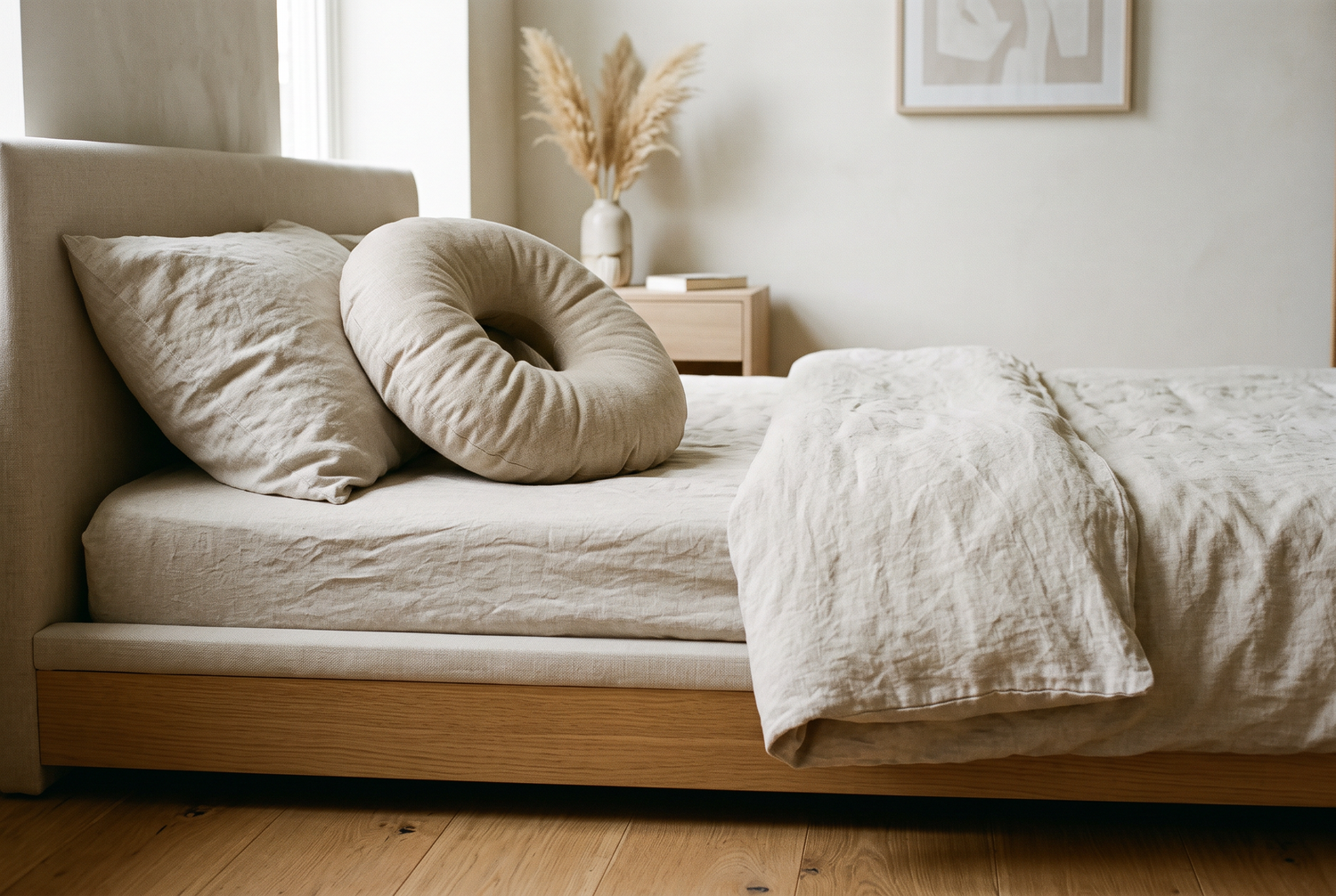
If you can only sleep on your back, you need to get the coccyx out of the load-bearing area. This can be achieved with a pillow or roll under the thighs – not under the knees, but a little higher, directly below the buttocks. This slightly tilts the pelvis backward, the sacrum lies flatter, and the coccyx lifts a few millimeters off the mattress. A roll 12 to 18 cm in diameter is sufficient. Alternatively, a ring cushion (donut cushion) with a cutout can be placed under the buttocks, but it often slips during the night.
Stomach sleeping: possible, but with reservations
Sleeping on your stomach completely relieves the coccyx, but puts strain on the cervical and lumbar spine. As a temporary solution during an acute phase, it is acceptable if a flat pillow under the stomach reduces the hollow back. As a permanent position, it is unfavorable for most people. You can find more about positions in general in the article Back pain and sleeping position.

Mattress and underlay: distributing pressure instead of concentrating it
When you have coccyx pain, the mattress is not a side issue. On a hard surface, the pelvis rests on three points when lying on your back: the two ischial tuberosities and the sacrococcygeal area. The harder the surface, the less contact area and the higher the pressure per square centimeter. A point-elastic mattress allows the buttocks to sink in enough so that the thighs and lower back also bear weight – this noticeably reduces the pressure on the coccyx. Memory foam and adaptive foam systems have a clear advantage here over pocket springs with thin padding or very firm cold foams.
At the same time, the pelvis must not sink into a hollow, because this curves the lumbar spine and puts the pelvic floor under tension. The mattress should therefore yield, but evenly – this is no longer the case with worn-out mattresses with dips of 2 cm or more. If you don't want to change your mattress yet, a 5 to 7 cm thick topper made of pressure-relieving foam can achieve a significant improvement; thin toppers of 2 to 3 cm do little. Our mattress topper guide explains what a topper can and cannot do. And for the duvet: it should be light so that it doesn't push the pelvis down when lying on your side.
| Measure | Effect on the coccyx | Effort |
|---|---|---|
| Side sleeping with knee pillow | Complete relief | Low |
| Back sleeping with roll under thighs | Pelvic tilt, coccyx free | Low |
| Ring cushion under buttocks | Cut-out, slips at night | Low |
| Pressure-relieving topper 5–7 cm | Weight distributed over larger area | Medium |
| Point-elastic mattress | Best pressure distribution, all positions | Higher, long-term |
Getting up without a jolt: the right technique
The moment of getting up is often worse than lying down when you have coccyx pain. If you sit up directly from a supine position, you roll over the coccyx and simultaneously tense the pelvic floor – the combination triggers the typical sharp pain. The alternative is to turn to the side: first roll onto your side, slightly bend your knees, then slide your legs over the edge of the bed and push yourself up with your lower arm and upper hand until you are sitting on the edge of the bed. You will automatically sit more on your thighs than on your coccyx. From a sitting position, stand up with your upper body slightly tilted forward, shifting your weight to your feet, without leaning back on your buttocks.
Bed height also plays a role: a bed with the top edge of the mattress approximately at knee height (usually 50 to 60 cm) allows you to get up without deep bending of the pelvis. With very low beds under 45 cm, you have to push yourself up from a squat, which puts strain on the pelvic floor and coccyx. A headboard or a stable bedside table to hold onto provides additional security. When lying down, reverse the movement: sit on the edge of the bed, lie on your side, lift your legs – never fall backward onto the mattress.
During the day and in the evening: what prepares you for sleep
Coccyx pain at night is often the bill for the day. Sitting on a hard office chair for eight hours irritates the joint so much that it is inflamed and tender in the evening. A wedge cushion with a cutout for the coccyx or a donut cushion reduces the strain during the day, and getting up briefly every 30 to 45 minutes also helps. When sitting, lean slightly forward, putting your weight on your sit bones and thighs, not leaning back. Car journeys and cycling should be kept short during acute phases.
In the evening, warmth helps: a warm bath of 37 to 39 °C or a cherry pit pillow on the sacrum for 15 minutes relaxes the pelvic floor muscles, which are often tense with chronic coccyx pain. Gentle stretches for the glutes and hip flexors – such as the pigeon pose from yoga or drawing the knees to the chest when lying on your back, 30 seconds per side – reduce tension at the coccyx attachment. For persistent complaints, pelvic floor physical therapy is often the decisive component, as it treats the muscles that pull on the coccyx. A good evening routine with fixed times also helps you fall asleep.
Common mistakes and when to see a doctor
The most common mistake is opting for a hard mattress, assuming "firm" is better for the back. With coccyx pain, the opposite is true: hardness concentrates the pressure. The second mistake is using a ring cushion as a permanent sitting solution – with prolonged use, it can overload the tissue around the cutout; wedge cushions with a posterior cutout are usually better. The third mistake is avoiding all movement: gentle activity and stretching promote healing, complete rest prolongs it. The fourth mistake is waiting it out: coccyx pain after a fall should be medically assessed within a few days to rule out a fracture. And generally: if symptoms persist for longer than six to eight weeks, occur without an identifiable trigger, or are accompanied by fever, weight loss, bleeding, or bladder and bowel problems, an urgent investigation is necessary. In rare cases, other underlying causes of the pain need to be treated.

Get CHF 25 discount
Subscribe to our newsletter and receive a one-time CHF 25 discount. ✓ 200 nights trial sleep ✓ 10 years warranty
Frequently asked questions about coccyx pain when lying down
What is the best sleeping position for coccyx pain?
Side-lying with a 10 to 15 cm thick pillow between the knees. This completely frees the coccyx. When lying on your back, a roll under the thighs helps to tilt the pelvis and lift the coccyx.
Is a hard mattress better for coccyx pain?
No. A hard mattress concentrates pelvic weight on the sit bones and coccyx. A point-elastic mattress allows the buttocks to sink in and distributes the weight to the thighs and lower back.
How do I get up pain-free with coccyx pain?
Turn to the side: roll onto your side, slide your legs over the edge of the bed, push yourself up with your arm and stand up sitting on your thighs. Never sit up directly from a supine position.
Does a ring cushion help in bed?
It can relieve the coccyx when lying on your back, but it easily slips at night. A firm roll under the thighs is usually more reliable. During the day, a wedge cushion with a posterior cutout is often better than a ring.
How long does coccyx pain last?
After a bruise, usually a few weeks, with chronic forms, months. If the pain lasts longer than six to eight weeks, the cause should be medically clarified.
When is coccyx pain a reason to see a doctor?
After a fall on the buttocks, for pain without a recognizable trigger, if it lasts longer than six to eight weeks, or if fever, weight loss, bleeding, or bladder and bowel problems occur.
This article is for general information only and does not replace medical advice.








Leave a comment
This site is protected by hCaptcha and the hCaptcha Privacy Policy and Terms of Service apply.