

Do you wake up at night because your hip is burning or aching dully – and in the morning, your side feels as if you've been lying on a stone? Hip pain while sleeping is one of the most common nocturnal complaints, especially for side sleepers. The good news is that in most cases, it's not due to a serious illness but rather an unfavorable combination of sleeping position, pressure distribution, and sleeping surface – and these are things that can be addressed.
The short answer: Hip pain while sleeping is usually caused by localized pressure on the side of the hip joint when lying on your side – for example, due to a mattress that is too hard or worn out – or by a twisted pelvic position. The best remedies are a pressure-relieving, adaptive mattress, a pillow between the knees, and proper alignment of the pelvis and spine. If the pain persists or radiates, the cause should be clarified by a doctor.
- Nocturnal hip pain often arises from localized pressure while lying on your side – the hip bears a large part of the body's weight in this position.
- Common medical causes include irritation of the bursa (bursitis), tendon irritation at muscle attachments, and osteoarthritis – often barely noticeable during the day but exacerbated at night by continuous pressure.
- An adaptive mattress with good pressure distribution allows the shoulder and hip to sink in while simultaneously supporting the waist – thus keeping the pelvis neutrally aligned.
- A pillow between the knees, regular movement, and gentle stretching further relieve the hip.
Why does the hip hurt at night, of all times?
During the day, the hip is in motion: joint fluid circulates, muscles stabilize, and pressure is constantly redistributed. At night, however, the joint lies for hours in the same position – and when lying on your side, a significant portion of the body's weight rests on a small area around the greater trochanter, the bony protrusion on the outside of the hip. This is precisely where bursae and tendon attachments are located, which are sensitive to continuous pressure.
Overview of the most common causes
Nocturnal hip pain is usually caused by one or more of these factors: irritation of the bursa on the outside of the hip (trochanteric bursitis), irritated gluteal tendon attachments (gluteal tendinopathy), early-stage hip osteoarthritis, muscular tension in the pelvic and lumbar region – or simply a sleeping surface that does not distribute pressure adequately. Pregnancy, intense sports, or prolonged sitting during the day can also make the hip more sensitive. If the pain radiates from the lower back into the leg, it's worth checking out our article on sciatica and disc problems.

Sleeping position and hip: Which position relieves, which burdens?
Not every sleeping position affects the hip joint in the same way. The following overview shows what matters in each position:
| Sleeping position | Effect on the hip | Tip for relief |
|---|---|---|
| Side position (painful side down) | High localized pressure directly on the irritated tissue | Switch to the other side, pressure-relieving mattress |
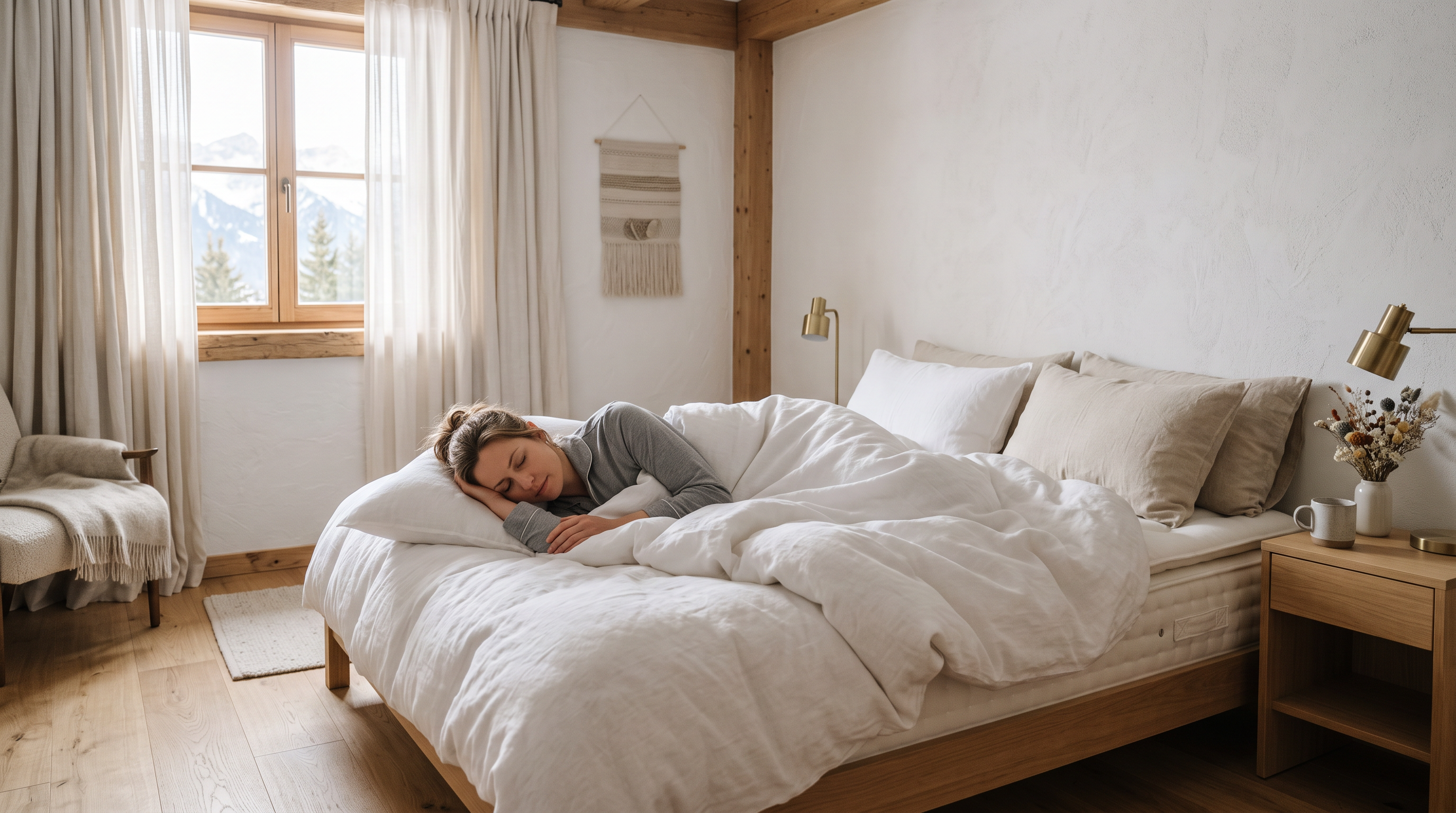
| Side position (painful side up) | Without support, the upper leg falls forward and twists the pelvis | Place a pillow between the knees, bend legs slightly |
| Back position | Usually the gentlest – pressure is distributed over a large area | Small pillow under the knees to relax the pelvis and lumbar area |
| Stomach position | Overstretches hip flexors and lumbar spine | Avoid if possible or place a flat pillow under the pelvis |
Since most affected individuals are side sleepers, it is also worth consulting our detailed guide on the right mattress for side sleepers, as well as looking at the best sleeping position for back pain – the hip and lower back are biomechanically closely linked.
The role of the mattress: Pressure distribution instead of firmness level
Many sufferers first ask: "Do I need a firmer or softer mattress now?" The honest answer: That's the wrong question. Firmness levels are not standardized in Switzerland – an "H3" can feel completely different depending on the manufacturer – and they don't address the actual problem. What matters is not how firm a mattress is, but how it distributes pressure: it must yield at the hip and shoulder, and support at the waist and lumbar region. If the mattress is too hard, pressure builds up on the hip bone; if it's saggy, the pelvis sags, and the joint is twisted. We explain in detail how modern foam technology behaves in our article on memory foam and viscoelastic foam.
This is precisely where an adaptive design comes in: The EvoPoreHRC Premium memory foam of the Ora Ultra automatically adapts to body shape, weight, and sleeping position – the hip sinks in as far as pressure relief requires, while the core of the body remains supported. A mattress for everyone, without the guesswork of firmness levels. By the way: If your current mattress already shows hollows, that's a clear warning sign – you can read when a change is due in "How often should you change your mattress?".

7 tips for nights without hip pain
1. Pillow between the knees: When lying on your side, a firm pillow between the knees keeps the pelvis straight and prevents the upper leg from falling forward.
2. Check pressure relief: If you wake up with numb areas or pressure pain in your hip, your mattress is not distributing pressure adequately.
3. Practice switching sides: Consciously fall asleep on your pain-free side – with a pillow behind your back as a gentle barrier against rolling back.
4. Gentle stretching: Hip flexor and gluteal muscle stretches in the evening loosen the tissue; even five minutes can make a noticeable difference.
5. Movement during the day: Prolonged sitting shortens the hip muscles – regular walks keep the joint supple.
6. Warmth before sleep: A warm shower or hot water bottle relaxes the muscles around the hip.
7. Maintain a sleep routine: Good, deep sleep lowers pain sensitivity – you can find the basics in our sleep hygiene guide.
Get CHF 25 discount
Subscribe to our newsletter and receive a one-time CHF 25 discount. ✓ 200 nights trial sleep ✓ 10 years warranty
Frequently Asked Questions about Hip Pain During Sleep
Why does my hip hurt at night, but barely during the day?
At night, the hip joint lies motionless for hours under continuous pressure, whereas during the day, movement promotes circulation and constantly redistributes pressure. Irritated bursae and tendon attachments on the outside of the hip therefore typically manifest when at rest – especially when lying on the affected side.
Which sleeping position is best for hip pain?
The gentlest position is usually on your back, as body weight is distributed over a large area. If you sleep on your side, you should lie on the pain-free side and place a pillow between your knees to keep the pelvis straight. The stomach position is unfavorable for hip pain.
Is a hard or soft mattress better for hip pain?
Neither – pressure distribution is crucial. A mattress that is too hard concentrates pressure on the hip bone, while a saggy one allows the pelvis to sink. An adaptive mattress that yields at the hip and shoulder while supporting the waist is ideal. The firmness level is not a reliable indicator for this, as it is not standardized.
Does a pillow between the knees really help?
Yes. When lying on your side, a pillow between the knees prevents the upper leg from falling forward and twisting the pelvis. This significantly relieves the hip joint, sacroiliac joint, and lumbar spine – one of the simplest and most effective immediate measures.
When should I see a doctor for hip pain?
If the pain lasts longer than two to three weeks, increases at rest, radiates into the leg, is accompanied by swelling or fever, or occurs after a fall, you should have the cause clarified by a doctor.
This article is for general information and does not replace medical advice.









Leave a comment
This site is protected by hCaptcha and the hCaptcha Privacy Policy and Terms of Service apply.