
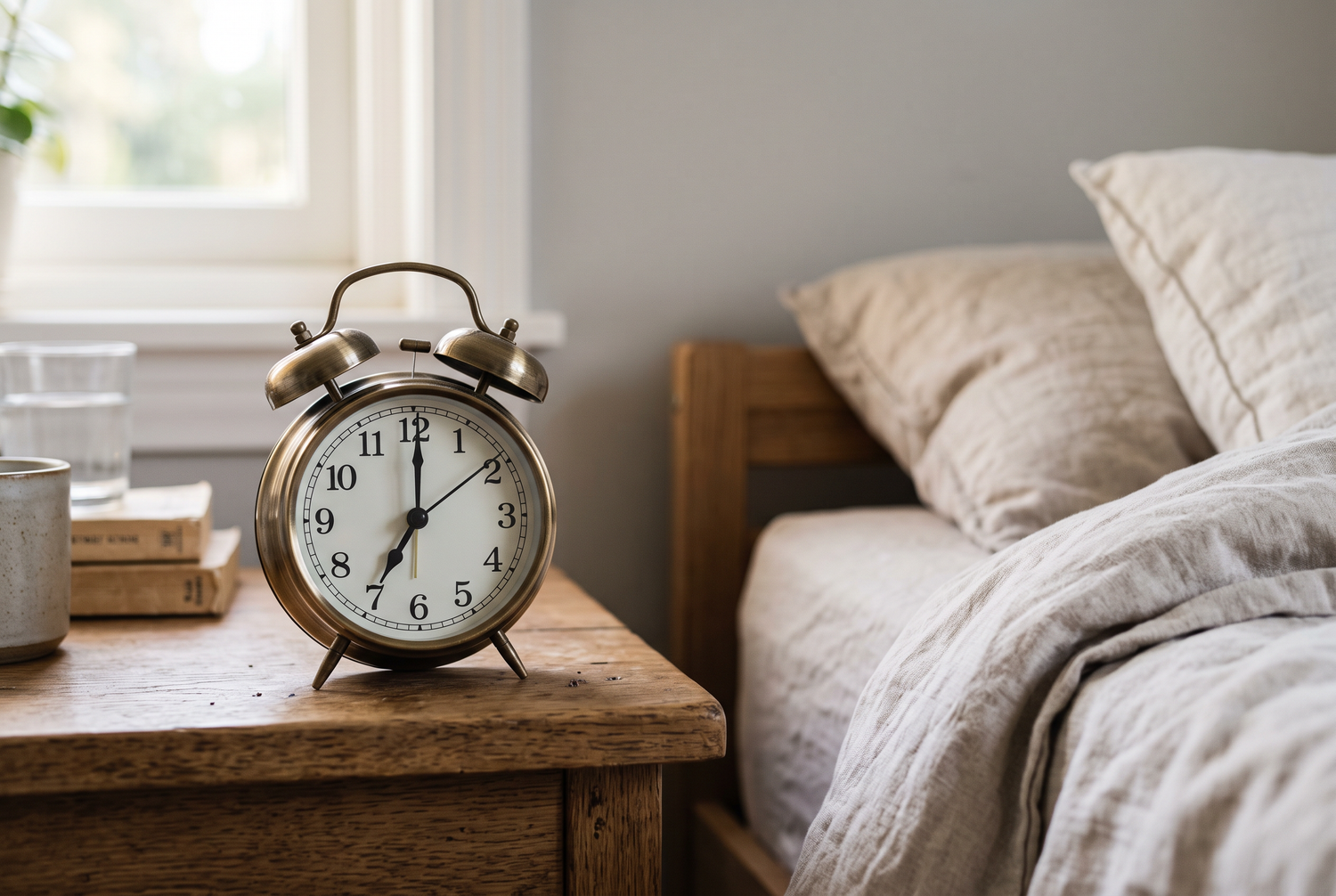
People who sleep poorly usually go to bed earlier, stay in bed longer in the morning, hoping to catch at least a few hours of sleep. However, this very behavior often perpetuates insomnia: the time spent in bed increases, the proportion of actual sleep decreases, and the bed becomes a place of wakefulness. Sleep restriction reverses this principle. It specifically shortens the time in bed to the actual time slept, thereby rebuilding natural sleep pressure. The method was developed in the 1980s by sleep researcher Arthur Spielman and is now a core component of cognitive behavioral therapy for insomnia (CBT-I), which is recommended by professional societies worldwide as the first-line treatment for chronic insomnia. Studies show that sleep restriction alone can reduce sleep onset latency and nighttime wakefulness by an average of 30 to 50%. This guide explains how the method works, how to calculate your sleep window, and what to pay attention to during the strenuous first few weeks.
The short answer: With sleep restriction, you limit the time in bed to the number of hours you actually sleep on average, but to a minimum of five to five and a half hours. The wake-up time remains the same every day, and the bedtime is derived from it. Because you spend less time in bed, sleep pressure increases, you fall asleep faster, and wake up less often. As soon as your sleep efficiency, meaning the proportion of sleep within the time in bed, is over 85 to 90%, you extend the sleep window by 15 minutes weekly until you reach your optimal sleep duration. The first one to two weeks are strenuous, after which sleep noticeably solidifies. People with epilepsy, bipolar disorder, sleep apnea, or in safety-critical professions should only use the method under medical supervision.
- Sleep restriction adjusts time in bed to actual sleep time, building sleep pressure. It is the most effective single component of CBT-I.
- Step 1: Keep a sleep diary for two weeks. Step 2: Calculate average sleep time. Step 3: Set time in bed to this value (never below 5 hours).
- A fixed wake-up time seven days a week is the most important anchor; bedtime is derived from it.
- If sleep efficiency is over 85–90%, extend the window by 15 minutes per week; if under 80%, shorten by 15 minutes.
- Daytime sleepiness is normal in the first 1–2 weeks; do not drive if excessively drowsy, no naps.
Why more time in bed worsens sleep
Sleep is regulated by two systems: the circadian rhythm, which sets the clock time, and homeostatic sleep pressure, which increases with each waking hour and decreases during sleep. A healthy sleeper requiring seven hours of sleep builds up enough pressure after 16 to 17 hours of wakefulness to fall asleep within 10 to 20 minutes. With insomnia, this system gets out of balance: someone who lies in bed for nine hours but only sleeps for six has a sleep efficiency of 67%. The three hours of wakefulness are filled with rumination, frustration, and clock-watching, and the brain learns to associate the bed with wakefulness.
In addition, extended time in bed dilutes sleep. The body distributes the available six hours of sleep over a nine-hour window: with long sleep onset times, several wake-up periods, and an early morning twilight that doesn't feel restorative. The proportion of deep sleep decreases because sleep pressure never gets truly high. Sleep restriction reverses the process: a shorter window concentrates sleep, increases the proportion of deep sleep, and re-trains the association "bed means sleep." If you want to understand how the individual sleep stages interact, you can find the basics in our article on sleep stages.
Sleep restriction step by step
Step 1: Two weeks of sleep diary
Every morning, note down: bedtime, estimated sleep onset time, number and duration of wake-up periods, wake-up time, getting-out-of-bed time. Estimates are sufficient; do not look at the clock. A template and tips can be found in our guide on sleep diaries.
Step 2: Calculate average sleep time
Add up the estimated total sleep time for all 14 nights and divide by 14. Example: You lie in bed from 10:30 PM to 7:00 AM (8.5 hours), but on average only sleep 5 hours and 45 minutes.
Step 3: Set your sleep window
Your new time-in-bed window corresponds to your average sleep time, rounded up to the nearest quarter hour, but never less than 5 to 5.5 hours. In the example: 5 hours 45 minutes. First, set a wake-up time that fits your daily routine, for instance, 6:30 AM. This then determines your earliest bedtime: 12:45 AM.
Step 4: Implement consistently
Do not go to bed before 12:45 AM, even if you are tired, and get up at 6:30 AM, even on weekends, even after a bad night. No naps during the day. The bed remains reserved for sleep.
Step 5: Evaluate and adjust weekly
Each week, calculate your sleep efficiency: sleep time divided by time in bed multiplied by 100. If it's over 85 to 90%, extend the window by 15 minutes by going to bed earlier. If it's under 80%, shorten it by 15 minutes (never below 5 hours). Between 80 and 85%, everything stays the same.

Calculation example: How the sleep window develops
| Week | Time in bed window | Avg. sleep time | Sleep efficiency | Adjustment |
|---|---|---|---|---|
| Starting point | 10:30 PM–07:00 AM (8.5 h) | 5 h 45 min | 68% | Set window to 5 h 45 min |
| Week 1 | 00:45 AM–06:30 AM (5.75 h) | 5 h 00 min | 87% | +15 min |
| Week 2 | 00:30 AM–06:30 AM (6 h) | 5 h 30 min | 92% | +15 min |
| Week 3 | 00:15 AM–06:30 AM (6.25 h) | 5 h 50 min | 93% | +15 min |
| Week 4 | 00:00 AM–06:30 AM (6.5 h) | 6 h 05 min | 94% | +15 min |
| Week 6 | 11:30 PM–06:30 AM (7 h) | 6 h 20 min | 90% | Maintain or +15 min |
| Week 7 | 11:15 PM–06:30 AM (7.25 h) | 6 h 15 min | 86% | Back to 7 h: optimal duration found |
The example shows the typical progression: actual sleep time increases from 5 h 45 min to approximately 6 h 20 min, but above all, sleep becomes compact and reliable. If efficiency decreases again during extension, you have found your individual sleep duration. How much sleep different age groups actually need can be read in our article How much sleep do I need?.
The first two weeks: What to expect
Sleep restriction is not a gentle method. In the first week, daytime sleepiness usually increases because you spend less time in bed than usual, and sleep pressure is just building up. Concentration, mood, and energy can suffer. This is not a sign that the method isn't working, but rather the mechanism itself: precisely this pressure ensures that you fall asleep faster and sleep through the night in the second week. Most people report a noticeable improvement after 10 to 14 days, and a stable, new sleep pattern after four to six weeks.
To get through this phase well, a few rules help. Plan the start for a time without important exams or travel. Use bright daylight in the morning, at least 20 to 30 minutes outdoors, to stabilize your circadian rhythm. Be physically active during the day, but not intensely in the last two hours before your sleep window. Avoid caffeine after 2 PM and alcohol, which fragments sleep. Fill the late evening until bedtime with calm, pleasant activities in dim light, but not in bed and not falling asleep on the sofa. Ideally, combine the method with stimulus control: If you lie awake for more than about 20 minutes at night, get up and only return when you feel sleepy. Rumination in bed is one of the most common reasons for failure; strategies against it can be found in our article on stress and rumination with sleep problems.
Common mistakes that cause sleep restriction to fail
The most common mistake is making an exception on weekends. Someone who stays in bed until 9 AM on Saturday shifts their rhythm by two and a half hours and effectively starts over on Monday. The fixed wake-up time applies seven days a week. Second mistake: naps. Even 20 minutes in the afternoon reduce the sleep pressure that the method aims to build. Third mistake: going to bed earlier because you're "so tired." Evening tiredness is the goal, not the problem; it should only be utilized within the set window.
Fourth mistake: extending the window too quickly. If you add an hour after three good nights, you dilute your sleep again. 15 minutes per week is the proven increment. Fifth mistake: giving up too soon. The method needs at least two, preferably four, weeks before a judgment is worthwhile. Sixth mistake: checking the clock at night. This creates mental calculations and tension; turn the alarm clock away. Seventh mistake: applying the method without understanding the basics. Sleep restriction works best in conjunction with good sleep hygiene, a cool, dark bedroom at 18 °C, and a sleeping surface where you don't wake up due to pressure points or sweating. Eighth mistake: setting the time in bed to less than five hours. This is not recommended even with very short estimated sleep time, as it compromises daytime safety.
Who is sleep restriction not suitable for?
The method is effective, but not for everyone. In epilepsy, sleep deprivation can trigger seizures. In bipolar disorder, shortened sleep can trigger manic episodes. In untreated sleep apnea, restless legs syndrome, or parasomnias like sleepwalking, the underlying condition must first be treated. People in safety-critical professions, such as professional drivers, pilots, or shift workers operating machinery, should only use the method during a phase where temporary daytime sleepiness does not pose a risk, or opt for a milder variant, known as sleep compression, where the window is gradually shortened by 15 to 30 minutes per week instead of immediately set to the sleep time.
Pregnant women, people with severe depression with suicidal thoughts, and individuals with chronic pain conditions should also discuss the method with their doctor or a sleep specialist. For everyone else, the following applies: Sleep restriction has been tested in numerous randomized studies and shows effects that are equivalent to or surpass those of sleep aids, but without side effects and with sustained effects even after the end of use. Those who feel unsure or suffer from chronic insomnia benefit from structured CBT-I, in which sleep restriction is therapeutically accompanied. In Switzerland, sleep medicine centers and specialized psychotherapists offer such programs, increasingly also digitally.

Get CHF 25 discount
Subscribe to newsletter and receive a one-time CHF 25 discount. ✓ 200 nights trial sleep ✓ 10 years warranty
Frequently Asked Questions about Sleep Restriction
What exactly is sleep restriction?
A behavioral therapy method for insomnia that limits the time spent in bed to the actual time slept. This increases sleep pressure, sleep becomes more compact and deeper, and the bed is re-associated with sleep instead of wakefulness.
How do I calculate my sleep window?
Keep a sleep diary for two weeks and calculate your average actual sleep time. This number of hours, but a minimum of 5 to 5.5 hours, is your time-in-bed window. Set a fixed wake-up time; your bedtime will be derived from it.
How long does it take for sleep restriction to work?
Most people notice a significant improvement in falling asleep and staying asleep after 10 to 14 days. A stable new sleep pattern usually establishes itself after four to six weeks.
Can I nap during sleep restriction?
No. Every nap reduces the sleep pressure that the method aims to build up. In cases of extreme sleepiness, a short rest without sleep is allowed, but not in bed.
What is the difference between sleep restriction and sleep compression?
With sleep restriction, the time-in-bed window is immediately set to the actual sleep time. With sleep compression, it is gradually shortened by 15 to 30 minutes per week. Compression is gentler and suitable for older people or individuals who cannot risk severe daytime sleepiness.
Who is sleep restriction not suitable for?
For individuals with epilepsy, bipolar disorder, untreated sleep apnea, parasomnias, or those in safety-critical professions. Pregnant women and individuals with severe depression should also only use the method under medical or therapeutic supervision.
This article is for general information purposes only and does not replace medical advice.









Leave a comment
This site is protected by hCaptcha and the hCaptcha Privacy Policy and Terms of Service apply.