
Around 700,000 mattresses are disposed of in Switzerland every year – most of them end up in incineration plants. Those who consider the environment when buying quickly face difficult questions: Is natural latex really more ecological than foam? How much does transport weigh? And what use is the most sustainable material if the mattress is worn out after five years? The ecological balance of a mattress is determined over its entire life cycle: raw material extraction, production, transport, period of use and disposal. Surprisingly often, it is not the material but the lifespan that determines the environmental impact per year of sleep. In this guide, we take a sober look at common mattress materials, clear up eco-myths, and show you the criteria you can use to make genuinely more sustainable purchases.
The short answer: No mattress type is universally "green" – the decisive factor is the environmental impact per year of use. A durable mattress that lasts 10 instead of 5 years halves its ecological footprint, virtually regardless of the material. Natural latex scores points with renewable raw materials but involves long transport routes and energy-intensive processing; high-quality foams compensate for their fossil origin with low weight, efficient production, and high durability. The biggest levers for buyers: longevity, freedom from harmful substances, replaceable components, and a manufacturer with a serious take-back or second-life concept.
- The ecological balance covers the entire life cycle: raw materials, production, transport, use, and disposal – not just the material.
- The period of use is the biggest lever: double the lifespan means approximately half the environmental impact per year of sleep.
- Natural materials are not automatically more ecological – cultivation areas, transport routes, and processing also count.
- In Switzerland, most old mattresses are incinerated; recycling and second-life programs are only slowly gaining importance.
- Good purchase criteria: high density, tested for harmful substances, washable cover, long warranty, and take-back offers.
What does an ecological balance mean for a mattress?
An ecological balance (Life Cycle Assessment, LCA) records all environmental impacts of a product "from cradle to grave": the energy and resource consumption of raw material extraction, production emissions, transport, the usage phase, and finally disposal. For mattresses, two items typically dominate: the production of core materials and disposal at the end of life. An average double mattress causes roughly 100 to 250 kg of CO2 equivalents over its life cycle – calculated per year, it therefore makes a big difference whether these emissions are distributed over 5 or 10 years of use. The system boundary is also important: a washable cover extends hygienic usability; replaceable toppers or cores prevent the entire mattress from being replaced due to a worn layer. Serious comparisons therefore always calculate per year of use – a figure that, unfortunately, rarely appears in advertising. Our guide Recognizing a Sustainable Mattress goes into more detail about what sustainability means for mattress purchases.
Materials in the Eco-Check: Foam, Latex, Pocket Spring, and Natural Fibers
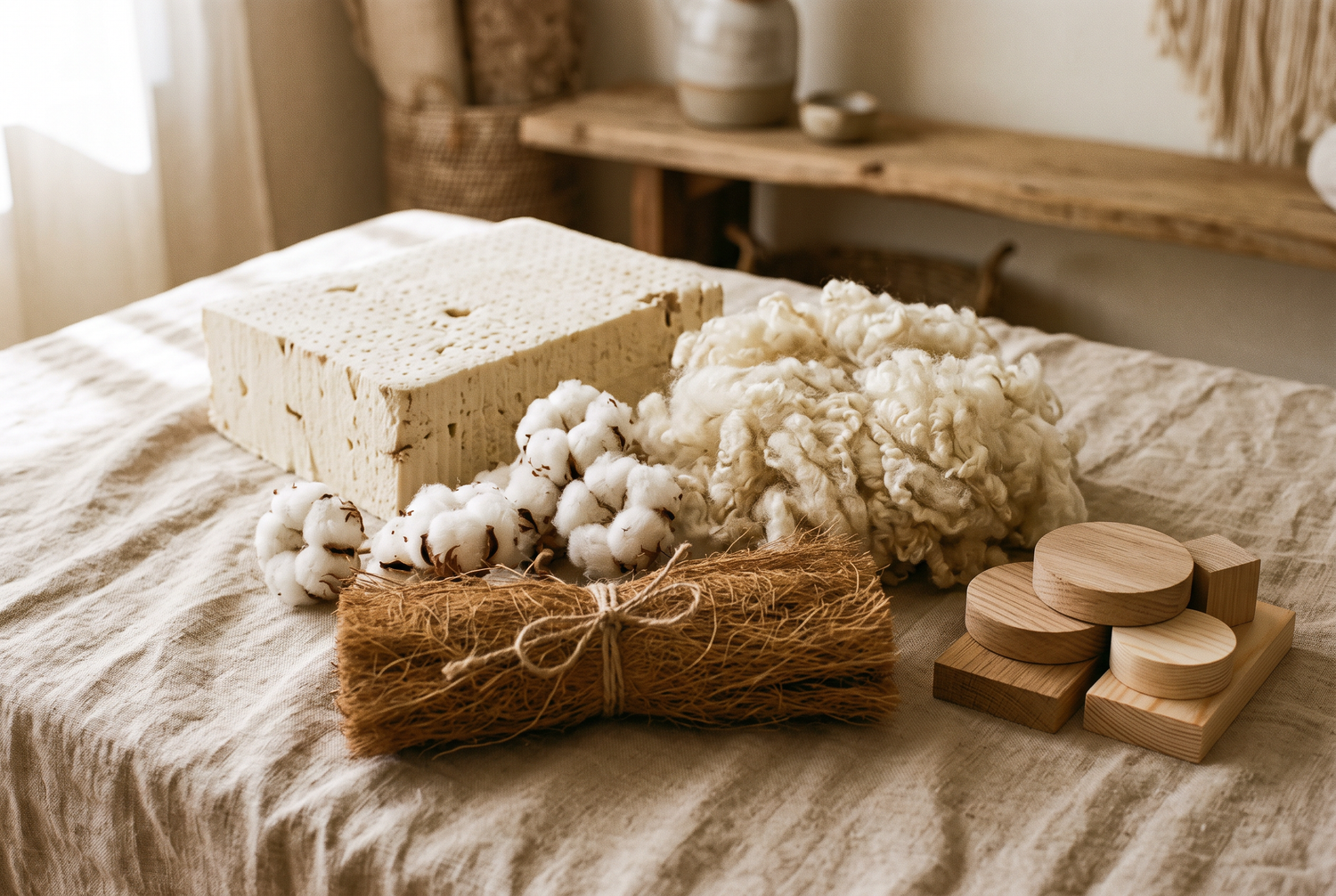
Each core material has its own ecological profile. Polyurethane foams (cold, comfort, and memory foam) are petroleum-based – their advantage lies in their low material weight, efficient production, and, with high quality, long durability. Natural latex comes from the rubber tree, a renewable raw material that binds CO2 during growth; however, vulcanization is energy-intensive, and the raw material usually travels from Southeast Asia. Steel springs have energy-intensive production but are easily recyclable at the end of their life. Natural fibers such as coconut, horsehair, or wool score well for raw materials but are often glued to other materials, making separation difficult.
| Material | Strengths in the Ecological Balance | Weaknesses in the Ecological Balance |
|---|---|---|
| PU Foam (Cold/Memory Foam) | Lightweight, efficient production, durable with high density | Fossil raw material, recycling still not widely established |
| Natural Latex | Renewable raw material, very durable | Long transport routes, energy-intensive vulcanization, high weight |
| Pocket Spring | Steel easily recyclable, durable | Energy-intensive steel production, material mix complicates separation |
| Natural Fibers (Coconut, Wool) | Renewable, partly by-products of agriculture | Often glued and difficult to separate, transport routes |

Production and Transport: the Underestimated Factors
Two items are often overlooked in eco-discussions. First, processing: even natural materials need to be washed, spun, glued, or vulcanized – processes that require energy, water, and sometimes chemicals. Second, transport: natural latex from Sri Lanka or Malaysia travels over 15,000 km by ship, and because latex is significantly denser than foam at 60 to 90 kg per cubic meter, more mass is moved per mattress. Although sea freight is efficient per tonne-kilometer, it adds up for heavy products. Conversely, vacuum-compressed foam mattresses benefit twice: they weigh less and can be rolled for transport in a fraction of the volume – a truck can fit three to four times more mattresses than uncompressed. The last mile also counts: a bundled parcel delivery usually performs better than a single delivery by a furniture forwarder. And finally, the packaging itself: recycled and recyclable films and cartons are now standard for manufacturers who take their balance seriously.
Useful Life: The Biggest Lever for the Ecological Balance
The simplest eco-calculation is also the most effective: environmental impact divided by years of use. A mattress with 150 kg CO2 equivalents that is worn out after 5 years accounts for 30 kg per year; if it lasts 10 years, it's 15 kg. Therefore, quality is an ecological criterion: foams with a high density of RG 40 and above maintain their support for many years, while cheap foams quickly form hollows and need to be replaced. Care also extends life: regular turning, a washable cover, good ventilation against moisture, and an intact slatted frame. Realistic figures for the durability of various types can be found in the article Mattress Lifespan. The hygiene argument is also important: after 8 to 10 years, mite infestation and material fatigue usually indicate a need for replacement – an "eternal" mattress is neither realistic nor desirable. The goal is to fully and healthily utilize the technical lifespan, not premature replacement due to a desire for new design or holding onto it for too long out of frugality.
Disposal and Recycling in Switzerland
At the end of its life, the downside of the material mix becomes apparent: a classic mattress consists of foam, textiles, adhesives, and sometimes steel – firmly bonded and difficult to separate. In Switzerland, old mattresses are therefore predominantly incinerated, where at least energy is recovered; material recycling is only just beginning. However, progress is being made: steel springs are magnetically sorted and recycled, shredded foam finds a second life as carpet underlay or insulation material, and chemical recycling of PU foam is being tested in pilot plants. For consumers, the most important thing is to dispose of mattresses via official bulky waste collection or disposal centers – illegal dumping is not an option – and to check the retailer's take-back offers when buying new. Even better is reuse: professionally reconditioned mattresses with new covers, as offered by second-life programs, save most of the manufacturing emissions. Details on both methods can be found under Disposing of a Mattress and Mattress Recycling and Sustainability.
Myths in the Fact Check
Myth one: "Natural material is always more ecological." Not necessarily – cultivation areas, water consumption, transport, and processing can burden the balance of natural products, while a durable, efficiently produced foam can perform better per year of use. Myth two: "Recycling solves the problem." Currently, only a small portion of mattresses are materially recycled; prevention through longevity remains more effective than any recovery. Myth three: "Eco-labels guarantee a good ecological balance." Labels like OEKO-TEX Standard 100 primarily test for harmful substances in the end product – an important criterion for your health, but not a life cycle analysis. The article OEKO-TEX and Harmful Substances explains what common seals really mean. Myth four: "A used mattress is the most ecological choice." Privately resold mattresses are hygienically delicate; professionally refurbished second-life models with new covers, on the other hand, combine ecology and hygiene. Myth five: "Heavy mattresses are more sustainable." More mass initially means more resources – the crucial factor is whether the material lasts proportionally longer.
Practice: How to Buy Measurably More Sustainably
First: Buy for longevity. For foams, look for a density of RG 40 or higher, solid workmanship, and at least a 10-year warranty – a manufacturer who gives a long warranty expects long durability themselves. Second: Choose products tested for harmful substances with OEKO-TEX Standard 100 or comparable certificates. Third: Prefer washable, removable covers – hygiene extends the lifespan. Fourth: Check trial sleep offers. Someone who can test for 200 nights avoids mispurchases – and mispurchases are the worst thing that can happen ecologically. Clarify what happens to returns: reputable providers refurbish them or donate them instead of destroying them. Fifth: Think in components – a replaceable topper can extend the life of the core. Sixth: Dispose of the old mattress correctly and ask about take-back or second-life options. And seventh: Distrust general "climate neutral" promises without verifiable data – demand concrete information instead of green adjectives.

Get CHF 25 discount
Subscribe to our newsletter and receive a one-time CHF 25 discount. ✓ 200 nights trial sleep ✓ 10 years warranty
Frequently Asked Questions About the Ecological Balance of Mattresses
Which mattress material has the best ecological balance?
There's no general answer, as raw materials, processing, transport, and lifespan all play a role. When calculated per year of use, durable, high-quality mattresses perform best – regardless of whether the core is made of foam or natural latex.
Is natural latex more ecological than foam?
Natural latex is based on a renewable raw material but involves long transport routes, high weight, and energy-intensive processing. A durable foam with high density can achieve a comparable or better balance per year of use.
How are mattresses disposed of in Switzerland?
Most old mattresses go to incineration plants for energy recovery via bulky waste collection or disposal centers. Material recycling is still in its early stages; steel springs are already recycled, and foam is partly processed into insulation and underlay material.
What environmental benefits does a second-life mattress offer?
Professionally refurbished mattresses with new covers save most of the manufacturing emissions because the core is reused. This combines ecology and hygiene – unlike buying used mattresses privately.
Does an OEKO-TEX label indicate anything about the ecological balance?
No, OEKO-TEX Standard 100 tests for harmful substances in the end product, not the life cycle. The label is important for health but does not replace an ecological balance – for environmental impact, longevity and disposal method are primarily important.
What is the most important eco-tip when buying a mattress?
Buy durable quality with a long warranty and use trial sleep offers to avoid mispurchases. A mattress that lasts 10 years instead of 5 halves its environmental impact per year of sleep – no other criterion has such a significant influence.





Leave a comment
This site is protected by hCaptcha and the hCaptcha Privacy Policy and Terms of Service apply.