
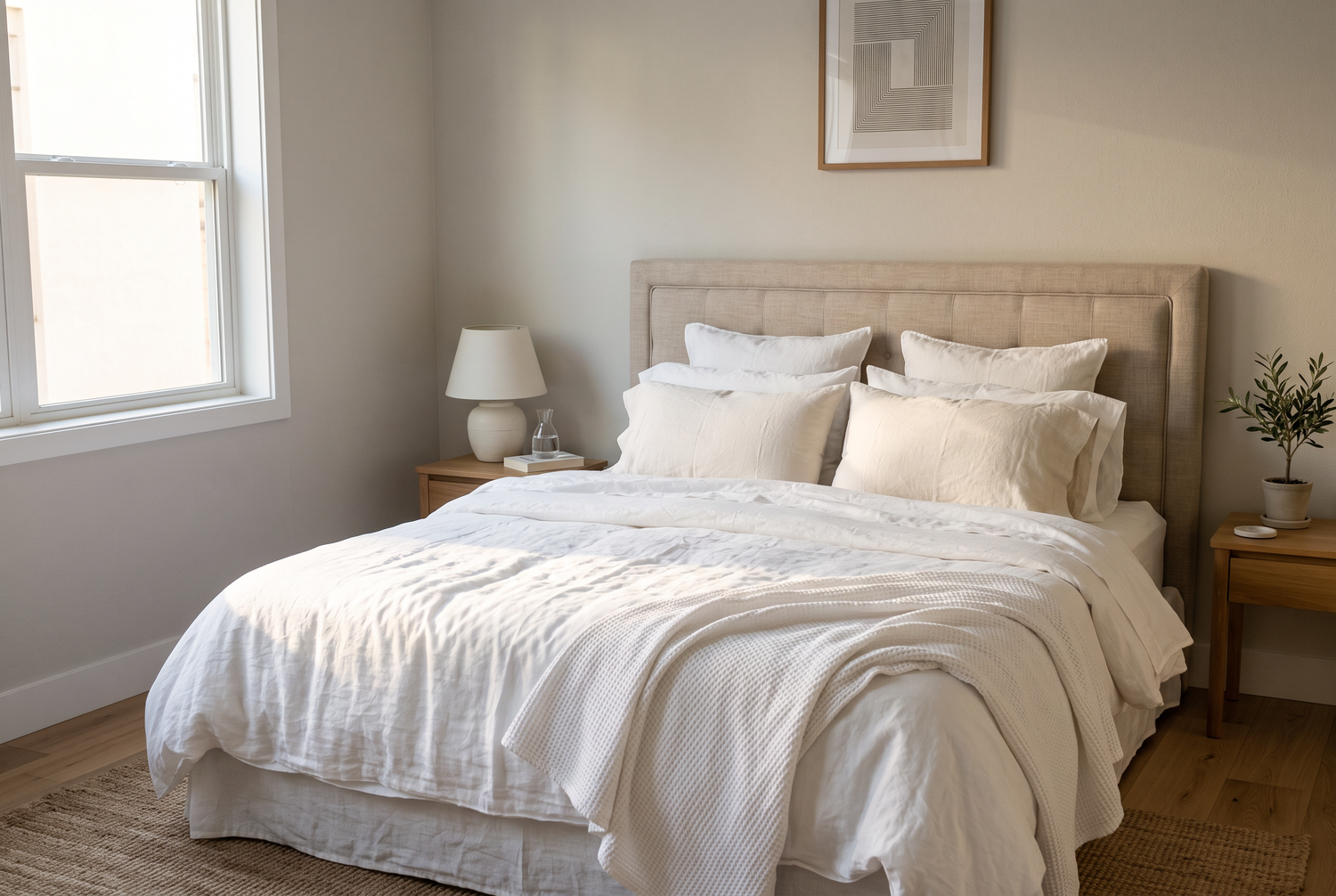
Should your head point north when sleeping? Or east, as Indian traditions recommend? The question of the right cardinal direction for your bed has occupied people for centuries, and it resurfaces at the latest when furnishing a new bedroom. The answers from Feng Shui, Vastu Shastra, and European folklore contradict each other cheerfully, while science takes a refreshingly sober stance. In this article, we'll sort through the traditions, take an honest look at the sparse research on the Earth's magnetic field, and then show which tangible factors really influence bed positioning. Because while the cardinal direction probably makes little difference, noise, light, drafts, and proximity to heating concretely determine your sleep quality. By the end, you'll know where your bed should be, with or without a compass.
The short answer: There is no scientific evidence that a particular cardinal direction leads to better sleep. Traditions recommend different things: Feng Shui prefers a protected position with a wall at the back, Vastu Shastra advises the head to the south or east, and European folklore to the north. More important than the compass are measurable factors: a stable wall behind the headboard, distance from windows and heating, protection from noise and morning light, and freedom from drafts. Optimizing these points brings more benefit than any cardinal direction.
- Studies have not been able to prove a reliable effect of cardinal direction on sleep quality; the data is thin and contradictory.
- Traditions contradict each other: Vastu recommends head to the south or east, folklore to the north, Feng Shui prioritizes a protected position in the room.
- Measurably important are: a stable wall behind the head, 50 cm distance from heating and exterior wall, no placement directly under the window.
- Noise sources and morning light determine the best position more than any compass; the bed belongs in the quietest, darkest spot in the room.
- If you reposition your bed, you should test it for 1 to 2 weeks; the body needs a few nights to assess a new position.
Why the question of cardinal direction is so old
The alignment of the sleeping place has been imbued with meaning in almost all cultures. In Indian architectural doctrine, Vastu Shastra, a head-to-south position is considered ideal because the body is supposed to lie like a magnet in the Earth's field; a head-to-north position is considered unfavorable. European folklore came to the opposite conclusion and recommended the head to the north, supposedly in alignment with the field lines. Feng Shui, on the other hand, is less concerned with the compass than with the position in the room: a wall at the back, the door in view, as described in the article on Feng Shui in the bedroom. These contradictions alone show that there is no universal, culture-independent truth about the best cardinal direction. What unites the traditions is the desire for a protected, quiet sleeping place, and this core can be realized even without a worldview. Historically, practical reasons also played a role: beds stood away from drafty doors and cold exterior walls long before anyone spoke of magnetic fields.
What does research say about the Earth's magnetic field?
The Earth's magnetic field is very weak, about 25 to 65 microteslas; for comparison, an MRI scanner operates with fields about 100,000 times stronger, without patients suffering from sleep disturbances. Some animal species, such as migratory birds or deer, are demonstrably guided by the magnetic field, and a few small human studies have looked for effects of sleep orientation, with inconsistent, methodologically weak results and without convincing replication. The scientific consensus, therefore, is: a relevant influence of cardinal direction on human sleep has not been proven. What studies do prove, however, is that the placebo or expectation effect is particularly strong when it comes to sleep. Those who are convinced they are lying in the "right" direction relax more easily and actually fall asleep better. This is not a flaw, but a usable effect: if facing north makes you feel good and the position works practically, there is nothing against it. However, no one should accept an otherwise impractical arrangement for this reason.

Overview of Traditions
If you still want to know the interpretations, here is a summary, including what might practically be behind them:
| Head points to | Traditional Interpretation | Practical Consideration |
|---|---|---|
| North | Folklore: restful; Vastu: unfavorable | No measurable effect, north side is often the cooler side of the room |
| East | Vastu and Ayurveda: beneficial, direction of the rising sun | With east-facing windows, morning light wakes you early, plan for blackout |
| South | Vastu: ideal for deep sleep | No measurable effect, south rooms heat up more in summer |
| West | Mostly rated as neutral to unremarkable | Evening sun can heat up the room, otherwise unproblematic |
The table makes it clear: the practical columns deal with temperature and light, not magnetism, and that is where the real leverage lies.
What really matters: the six practical factors
First, the wall: The headboard belongs against a stable interior wall; this provides support, protects against cold radiation from the exterior wall, and dampens noise. Second, the window: Directly under it, drafts, street noise, and early light are disturbing; keep at least one meter distance or consistently darken, tips for this in the guide Darken the bedroom. Third, the heating: Less than 50 cm distance dries out mucous membranes and disturbs the nocturnal temperature drop; an ideal room climate of 16 to 19 degrees remains, as explained in the article on the ideal sleep temperature. Fourth, the door: It should be visible, but the bed should not be directly in its line; this avoids drafts and the unconscious feeling of lying "in the passageway." Fifth, noise sources: Choose the side of the bed away from the street, the elevator, and the neighbor's wall with the TV. Sixth, the bed mechanics: Access from both sides makes it easier for couples to get up without waking their partner, and the mattress needs air circulation all around.
Common mistakes when aligning your bed
Mistake 1: Prioritizing the compass. If you place the bed in the middle of the room or next to the heater for a north orientation, you are trading an unproven advantage for tangible disadvantages. Mistake 2: Placing the headboard under the window. Especially in old buildings, it can be noticeably drafty there, and in summer, the light wakes you up from 5:30 am. Mistake 3: Squeezing the bed against the most unsuitable wall just so the wardrobe fits better. The bedroom is for sleeping, the bed gets the best wall, the wardrobe makes do. Mistake 4: Ignoring an uninsulated exterior wall. On poorly insulated exterior walls, the surface temperature can be several degrees below room temperature in winter, which feels like unpleasant cold radiation; 10 cm wall distance and a solid headboard help. Mistake 5: Judging immediately after repositioning. The body needs a few nights to adjust before a new position can be fairly evaluated; give each variant at least a week and simultaneously maintain consistent sleep hygiene so that the comparison remains meaningful.

Get CHF 25 discount
Subscribe to newsletter and receive a one-time CHF 25 discount. ✓ 200 nights trial sleep ✓ 10 years warranty
Practice: four steps to the best bed position
Step 1: Analyze the room. For each wall, note: interior or exterior wall, distance to window, door, and radiator, noise sources behind it. The wall with the fewest drawbacks is your candidate. Step 2: Test the position. Headboard against the chosen wall, door in view, at least 50 cm to heating and window, for couples 60 cm passage on both sides. If several walls are equally suitable and you prefer a certain cardinal direction, take it; the feel-good factor is real. Step 3: Sleep for a week and evaluate. Pay attention to the time it takes to fall asleep, nocturnal awakenings, and how you feel in the morning, ideally with short notes. Step 4: Fine-tune. If morning light is a bother, curtains help; if it's drafty, a higher headboard or bed modification helps; if sleep remains restless, it's often not due to the position but to the mattress, a look at the age and condition of the mattress is worthwhile, reference points can be found in the article on the lifespan of a mattress.
Frequently asked questions about bed alignment
Which cardinal direction should my head face when sleeping?
Scientifically, there is no proven best direction. Traditions recommend different things: Vastu Shastra suggests south or east, European folklore north. Decisive factors are instead peace, darkness, freedom from drafts, and a stable wall behind the head.
Does the Earth's magnetic field affect our sleep?
A relevant influence has not been proven. The Earth's magnetic field is extremely weak, and the few studies on sleep orientation show inconsistent, methodologically weak results without reliable replication.
Why shouldn't the bed be under the window?
Directly under the window, drafts, cold radiation, street noise, and early morning light can be disturbing. If you don't have another wall, you should consistently darken, seal the window well, and use a high headboard.
Is it bad if your feet point towards the door?
Not for health; it's a symbolic rule from Feng Shui and folklore. Practically relevant is rather that the bed is not in the draft line between the door and window and that the door remains visible from the bed.
How much distance does the bed need from the heater?
At least 50 cm. Directly next to the radiator, the air dries out the airways, and the heat disturbs the nocturnal lowering of body temperature, which is necessary for deep sleep. An ideal room temperature of 16 to 19 degrees remains.
How long should I test a new bed position?
At least one week, preferably two. The body needs a few nights to get used to a changed environment; only then can it be fairly assessed whether falling asleep and staying asleep have improved.










Leave a comment
This site is protected by hCaptcha and the hCaptcha Privacy Policy and Terms of Service apply.