
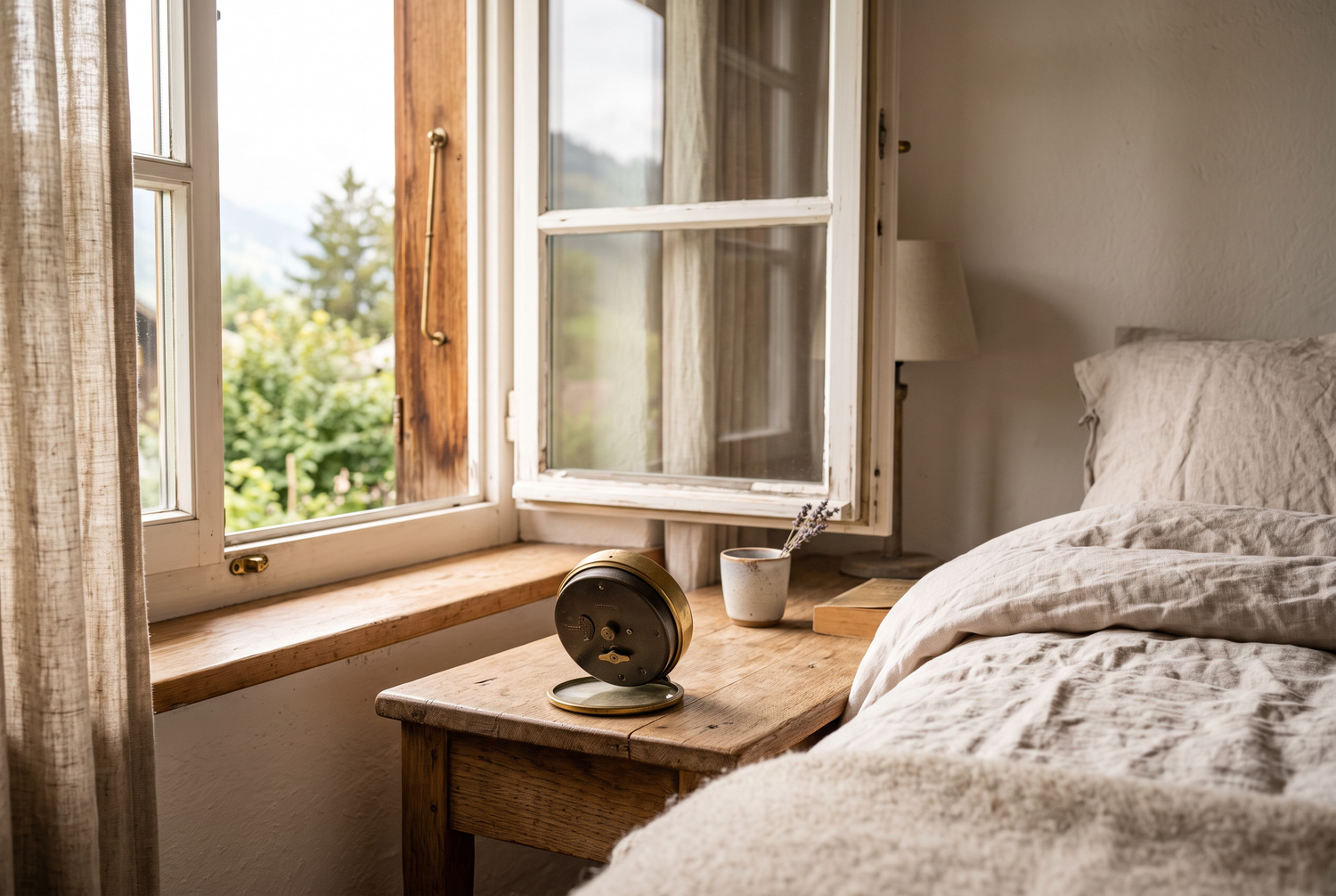
Monday morning, 6:30 AM: The alarm rings, and even though the weekend was supposed to be for recovery, starting the week feels like recovering from a long-haul flight. This is no coincidence – those who go to bed significantly later on Fridays and Saturdays and sleep until 10 or 11 AM shift their internal clock by several hours. Biologically speaking, they fly two time zones west every weekend and back again on Sunday. Chronobiologists call this phenomenon social jet lag: the chronic discrepancy between biological sleep time and the socially dictated times for work, school, and appointments. A large part of the population is affected – often without knowing it. In this article, we explain how social jet lag arises, how you can calculate your personal value in two minutes, and what strategies you can use to save your weekend recovery without disrupting your internal clock.
The short answer: Social jet lag refers to the shift in the midpoint of sleep between working days and days off. Studies show that a difference of about one to two hours is associated with poorer mood, higher BMI, unfavorable metabolic values, and increased consumption of stimulants. Weekends do not automatically make you sick – the chronic repetition is the problem. The most effective countermeasure: shifting wake-up times by no more than 60 to 90 minutes even on weekends, and making up for lost sleep by going to bed earlier instead of sleeping in late.
- Social jet lag = difference in the midpoint of sleep between working days and days off; relevant from 1-2 hours.
- Large survey studies show: Around two-thirds of working people have at least 1 hour of social jet lag, about one-third have 2 hours or more.
- Chronic shifting is associated with higher BMI, poorer mood, and unfavorable metabolic values – causality is still being researched.
- Late chronotypes ("owls") and young adults are most affected.
- Most important levers: consistent wake-up time (max. +60-90 min on weekends), morning light, and earlier bedtime instead of sleeping in late.
What exactly is social jet lag?
The term comes from Munich chronobiologist Till Roenneberg, who coined it with colleagues in 2006. Social jet lag is measured by the midpoint of sleep: the exact time halfway between falling asleep and waking up. Someone who sleeps from 11 PM to 6:30 AM during the week has their midpoint of sleep at 2:45 AM. On weekends, sleeping from 1 AM to 10 AM, the midpoint is at 5:30 AM – the difference of 2 hours and 45 minutes is their personal social jet lag. This concept makes visible what many intuitively feel: the body lives against its biological clock during the week and catches up on the weekend with what the alarm clock denies it. Unlike travel jet lag, however, there is no adaptation because the change repeats every week. The internal clock is thus kept in a constant back-and-forth – with consequences for hormones, metabolism, and mood. Important: Social jet lag is not a lifestyle problem of party-goers, but affects everyone whose daily routine starts earlier than their biology dictates.
How widespread is the phenomenon?
Very. Evaluations of the Munich Chronotype Database with over 200,000 participants show that about two-thirds of the working population experience at least one hour of social jet lag, and about one-third experience two hours or more. Young people and young adults between 16 and 25 years are most affected – in this phase of life, the chronotype biologically shifts later, while school and training start early. A 17-year-old student who biologically only gets tired around midnight but has to get up at 6:15 AM inevitably accumulates massive social jet lag – more on this in the article about teenagers and sleep deprivation. The phenomenon decreases with age as the chronotype shifts earlier again. The effect of the place of residence is also interesting: people in urban areas with little daylight exposure generally have later chronotypes and more social jet lag than people who spend a lot of time outdoors. This already indicates the direction of the most important countermeasure: morning light.
What social jet lag does to the body
The research is extensive, albeit predominantly observational – so causalities should be interpreted with caution. Documented effects include: a higher body mass index in people with pronounced social jet lag, especially in those who are already overweight; unfavorable blood sugar and fat metabolism values; an increased risk of depressive moods; and higher consumption of caffeine, nicotine, and alcohol. A Dutch study found that two hours of social jet lag were associated with about twice the risk of metabolic syndrome compared to less than one hour. The mechanisms are plausible: living against the internal clock means eating at biologically unfavorable times, getting light at the wrong time, and chronically shortening sleep during the week – the resulting sleep deficit adds to the problem. Important for context: a comfortable Sunday with an hour of sleeping in won't make you sick. It's about the chronic, years-long repetition of large shifts.

Chronotype: Why "owls" suffer particularly
Whether someone suffers from social jet lag heavily depends on their chronotype – the genetically determined tendency towards early or late sleep times. Early types ("larks") cope well with a workday start around 7 or 8 AM; their biological sleep time largely aligns with social rhythms. Late types ("owls"), however, only get tired around midnight or later and would biologically need to sleep until 8 or 9 AM – the early alarm clock cuts off one to two hours of sleep night after night. On weekends, their body then catches up, further solidifying the shift. Studies consistently show: the later the chronotype, the greater the average social jet lag. Which type you are and how to deal with it can be found in the article Chronotypes: Lark or Owl?. Important to know: the chronotype cannot be changed by willpower, but it can be shifted by 30 to 60 minutes – mainly through consistent light management: plenty of bright light in the morning, dimmed warm light in the evening.
How to calculate your social jet lag
You only need four time entries from a typical week: bedtime and wake-up time on working days and on days off – each without alarm clock distortion on your day off. Step 1: Calculate the midpoint of sleep for working days. Example: 11:15 PM to 6:15 AM results in a midpoint of sleep at 2:45 AM. Step 2: Do the same for days off. Example: 0:30 AM to 9:30 AM results in 5:00 AM. Step 3: The difference is your social jet lag – here 2 hours 15 minutes. For context: values under one hour are considered harmless, one to two hours as moderate, and above that as pronounced. A second insightful value is the sleep duration difference: anyone who regularly sleeps 2 or more hours longer on weekends than during the week simply doesn't get enough sleep on weekdays – regardless of timing. In this case, the solution is not less weekend sleep, but more sleep during the week, typically by going to bed 30 to 60 minutes earlier.
| Social Jet Lag | Classification | Recommendation |
|---|---|---|
| under 1 hour | Harmless | Maintain rhythm |
| 1–2 hours | Moderate – normal for many working people | Stabilize wake-up time on weekends, use morning light |
| 2–3 hours | Pronounced – associated with metabolic and mood consequences | Shift bedtime earlier on weekdays, light management, naps instead of sleeping in |
| over 3 hours | Strong – common for late chronotypes and adolescents | Systematic adjustment, potentially review working hours, medical advice for symptoms |
Common mistakes when dealing with the weekend
Mistake one: compensating for the week's deficit with a single mega sleep-in until noon – this maximizes the shift in the internal clock and makes falling asleep on Sunday evening almost impossible. Mistake two: trying to go to bed especially early on Sunday, even though the body isn't tired after the late weekend; the result is frustrating wakefulness that further confuses sleep pressure. Better: go to bed at the usual weekday time on Sunday and consistently get up at the alarm time in the morning. Mistake three: spending Sunday evening with bright screen light – this further delays melatonin secretion, especially when the clock is already shifted back. Mistake four: caffeine as a Monday solution; late coffee shifts the problem to the next night. Mistake five: ignoring daylight saving time – the switch to summer time acts like an additional hour of social jet lag for the entire population, as our article on daylight saving time shows. Those who already live shifted should pay particular attention to consistent times during these weeks.
7 strategies against social jet lag
First: stabilize your wake-up time – on weekends, no more than 60 to 90 minutes later than on weekdays. Your wake-up time is the strongest regulator of your internal clock. Second: get morning light – 15 to 30 minutes of daylight within the first hour after waking up, even on cloudy days (outdoors, even then, there are 5,000 to 20,000 lux, indoors usually less than 500). Third: shift sleep earlier – if you need more sleep, go to bed earlier on weekends instead of sleeping in longer. Fourth: nap instead of sleeping in – a 20-minute nap in the early afternoon provides recovery without shifting your clock. Fifth: dim evening light – from 9 PM, use warm, dimmed light and reduce screen time. Sixth: keep meal times consistent – eating times also set peripheral body clocks; if you have breakfast at 11 AM on weekends instead of 7 AM, you're shifting your clock further. Seventh: exercise in the morning or at lunchtime – physical activity stabilizes your rhythm, while late intense sessions have a delaying effect. If you consistently implement these points for four weeks, you will usually feel a significant difference by Monday morning.

Secure a CHF 25 discount
Subscribe to our newsletter and receive a one-time CHF 25 discount. ✓ 200 nights trial sleep ✓ 10-year warranty
Frequently Asked Questions about Social Jet Lag
What does social jet lag mean?
Social jet lag is the difference between the midpoint of sleep on working days and on days off. It shows how much daily life deviates from biological sleep time. A difference of about one to two hours is considered relevant.
Is sleeping in on weekends unhealthy?
Not in moderation. Sleeping in up to about an hour longer is unproblematic and can partially compensate for a sleep deficit. The chronic, significant shifting by two or more hours is problematic – it acts like a weekly mini-jet lag.
How can I reduce my social jet lag?
Keep your wake-up time consistent even on weekends (maximum 60 to 90 minutes later), get daylight in the morning, dim lights in the evening, and make up for lost sleep by going to bed earlier and taking short naps instead of sleeping in late.
Does social jet lag make you fat?
Observational studies show a link between pronounced social jet lag and a higher BMI, as well as less favorable metabolic values. Whether the shift itself is the cause is still being researched – a combination of sleep deprivation, late eating, and light at the wrong time is plausible.
Are owls more affected than larks?
Yes. Late chronotypes have to live most against their internal clock during the week and therefore catch up more on the weekends. The later the chronotype, the greater the average social jet lag.
Can I change my chronotype?
Fundamentally, no – it is genetically determined and age-dependent. However, with consistent light management, fixed wake-up times, and adjusted evening routines, it can be shifted by about 30 to 60 minutes.
This article serves for general information and does not replace medical advice.









Leave a comment
This site is protected by hCaptcha and the hCaptcha Privacy Policy and Terms of Service apply.