
Rheumatism and sleep have an unhealthy relationship: those who sleep poorly due to painful joints experience more pain, stiffness, and exhaustion the next day – and sleep even worse the following night. Around 60 to 80 percent of people with rheumatoid arthritis report sleep problems, significantly more than in the general population. In Switzerland, an estimated 70,000 to 85,000 people live with this diagnosis, in addition to other inflammatory forms of rheumatism such as psoriatic arthritis or polymyalgia rheumatica. The night is particularly critical because inflammatory activity peaks in the early morning hours, and joints stiffen at rest. This guide shows what you can change regarding positioning, mattress, pillows, warmth, and evening routine to sleep more restfully despite rheumatism – as a supplement to rheumatological therapy, not a replacement.
The short answer: For rheumatism, four things most reliably improve sleep: a mattress that evenly distributes pressure on hips, shoulders, and knees; joint-friendly positioning with pillows between the knees and under the arms; warmth in the 30 minutes before bedtime; and a regular sleep rhythm that stabilizes the nocturnal inflammation curve. If you still wake up regularly at night, you should discuss the timing of your medication with your doctor.
- Sleep deprivation measurably lowers the pain threshold and increases inflammatory markers – the cycle must be actively broken.
- Inflammatory activity is highest between 2 and 6 AM, which is why morning stiffness and nocturnal awakenings are typical.
- Pressure-relieving mattresses reduce pressure points on the hips, shoulders, and knees; rock-hard is counterproductive.
- Pillows between the knees, under the arms, and a step pillow for joint swelling relieve the affected areas.
- Warmth before sleep (bath 37–39 °C, hot water bottle, cherry pit pillow) relaxes muscles and joints for falling asleep.
Why rheumatism and sleep reinforce each other
Chronic pain and sleep disturbance are not a one-way street. Experimental studies show that just one night of interrupted sleep lowers the pain threshold of healthy people by 15 to 25 percent. In the case of rheumatism, sleep deprivation also increases the release of pro-inflammatory messengers such as interleukin-6 and intensifies the nocturnal drop in cortisol. Cortisol is the body's natural anti-inflammatory hormone, whose level is lowest around midnight. Precisely in this window, inflammatory activity in the joints increases and reaches its peak between 2 and 6 AM – the reason why affected individuals often wake up during this time and experience 30 to 90 minutes of stiffness in the morning.
Fatigue, the deep exhaustion that many rheumatism patients describe as their most distressing symptom, is largely a sleep problem. If you want to reduce it, you cannot avoid better sleep. Conversely, affected individuals whose sleep improves often report less pain with unchanged medication. We have separately described the role of sleep for the immune system in general – this connection is particularly relevant for autoimmune diseases.
The right mattress for rheumatism
Rheumatic joints are sensitive to two things: pressure and misalignment. A mattress must therefore give way at the points where joints rest – in the side position, these are the shoulder, elbow, hip, and knee; in the supine position, shoulder blades, sacrum, and heels. At the same time, the pelvis must not sink so deeply that the spine bends. A rock-hard mattress fulfills the second requirement but fails the first: it creates pressure peaks at the joint prominences, which, with inflamed joints, become painful after one to two hours and lead to waking up.
Adaptive foams with high point elasticity best solve this conflict because they yield at each point only as much as the local weight requires. Freedom of movement is also important: anyone who changes position at night with swollen fingers or painful shoulders needs a mattress that is easy to turn out of. Too soft, sluggish systems make every change of position an effort. You can read more about the differences in our article on point elasticity and surface elasticity. And if your current mattress has visible depressions, changing it when you have rheumatism is not a comfort issue but a health issue: depressions force hips and knees into rotational positions that further irritate inflamed joints.

Joint-friendly positioning: step by step
Proper positioning depends on which joints are affected. For hip and knee involvement, side lying with a pillow between the knees is standard: it keeps the pelvis and thighs in alignment and prevents the upper knee from tipping forward and twisting the hip. The pillow should be 10 to 15 cm thick and extend from the knees to the ankles. For shoulder involvement, one should not lie on the affected side; a pillow in front of the torso, on which the upper arm rests, prevents the shoulder from falling forward. For hand and finger joints, it helps not to place the hands under the pillow or head – instead, loosely on a small pillow in front of the body.
In the supine position, a knee roll of 8 to 12 cm relieves the lumbar spine and hip joints. If ankles or feet are swollen, the foot end may be slightly elevated, 5 to 10 cm is sufficient. And for cervical spine involvement, the pillow should support the neck without raising the head – here, it's worth looking at our article on orthopedic neck support pillows. Many affected individuals find a long body pillow most comfortable because it supports the knees, arms, and abdomen in one piece.
| Affected Joints | Recommended Position | Aids |
|---|---|---|
| Hips, Knees | Side or back sleeping | Pillow between knees (10–15 cm) or knee roll |
| Shoulder | Back sleeping or on the healthy side | Pillow in front of torso for the arm |
| Hands, Fingers | Any, hands free | Small pillow, possibly night splint after consultation |
| Feet, Ankles | Back sleeping | Foot end elevated 5–10 cm, light blanket |
| Cervical Spine | Back sleeping | Neck support pillow, head not elevated |
Warmth, cold, and the right duvet
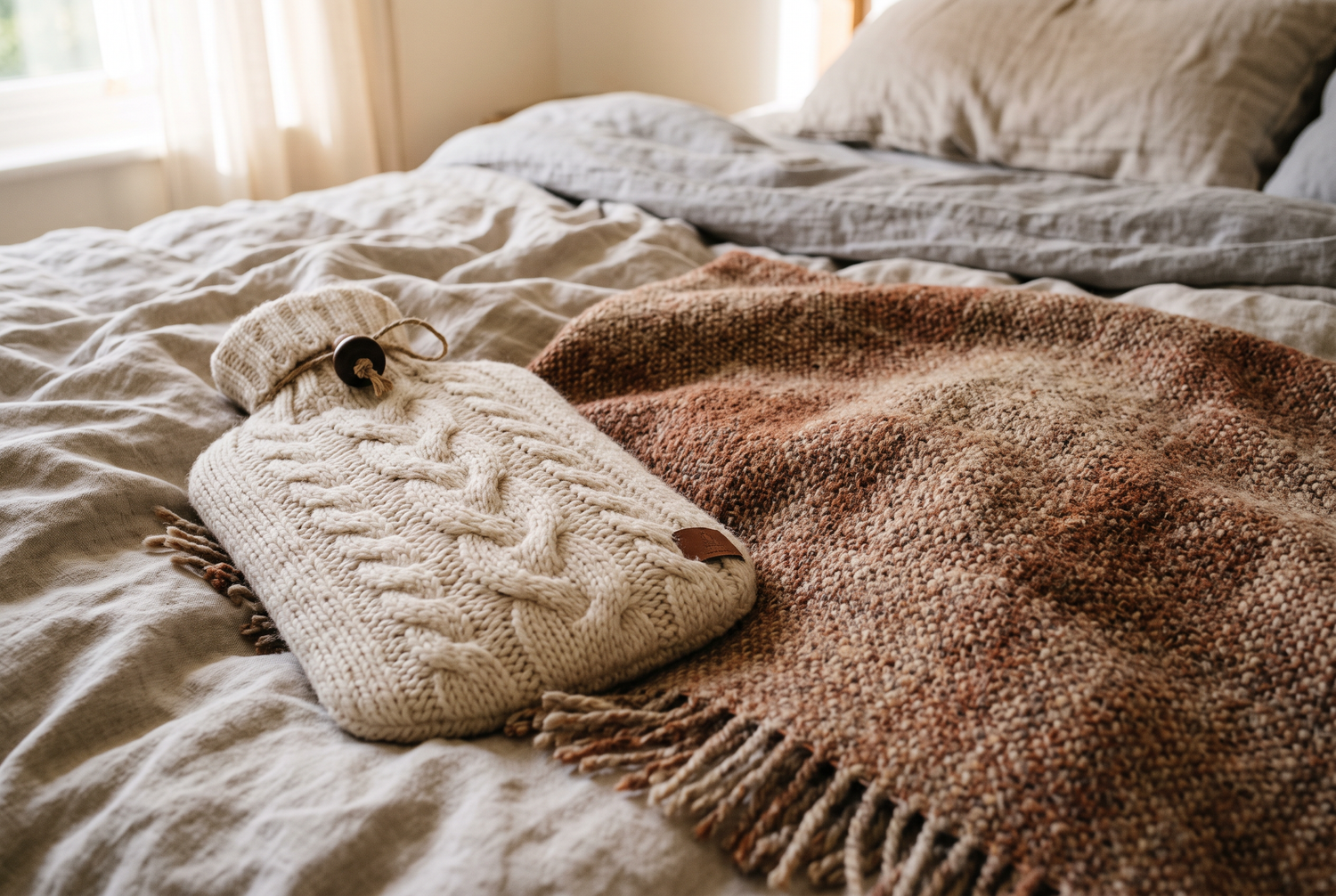
Outside of acute flare-ups, warmth is the method of choice for falling asleep with rheumatism: it dilates blood vessels, relaxes the muscles around the joints, and lowers pain perception. A bath of 37 to 39 °C for 15 to 20 minutes, about an hour before bedtime, has a double effect: it warms the joints, and the subsequent drop in core body temperature signals to the brain that it's time to sleep. Alternatively, a hot water bottle, cherry pit pillow, or an electric underblanket on a low setting for the first 30 minutes in bed can help. For acutely inflamed, hot, and swollen joints, however, cooling is indicated – a cold pack, wrapped in a cloth, for 10 to 15 minutes.
The duvet should be light: a heavy duvet of 3 kg or more presses on inflamed toes, ankles, and knees. Down or light wool duvets with 600 to 900 g filling keep you warm without adding weight. And the room climate: 17 to 19 °C is ideal, but drafts directly at the bed should be avoided, as cooling joints are stiffer in the morning. You can read which duvet suits which season in the article Duvet for summer and winter.
Evening routine and medication timing
A consistent evening routine helps with rheumatism in two ways: it prepares the nervous system for sleep and stabilizes the circadian rhythm, which co-determines the nocturnal inflammation curve. A routine of about 60 minutes has proven effective: 10 minutes of gentle movement (moving joints, no strength training), 15 to 20 minutes of warmth, then 20 to 30 minutes of quiet activity in dim light – without screens, as blue light delays melatonin release. Going to bed and waking up should happen at roughly the same time each day, even on weekends, with a tolerance of 30 minutes.
An issue that many sufferers do not address is the timing of medication. For some preparations, taking them in the evening instead of the morning can better mitigate the nocturnal inflammation peak; for certain cortisone preparations, there are extended-release forms specifically developed for this purpose. Whether and how this applies to you can only be decided by your rheumatologist – never change the timing independently. Likewise, if you regularly wake up between 2 and 5 AM due to pain, this is important information for your appointment, as it may indicate inadequately controlled disease activity.
Common mistakes with rheumatism in the bedroom
The first mistake is the assumption that a hard mattress is "good for the back" and therefore also good for rheumatism. With inflamed joints, pressure distribution is more important than firmness. The second mistake is sleeping on the painful side out of habit – this habit can be retrained in two to three weeks with a pillow behind the back to make turning over more difficult. The third mistake is using alcohol as a sleep aid: while it shortens the time it takes to fall asleep, it fragments the second half of the night, when inflammatory activity is already highest, and can interact with rheumatism medication. The fourth mistake is avoiding exercise during the day for fear of pain: regular, moderate activity has been shown to improve both pain and sleep in rheumatism. And the fifth mistake is omitting sleep problems during a consultation – they are a therapeutic goal, not a side issue. What else helps with osteoarthritis and joint pain is described in a separate article.

Get CHF 25 discount
Subscribe to newsletter and receive a one-time CHF 25 discount. ✓ 200 nights trial sleep ✓ 10 years warranty
Frequently Asked Questions about Rheumatism and Sleep
Why do I always wake up early in the morning with rheumatism?
Inflammatory activity peaks between 2 and 6 AM because the anti-inflammatory cortisol level is lowest at night. At the same time, joints stiffen at rest. Both together lead to the typical early morning awakening.
Which mattress is best for rheumatism?
A mattress with high point elasticity that yields at the shoulders, hips, and knees but supports the pelvis. Rock-hard mattresses create pressure points on inflamed joints, while excessively soft ones make changing position difficult.
Does warmth or cold help better with falling asleep?
Outside of acute flare-ups, warmth: a bath of 37 to 39 °C, a hot water bottle, or a cherry pit pillow relax joints and muscles. For acutely hot, swollen joints, cooling for 10 to 15 minutes is more appropriate.
How do I position painful knees and hips at night?
In side lying position with a 10 to 15 cm thick pillow between the knees, extending to the ankles. In supine position with an 8 to 12 cm knee roll that relieves the hip and lumbar region.
Does sleep deprivation really worsen rheumatism?
Yes. Even one interrupted night lowers the pain threshold by 15 to 25 percent and increases pro-inflammatory messengers. Better sleep leads to less pain and less fatigue for many affected individuals.
Should I take my rheumatism medication in the evening?
This can be beneficial for some preparations to mitigate the nocturnal inflammation peak – but the decision rests solely with your rheumatologist. Never change the timing independently.
This article is for general information purposes only and does not replace medical advice.








Leave a comment
This site is protected by hCaptcha and the hCaptcha Privacy Policy and Terms of Service apply.