
Anyone living with ankylosing spondylitis knows the pattern: pain in the lower back and buttocks intensifies in the second half of the night, waking you between three and five in the morning, and the day begins with stiffness that only subsides after 30 to 60 minutes of movement. The disease, medically known as axial spondyloarthritis, is estimated to affect 0.3 to 0.5 percent of the population in Switzerland and usually begins between the ages of 20 and 40. Because the inflammation in the spine and sacroiliac joints becomes noticeable precisely during rest, sleep is often the most difficult time of day for those affected. At the same time, the way one lies influences how the spine develops in the long term. In this guide, we explain why ankylosing spondylitis disrupts sleep so severely, which sleeping positions rheumatologists and physiotherapists recommend, what matters when it comes to mattresses and pillows, and how to make nights and mornings more bearable.
The short answer: For ankylosing spondylitis, the rule is to lie as straight as possible. Lying on your back with a flat pillow and occasionally on your stomach helps maintain an upright spine and counteracts the formation of a rounded back. The mattress should support the body without allowing the hips to sink, but yield enough at the shoulders and pelvis so that lying on your side does not cause pain. Regular sleep times, evening exercise, and warmth before bed mitigate nocturnal stiffness. The therapy itself belongs in the hands of rheumatologists.
- Inflammatory back pain in ankylosing spondylitis is strongest at night and in the morning and improves with movement – unlike mechanical back pain.
- Lying stretched out on your back or stomach supports an upright spinal posture; the fetal position should be avoided.
- The pillow should be flat (4 to 8 cm) so that the head is not bent forward.
- The mattress needs support in the pelvic area while also providing pressure relief at the shoulders and hips.
- Evening stretching, warmth, and regular sleep times reduce nocturnal awakenings.
Why ankylosing spondylitis disrupts sleep so severely
The pain in axial spondyloarthritis is inflammatory, not mechanical. While an overused back recovers with rest, the opposite is true for ankylosing spondylitis: during rest phases, inflammatory messengers like interleukin-17 and TNF-alpha accumulate at the affected joints, and the lack of movement causes the tissue to stiffen. That's why the second half of the night, when the body lies still for the longest period, is the most painful phase. Studies with affected individuals show that about 60 to 70 percent report nocturnal awakenings due to pain, and sleep quality correlates closely with disease activity.
Additional factors contribute: Chest mobility can be restricted, which makes breathing shallower when lying down. Fatigue, medically known as fatigue, is an independent symptom of the disease and affects more than half of patients. And chronic sleep deprivation, in turn, increases pain sensitivity, creating a vicious cycle. Breaking this cycle is one of the most important goals, alongside pharmacological therapy. Fundamentals of the interaction between sleep phases and recovery can be found in our pillar article.
The right sleeping position for ankylosing spondylitis
The recommendation from the Swiss Rheumatism League and physiotherapy has been consistent for decades: lie as stretched out as possible. The reason is the spine's tendency to stiffen in kyphosis, i.e., with a rounded back. Every night spent in a curled-up side position reinforces this tendency, while every night spent in a stretched position counteracts it.
Supine position (lying on your back)
The supine position is the basic position. The pillow should be flat, 4 to 8 cm, so that the head does not tilt forward and the cervical spine remains in line with the thoracic spine. If you cannot fully straighten your legs, initially place a thin roll under your knees and gradually reduce it over weeks. The goal is for your kneecaps to eventually almost touch the surface.
Prone position (lying on your stomach)
The prone position is explicitly recommended for ankylosing spondylitis – as one of the few diagnoses for which this is the case. It stretches the hip flexors and lumbar spine and counteracts the development of a rounded back. Lie without a pillow or with a very flat pillow under your stomach, turning your head to the side. If you cannot tolerate the prone position all night, you can start with 15 to 20 minutes in the evening and in the morning.
Side position
The side position is allowed, but stretched: legs long, not pulled up, a pillow between the knees keeps the pelvis straight. The fetal position with knees pulled up and a rounded back should be avoided, even if it feels temporarily relieving. For general information on sleeping positions for back pain, please refer to our separate article.

Which mattress for ankylosing spondylitis?
The old recommendation "as hard as possible" is outdated. A board-hard surface prevents sinking, but in the supine position it creates pressure points on the sacrum and shoulder blades, and in the side position on the hip and shoulder – precisely where inflammatory pain already exists in ankylosing spondylitis. What those affected need is a mattress that can do two things at once: support the pelvis so that the lumbar spine does not sag, and yield enough at the shoulders and hips to prevent pressure pain. Modern adaptive foam systems achieve precisely this because they react selectively: more counterforce under the heavy pelvis, less under the shoulder.
Freedom of movement is also important. Those who already change position frequently at night to avoid pain should not "sink" into a mattress that makes every change of position an effort. A core with high resilience is advantageous here. And the mattress should remain flat: hollows deeper than 1.5 to 2 cm are a reason to change for ankylosing spondylitis, as they pull the spine into a lateral curve. We have described how to recognize a sagging mattress in a separate article.
| Feature | Favorable for Ankylosing Spondylitis | Unfavorable |
|---|---|---|
| Sleeping Surface | Even, without hollows | Hollows from 1.5–2 cm |
| Support Behavior | Supports the pelvis, relieves shoulders | Board-hard or deep sinking |
| Resilience | High, easy position changes | Sluggish, "sinking in" |
| Pillow | Flat, 4–8 cm | High, multiple pillows |
| Bed | Entry height 50–60 cm | Very low, deep sofa |
Pillow, bed height, and sleep environment
The pillow is almost as important as the mattress for ankylosing spondylitis. Because the cervical spine can also be affected and the head tends to tilt forward over time, the pillow should be flat enough that the head lies in line with the spine when lying on your back – usually 4 to 8 cm. Many affected individuals find a thin pillow or a small neck roll more comfortable than a classic 50 × 70 cm pillow. If you already have a fixed forward tilt, you will need a slightly higher pillow so that your head doesn't hang in the air – here, coordination with physiotherapy is beneficial. Our pillow guide explains how to measure the height.
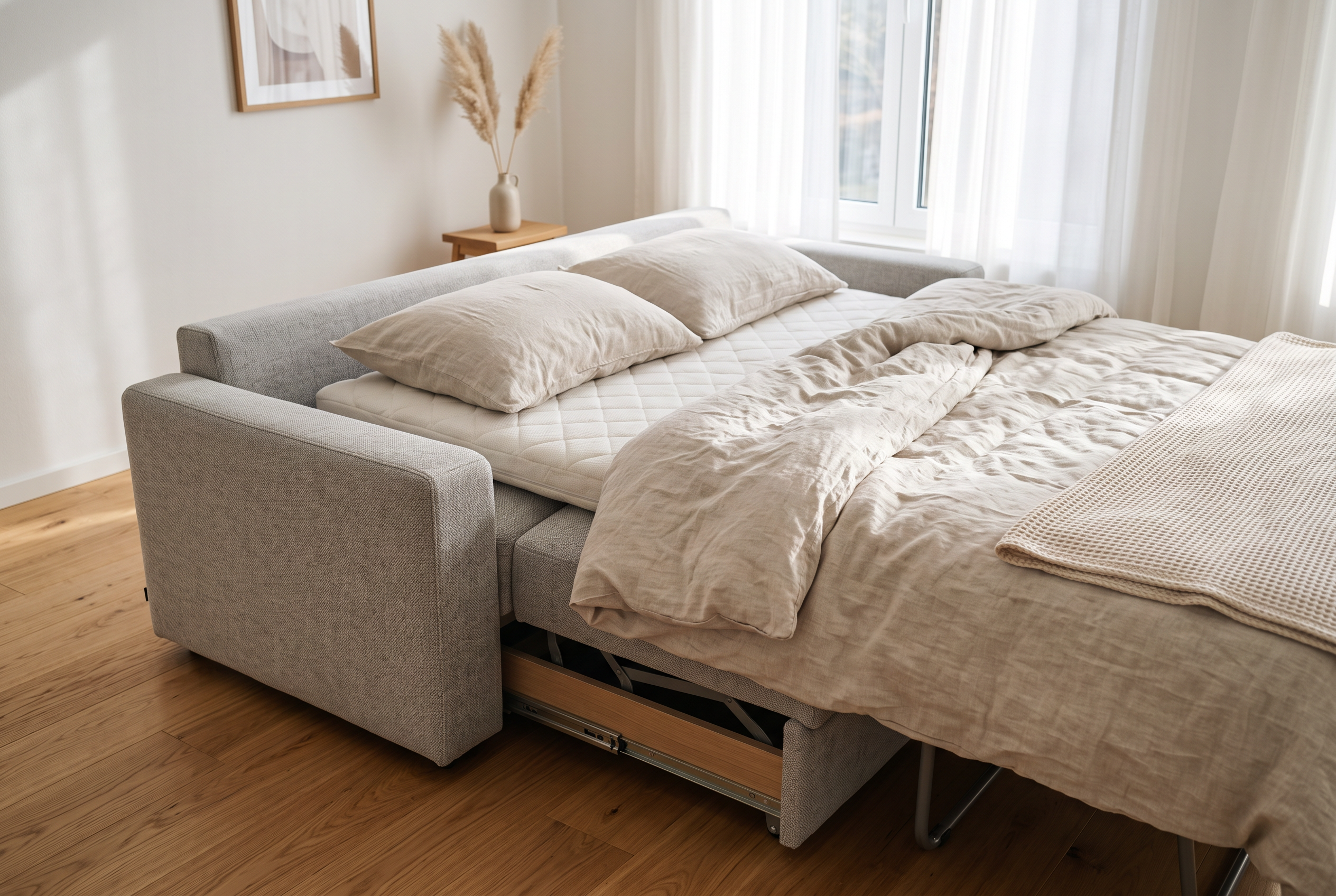
The bed height influences the morning: with an entry height of 50 to 60 cm (top edge of the mattress), it is easier to get up with a stiff back than at 40 cm. A bed frame with a sturdy frame that you can lean on also helps. As for room climate: 17 to 19 °C, but the duvet should keep your back warm, as cold exacerbates stiffness. Some affected individuals swear by a warming underblanket or a cherry stone pillow in the lumbar region during the first 20 minutes after going to bed.
Evening routine against nocturnal stiffness
What you do in the two hours before sleep co-determines how the night goes. For ankylosing spondylitis, movement is the most effective non-pharmacological measure, and a short evening program significantly reduces morning stiffness. A sequence of 15 to 20 minutes has proven effective: pelvic circles while standing (2 minutes), cat-cow in tabletop position (10 repetitions), chest stretch in a doorway (3 × 30 seconds), rotational stretch of the thoracic spine while sitting (5 repetitions per side), and finally 5 minutes in the prone position with forearms supported. All exercises should be coordinated with physiotherapy, especially in cases of advanced stiffening.
Afterward, warmth helps: a warm shower of 38 to 40 °C or 15 minutes with a hot water bottle on the sacrum. Then, consistent sleep times – the internal clock also regulates cortisol, which has anti-inflammatory effects and peaks in the morning. A regular rhythm stabilizes this course. If you wake up due to pain, you should not stay in bed and fight it, but rather get up for 5 to 10 minutes, walk slowly, do a few stretches, and then return to bed. What else constitutes good sleep hygiene we have summarized in detail.
Common mistakes with ankylosing spondylitis in bed
The most common mistake is reaching for a high pillow or two pillows because it seems more comfortable in the short term. In the long term, it promotes the forward tilt of the head. The second mistake is the fetal position as a permanent position: it feels relieving for acute pain but exacerbates kyphosis. The third mistake is sleeping on the sofa or in a sagging bed out of habit – especially with ankylosing spondylitis, a flat surface is crucial. The fourth mistake is avoiding evening exercise for fear of disturbing sleep; gentle stretching usually promotes sleep. And the fifth mistake is ignoring new symptoms: if nocturnal pain significantly increases, fever occurs, or breathing becomes difficult when lying down, this should be promptly addressed with a rheumatologist.

Get CHF 25 discount
Subscribe to newsletter and receive a one-time CHF 25 discount. ✓ 200 nights trial sleep ✓ 10 years warranty
Frequently asked questions about ankylosing spondylitis and sleep
Which sleeping position is best for ankylosing spondylitis?
Stretched out on your back with a flat pillow, and occasionally on your stomach. Both counteract the formation of a rounded back. Lying on your side in a stretched position with a pillow between your knees is fine, but the fetal position should be avoided.
Why is pain stronger at night with ankylosing spondylitis?
The pain is inflammatory and increases with rest because inflammatory messengers accumulate in the joints and the tissue stiffens without movement. Therefore, the second half of the night is typically the most painful phase.
Do you need a hard mattress for ankylosing spondylitis?
No, the recommendation "as hard as possible" is outdated. The mattress should support the pelvis so that the lumbar spine does not sag, but at the same time allow the shoulders and hips to yield to avoid pressure pain.
How high should the pillow be for ankylosing spondylitis?
As flat as possible, usually 4 to 8 cm, so that the head lies in line with the spine when on your back. If there is already a fixed forward tilt of the head, a slightly higher pillow may be necessary.
What helps with morning stiffness?
An evening stretching program of 15 to 20 minutes, warmth before sleeping, consistent sleep times, and a warm back at night. In the morning, slow movement and a warm shower help.
When should one see a doctor for nocturnal pain?
If nocturnal pain significantly increases, fever occurs, breathing becomes difficult when lying down, or new symptoms appear. The treatment of ankylosing spondylitis fundamentally belongs under rheumatological care.
This article is for general information purposes only and does not replace medical advice.







Leave a comment
This site is protected by hCaptcha and the hCaptcha Privacy Policy and Terms of Service apply.