
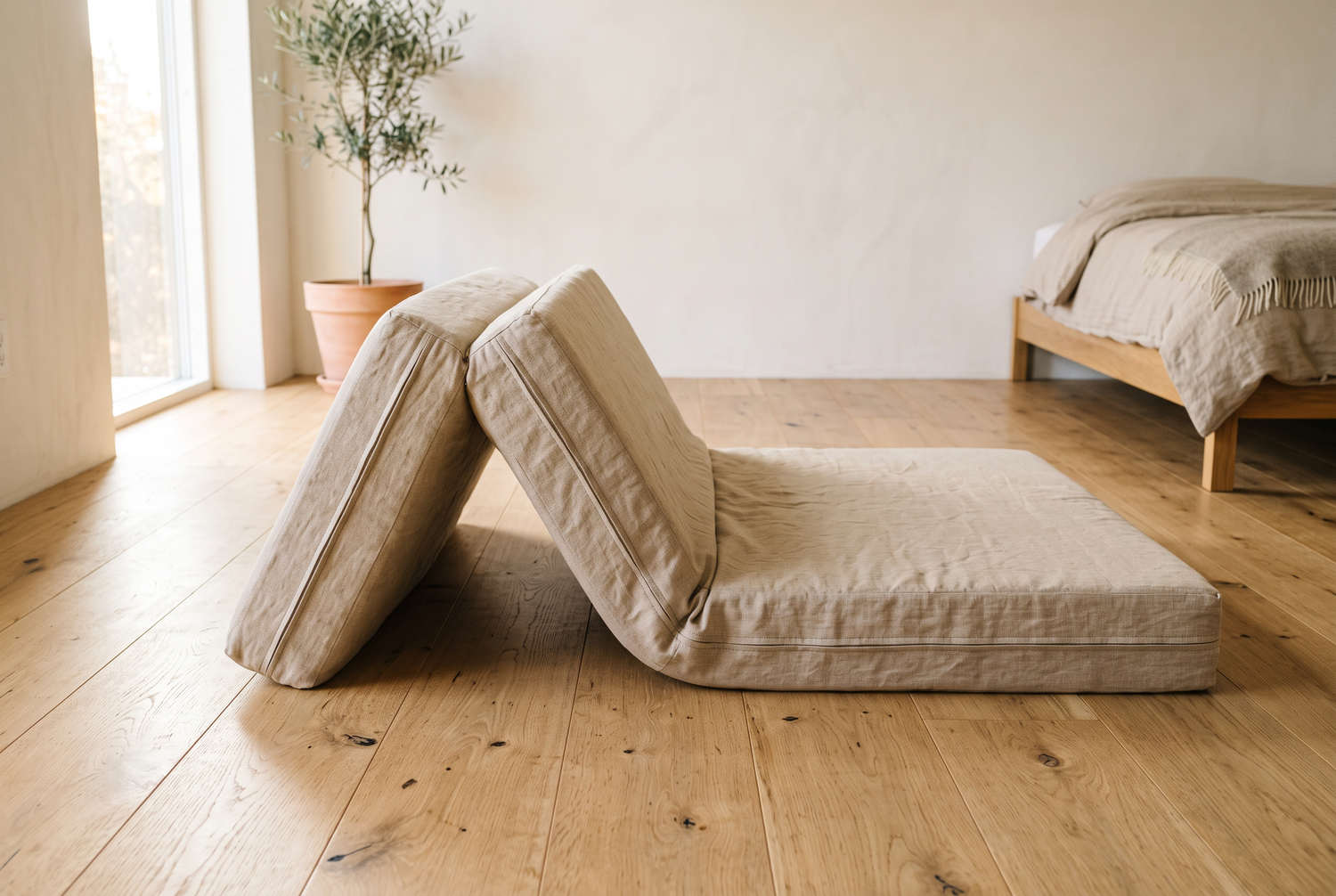
A folding mattress promises a lot: it can be folded to a third of its length, disappears into a closet or under the bed, serves as a seating cube during the day and a guest bed at night. It is therefore popular in small Swiss apartments, children's rooms, or motorhomes. At the same time, it has a reputation as a thin, hard emergency solution that no one willingly sleeps on for two consecutive nights. Both are true – depending on which model you buy and what you use it for. There are worlds of difference between a 5 cm thin folding mattress for 40 francs and a 12 cm thick model with high-quality cold foam. In this guide, we explain how a folding mattress is constructed, what dimensions and materials make sense, for whom it is really worthwhile, and where its limits lie.
The short answer: A folding mattress is worthwhile for guests, children, camping, and overnight stays of a few days – if it is at least 8 to 10 cm thick and made of foam with a density of 30 kg/m³ or more. It is not intended for daily sleep for months: the folds and limited height will sooner or later lead to pressure points and back problems for adults. It is practical as a secondary mattress, but not a good idea as a main mattress.
- Folding mattresses are usually 3-part, 5 to 12 cm high; for adults, 8 to 10 cm is the minimum.
- The density of the foam is crucial: below 25 kg/m³, hollows quickly form; from 30 kg/m³, the mattress is usable.
- The folds in 3-part models are roughly at shoulder and knee height – making them more comfortable to lie on than 2-part models.
- Typical uses: guest bed, children's room, camping, motorhome, yoga, and play mat.
- For more than 2 to 3 consecutive nights, a full-fledged mattress is a better choice, even for guests.
How a folding mattress is constructed
The classic folding mattress consists of three equally sized foam blocks connected by the cover. With a length of 195 to 200 cm, each segment is about 65 cm long. When folded, it forms a cube of about 65 × 80 × 30 cm, which can serve as a stool. Two-part models fold only once, making them flatter when folded (about 100 cm long), but they have the fold exactly in the middle – where the pelvis rests when lying down. This is why three-part folding mattresses are significantly more comfortable to lie on: their folds are approximately at shoulder and knee height, where less weight is applied.
The core is almost always polyurethane foam, less commonly cold foam or a sandwich of base foam with a thin comfort layer. The cover is usually a cotton or microfiber fabric with a zipper, sometimes with a carrying handle. Because the segments must be freely movable, there is no continuous core, no zones, and no springs. The sleeping properties therefore depend only on two factors: height and foam quality. How foam generally works in mattresses is explained in our article Foam Mattress.
Height and density: the two crucial numbers
The height determines how far you can sink in before you feel the floor. At 5 cm, an adult weighing 75 kg will noticeably press through at the hips and shoulders; at 8 cm, it's fine for one night; at 10 to 12 cm, it's also suitable for several nights. For children up to about 30 kg, 5 to 6 cm is sufficient because their weight is concentrated over a smaller area and they don't sink in as deeply.
The density (RG) indicates how many kilograms of foam are in a cubic meter. It is the best indicator of durability: foam with an RG of 18 to 22 kg/m³, as found in many cheap folding mattresses, noticeably loses its resilience after just 20 to 30 nights. From an RG of 30 kg/m³, the foam is solid; from 35 to 40 kg/m³, it is high quality. You can read what this means in detail in our article on Cold Foam and Density. The catch: Many retailers do not specify the RG for folding mattresses. A rough test in the store: Press your palm 5 cm deep into the foam and release. If the surface returns in less than a second, the foam is usable; if a dent remains, it is too light.
| Purpose | Recommended Height | Density | Max. continuous duration |
|---|---|---|---|
| Play and yoga mat | 4–6 cm | from 22 kg/m³ | – |
| Children's overnight stay | 5–7 cm | from 25 kg/m³ | 1 week |
| Adult guest bed | 8–10 cm | from 30 kg/m³ | 2–3 nights |
| Camping / Motorhome | 10–12 cm | from 35 kg/m³ | 1–2 weeks |
| Daily sleep | not recommended | – | – |

For whom a folding mattress is truly worthwhile
The classic case is the guest bed in an apartment without a guest room. A 10 cm thick folding mattress measuring 80 × 200 cm weighs 4 to 6 kg, can be unrolled in seconds, and takes up less space than a suitcase when folded. For two to three nights, this is absolutely comfortable for most guests – especially with a thin fitted sheet and a proper blanket. We compare available alternatives in the article Guest Mattress: the best solutions.
The second case is children: As a play mat, for friends staying overnight, or as an interim solution after moving out of the crib, the folding mattress is ideal because children are light and the floor is their natural play zone anyway. The third case is a motorhome or tent, where a foldable mat with 10 to 12 cm height and good foam clearly beats an air mattress in comfort and insulation – more on this in the article Mattress for Motorhome and Camping. The fourth case is a vacation rental or studio where an additional sleeping option is occasionally needed without a whole bed taking up space.
Where the folding mattress reaches its limits
The limit is continuous sleep. A folding mattress does not have a load-bearing core that distributes weight over a length of 200 cm. Instead, three individual blocks bear the weight, yielding at the folds. For an adult weighing 70 to 90 kg, the pelvis will eventually sink deeper than the shoulders and legs, causing the spine to enter a slight swayback position, and the muscles will work against this all night long. After one to two weeks, typical symptoms appear: morning stiffness in the lower back, numb arms when lying on your side, and a feeling of not being properly rested.
In addition, there's the climate: on the floor, the air is 1 to 3 °C cooler than at bed height, and moisture collects under a mattress without ventilation. If you leave the folding mattress out every night, you risk mold stains on the underside after a few weeks, especially on parquet or laminate. What generally needs to be considered when sleeping on a mattress on the floor has been summarized separately. In short: as a secondary mattress for a few nights, the folding mattress is a good invention; as a substitute for a bed, it is not.
Practice: How to use and care for a folding mattress correctly
To ensure your folding mattress lasts long and remains comfortable, a few simple rules help. After each night, stand the mattress upright or fold it up and store it in a dry place – not in a damp cellar. When in use, place a thin underlay, such as a wool blanket or a slatted frame topper, underneath to insulate against cold from the floor and allow air to circulate. Always use a fitted sheet or a washable cover, as the core itself cannot be cleaned. Rotate the mattress 180 degrees with each use and flip it every few weeks so that all segments are evenly loaded.
New foam folding mattresses often have a slight chemical odor for the first few days – these are residual gases from production that disappear after 2 to 5 days of airing. For this, unfold the mattress in a well-ventilated room. And when buying, check whether the cover is removable and washable at at least 40 °C; for guest mattresses, this is a real hygiene advantage. If you use the folded mattress as a stool, keep an eye on the weight: continuously sitting on the same segment will cause it to wear out faster than one night of lying down.
Myths fact-checked
"A folding mattress is just as good as a thin normal mattress." This is only true with the same height and density – and even then, the folds remain a weak point. A continuous 10 cm mattress always lies more evenly than a three-part one. "The harder, the better for the back." This is also a misconception, familiar to us from outdated firmness ratings: a mattress that is too hard distributes pressure poorly and doesn't allow the shoulders and hips to sink in, leading to numbness in the side-lying position. "Any folding mattress is suitable for children." For toddlers under two years old: no soft, yielding surfaces without supervision, and no folds where the head can get trapped. From kindergarten age onwards, a firm folding mattress is unproblematic, however.

Get CHF 25 discount
Subscribe to the newsletter and receive a one-time CHF 25 discount. ✓ 200 nights trial sleep ✓ 10-year warranty
Frequently asked questions about folding mattresses
How thick should a folding mattress be for adults?
At least 8 cm, preferably 10 to 12 cm. With thinner models, the pelvis of a person weighing 70 to 90 kg will press through to the floor, leading to pressure points and tension.
Can you sleep permanently on a folding mattress?
Not recommended. The folds and limited height will lead to back problems for adults after one to two weeks. As a guest or travel mattress for a few nights, however, it is well suited.
Is a 2-part or 3-part folding mattress better?
The 3-part one is more comfortable to lie on because its folds are at shoulder and knee height. With the 2-part one, the fold is directly under the pelvis, where most of the weight is applied.
What density should the foam have?
At least 30 kg/m³ for adults; from 35 kg/m³, the foam is durable. Cheap models with 18 to 22 kg/m³ will develop noticeable hollows after just 20 to 30 nights.
How do you store a folding mattress correctly?
Folded or upright in a dry place, not in a damp cellar. After each use, it should air out unfolded for a few hours to allow moisture to escape.
Is a folding mattress suitable for children?
Yes, from kindergarten age, as a play mat or for overnight guests, 5 to 7 cm height is sufficient. For toddlers under two years old, soft, yielding surfaces without supervision are not suitable.







Leave a comment
This site is protected by hCaptcha and the hCaptcha Privacy Policy and Terms of Service apply.