
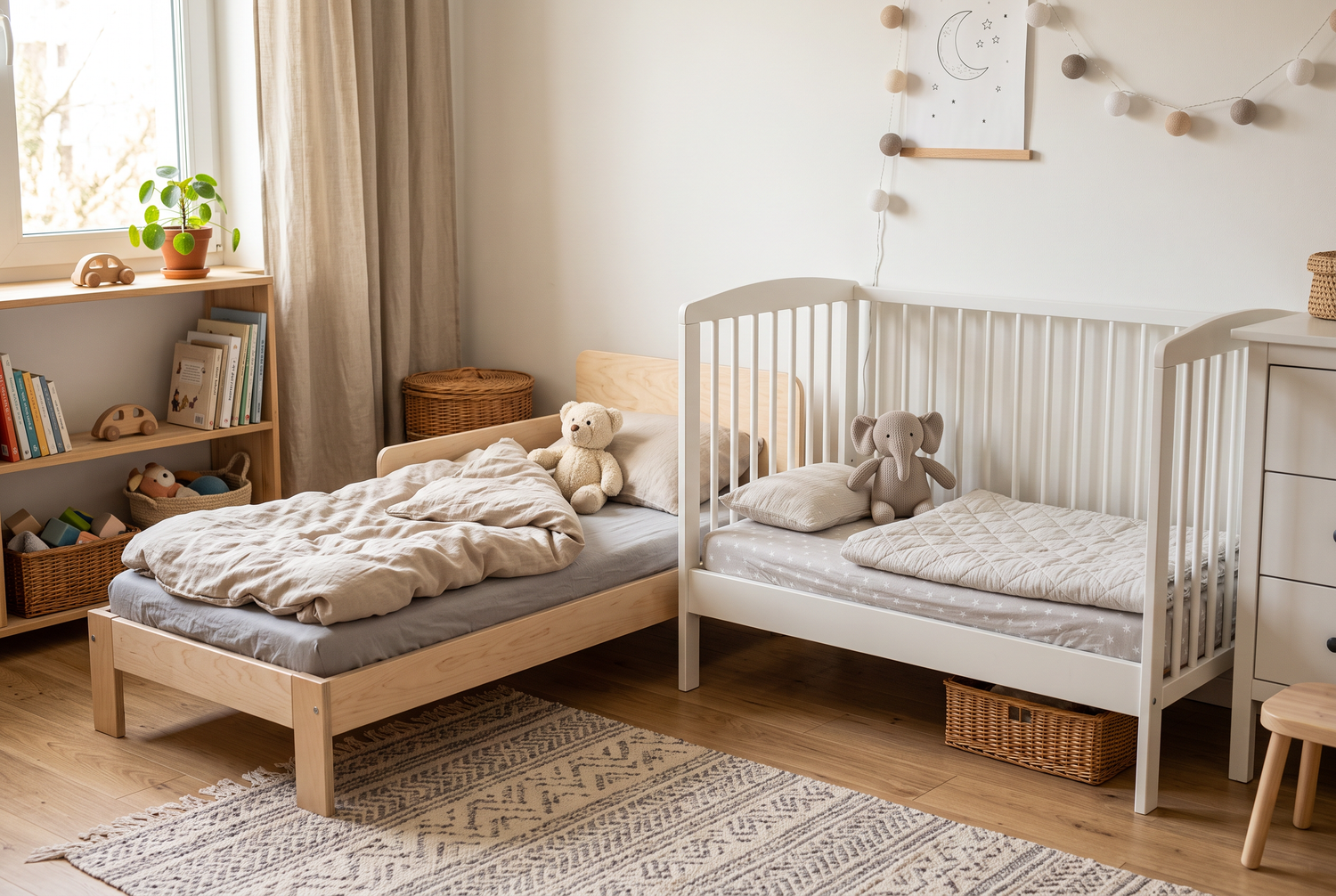
Eventually, the time comes: the toddler climbs over the crib rails, their legs bump against the footboard, or the child loudly protests against the "baby bed." The transition from a crib to an open bed is a small developmental milestone – and for many parents, it's associated with uncertainty. If the change is made too early, the child might suddenly appear in the parents' bed at night or empty the toy shelf at three in the morning; if it's too late, dangerous climbing attempts over the crib bars are a risk. The good news: there are clear signs for the right time, proven strategies for a gentle transition, and simple safety rules for the new freedom. This guide shows you how to recognize when your child is ready for a bed, which bed and mattress are suitable now, how to make the first nights successful – and which mistakes make the transition unnecessarily difficult.
The short answer: Most children transition to an open bed between 18 months and 3.5 years – but at the latest, as soon as they actively climb over the rails or their chest height is above the rail when standing: at that point, the crib is no longer protection, but a fall risk. An ideal solution is a low junior bed (sleeping surface approximately 20–30 cm above the floor) or a converted crib with removed bars, combined with a bed rail, a childproofed room, and unchanged bedtime routines. Without pressure and with a little patience, the transition is usually achieved in one to two weeks.
- Transition window: usually between 18 months and 3.5 years – mandatory as soon as the child climbs over the rails.
- Safety before comfort: low sleeping height (20–30 cm), bed rail, childproofed room, secured outlets, and anti-tip devices on furniture.
- Many cribs (70×140 cm) can be converted into junior beds with conversion kits – the familiar mattress remains, easing the transition.
- Maintain routines: same sequence, same bedtime, same cuddly toy – only the bed changes.
- Avoid stacking major changes: Don't simultaneously wean, ditch the pacifier, move house, or start potty training.
How do I know my child is ready?
The most reliable signal is climbing: as soon as a child manages to climb out of the crib – or even seriously attempts to – action must be taken, because a fall from a crib height of 60–70 cm onto the back of the head is more dangerous than any open bed edge. A guideline also states: if the child's chest level when standing is above the top edge of the crib rails (usually from about 89–90 cm body height), the crib no longer offers effective protection. In addition, there are more subtle signs: the child appears confined in the bed, regularly bumps their head or feet against the ends, asks for the "big bed," or wants to get in and out independently – for example, because they are already using the potty at night. However, mere ambition is not a reason to change: a content child can happily sleep in a crib until three or three and a half; the confinement offers many children security and prevents nighttime wandering. The guide Children's Sleep Times shows how much sleep your child needs at what age.
Which bed comes next? A comparison of options
For the time after the crib, there are three proven paths – with different strengths:
| Option | Sleeping Surface | Strengths | Considerations |
|---|---|---|---|
| Converted crib | 70 × 140 cm | familiar environment, no new purchase, same mattress | becomes too short from approx. 4–5 years |
| Junior bed | 70 × 160 cm | low height, child-friendly size | Interim solution – another change needed later |
| Standard bed 90 × 200 cm | 90 × 200 cm | long-term solution until adolescence, free choice of mattress | bed rail and low frame sensible in the first few months |
Budget-conscious families often do best with the direct jump to 90 × 200 cm: a low bed frame plus a removable bed rail grows with the child for years. It is then important to have an age-appropriate mattress – firm enough for the light child's body, breathable, and tested for harmful substances. The Children's Mattress Guide explains what matters.

Safety in an open bed: the room becomes the bed
With an open bed, the safety logic fundamentally changes: previously, the crib rails kept the child in bed – now the entire room must be safe, as the child can get up at night. The checklist: secure electrical outlets, install anti-tip devices on shelves and dressers (furniture tip-overs are among the most common nursery accidents), equip windows with child-safe handles, keep blind cords out of reach, no small items on the floor. A stair gate at the room door or at the top of the stairs prevents nighttime excursions into dangerous areas. At the bed itself: keep the sleeping height as low as possible (20–30 cm), a bed rail for the first few months – alternatively, initially a mattress directly on the floor with a good slatted base for ventilation will suffice – and a soft rug or a folding mat next to the bed just in case. Also check the darkness of the room: a dim, warm-toned night light (under 10 lux, orange instead of blue) helps children who wake up at night without disturbing their sleep.
How to make the transition successful: the gentle plan
A four-step approach over one to two weeks has proven effective. First: announce and involve – the child can help choose the new bed or bedding and "try it out," preferably during naptime first. Second: bring familiar items – the same cuddly toy, the same sleeping bag or blanket, and even the same mattress if converting the crib; the smell and feel create continuity. Third: strictly maintain routines – same bedtime, same sequence of snack, brushing teeth, story, song; the bed is the only variable. Fourth: react calmly and consistently – if the child gets up, gently but briefly guide them back, with a short explanation the first time, and with minimal stimulation afterwards. Most children understand after a few nights that the new bed is just as reliable as the old one. If protests or frequent nighttime waking still occur, consider the overall picture: overtiredness, late screen time, or a too-bright room can sabotage any bed transition. Tips on this are provided in the article Helping Your Child Sleep Better.
Common mistakes during the transition
Mistake one: changing too early. Before 18 months, most children lack the impulse control to stay in bed – the transition then becomes a weeks-long test of patience. Mistake two: stacking major changes. A new sibling, starting daycare, saying goodbye to the pacifier, and a bed change in the same week can overwhelm any child; plan at least four to six weeks between major changes. Particularly practical: if the crib will soon be needed for a sibling, transition the older child two to three months before the birth – otherwise, they might feel "displaced" by the baby. Mistake three: using the new bed as a threat ("If you're not good...") or an over-instrumentalized reward – the bed should remain emotionally neutral-positive. Mistake four: having discussions at night; long negotiations at 2 AM reward getting out of bed. Mistake five: dramatizing setbacks. Sleep regressions are normal and temporary at this age – background on this in the article about Sleep Regressions in Toddlers. And mistake six: skimping on the mattress. Children grow at night – deep sleep and growth hormones need a surface that correctly supports their light body instead of letting it sink into an old adult's leftover mattress.
Get CHF 25 discount
Subscribe to our newsletter and receive a one-time CHF 25 discount. ✓ 200 nights trial sleep ✓ 10 years warranty

Frequently Asked Questions about the transition to a toddler bed
When should a child transition from a crib to a toddler bed?
Usually between 18 months and 3.5 years. The transition becomes mandatory as soon as the child climbs over the rails or their chest line is above the rail when standing – at that point, the risk of falling from the crib is higher than in an open bed.
What bed size is appropriate after a crib?
Either a junior bed (70 × 140–160 cm) as an interim step, or directly a standard bed (90 × 200 cm) that lasts until adolescence. Important features include a low sleeping height and a bed rail initially.
How long does the adjustment period take?
With consistent routines and calm persistence, usually one to two weeks. Individual restless nights or setbacks during transition phases are normal and not a sign that the change was too early.
What to do if the child keeps getting up at night?
Gently but briefly guide them back – every time. Lengthy nighttime discussions or bringing them into the parents' bed reward getting up. A stair gate at the door also secures the child until the new routine is established.
Does the child need a new mattress for the new bed?
When converting the crib, the familiar mattress can remain – this even facilitates the transition. When moving to a 90 × 200 cm bed, an age-appropriate child's mattress is needed: firm enough for the light body, breathable, and tested for harmful substances.
Should one transition before the birth of a sibling?
Yes, ideally two to three months before the due date – or significantly later. If the older child feels "pushed out of bed for the baby," it unnecessarily strains the transition and the sibling relationship.










Leave a comment
This site is protected by hCaptcha and the hCaptcha Privacy Policy and Terms of Service apply.