The late dinner with friends, the midnight snack in front of the fridge, or the strict "nothing after 6 PM" rule: hardly any topic is subject to so many rules and half-truths as eating before bedtime. Yet, the connection between meals and restful sleep is measurable: digestion, core body temperature, and blood sugar directly influence how quickly you fall asleep and how soundly you sleep. A heavy meal shortly before bed can reduce deep sleep phases and promote reflux – but no one sleeps well on an empty stomach either. The truth, as often, lies in the middle and depends on quantity, composition, and timing. This guide carefully assesses the current research and provides concrete recommendations for your evening plate – including the question of which snack is actually okay late in the evening.
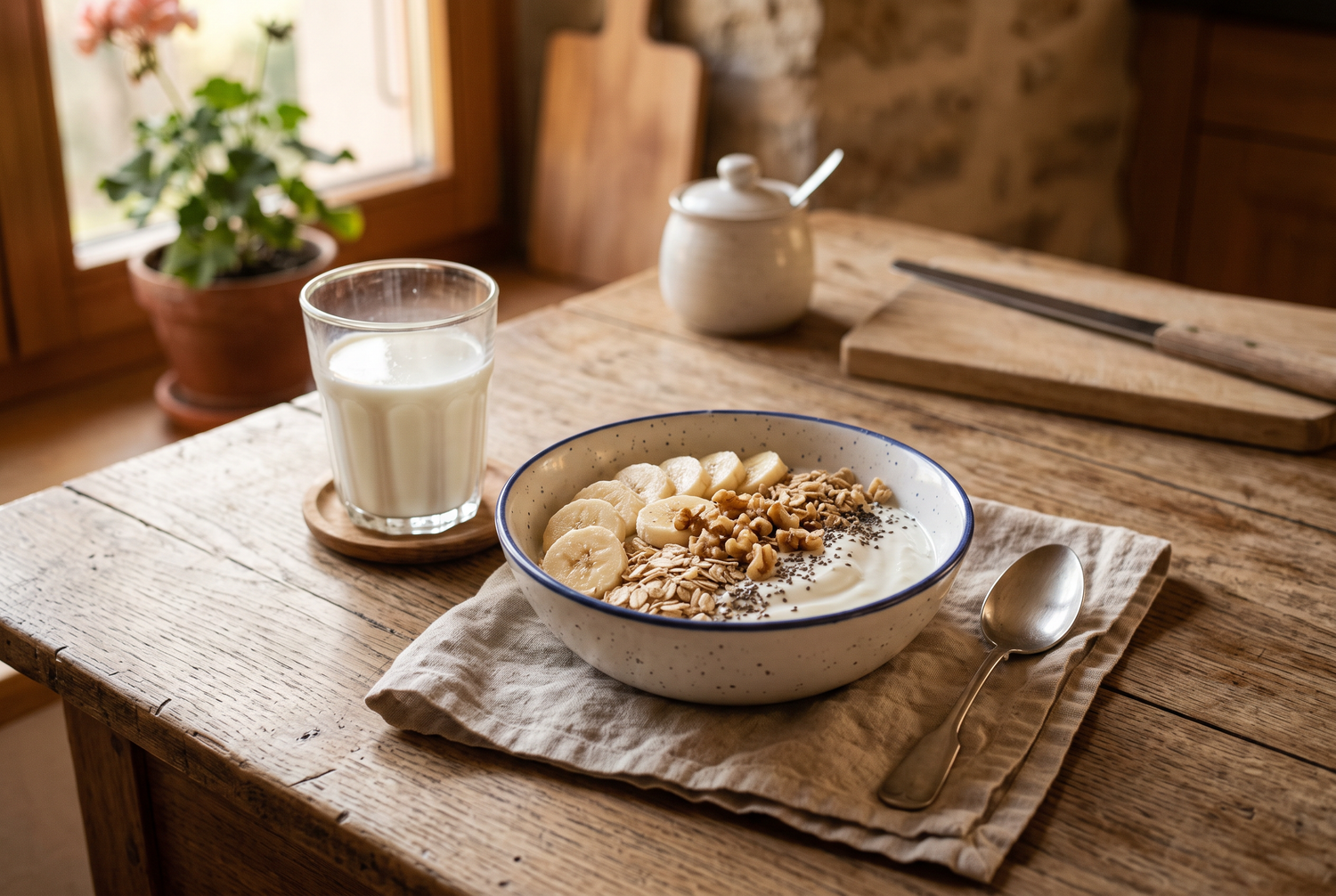
The short answer: Ideally, the last large meal should be 2 to 3 hours before bedtime – this allows for main digestion to be completed without you going to bed hungry. A small, light snack of 100 to 200 kcal (e.g., plain yogurt with banana or a handful of nuts) is unproblematic even later and can even help people with nocturnal hunger. In the evening, you should especially avoid very fatty, very spicy, and very large meals, as well as alcohol and late coffee – they measurably disrupt deep sleep and continuous sleep.
- Rule of thumb: finish large meals 2 to 3 hours before bed – neither completely full nor hungry when going to bed.
- Heavy, fatty meals extend gastric emptying time to 4 to 6 hours and can worsen deep sleep and reflux.
- A light snack (100–200 kcal) with complex carbohydrates and some protein is fine even shortly before bed.
- Although alcohol makes you sleepy, it fragments the second half of the night – it is not a sleep aid.
- Going to bed hungry is just as unfavorable as being overly full: a drop in blood sugar can promote nocturnal awakenings.
What happens in the body when you sleep on a full stomach
After a large meal, the body works at full throttle: the stomach needs 2 to 4 hours for an average mixed meal, and 4 to 6 hours for very fatty dishes, until most of it is passed on to the small intestine. During this time, metabolism and core body temperature are elevated – which is unfavorable, as the core temperature needs to drop by about 0.5 °C to fall asleep. So, if you go to bed directly after eating, you are physiologically working against your body's sleep drive. Add to this the position: when lying down, there is no gravity to hold the stomach contents down – heartburn and silent reflux increase, especially with late, heavy meals. Studies also show that very late meals can be associated with more nocturnal awakenings and less deep sleep. Important for classification: the effects vary individually – younger people with robust digestion often hardly notice late meals, while people prone to reflux sleep worse even with moderate portions.
The ideal interval: When should the last meal be?
The often-quoted rule "nothing after 6 PM" has no scientific basis – what matters is not the time of day, but the interval before bedtime. A practical guideline is to finish large, warm meals 2 to 3 hours before going to bed. So, if you go to bed at 11 PM, you ideally eat dinner between 7 PM and 8:30 PM – which is usually quite manageable for Swiss eating habits. For people prone to reflux, it may be more like 3 to 4 hours, combined with a slightly elevated headrest. However, the interval should not be too long: if you eat your last meal at 5 PM and go to sleep at 11 PM, you risk a noticeable drop in blood sugar during the night – the body then releases activating hormones like adrenaline and cortisol, which can promote nocturnal awakenings. In this case, a small snack around 9:30 PM is the better solution. The 10-3-2-1-0 rule also works with a 3-hour window for the last large meal.

These foods are good in the evening – these are not
Not just when, but also what matters. The overview:
| Category | Good in the evening | Better avoid |
|---|---|---|
| Main meal | Steamed vegetables, potatoes, rice, fish, poultry, soups | Fried food, fondue/raclette in large quantities, fatty roasts, very spicy food |
| Snacks | Plain yogurt, banana, oats, handful of nuts (approx. 30 g), rusk | Chips, large amounts of chocolate, sweet desserts shortly before bed |
| Drinks | Herbal tea, water, small amount of warm milk | Coffee/energy drinks after approx. 2–3 PM, alcohol, highly carbonated sugary drinks |
| Portion size | Satisfying, but not completely full (approx. 80%) | "All you can eat" late in the evening |
Background: Complex carbohydrates with some protein stabilize blood sugar overnight and provide tryptophan, the building block of the sleep hormone melatonin. Very fatty and very spicy foods, on the other hand, prolong digestion and raise body temperature. More details on individual foods can be found in the article Foods for good sleep.
Fact-checking myths
"Eating after 6 PM makes you fat." For body weight, the total daily energy balance is primarily what counts, not the time. Late eating can indirectly lead to overconsumption (snacking in front of the TV), but it is not inherently a weight-gainer. "Going to bed hungry hardens you." On the contrary: significant hunger activates the body and makes it harder to fall asleep; a drop in blood sugar can also trigger nocturnal awakenings. "A nightcap helps you fall asleep." While alcohol shortens the time it takes to fall asleep, it demonstrably fragments the second half of the night, suppresses REM sleep, and increases snoring – detailed in the article Alcohol and sleep quality. "Cheese in the evening causes nightmares." There is no reliable evidence for this – very lavish meals can, however, make sleep more restless, which makes dream recall more likely. "Carbohydrates in the evening are taboo." This is also outdated: moderate portions of complex carbohydrates in the evening are even sleep-promoting for most people.
Nocturnal hunger: What to do if your stomach rumbles at 11 PM?
If you regularly go to bed hungry, you should first check your daily routine: often, lunch is too small or dinner is too early or too low in protein. In the short term, a targeted late snack of 100 to 200 kcal helps, about 30 to 60 minutes before bedtime: a cup of plain yogurt or quark with half a banana, a small bowl of oatmeal with milk, a rusk with a little honey, or about 30 grams of unsalted nuts. Such combinations of complex carbohydrates and protein are filling without heavily burdening digestion. On the other hand, sugar-fat bombs like ice cream or chips are unfavorable: they rapidly raise blood sugar and cause it to fall just as quickly – potentially leading to waking up a few hours later. Also important: drink most of your fluids throughout the day and reduce the amount in the last hour so that your bladder lasts through the night. If you regularly experience nocturnal hunger pangs despite snacking, you should have this medically checked.
Special case: Reflux and sensitive digestion
For people with heartburn, the timing of the evening meal is the most important lever of all. When lying down, stomach acid can more easily flow back into the esophagus – typical consequences are burning, sour regurgitation, nocturnal coughing, and restless sleep. Three measures have proven effective: first, a 3 to 4-hour gap between a large meal and bedtime; second, reducing triggers such as very fatty, spicy foods, alcohol, peppermint, and large amounts of coffee in the evening; third, elevating the upper body slightly – about 10 to 15 cm at the head of the bed, ideally using an adjustable headrest rather than a stack of pillows, which only kinks the neck. Sleeping position also plays a role: sleeping on the left side is considered more reflux-friendly because the stomach entrance is then higher than the main body of the stomach. Detailed tips can be found in the guide Heartburn and Reflux at Night. If symptoms persist despite adapted habits, they should be medically evaluated.
Practice: How a sleep-friendly evening looks
An example routine for an evening with bedtime at 11 PM: Dinner is at 7 PM – satisfying but not overloaded, such as roasted vegetables with potatoes and fish. From 8 PM onwards, only herbal tea or water; coffee and black tea have been taboo since early afternoon, as caffeine has a half-life of about 4 to 6 hours – more on this in the article Caffeine and Sleep. Around 9:30 PM, if hunger strikes: a small snack like yogurt with banana. After that, the actual evening routine begins – dimming lights, reducing screen time, perhaps a relaxation exercise. The bedroom is ventilated to 16 to 19 °C. This rhythm gives the body everything it needs: completed main digestion, stable blood sugar, decreasing core temperature. After two to three weeks, this becomes a habit that the body rewards with faster falling asleep and calmer nights – the basic principles of good sleep hygiene work most effectively in combination.

Get CHF 25 discount
Subscribe to newsletter and receive a one-time CHF 25 discount. ✓ 200 nights trial sleep ✓ 10 years warranty
Frequently Asked Questions about Eating Before Bed
How long before bed should you stop eating?
Ideally, finish large meals 2 to 3 hours before bedtime; if prone to reflux, rather 3 to 4 hours. A small snack of 100 to 200 kcal is unproblematic even 30 to 60 minutes before bed. A rigid time like "nothing after 6 PM" is not necessary.
Is it bad to go to bed hungry?
Yes, significant hunger makes it harder to fall asleep, and a drop in blood sugar can promote nocturnal awakenings. A small snack of complex carbohydrates and some protein, such as yogurt with banana or a small portion of oatmeal, is better.
What is the best snack right before bed?
Combinations of complex carbohydrates and protein with 100 to 200 kcal are proven effective: plain yogurt or quark with half a banana, oatmeal with milk, rusk with honey, or about 30 grams of unsalted nuts. They satisfy hunger, stabilize blood sugar, and hardly strain digestion.
Does eating late make you fat?
The energy balance of the entire day is decisive, not the time. However, late eating often leads to unconscious additional consumption, such as snacking in front of a screen, and very late large meals can disturb sleep – which in turn negatively affects appetite and hunger hormones the next day.
Why do you sleep poorly after a heavy meal?
The body works at high speed on digestion: metabolism and core temperature remain elevated, while the temperature actually needs to drop to fall asleep. Lying down also increases the risk of reflux. The result is longer time to fall asleep, less deep sleep, and more waking phases.
Does warm milk with honey really help you fall asleep?
The amount of milk provides too little tryptophan for a direct pharmacological effect. What is effective is rather the ritual: a warm drink calms, signals the body that the day is ending, and can certainly help with falling asleep as a fixed part of the evening routine.
This article is for general information purposes only and does not replace medical advice.





Leave a comment
This site is protected by hCaptcha and the hCaptcha Privacy Policy and Terms of Service apply.